Showing posts with label parodies of books we love. Show all posts

21 April 2020

The Strange Death of the Virus Vanguard!

On 20 April, the government of Singapore presented a new tool in the public-health armamentarium fighting the coronavirus epidemic: superheroes!

The Virus Vanguard team, created with the help of a large collective named Band of Doodlers, consisted of five heroes:
  • Dr Disinfector, who can spot, smell, and hear viruses and bacteria.
  • Fake News Buster, wielding his Mallet of Truth against false claims and fake news.
  • Circuit Breaker, a solar-powered robot mentally controlled by a young girl who volunteers at a nursing home.
  • Care-Leh Dee, pronounced “care lady,” who “uses empathy to absorb all negativity.”
  • MAWA Man, who Must Always Walk Alone, pushing people away with force beams.
A day later, the government took down the webpage and disavowed the team.

What happened? It looks like the saga began with a large collective named Band of Doodlers who do public art in a graffiti style.

On 7 April, on the Band of Doodlers’ Facebook page, an artist named Mas Shafreen presented the first proposal for the Covid Warriors, including Safe-Distancing Girl, Santizer Soze, Contact Tracer, Expressman, and the Nurse. They fought the evil King Corona. It looks like other artists and writers joined in the fun.

At some point, it appears, the government got involved. The heroes probably went through a committee process, emerging with a team that conformed to epidemiological priorities.

Once the Virus Vanguard was official, however, it became fair game for much more criticism than just a bunch of superheroes created by a friendly band of artists stuck at home with lots of time.

People complained that for the government to promote superheroes as thousands of people got sick and died was a waste of time and in poor taste.

Critics judged that not only were the characters derivative [duh!—they’re superheroes], but some of the artwork was clearly traced from others’ work.

But the most passionate criticism seems to have focused on MAWA Man. He’s of course supposed to embody the virtue of keeping two meters away from everyone. Mas Shafreen and his colleagues gave MAWA Man this tragic backstory: “a fanatical Manchester United fan who grew up in the 80s when Liverpool kept winning titles and he was constantly taunted by his two Liverpool fan brothers. This made him despise everything Liverpool including their motto You’ll Never Walk Alone (YNWA).”

Now that seems obviously satirical to me, but many football fans are passionate about their teams and their fight songs. Liverpool fans probably feel such slights even more keenly now that Man U has been on top for several years. Those fans, too, complained volubly about the Virus Vanguard and even started an online petition.

So the Singapore government took the webpage down, Mas Shafreen has apologized and even offered to leave the Band of Doodlers, and the world is bereft of the only Covid-19-fighting superheroes.

But wait! Now there’s a growing backlash against the backlash, supporting Band of Doodlers for its efforts.

12 January 2014

Another Look at Leaving the Manor

This is from Comics Should Be Good!’s series “The Line It Is Drawn,” this week a challenge to draw well-known comics characters in an homage to a well-known painting.

This is, of course, a reworking of the opening pages of “One Bullet Too Many” from 1969 as Norman Rockwell’s “Breaking Home Ties.” The subject was suggested by Keith Alan Morgan.

The artist who drew this, Bill Walko, created the webcomic The Hero Business and is a mainstay at Titans Tower.

16 October 2013

I Could Just Eat This Up

I look askance at our current culture’s habit of declaring that something is the best Thing EVER, so that may slightly dampen my expression of enthusiasm for Betsy Bird’s “Re-Sendakify Sendak Project”: inviting a recently celebrated children’s-book illustrator to create art for one of Maurice Sendak’s books in the style of another celebrated children’s-book illustrator.

The example above shows the opening panels from Sendak’s Where the Wild Things Are in the style of Jules Feiffer’s Village Voice cartoons as drawn by Nick Bruel.

Other works of elevated collective genius in Bird’s posting include Pierre in the style of Chris Van Allsburg by Nathan Hale and Bumble-Ardy in the style of Richard Scarry by K-Fai Steele. And then the next generation gets into the act.

It’s the best thing ever.

29 September 2013

Once a Flying Grayson

I’m featuring this sketch by Maris Wicks in honor of the panel that I moderated at yesterday’s Massachusetts Independent Comics Expo, featuring her, E. J. Barnes, Kriota Willberg, and Rosemary Mosco.

Maris and her sidekick Joe Quinones (his 2008 version of the TV Teen Titans Robin back here) recently collaborated on a story in the first issue of the Batman Black and White magazine. No Robins appear in their Harley-and-Ivy tale, but Dick Grayson had a fine New Frontier-style showcase in Chip Kidd and Michael Cho’s story earlier in the same magazine.

Today at MICE I’m moderating another panel, this one featuring R. Sikoryak, whose version of Robin provided the moral center of his version of Crime and Punishment.

09 July 2013

Lifting the Curtain

The season’s most incisive commentary on The Wonderful Wizard of Oz comes from Zach Weiner’s Saturday Morning Breakfast Cereal comic. Click on the panels above for the full truth.

Thanks to L. Frank Baum Memorial Award winner Eric Gjovaag and journalist Laura Gjovaag for unearthing this emerald.

02 July 2013

The Wizard’s Not the Only One Hiding Something

Dan Piraro writes of this Bizarro cartoon, which appeared Sunday: “I like the art on this one, especially the body language of the Tin Man. There are also a whopping 8 hidden Easter eggs in this one. See if you can find them all! (Or don’t. I’m not trying to push you around.)”

21 April 2013

The Pants Show That’s Not Actually the First Robin

This is yesterday’s entry from Dan Piraro’s daily comic, Bizarro. The comic for the day before was about Batman and Superman. And Piraro even has a collection of superhero spoofs on the market.

In my hometown paper, Bizarro is a real strip, in the horizontal format, albeit usually a single panel. But other papers and the web run the gags in this aspect ratio. That means Piraro has to redraw every entry with other details; in this case, the horizontal version has another curious framed artwork hanging to the right, next to the lit firecracker. What cartoonists won’t do to keep us entertained.

09 April 2013

Yes, I Know She’s Supposed to Be Inside the House

Prints of “Dorothy’s World” by John Coulter are available through Gallery Nucleus in Alhambra.

His work is part of the exhibition “Not in Kansas Anymore: A Tribute to The Wizard of Oz.”

I’m unduly fond of “Nikko and Toto” by an artist called Cuddly Rigor Mortis, but that might be because I played the Winged Monkey Who Grabs Toto in my second-grade production of The Wizard of Oz.

04 April 2013

Local Heroes

I won’t be attending MoCCA this year, but I’ll be represented at that independent comics festival by a couple of titles from Dan Mazur’s Ninth Art Press. One is The Greatest Comics Anthology of All Time, introduced back here.

And Geoff Halvorsen and I have a story in the inaugural issue of In a Single Bound, a magazine of eight short superhero comics set in Boston and hot off the press.

This tale is really Geoff’s baby. We were talking at a Boston Comics Roundtable meeting about his frustration with finding a structure for his visual ideas, so I listened and thought and came back with a story set at MIT. Dan, the magazine editor, provided great suggestions to make the result more “superheroey.” Geoff handled all the layout, art, and lettering. The result is the Tesla Club’s first tale, “The Infinite Corridor.”

Part of the point of In a Single Bound is that it’s not so “superheroey.” These are stories set in Boston, after all, not braggadocious New York or its other-universe avatars (Gotham, Metropolis). They tend toward the smart, skewed, and parodic. The parody might be directed at the superhero genre or the Hub itself. We’ll see how the collection fares in Manhattan this weekend before it flies back to home base for the Boston Comic-Con.

25 March 2013

Never Saw It, But I Read the MAD Parody

At Film Comment, Grady Hendrix traces the rise and fall of MAD Magazine’s film parodies:

…the arrival of Mort Drucker in 1957 changed everything. Initially no one saw Drucker’s talent. Then in 1959 he drew the television parody The Night Perry Masonite Lost a Case and the basic movie parody format for the next 44 years was born.

Opening with a splash panel that took up two-thirds of the page, it was all cartooning, used square word balloons, and the dialogue was copy cast. Playing to Drucker’s strengths, The Night Perry Masonite Lost a Case opted for an extremely tame design, mandated by art directors John Putnam and Leonard Brenner, who gave Drucker his panel layouts. The panels were mostly two-shots and medium shots, usually showing the characters from the waist up.

The comedy came from Drucker’s uncanny ability to capture the likeness of an actor and then blow it up to the point where it started to deform but didn’t quite tip over into caricature. The cartoonist’s equivalent of an actor’s director, Drucker was a master of drawing hands, faces, and body language, and his approach (he wound up creating 238 movie satires) became the house style.
I was one of the young readers Hendrix writes about, being introduced to movies I couldn’t see and in many cases hadn’t heard of through their MAD parodies. Years before I saw The Godfather movies, for example, I knew the plot of the first and how the second one jumped back and forth in time.

Sometimes the MAD writers parodied movies as musicals, and that provided a double education: not just the movies but the songs the writers felt were in the American canon. Even now I remember lines from a song for James Bond set to “The Surrey with the Fringe on Top” more surely than I remember the plots of any early Bond film or Oklahoma!

24 March 2013

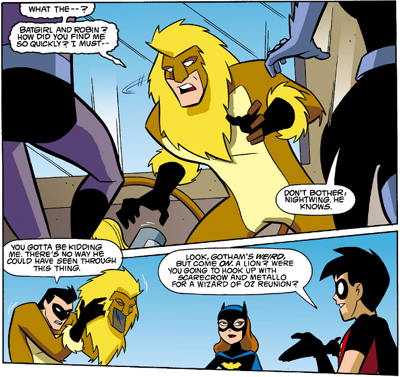
“Gotham’s weird, but come on.”

Since Oz and Ends has been talking a lot about Oz lately, I figured the weekly Robin could get into the game.

These panels are from Batman: Gotham Adventures, #19, set in the DC Animated Universe of the 1990s. That continuity’s Tim Drake has been feeling morose because his work as Robin doesn’t seem to have a lasting effect. (This is an odd sentiment for a teenager, but then Tim was always mature for his age.)

Batgirl and Nightwing try to give Robin reasons to go on by dressing up as easily defeated costumed criminals like…Lionman!


Below are images of the Scarecrow and Metallo from the DCAU, looking much scarier than they should be for this light-hearted Bat-family tale by Scott Peterson, Tim Levins, and Terry Beatty.

17 February 2013

Crossover Events

I hadn’t realized that in December 2011 Ross converted his blog about imaginary issues of The Brave and the Bold (featuring Batman team-ups) into imaginary issues of Super-Team Family, featuring team-ups of any superheroes.

Which of course means more opportunity for Robin. Since Ross uses the grown-up Earth-2 Robin’s short-lived chest emblem as his own avatar, I assume that was part of the appeal for him, too.

As someone who collected all the original Invaders magazines (including Annuals, crossovers, and What If?), my favorite new cover might be this one, letting the kid sidekicks of that 1940s team meet the 1960s Teen Titans.

But I don’t think we need a direct replacement.
Besides, Bucky was a sensational character find of 1941.

From the more modern section, this cover definitely deserves a balloon saying, “Eep.”

(Hat tip to Facebook’s Robin Appreciation Group.)

29 January 2013

A Darker Dorothy in London

Opening next month at the Immersion Theatre in London, Dorothy in Oz, a “skewed adaptation” of L. Frank Baum’s The Wonderful Wizard of Oz. The troupe promises “a piece unlike anything that has ever been seen on the London fringe circuit.”

What does that mean? When playwright James Michael Shoberg directed his own company’s premiere of the drama in 2009, the Pittsburgh City Paper said:
Shoberg, Pittsburgh’s self-styled striver after “darker tastes in art,” usually combines a fixation with sex, drugs, rock ’n’ roll and dazzling costumes with cumbersome scene changes and sloppy projections. Forcing the often-rambling style of Shoberg and/or his players onto a smaller stage, much closer to the audience, focuses the production. . . .

His Dorothy in Oz includes winking references from various versions of the story—The Wiz as well as generous dollops of the iconic 1939 movie—as he twists the familiar characters and their journey. The new setting is a psychiatric hospital for the unfortunate Dorothy, here named Dottie. . . .

The most fun comes from Carrie L. Shoberg’s glitzy and ditzy portrayal of Glinda, and from the stunning ensemble—costume, props and performance—of Brittany Spinelli as the doctor’s secretary. The three companions are a mixed bag: Chucky Hendershot almost boneless as he wrestles with gravity and a heroin addiction as a Goth “Skarekrow”; Sean Michael Gallaher appropriately loud as the anger-challenged multi-pierced punk “Rusty Tinneman”; and Joseph A. Roots totally smooth as the repulsive “Harry Lyons.” In the title role, Adrienne Fischer is credible and credibly brave, but the character just doesn’t have the fun the others do.
Dorothy in Oz is scheduled to run in London 26 Feb-17 Mar 2013.

09 January 2013

Oz from Oz

You’ll be pleased to know you can get this cartoon as a t-shirt from Mike Jacobsen’s Neato Shop.

Jacobsen is also the creator of this Superman brilliance.


And this warning about the dangers of science going too far.

Jacobsen shares new work regularly from Australia at See Mike Draw.

23 October 2012

Finally an Explanation for Dorothy’s Strange Dream

Caleb Crain alerted me to the existence of this public safety poster from the Allegheny County (Pennsylvania) Health Department:
Dorothy lived in the midst of the great Kansas prairies, with Uncle Henry, who was a farmer, and Aunt Em, who was the farmer’s wife. Their house was small, for the lumber to build it had to be carried by wagon many miles. There were four walls, a floor, and a roof, which made one room. One day after returning from the outhouse, Aunt Em forgot to wash her hands, which caused a bacterial infection to spread among the whole family, including the dog. In addition to severe stomach cramps and a dreadful fever, Dorothy started to have some really strange dreams.
Okay, there are less appealing Oz stories than Dorothy Return to Oz.

This poster was part of an award-winning public health campaign. There are also germ-driven versions of Treasure Island; Are You There, God? It’s Me, Margaret; and other classics.

12 August 2012

The Kidd-Millionaire Robin

The book designer and comic-book critic Chip Kidd recently published a Batman adventure subtitled Death by Design, with art by Dave Taylor. Impressive as that volume looks, it doesn’t feature Robin, so I haven’t sat down to read it.

Death by Design isn’t Kidd’s first Batman story, however. A few years back he scripted two adventures drawn by Tony Millionaire for DC’s self-parodying Bizarro Comics and Bizarro World collections. “The Bat-Man” reads and looks like an underground-comics version of the earliest, solo Batman adventures. A version of the Penguin hypnotizes Bruce Wayne’s fiancée, Julie Madison, as well as holding sway over a giant ape—things that a vampirical villain called the Monk did in Batman, #31-2.

Kidd and Millionaire’s “Batman with Robin the Boy Wonder” is a classic “Boy Hostage” story crossed with the high Gothic supernatural tone that dominated that first year of Batman tales. This time the villain is the Monk himself. Through completely unexplained means he kidnaps Robin’s consciousness, traps it in the body of a caged bird, and makes Robin’s body act evil. (See panel above.)

Back in 1939, Batman eliminated the Monk by shooting silver bullets into his coffin before Robin ever swung onto the scene. Once Dick Grayson appeared in April 1940, along with new chief editor Whitney Ellsworth, Batman’s guns and killing and the Gothic milieu all went away for decades. Kidd and Millionaire thus offer a taste of what the Dynamic Duo’s adventures might have been like if that hadn’t happened.

TOMORROW: When Batman went goth again.

14 July 2012

How Teen Boat! Was Launched

Adolescence is a period of change, but in our culture we paradoxically view it as a period of change into what you really are the whole time. Almost all popular-media stories about teens consciously trying to change themselves end with some level of failure for not being honest about their true selves. Instead, our modern stories emphasize self-acceptance, recognizing the value of what you are all along. Whether that’s a purely Good Thing is another matter.

Which, by a roundabout course, brings me to Teen Boat!, a new collection of comics adventures by writer Dave Roman and artist John Green. Little Willow’s interview with Roman at Bildungsroman dredges up the start of this tale:
…the inspiration came to us while we were on a bus. Long trips can often lead to loopy thoughts, especially for comic creators. One minute John Green and I are discussing ’80s cartoons and the spectrum of cool vs. less-cool transformation powers, then we’re talking about imaginary boardroom meetings gone wrong, and before long we were pitching tag lines like “The ANGST of being a teen, the THRILL of being a boat.”

It easily could have stayed a joke amongst ourselves, but we felt compelled to share our idea of a teenager who transforms into a yacht with all our cartoonists friends. The more they laughed, the more John and I were motivated to turn the silly premise into something real. And one of the many beautiful things about comics is there's very little stopping you from making that happen.

Our first Teen Boat! books were printed on a black and white photocopier, hand stapled, and hand sold for 50 cents each at indie comic shows. Ten years later, it’s a full-color hardcover book sold in bookstores everywhere and endorsed by the Junior Library Guild!
Specifically, Teen Boat! appears to have been inspired by Turbo Teen, a 1984 animated cartoon about a boy who makes temperature-sensitive shifts to and from being a car. Hard to imagine why that show lasted only twelve episodes.

Teen Boat! began as a series of black-and-white minicomics parodying such adventures through a adolescent hero who can change into a small yacht. It grew into a substantial (though unfinished) collection of stories from Clarion, now fully colored (by a team that included Braden Lamb).

Mercifully, the collection doesn’t include an origin story. We have no idea how Teen Boat came to be both a boy and a boat. (In one flashback panel he has a mom.) Nor does he have a secret identity—his name is Teen Boat. But we don’t need those elements of the classic superhero narrative. All that matters for these stories is that our hero is stuck/blessed with being both a boat and a teenager.

Beyond that premise, Teen Boat! floats on an ocean of North American teen-comedy-adventure stories from cartoons, sitcoms, and comics. We see the rich and jockish bully, the pretty exchange student, the inveterate rule-breaker, and other familiar high-school types. Teen Boat’s best friend climbs in through his bedroom window as on Clarissa Explains It All or Doogie Howser, M.D. Stories revolve around the class trip, the big dance, the school election, the driving test, the mystery that only a teen-aged amateur sleuth can solve, and other common rites of passage.

Yet Teen Boat! goes deeper than parody. As other have noted, including the AV Club and Hal Johnson at Paste Magazine, these stories has real heart. Just because the situations that teenagers find themselves in can easily be parodied doesn’t mean the underlying emotions aren’t real.

Teen Boat’s everyboat quality makes him an appealing hero. While young readers may laugh at the parodic touches, they may also recognize their own concerns in him. And when they see that even Teen Boat worries about skin blemishes or how to buy “nautical accessories,” might that offer a little more perspective on their own angst?

22 January 2012

Sitting with the Tiny Titans

DC Comics is bringing Tiny Titans to a close soon at issue #50. I’ve read only occasional issues and pages of this magazine, mostly those with an especially high Robin quotient. A put-upon version of Robin is at the center of its cast, who are school-age versions of the second generation of DC superheroes.

The third and fourth generations, each with their own Robins, appear as babies and toddlers. That leaves plenty of opportunity for the older kids to babysit. But not really all the kids, at least equally.

I think the babysitting theme started in issue #4, which DC marketed with this line:
Meet the Little Tiny Titans as they show Wonder Girl just how tough babysitting can be!
Inside, Wonder Girl and another heroine named Bumblebee babysit four teeny-Tiny Titans while Robin, Speedy, and Cyborg go play baseball.

The copy for #15:
And it’s Rose's turn to babysit the Terror Titans when a group activity yields fiery results.
In #23, Robin visits Batgirl and meets two of his little fans.

In #27:
When Raven has to watch Kid Devil for the weekend,…
Have you noticed a pattern?

The cover at top is #29, which came with this copy:
It's Supergirl's turn to toddler-sit the tiny Tiny Titans! Can she handle this crisis of infinite toddlers – or will she burst into tears?
But I don’t recall seeing Robin take on that job. Sometimes he hangs around Batgirl as she does the job because he has a crush on that little red-haired girl. In the “All-Robins Issue” he volunteers to pick up her charges from a daycare center (run by a woman), but he doesn’t actually look after them.

The story in issue #26 has Beast Boy watching over Miss Martian, but the word “babysit” wasn’t part of its marketing copy, and Beast Boy actually insists it’s not his turn. Even if we agree that he really is babysitting here, he’s the only example of male parity I could find. (Did I miss an important panel?)

Most recently, Tiny Titans, #47:
It’s Mrs. Atom’s turn to babysit the Baby Titans – Damien [sic], Arthur Jr., Smidgen, Kid Devil and Jason Toddler. Can she do it alone? Maybe Miss Martian can help!
And Bumblebee is back to babysitting as well. Even when a Tiny Titans story involves multiple baby-sitters, all three are female. Furthermore, Mrs. Atom is a character with no equivalent in the regular DC Universe. [Trust me, Ray Palmer’s love interest Jean Loring is not the same.] She seems to have been created to care for her children and others.
Overall, Tiny Titans appears to perpetuate the idea that child care is naturally a job for girls rather than boys. Ironically, some of Tiny Titans’s biggest fans include readers vocal about pressing DC to expand the exposure and range of female superheroes.

12 November 2011

Pingback

The following review originally appeared at Slashdot. Later it was copied onto Amazon, as of this week 10,196 of 10,568 people found it helpful:
Using deft allegory, the authors have provided an insightful and intuitive explanation of one of Unix's most venerable networking utilities. Even more stunning is that they were clearly working with a very early beta of the program, as their book first appeared in 1933, years (decades!) before the operating system and network infrastructure were finalized.

The book describes networking in terms even a child could understand, choosing to anthropomorphize the underlying packet structure. The ping packet is described as a duck, who, with other packets (more ducks), spends a certain period of time on the host machine (the wise-eyed boat). At the same time each day (I suspect this is scheduled under cron), the little packets (ducks) exit the host (boat) by way of a bridge (a bridge). From the bridge, the packets travel onto the internet (here embodied by the Yangtze River).

The title character -- er, packet, is called Ping. Ping meanders around the river before being received by another host (another boat). He spends a brief time on the other boat, but eventually returns to his original host machine (the wise-eyed boat) somewhat the worse for wear.

If you need a good, high-level overview of the ping utility, this is the book. I can't recommend it for most managers, as the technical aspects may be too overwhelming and the basic concepts too daunting. . . .
What I’d really like to know is why the book was titled The Story about Ping instead of The Story of Ping.