Showing posts with label AUTHOR Alec Siegel. Show all posts

26 October 2014

What Is Dick Grayson’s Core?

Kyle Higgins appears to be wrapping up his current work on the Dick Grayson character. The latest stories in Batman Beyond 2.0, including an upcoming chapter titled “The Final Fate of Dick Grayson,” have Alec Siegel’s name as co-writer, and Siegel’s the one signing the footnoted cross-references. (Wasn’t that once the editor’s prerogative?)

Therefore, even though Higgins is back on the Batman beat as one of the writers scripting the final stretch of Batman Eternal, and though he says he’ll likely return to Dick Grayson someday, his recent interview with Crave Online reads like a farewell retrospective:
Your work on Nightwing really expanded the character. Was everything in place from day one, or did it come as you wrote the story?

I had an idea from the start, but I learned so much along the way. I remember having a conversation with one of my best friends, who is an incredibly talented writer who works in TV and did some Gates Of Gotham with me [Ryan Parrot]. We said, when you boil Dick Grayson down, how do you describe him in a few sentences. What is his core? We did it as an exercise with Superman, Spider-Man, Batman, and boiled all them down to their central drive.

With Dick Grayson I couldn’t do it, I had a really hard time with it. I realized that was a problem. I know who the character is, but I can’t fully articulate why I love the character. It wasn’t until I settled on this idea that he grew up in a circus, so he’s all about catching people when they fall. That’s actually the final line of my final issue. I sat on that for over a year.

Dick seems more involved with the people he’s helping.

It’s about the empathy for who he saves. Every superhero, in one way or another, does it for the good of so-and-so, and they want to help people, but Dick Grayson more than all is about the people. He’ll save you from a mugger, tie your shoe and buy you a beer.

Dick and Bruce are very similar, but very different. Why?

Well, in a weird way one is more focused on his parents’ deaths, and the other is more focused on his parents’ lives. To me Dick and his Nightwing persona is more about spectacle than Batman. He’s sailing between buildings, it’s a performance and people can see him. He’ll operate in the daylight. It’s much more about the circus life and how he was brought up and the show. Nobody wants a brooding mopey Dick Grayson.
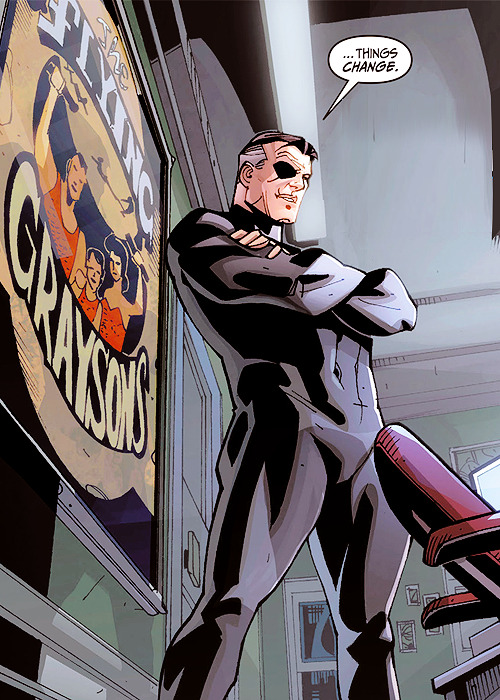
Another reason why the grim, one-eyed Dick Grayson in Batman Beyond 2.0 is a signal of a dystopic future.

Higgins continues to work on C.O.W.L., his story of a superhero labor politics in post-WW2 Chicago, for Image. We have yet to see the equivalent of Dick Grayson in those comics, but one did appear in Higggins’s student film, apparently set in the same world. And, to be frank, that character’s kind of mopey.

28 September 2014

Beyond Batman Beyond

It’s interesting to watch what DC Comics has done with its Batman Beyond storyline this year, reflecting changes in its target audience.

Batman Beyond was a spin-off of the very successful 1990s Batman TV cartoons of the 1990s. Les Daniels’s Batman history states, “a new show was requested that might skew toward younger viewers.” The resulting cartoon was set in the future when the world has more advanced technology and Bruce Wayne is a goddamn octagenarian. The new Batman was a hot-tempered teenager named Terry McGinnnis.

This show was an extension of the DC Animated Universe, thus not tied to the publisher’s main comic-book continuity. There was an accompanying comic book in 1999-2001, but readers were supposed to keep it separate in their minds from the main Batman titles of the time.

In this version of the future, Barbara Gordon has long ago retired as Batgirl and now holds her father’s old job as police commissioner. She was romantically involved with Dick Grayson when they were college-age, then later with Bruce Wayne for some unspecified period, and is now married to someone else. Dick himself, having established himself in the DCAU as Nightwing, has left Bruce’s team and is nowhere to be seen.

Batman Beyond lasted for 52 episodes plus a TV movie—a respectable but not sterling run. Nevertheless, it made a strong impression on a lot of viewers, including Kyle Higgins. He told Comics Alliance:
I was such a huge fan of the show. The DC Animated continuity was my introduction to DC Comics growing up. So I know that stuff inside and out, and I actually know it better than the books.
Higgins’s fondness for the cartoon is also evident in how he spoke about it on Kevin Smith’s podcast and in other interviews.

In 2010, DC launched a series of new Batman Beyond runs scripted by Adam Beechen. One of his mandates was to tie the world of the TV cartoon more closely to the DC comics (though those were about to go through some sudden changes themselves). Beechen brought back Dick Grayson, revealing that he’d stepped away from crime-fighting and from Bruce Wayne after losing one of his eyes in a fight.

That was the history Higgins inherited when he took over DC’s digital-first Batman Beyond series in 2013. His series was subtitled “2.0” because it showed Terry McGinnis breaking away from Bruce as mentor and working instead with Dick. Higgins was thus writing two different versions of Dick Grayson as he finished his Nightwing run and started this series.

In a story titled “Mark of the Phantasm” (digital issues #25-31), Higgins and co-writer Alec Siegel dug deeper into the relationships among Barbara, Bruce, and Dick. Craig Rousseau provided the art for the scenes set in the future, adhering to the standard Batman Beyond style. Phil Hester penciled scenes set in the past, following the style of the earlier Batman: The Animated Series cartoon and its spin-off comics.

Issue #28 shows Barbara and Dick telling Terry how they broke with Bruce. In their early twenties they had started to rekindle their relationship and Dick was ready to propose, only for Barbara to discover she’d become pregnant by Bruce—only for Barbara to miscarry after intervening in a mugging.

Remember, this story appeared in a continuity created to “skew toward younger viewers.” But that was back in 1999. Those same viewers have aged fifteen years and are ready for plot twists based on sexual relationships and spontaneous abortion. They got that more adult story even within the nostalgic visual style that Hester provided.

In another sign of the DCAU’s hold on today’s comics readers, the main DC Comics continuity is being disrupted by a crossover story called “Future’s End,” and Terry McGinnis as a next-generation Batman is in the middle of it all. While he still represents only one possible future for the company’s main continuity, he’s also what the company thinks its present-day readers want to see.