Showing posts with label BOOK Ozma of Oz. Show all posts

30 October 2012

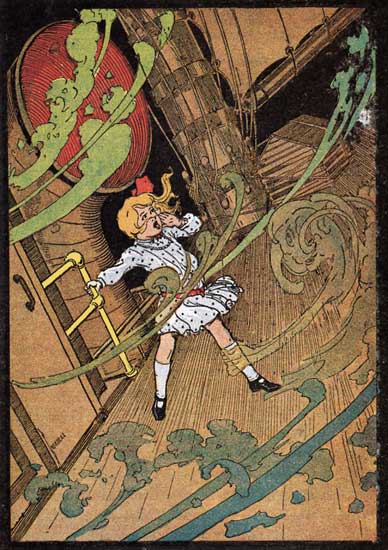
“A terrible storm”

The opening paragraphs of Ozma of Oz, by L. Frank Baum:
The wind blew hard and joggled the water of the ocean, sending ripples across its surface. Then the wind pushed the edges of the ripples until they became waves, and shoved the waves around until they became billows. The billows rolled dreadfully high: higher even than the tops of houses. Some of them, indeed, rolled as high as the tops of tall trees, and seemed like mountains; and the gulfs between the great billows were like deep valleys.

All this mad dashing and splashing of the waters of the big ocean, which the mischievous wind caused without any good reason whatever, resulted in a terrible storm, and a storm on the ocean is liable to cut many queer pranks and do a lot of damage.
Having sent Dorothy Gale to fairyland by cyclone (tornado), for her second trip Baum turned to this storm at sea. Next, in Dorothy and the Wizard in Oz, he used an earthquake. And then, since he’d exhausted the range of natural disasters, her next two trips were caused by magic from the Emerald City.

In The Scarecrow of Oz Baum had Trot and Cap’n Bill start their journey via a whirlpool—another type of nautical disaster. As with the earthquake suddenly opening a huge crack in the ground in Dorothy and the Wizard, people in the 1910s believed that such whirlpools existed in nature, but they don’t really. Does that mean magic must have been at work in those journeys too?

24 January 2012

Developing the Deadly Desert

The new issue of The Baum Bugle, the International Wizard of Oz Club’s main journal, includes two articles about the Deadly Desert that surrounds and protects Oz.

The desert wasn’t deadly at first; like a lot of details about Oz, L. Frank Baum developed the desert gradually as ideas and plot points occurred to him. In The Wonderful Wizard of Oz, a sandy waste cuts Oz off from the rest of the world, particularly that odd place (the Midwest) where the Wizard and Dorothy came from.

In The Marvelous Land of Oz, the Scarecrow, the Tin Woodman, and their companions fly over that desert out of Oz, where they find a country that apparently uses paper money denominated in dollars. As Michael O. Riley pointed out in Oz and Beyond, Baum’s first two books implied that Oz was nestled somewhere in arid southwestern North America.

But then in Ozma of Oz, Baum had Dorothy travel to Oz by starting in the Pacific Ocean, landing in a fairyland called Ev, and finally crossing the desert on an unrolling carpet. So the countries beyond the desert from Oz are definitely not America. In fact, they seem far from America. Furthermore, while the previous book showed characters standing on the desert, this one implied that doing so would be harmful, or at least unpleasant.

A couple of books later, Baum introduced the alliterative phrase “Deadly Desert.” He quoted this sign erected in front of it:
ALL PERSONS ARE WARNED NOT
TO VENTURE UPON THIS DESERT

For the Deadly Sands will Turn Any Living Flesh
to Dust in an instant. Beyond This Barrier is the

LAND OF OZ

But no one can Reach that Beautiful Country
because of these Destroying Sands

Curiously, that signs stands in an inhospitable, unpopulated spot, so we have to assume that either (a) it was placed there for the benefit of Dorothy and her companions at that moment, or (b) there are a lot more signs elsewhere along the edge of the sand.

Thereafter, the Deadly Desert is always said to be deadly, even when characters like the Wise Donkey manage inexplicably to cross it. In Baum’s penultimate book, The Magic of Oz, it even gives off nauseating fumes that force birds to fly at high altitudes.

And yet, for all the desert’s deadliness, in the entire Oz series no one ever dies on it.

TOMORROW: Tossing out a theory.

03 January 2012

Musical of Last Month: The Wizard of Oz

In December the New York Public Library celebrated the Wizard of Oz stage extravaganza that reached Broadway in 1903 as its “Musical of the Month.”

A huge and influential hit when it appeared, the show prompted L. Frank Baum to write sequels to his novel. It provided Dorothy with the surname Gale, the Tin Woodman with his original name Nick Chopper, and Oz with a former king named Pastoria. For fans of the MGM movie, the snowstorm that saves Dorothy and the Cowardly Lion from the poppies was borrowed directly from this show. But hardly anyone remembers the show itself.

As organized by Doug Reside, Digital Curator at the NYPL’s Library for the Performing Arts, the website offers four essays on the show:
These essays are illustrated with some of the images from the NYPL’s huge archive, including the photo of Fred Stone and David Montgomery as the Scarecrow and Tin Woodman above.

07 December 2011

Looking for Evrob

The detail above comes from one of the panels of the Marvel Comics adaptation of Ozma of Oz, drawn by Skottie Young. It shows the royal family of Ev soon after they’ve been disenchanted.

The big lunk in the lower left, with the single curly hair atop his dome, appears to be future king Evardo. At least that’s who is looking for cake in the royal pantry several pages later, as L. Frank Baum described.

However, an earlier page had the label “Evardo” on the smaller adolescent with the purple mantle and the even worse haircut. Either way, it’s quite a shift from John R. Neill’s portrait of a conventional young adolescent.

As in Baum’s novel, the prince we see most in this comic is Evring, the little prince whom Dorothy rescues. He’s also the most normal-looking of the boys that Young draws. Evring wears gloves on his spindly arms; since he’s not trained for manual labor like Tip in Young’s Marvelous Land of Oz art, the effect is to make him look more like a—gasp!—character in a cartoon.

Baum wrote that Evring is the baby of the family. I’m guessing that detail didn’t make it into Eric Shanower’s script because Young drew three other siblings as infants.

I’ve spent an abnormal amount of time thinking about the royal family of Ev because a few years back I wrote a story called “Evrob & the Nomes,” about one little prince’s second visit underground. It was published by the International Wizard of Oz Club in Oziana 2004; Sam A. Milazzo reviewed the story here.

That story required filling in more details about the royal family of Ev while staying close (in my mind) to those left by Baum and Neill. I liked the idea of the family as somewhat impoverished royals from the Edwardian period, wearing the medieval-style dress on the most formal occasions but early-twentieth-century military uniforms at other public events and early-twentieth-century bathing suits at the beach.

I kept Evring as the baby, but tried to show him through the next oldest boy’s eyes: as a mewling focus of resentment. I tried to paint King Evardo as an uptight adolescent stumbling his way through family responsibilities. The rest of the siblings were blank enough that I didn’t worry so much about being true to Baum.

One common element of the upper-class lifestyle of that time was domestic servants from colonized people: Indian and Chinese amahs, Southern mammies. So I gave the royal family of Ev an aged nanny from their country’s ethnic minority, the Wheelers.

In some ways I meant that story to upend readers’ assumptions about adventures in the Oz world, particularly Dorothy’s role in putting everything right. Like Young’s cartoons of the royal family of Ev, it’s an aggressively new look at an old tradition.

06 December 2011

Our First Glimpse of Evardo XV

The picture above, by John R. Neill, comes from the end of Ozma of Oz. It shows the dowager queen of Ev and her eldest son, the new King Evardo XV.

L. Frank Baum earlier described Evardo this way: “He was a grave and quiet youth, and would doubtless rule his people wisely and with justice.” He narrates this scene thusly:
Then the Queen took her eldest son out upon a balcony that overlooked the crowd of subjects gathered below, and said to them:

“Here is your future ruler, King Evardo Fifteenth. He is fifteen years of age, has fifteen silver buckles on his jacket and is the fifteenth Evardo to rule the land of Ev.”

The people shouted their approval fifteen times, and even the Wheelers, some of whom were present, loudly promised to obey the new King.

So the Queen placed a big crown of gold, set with rubies, upon Evardo’s head, and threw an ermine robe over his shoulders, and proclaimed him King; and he bowed gratefully to all his subjects and then went away to see if he could find any cake in the royal pantry.
He is fifteen, after all.

Baum has even less to say about most of the queen’s other children, aside from the youngest: Prince Evring, whom Dorothy rescues. The rest of the siblings are simply names: “The Princesses were named, Evanna, Evrose, Evella, Evirene and Evedna, while the Princes were Evrob, Evington, Evardo and Evroland.”

Baum derived the names of Evrob and Evedna from those of one son and his fiancée. Robert Baum was also inspiration for the young hero of Baum’s science-fiction novel The Master Key, and Edna Drucker was a family neighbor. They were in their early twenties when Ozma of Oz appeared, clearly older than the queen’s children.

As to other details of the Ev princes and princesses, especially as individuals, Baum’s book is basically silent.

TOMORROW: Filling in the gaps, one way or another.

29 November 2011

Kaliko Vision

In L. Frank Baum’s Ozma of Oz, Roquat the Nome King is served by a Nome introduced this way:
Meantime the King ordered refreshments to be served to those waiting, and at his command a rudely shaped Nome entered, bearing a tray. This Nome was not unlike the others that Dorothy had seen, but he wore a heavy gold chain around his neck to show that he was the Chief Steward of the Nome King, and he assumed an air of much importance, and even told his majesty not to eat too much cake late at night, or he would be ill.
Later, thinking himself out of the hearing of the guests, the Chief Steward tells the king, “You are a fool to waste so much time upon these people” from Oz.

Baum next visited the Nomes in The Emerald City of Oz, and in that book stated that the king’s steward was named Kaliko. He’s “frightened” by his master, “trembling and white with fear.” Baum offers this exchange:
“Fetch my pipe!” yelled the King.

“Your pipe is already here, your Majesty,” replied Kaliko.

“Then get my tobacco!” roared the King.

“The tobacco is in your pipe, your Majesty,” returned the Steward.

“Then bring a live coal from the furnace!” commanded the King.

“The tobacco is lighted, and your Majesty is already smoking your pipe,” answered the Steward.

“Why, so I am!” said the King, who had forgotten this fact; “but you are very rude to remind me of it.”

“I am a lowborn, miserable villain,” declared the Chief Steward, humbly.
Obviously that exchange shows a interpersonal dynamic very different from the earlier one.

In Who’s Who in Oz, Jack Snow stated that Kaliko first appeared in Ozma—in other words, that he was the Chief Steward in that book as well as the later one. As a young reader, I adopted that interpretation without question. It suggests that the Nome King’s anger over losing his Magic Belt in the earlier book makes it much more dangerous to talk back to him in the later.

More recently, however, such Oz scholars as David Hulan convinced me that might be too much of an assumption. What if the Nome King got rid of the first Chief Steward between the two books? In that case, Kaliko didn’t change his behavior drastically; rather, he could be obsequious enough to manage the angry monarch. What happened to the earlier Chief Steward? Based on what the Nome King orders for some Nome army officers in Emerald City, it would be nothing good.

The Marvel Comics adaptation of Ozma of Oz comes down firmly on the first interpretation, with the Chief Steward being named “Kaliko.” Scripter Eric Shanower’s choice makes for a smaller, more unified cast of characters for the series, and there’s certainly tradition behind it.

Artist Skottie Young also makes an interesting choice in how he designed the Nomes. His Nome King looks much like John R. Neill’s, with a human face, hair, and beard; five-fingered hands; and a caricatured but recognizably humanoid body. In contrast, Young draws the rest of the Nomes as little imps, basically isosceles triangles with tiny limbs and snappish personalities. And Kaliko is among them, as the picture below shows.
Looking ahead, will we see this little Kaliko assuming the Nome Kingdom’s throne?

28 September 2011

Filling the Big Hole in Dorothy and the Wizard in Oz

Yesterday I quoted from Newsarama’s interview with Eric Shanower and Skottie Young about their new adaptation of L. Frank Baum’s fourth Oz novel for Marvel Comics. Shanower also spoke of the narrative hole that Baum left in the plot of this book:
The main challenge of Dorothy and the Wizard in Oz is the scene where Ozma rescues Dorothy and her friends. I don’t want to give anything away to those who don’t know the story. But this point is a major disappointment to a lot of readers, and I’m trying to finesse it so it works better in the story.

In this book and in several of the other Oz books Baum has actually supplied me with the details to make it work better, so I’m taking advantage of that. I admit, however, that while previous Marvel Oz comics were steadfastly true to Baum’s texts, Dorothy and the Wizard in Oz will depart slightly from that practice because I’m trying to solve this plot problem that Baum left me with.
Eric and I have talked a bit about this challenge, and I look forward to seeing how he’s worked it out. I presented what I’d do in a 2008 centenary essay on the book in the International Wizard of Oz Club’s  Baum Bugle.

At the end of Ozma of Oz, Baum established that Ozma would use her Magic Picture once a week to make sure Dorothy was okay:
every Saturday morning Ozma would look at Dorothy in her magic picture, wherever the little girl might chance to be. And, if she saw Dorothy make a certain signal, then Ozma would know that the little Kansas girl wanted to revisit the Land of Oz, and by means of the Nome King’s magic belt would wish that she might instantly return.
As heedless of consistency as usual, Baum revised that arrangement in Dorothy and the Wizard to say that Ozma looks in on Dorothy every day at four o’clock. That allowed him to have Ozma pluck Dorothy from danger as soon as he ran out of ideas.

But what if the timing of Ozma’s checks was as originally described—once a week? Baum could have reminded readers of Dorothy’s arrangement early in Dorothy and the Wizard with a conversation like this:
“We won’t be down here with the Mangaboos forever,” Dorothy explained. “My friend Ozma looks for me ev’ry Saturday morning in her Magic Picture. This Saturday, I’ll give her my signal, and she’ll wish me out of here, and then I’ll ask her to bring you to the Em’rald City, too.”

Zeb frowned and looked around at the glass city. “It’s only Monday now.”

“And I don’t think these mangelwurzels will keep us around till Saturday,” grumbled Jim.

“Plus, how will you know when it’s the right time to signal?” asked Zeb. “The suns down here don’t work like the real one, up above.”

“Well, we’ll just have to keep track of the time,” said Dorothy. “Don’t you have a watch, Wizard?”

“I do,” said the old man, who had been looking most thoughtful since Dorothy mentioned Ozma. He pulled a big silver watch out of his vest pocket. “I’ll have to be very careful to keep this wound up and protected from shock, and to look for the right time to arrive.”
Such a conversation would prepare readers for the possibility of Ozma’s rescue. It would start a clock ticking—which adds tension to almost any plot. It would even fit with the themes of movement and time established in the book’s first line (“The train from ’Frisco was very late”).

Could Dorothy and her friends stay alive until Saturday? Could the Wizard track the days and hours correctly? Would Dorothy be able to send Ozma the signal at the right time? Imagine the travelers, say, stuck in a cave, waiting for Saturday morning to arrive at last, and hearing a mother dragon scrabbling through the tunnel behind them!

27 September 2011

The Darkness of Dorothy and the Wizard in Oz

Eric Shanower and Skottie Young have reached Dorothy and the Wizard in Oz, the fourth title, in their adaptation of L. Frank Baum’s Oz novels for Marvel Comics. When Newsarama interviewed the team, Shanower spoke to the book’s “darkness”:
The villains introduced in Dorothy and the Wizard in Oz are among Baum’s scariest. The Mangaboos, the underground vegetable people, are just creepy. The man-eating invisible bears are terrifying because you can’t tell whether one’s standing next to you ready to slash your guts out at any moment. The silent wooden Gargoyles are so alien—I can’t wait to see how Skottie draws them. . . .

To say that Dorothy and the Wizard in Oz is one of the darkest Oz books is no joke. The characters are in danger of imminent death in nearly every chapter. Baum’s evocation of the underground caverns they’re trapped in is oppressive. It’s weird and creepy, and those are reasons I love this book.
In an essay published in The Baum Bugle on the centenary of this book, I called Dorothy and the Wizard “one of Baum’s most breathlessly exciting fairy tales”:
The middle chapters, starting when the Mangaboos stuff the party into the Black Pit, resemble nothing so much as an action-filled videogame. Dorothy, the Wizard, and their friends run, jump, stab, and shoot their way up from one level to the next. Enemies become more formidable, the path harder to climb.
That essay also tabulated how often Dorothy and the Wizard uses forms of the words “die” and “kill”: 36 times. As early as chapter 2, during the earthquake, Baum tells us that young Dorothy and Zeb felt “the natural fear that sudden death was about to overtake them at any moment.” Chapter 4 ends with the Mangaboo prince saying, “Follow me, please, to meet your doom”—a powerful cliffhanger, but poor bedtime reading for small children. After being captured by the Gargoyles, Dorothy and her friends “expected nothing less than instant death.”

In his previous two Oz books, Baum had played down such talk; variations on the words “die” and “kill” appear only 13 times altogether in Ozma of Oz, for example. His young heroes in those books worry about being turned into statuary, not about being killed.

On the other hand, death hovers over the action in The Wonderful Wizard of Oz. During that adventure, Dorothy and her companions end up killing two witches, two Kalidahs, a wildcat, forty wolves, forty crows, and a giant spider, plus uncounted bees. And the book uses the word “kill” 34 times. So one could argue that Dorothy and the Wizard of Oz was really a return to form.

15 December 2010

Worlds Are Colliding

From Tom De Haven’s authorized novel It’s Superman!:

Clark Kent is more than just passingly familiar with robots.

As a boy, he read all of L. Frank Baum’s Oz novels, and from his introduction in Ozma of Oz, Tik-Tok the Clockwork Man became Clark’s favorite of all the series characters.
I’m still mulling over the rest of It’s Superman! Usually the tension in Superman coming-of-age stories is between Smallville and Metropolis. De Haven takes the whole country as his setting, with episodes in Hollywood and elsewhere, and Clark and Lois ending up in La Guardia’s New York instead of its shiny comic-book stand-in.

Among other touches I think are new is Clark as science-fiction fan. A Kansas boy of the 1920s reading the Oz books makes sense. Clark writing sci-fi stories like Jerry Siegel—that made me pause.

29 December 2009

Serious Comics and Talking Animals

Matt Phelan’s The Storm in the Barn is showing up on a number of “year’s best” lists, but my feelings on its magical plot machinations match those expressed by Jessica Bruder in the New York Times Book Review:

Jack finds himself face to face with the Storm King, an evil spirit who withheld the rain to win power. . . . Jack finally wins a climactic battle on top of a windmill, and it starts to rain. He’s saved everyone. Unless you go with a possibility suggested earlier in the book: Jack has “dust dementia” and has imagined the whole thing. Either way, the fight doesn’t feel all that redemptive.
Both this book and David Small’s Stitches allude to classic works of Victorian children’s literature, and that’s another way that the latter seems much stronger to me.

In The Storm in the Barn, Jack’s sister reads descriptions of a desert from L. Frank Baum’s Ozma of Oz. As I noted earlier, Phelan found those passages through Wikipedia, and his quotes are anachronistic—the kids’ mother couldn’t find the phrase “Deadly Desert” in that book because it didn’t appear till a later one. That’s just a symptom of how that literary allusion feels nailed on rather than organic to the story.

In contrast, David Small’s use of Alice in Wonderland in Stitches has clearly grown from his own childhood love of that book. Allusions are integrated throughout the story. First he shows himself as a young boy playing as Alice, getting to escape “to a land of talking animals, singing flowers and dancing teapots.”

Later, Alice’s nightmarish shrinking and growing informs one of the adolescent David’s recurring nightmares (shown through stat panels) as he struggles to escape from a confining house.

Finally, the White Rabbit comes on the scene as a therapist who provides the book’s breakthrough—without, of course, ever losing track of the time. It turns out David was in the nonsense world all along. Unlike The Storm in the Barn, Small’s Stitches is about sorting out the real nightmares from the fantastic ones, not mixing them up.

26 November 2009

Trees That Furnish Plenty of Food

So many passages in L. Frank Baum’s Oz books involve the magical availability of food—perhaps a reflection that that was a much bigger concern for American children a century ago. For this traditional feast day I’m quoting Dorothy Gale’s discovery of a lunch-box tree in Ozma of Oz, when she’s feeling hungry after being shipwrecked:

At first she was greatly disappointed, because the nearer trees were all punita, or cotton-wood or eucalyptus, and bore no fruit or nuts at all. But, bye and bye, when she was almost in despair, the little girl came upon two trees that promised to furnish her with plenty of food.

One was quite full of square paper boxes, which grew in clusters on all the limbs, and upon the biggest and ripest boxes the word “Lunch” could be read, in neat raised letters. This tree seemed to bear all the year around, for there were lunch-box blossoms on some of the branches, and on others tiny little lunch-boxes that were as yet quite green, and evidently not fit to eat until they had grown bigger.

The leaves of this tree were all paper napkins, and it presented a very pleasing appearance to the hungry little girl.

But the tree next to the lunch-box tree was even more wonderful, for it bore quantities of tin dinner-pails, which were so full and heavy that the stout branches bent underneath their weight. Some were small and dark-brown in color; those larger were of a dull tin color; but the really ripe ones were pails of bright tin that shone and glistened beautifully in the rays of sunshine that touched them.

Dorothy was delighted, and even the yellow hen acknowledged that she was surprised.

The little girl stood on tip-toe and picked one of the nicest and biggest lunch-boxes, and then she sat down upon the ground and eagerly opened it. Inside she found, nicely wrapped in white papers, a ham sandwich, a piece of sponge-cake, a pickle, a slice of new cheese and an apple. Each thing had a separate stem, and so had to be picked off the side of the box; but Dorothy found them all to be delicious, and she ate every bit of luncheon in the box before she had finished.
This passage comes shortly after Dorothy’s discussion with Billina the hen about the ethics or aesthetics of eating insects. Lunch-box trees allow Dorothy to eat a “ham sandwich” without worrying about what or who’s gone into that ham.

24 September 2009

“I naturally thought of Oz”

There may even be a rule that the closer American children’s books come to Kansas, the more they have to allude to The Wonderful Wizard of Oz and/or its sequels. Case in point: Matt Phelan’s graphic novel The Storm in the Barn, set in Kansas in 1937.

Phelan wasn’t a childhood Oz fan. He told the comics website Newsarama, “I didn’t actually read the first Oz book until I took a college class on children’s literature. I was surprised about how truly weird it is.” But once he decided to tell a story inspired by Donald Worster’s Dust Bowl, Phelan felt a need to bring in the Oz books:

Since the story is set in Kansas, I naturally thought of Oz, so I named his sister Dorothy. I thought that a girl named Dorothy who lived in Kansas at that time would naturally be interested in the Oz stories, so having her read the books seemed natural.
That quotation comes from Kelly R. Fineman’s conversation with Phelan, and she went on to write:
Whereupon I praised Matt’s knowledge of the Oz stories and confessed that I’d only read two, maybe three of the books as a kid, and Matt confessed that he’d pretty much done the same, but that plot summaries on Wikipedia drew his attention to Ozma of Oz because of its reference to a desert.

Initially, Matt read the book “just to read it”, but the references to the Deadly Desert turned out to be perfect for incorporation into The Storm in the Barn, which is set in Dust-Bowl Kansas where it hasn’t rained for years. Add to that the benefit of the Oz books being subject to fair use, and text from Ozma found its way into Jack’s story as well. Says Matt, “I just lucked out that it worked.”
(Actually, all books are subject to fair use, even when they’re under copyright. L. Frank Baum’s Oz books are in the public domain, and thus subject to any use, even “unfair.” Not that this use is unfair. It’s quite a nice use indeed.)

Ironically, the “references to the Deadly Desert” in the Wikipedia article and in The Storm in the Barn itself (Jack’s mother looks at the book and uses the phrase) don’t actually come from Ozma of Oz. That 1907 book refers to “the deadly, life-destroying sands of the desert” around Oz. The phrase “Deadly Desert” appears first in The Road to Oz (1909). The author David Alvin composed Wikipedia’s entry on Ozma of Oz using facts established in subsequent books.

14 September 2009

Look at the Pretty Pictures

At the Oz Enthusiast, Bill Campbell discusses an illustration that Dale Urey created for a never-published edition of Ozma of Oz. At some point the picture’s original background was whited out, and Campbell had it restored. However, in the end he seems to think that the erasure improved the composition of the picture.

Comixology ran an article by medieval historian and librarian Karen Green on the affinity between medieval narrative art and comics. All the usual sequential-art suspects are here: Trajan’s column (1st century), the Bayeux Tapestry (11th century), banderoles as word balloons (discussed back here). For additional Oz content, Green’s second essay in this online column was whether to add Alan Moore and Melinda Gebbie’s Lost Girls to the Columbia University collection.

Lastly, Tom Tomorrow’s Modern World (published online by Salon and Credo) channeled Goofus and Gallant to show the difference between political protests this year and those of the past, oh, seven or eight years.

06 June 2008

Para Bruin and the Mifkets

The Cowardly Lion in The Wonderful Wizard of Oz was a type L. Frank Baum returned to in several of his other fantasy stories: a big, carnivorous beast who looked frightening but was a real sweetie underneath. At the end of Wizard, the Lion has gained courage and is once again king of beasts, but what's interesting about that? Starting with Ozma of Oz (1907), Baum made the Cowardly Lion cowardly again, or at least fearful, and for good measure added a Hungry Tiger too troubled by his conscience to eat the fat babies he craves.

In John Dough and the Cherub, published between those two Oz books, the fearsome-looking animal is named Para Bruin. John Dough and his young friends meet Para on an island dominated by primitive imps called Mifkets. Here's the scene:

The bear was fat and of monstrous size, and its color was a rich brown. It had no hair at all upon its body, as most bears have, but was smooth and shiny. He gave a yawn as he looked at the new-comers, and John shuddered at the rows of long, white teeth that showed so plainly. Also he noticed the fierce claws upon the bear's toes, and decided that in spite of the rabbit's and the Princess' assurances he was in dangerous company.

Indeed, although Chick laughed at the bear, the gingerbread man grew quite nervous as the big beast advanced and sniffed at him curiously--almost as if it realized John was made of gingerbread and that gingerbread is good to eat. Then it held out a fat paw, as if desiring to shake hands; and, not wishing to appear rude, John placed his own hand in the bear's paw, which seemed even more soft and flabby than his own.

The next moment the animal threw its great arms around the gingerbread man and hugged him close to its body.

John gave a cry of fear, although it was hard to tell which was more soft and yielding--the bear's fat body or the form of the gingerbread man.

"Stop that!" he shouted, speaking in the bear language. "Let me go, instantly! What do you mean by such actions?"

The bear, hearing this speech, at once released John, who began to feel of himself to see if he had been damaged by the hug.

"Why didn't you say you were a friend, and could speak my language?" asked the bear, in a tone of reproach.

"You knew well enough I was a friend, since I came with the Princess," retorted John, angrily. "I suppose you would like to eat me, just because I am gingerbread!"

"I thought you smelled like gingerbread," remarked the bear. "But don't worry about my eating you. I don't eat."

"No?" said John, surprised. "Why not?"

"Well, the principal reason is that I'm made of rubber," said the bear.

"Rubber!" exclaimed John.

"Yes, rubber. Not gutta-percha, you understand, nor any cheap composition; but pure Para rubber of the best quality. I'm practically indestructible."

"Well, I declare!" said John, who was really astonished. "Are your teeth rubber, also?"

"To be sure," acknowledged the bear, seeming to be somewhat ashamed of the fact; "but they appear very terrible to look at, do they not? No one would suspect they would bend if I tried to bite with them."

"To me they were terrible in appearance," said John, at which the bear seemed much gratified.

"I don't mind confiding to you, who are a friend and speak my language," he resumed, "that I am as harmless as I am indestructible. But I pride myself upon my awful appearance, which should strike terror into the hearts of all beholders. At one time every creature in this island feared me, and acknowledged me their king, but those horrid Mifkets discovered I was rubber, and have defied me ever since."
Para's remark about the Mifkets' discovery inspired John R. Neill's endpapers illustration for John Dough. He drew a scene of the imps stretching Para across the breadth of the book--a scene that doesn't appear in the story and must take place before it.

Here's half of that picture, as it appears in my Reilly & Britton copy of John Dough:

The right endpaper shows the other half of this scene. To obtain the whole image, you either need to track down an old Reilly & Britton/Lee copy of John Dough and the Cherub, or order the new Hungry Tiger Press edition.

10 December 2006

Dorothy on a Proper Diet

In Ozma of Oz (1907), a yellow hen named Billina serves as Dorothy's animal companion instead of Toto. And they reach fairyland through a storm at sea rather than a cyclone. But the biggest difference may be that Billina speaks, and doesn't stand for lectures, from Dorothy or anyone else.

Here's a discussion between the hen and the little girl over what's proper to eat.

It did not take the castaways long to reach the shore, you may be sure. The yellow hen flew to the sands at once, but Dorothy had to climb over the high slats. Still, for a country girl, that was not much of a feat, and as soon as she was safe ashore Dorothy drew off her wet shoes and stockings and spread them upon the sun-warmed beach to dry.

Then she sat down and watched Billina, who was pick-pecking away with her sharp bill in the sand and gravel, which she scratched up and turned over with her strong claws.

"What are you doing?" asked Dorothy.

"Getting my breakfast, of course," murmured the hen, busily pecking away.

"What do you find?" inquired the girl, curiously.

"Oh, some fat red ants, and some sand-bugs, and once in a while a tiny crab. They are very sweet and nice, I assure you."

"How dreadful!" exclaimed Dorothy, in a shocked voice.

"What is dreadful?" asked the hen, lifting her head to gaze with one bright eye at her companion.

"Why, eating live things, and horrid bugs, and crawly ants. You ought to be 'shamed of yourself!"

"Goodness me!" returned the hen, in a puzzled tone; "how queer you are, Dorothy! Live things are much fresher and more wholesome than dead ones, and you humans eat all sorts of dead creatures."

"We don't!" said Dorothy.

"You do, indeed," answered Billina. "You eat lambs and sheep and cows and pigs and even chickens."

"But we cook 'em," said Dorothy, triumphantly.

"What difference does that make?"

"A good deal," said the girl, in a graver tone. "I can't just 'splain the diff'rence, but it's there. And, anyhow, we never eat such dreadful things as bugs."

"But you eat the chickens that eat the bugs," retorted the yellow hen, with an odd cackle. "So you are just as bad as we chickens are."

This made Dorothy thoughtful. What Billina said was true enough, and it almost took away her appetite for breakfast.
I love the "almost" in the last line. After all, a little girl's gotta eat.
