Showing posts with label travel notes. Show all posts

12 June 2024

OzCon 2024 Getting into the Game

This July’s OzCon International in Pomona will be the sixtieth annual Oz fan convention on the west coast. OzCon started as the Winkie Convention, for people who lived in the western quadrant of the USA.

These days, OzCon attracts people from all over. Co-director Colin Ayres is from Shropshire, I’m from New England, and one of this year’s guests is from Australia.

Once again I’ve been helping to plan the program. I’ll speak briefly, moderate a panel on what stories the manuscripts of the Oz books can tell us, and help with other tasks.

As the graphic above from convention co-director Jay Davis says, the schedule is up now at OzConInternational.

19 March 2024

On the Road to CharlOz, Sept. 26–29

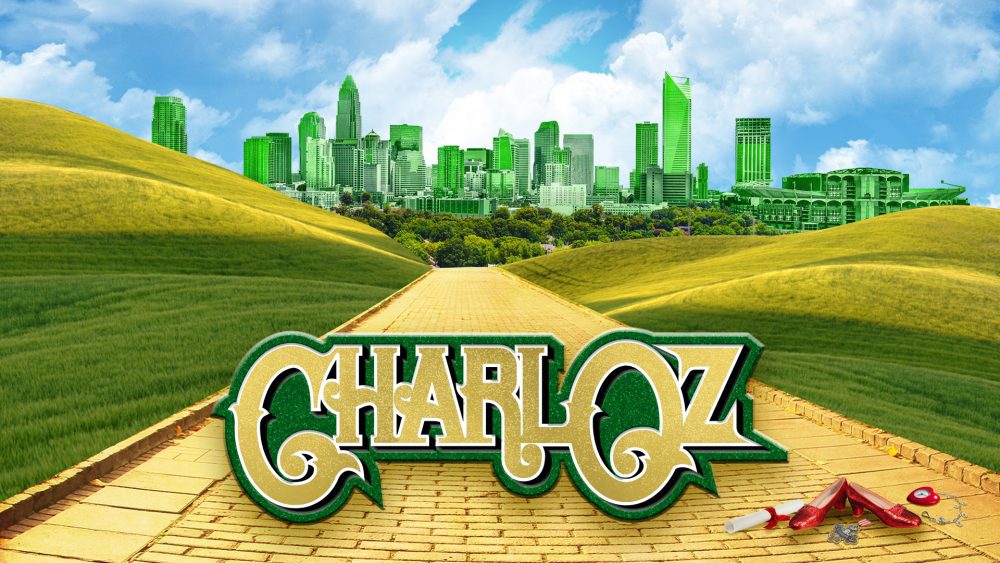
On September 26-29, 2024, the city of Charlotte, North Carolina; the University of North Carolina at Charlotte; and other local and national organizations will host CharlOz, a stretching over four days to explore the Oz mythos and its cultural legacy.

I’ll be there, speaking at two events on the schedule for Friday, 27 September:
  • a panel discussion of the new essay collection The Characters of Oz, featuring editor Dina Massachi and fellow contributors Mark West, Katharine Kittredge, Walter Squire, Paige Gray, Angelica Shirley Carpenter, and Gita Dorothy Morena.
  • a talk later that afternoon titled “‘My! what a lot of Kings and Queens!’: The Meanings of Monarchy in L. Frank Baum’s Fantasies.”
The schedule of CharlOz events includes many other speakers and presentations, including:
  • an opening keynote speech by novelist Gregory Maguire.
  • presentations by comics artists Eric Shanower and Janet R. Lee, puppeteer and director James Ortiz, and film restorer Nate Barlow.
  • talks by scholars Ryan Bunch, Angelica Shirley Carpenter, Atticus Gannaway, Judy Bieber, Anastasia Rose Hyden, Brady Schwind, Paige Gray, Katharine Kittredge, and many more.
  • a Saturday full of family programming.
  • theatrical, cinematic, and gallery interpretations of Oz.
The International Wizard of Oz Club will also have its national convention in Charlotte coinciding with this festival.

18 July 2023

Call for Presentations at the CharlOz Festival

On September 27-29, 2024, the city of Charlotte, North Carolina; the University of North Carolina at Charlotte; and other organizations, local and national, will host CharlOz, a three-day festival exploring The Wonderful World of Oz and its cultural legacy.

The event is now open to proposals for presentations on almost any aspect of Oz, particularly:
  • History and Culture: Oz’s reflection of American history and/or culture
  • Social and Economic: Aspects of Oz relating to race, class, disability, or childhood
  • Visual and Performing Arts: Analysis of the visual or performing arts as they relate to Oz
  • Literary Arts: Authors and/or illustrators who have adapted Oz, and how those adaptations fit into the larger framework Oz provides
  • Gender Studies: Oz themes that examine gender roles/norms/traditions and sexualities, including LGBTQIA+ Oz portrayals of education, love, herosim, self-reliance, and teamwork
  • Technology: Application of non-traditional technologies that include podcasts, games, making, or other examinations of how varied technology transforms Oz themes
  • Mass-Marketing: Presentations of how a creator’s mass-marketed Oz work fits within the larger Oz world
Presentations can take the form of individual talks, group talks, workshops, roundtables, or panels.

The guidelines for submitting a 250-word proposal are on this page. The submission deadline is November 17, 2023. The organizing committee will respond to submitters by the end of January.

22 May 2020

Family Puzzles

I grew up doing jigsaw puzzles with my family. There were puzzles for the whole family that took up a side table or a dedicated board. And there were small puzzles that belonged just to me.

Not only were puzzles part of my family culture but my family had a particular culture when it came to puzzles. I knew families that sprayed completed puzzles with lacquer and hung them, as works of art or trophies. We just disassembled them after a day and a couple of months later brought out another.

One of our strongest family customs, which I credit to my dad, was that we didn’t consult the picture on the box after opening it. We had to build up the picture from memory and the pieces themselves. I didn’t realize how rare this was until I started to participate in the “community puzzle” at my local library and declined to look at the box there.

Together my family got through some fiendish jigsaw puzzles, such as Little Red Riding Hood’s Hood, a circle that was entirely one shade of red. And puzzles got us through a hard time: in the year after my brother died in his twenties, my mother and I did a lot of puzzles silently in the side room.

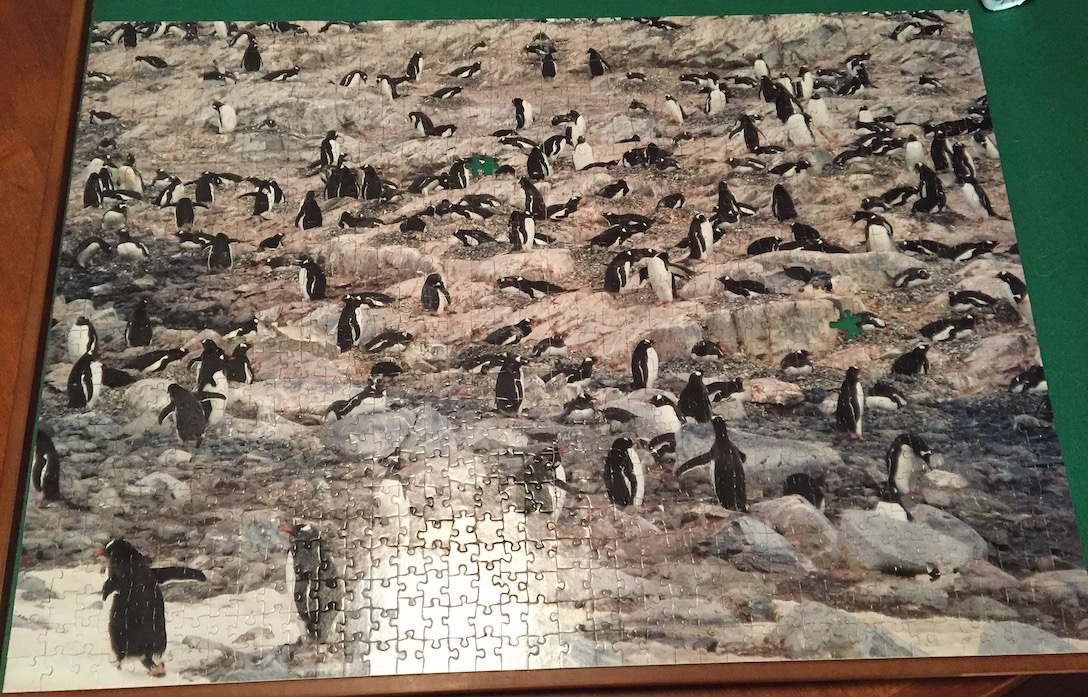
Five years ago, my dad went to Antarctica. He was in his late seventies, so that was a notable feat. (Since then, he’d been on an Arctic cruise, so maybe not so notable.) He came back with lots of photos to show me on his laptop.

One of those images showed scores of black and white (and orange-beaked) penguins on the slushy gray Antarctic landscape. I looked at that and thought, “That could be a jigsaw puzzle.” A damned hard jigsaw puzzle, to be sure. So I snuck the file onto my thumb drive, sent it off to a company that makes custom puzzles, and gave it to Dad as a present.

This month, four and a half years and one global plague that keeps everyone home later, Dad reported that he had completed the penguin puzzle!

02 April 2020

A Picture Book for Patriots Day

A couple of years ago, I did a specialized editorial job for Disney’s publishing wing.

The company contacted me because of my research into the start of the Revolutionary War and asked me to fact-check a picture book on the topic.

Most Wanted: The Revolutionary Partnership of John Hancock and Samuel Adams is written by Sarah Jane Marsh and illustrated by Edward Fotheringham. Earlier, they collaborated on Thomas Paine and the Dangerous Word, also from Disney.

On the day after OzCon 2018, a bunch of attendees made plans to go to Disneyland. I expected to go with them until I suddenly realized I’d had my fill of company and wanted to decompress in a library with a manuscript and my history sources. So instead of giving money to the Disney Corporation, I spent the day earning money from it with this job.

Most Wanted was published this week, just in time for the pandemic cancellation of the reenactment of the Battle of Lexington and Concord, which provides the book’s climax. That was bad luck for Marsh and Fotheringham, I thought. But as I was preparing this blog post, I realized the book had gone through another big change recently.

Powell’s was now listing Most Wanted as a Little, Brown title. Same with the Paine book. I had to reassure myself that my little story about Disney was accurate.

Then I remembered that in February the Disney Corporation sold a thousand children’s titles to Hachette, parent company of Little, Brown. Hachette was already distributing for Disney, so the supply chain is intact (except for the retail end, of course). There’s a lot of editorial and marketing shuffling going on, though.

I hope Most Wanted comes through the turmoil unscathed, the way Samuel Adams and John Hancock made it out of Lexington and to the Second Continental Congress.

18 July 2017

The Tin Woodman of Forkland

Starting in 1993, Jim Bird has been building statuary out of old farm equipment and hay bales on his fields in Forkland, Alabama.

Among those figures is this “32-foot sculpture of the tin man from Oz, assembled from old bathtubs, 55-gallon drums and a discarded fuel tank—and topped with an old fertilizer spreader.”

As of 2015, this was the most expensive of Bird’s statues since he spent $40 on paint; otherwise, he has a rule not to spend more than $5. The heart has text which reads, “Jim loves Lib.” That’s a message for Bird’s wife Lib; he started building his figures when she was on a trip and he missed her.

(Photo courtesy of the Library of Congress.)

22 December 2015

Slice of Life

At the Hungry Tiger Talk blog, David Maxine has written about the one-of-a-kind Oz-related item that was part of our first meeting, when we were teenagers. This is my side of the story.

Back in 1979, at the age of thirteen, I attended my first International Wizard of Oz Club convention. This was the Munchkin Convention, meaning it drew Oz fans from the eastern part of the United States. In the books, you see, the Munchkins live in the eastern part of Oz. (In most of the books. It’s a long story, which David summarized here.)

That year the Munchkin Convention was in Cherry Hill, New Jersey, a reasonably short car ride from my grandparents’ home in suburban Philadelphia. I’d already done some air travel by myself, so I felt confident flying down to visit Grandpa and Grandma.

I wasn’t so confident about meeting the Munchkin conventioneers. I was a shy kid, and I’d never been at that sort of gathering before, much less on my own. It turned out to be a milestone event because it was the first time adult strangers treated me as a peer. For that, I’ll always be grateful to the Oz Club.

There were other teenagers there as well, or at least one: Judy Bieber. But she intimidated me. I was thirteen, and she was (and remains) a couple of years older, which felt like an incredibly significant gap. She was also smart, pretty, and seemingly very much at home in Munchkinland. She created the quiz about the Oz books for that year. She and her father Herm were selling older Oz editions. She appeared to have everything.

To the surprise of the room, and the astonishment of myself, I won Judy’s quiz. The Oz books were the first field of knowledge I really tried to master, and my brain is good at retaining trivial information. And, though I didn’t know it at the time, previous winners were probably sitting out that event. The prize that Judy supplied was an abridged “Junior” edition of Rinkitink in Oz with some John R. Neill color plates. I’m sure that was the first time I’d ever seen one of those abridgments. It may have been the first time I ever knew about them.

By the end of that day, while I was waiting for my grandmother to pick me up, I was already worrying about my responsibilities for the following year. The winner of each year’s quiz had to write the next year’s quiz and supply the prize. I remember another attendee congratulating me on winning and asking if I was already thinking about new questions, and me replying that I was already thinking about the prize.

Making the quiz was fun. I decided to base it on Neill’s pictures and books, and I had fun laying it out. But for a prize? I didn’t have much money to spend, I didn’t know the range of possibilities, and I wasn’t linked into collectors’ networks. I also wasn’t good at asking for help (I’m still not). I wanted to solve this problem on my own—since I was acting as an adult, and all that.

So I decided to use my time in woodworking class to make a prize. A pair of O and Z bookends didn’t work out, but I grabbed a piece of mahogany and figured out a design for a cheese board that incorporated Neill’s OZ symbol in its handle. I didn’t do a great job with the carving, but it was a one-of-a-kind Oz-related trophy. And its real value was symbolic, right?

As David guessed, during the 1980 Munchkin Convention I decided to augment that cheese board with an edition of The Wizard of Oz autographed by Margaret Hamilton, who was there. So now I can also say that I had a brief conversation with her. Very brief.

The person who won my quiz was David Maxine, who had come from out west all the way to Cherry Hill. He was also a teenager. But, like Judy, he was (and is) a couple of years older than me. The difference is minuscule now—we’re all part of what I called the “white cover generation” of Oz fans. But back then David was also daunting.

Looking back, I realize that my thinking at thirteen was skewed by the universal adolescent assumption that every other teen is having more fun than you. To me David seemed like an old hand at Oz conventions and collecting and life. I should have perceived that this was his first time at the Munchkins, and he had no idea I was at just my second gathering. We had more in common than I realized.

If I’d known the winner of my quiz was going to be another teen, I probably wouldn’t have made a kitchen implement. If I’d had the boldness to befriend Judy the year before, I could probably have asked her and Herm to snatch up one of those abridged editions for the 1980 prize. But I couldn’t see any of those possibilities at the time.

I also couldn’t see that David and I would reconnect in something called “online” almost twenty years later. During some Ozzy conversation he mentioned that he still had the cheese board, which was both astonishing and gratifying. (As he’s pointed out, it’s compact and almost impossible to break.) And now that we’re both adults and have had online exchanges about such things as Swiss chard, a kitchen implement turns out to have been more appropriate than we knew. It’s come to symbolize a real-world friendship rooted in Oz.

07 December 2015

“Uncomfortable with how he came to have it”

From Eula Biss’s essay “White Debt” in yesterday’s New York Times Magazine:
I read several hundred pages of Little House on the Prairie to my 5-year-old son one day when he was home sick from school. Near the end of the book, when the Ingalls family is reckoning with the fact that they built their little house illegally on Indian Territory, and just after an alliance between tribes has been broken by a disagreement over whether or not to attack the settlers, Laura watches the Osage abandoning their annual buffalo hunt and leaving Kansas. Her family will leave, too.

At this point, my son asked me to stop reading.

“Is it too sad?” I asked.

“No,” he said, “I just don’t need to know any more.” After a few moments of silence, he added, “I wish I was French.”

The Indians in Little House are French-speaking, so I understood that my son was saying he wanted to be an Indian. “I wish all that didn’t happen,” he said. And then: “But I want to stay here, I love this place. I don’t want to leave.” He began to cry, and I realized that when I told him Little House was about the place where we live, meaning the Midwest, he thought I meant it was about the town where we live and the house we had just bought.

Our house is not that little house, but we do live on the wrong side of what used to be an Indian boundary negotiated by a treaty that was undone after the 1830 Indian Removal Act. We live in Evanston, Ill., named after John Evans, who founded the university where I teach and defended the Sand Creek massacre as necessary to the settling of the West. What my son was expressing — that he wants the comfort of what he has but that he is uncomfortable with how he came to have it — is one conundrum of whiteness.
This five-year-old’s reaction could not have been solely based on what Laura Ingalls Wilder and her daughter wrote in that book, which reflects previous centuries’ views of that conflict (Ma Ingalls’s even more old-fashioned than Pa’s and the authors’). That suggests that, at least for him, he’s picking up a broader perspective about the long, often fatal conflict over land in North America.

This anecdote reminded me of time nearly a decade ago when I accompanied Godson and Godson’s Brother, along with their parents, to Plimoth Plantation. The boys were about six, and they enjoying tearing around the recreated meetinghouse/fort in that museum village, peering down the cannon barrels out across the stockade.

Then Godson’s Brother stopped and told me very seriously that if he were able to go back to Plymouth in 1627, he would give the Natives rifles. (Actually, he said “wifles,” because he was still having trouble with some consonants.) I rather hoped he was thinking about establishing a fairer balance of power rather than more deadly fighting, especially since some of my ancestors would have been on the other side of those mythical rifle shots. Again, comfort and discomfort, and a broader perspective from today’s kids.

07 October 2014

A Call for Papers on Maps in Children’s Books

I recently saw this call for papers on “Maps and Mapping in Children's Literature”:
Literature for children and young adults is a rich source of material for the study of literary maps, one that has been largely overlooked, despite the growth in academic interest in this area of study. We are therefore seeking contributions for a proposed collection on maps in children’s literature that will bring together the best current thinking on the topic, which will become a resource for scholars, and provide a springboard for further study in this area, particularly in terms of interdisciplinary and international discourses.

Possible areas for consideration include, but are not limited to:
  • The interplay of literary maps and texts
  • The historical and aesthetic development of maps and mapping in children’s literature
  • The impact of genre and form on maps (for example in works of fantasy and picturebooks)
  • The cultural, ideological, pedagogical, metaphorical, cognitive, narrative and imaginative function of maps in children’s literature
  • Differences in form and function between literary maps in children’s literature and those found in adult literature
  • The shifting iconography of literary maps
  • Issues of representation in maps and mapping
  • The use of maps in works of non-fiction for children
  • The role of maps and mapping in constructions of children’s spatial, personal (including gendered), regional, international and global identities.
  • The poetics and politics of maps and mapping in writing for children
Contributions might cover a range of maps from different sources or times, or focus on maps in a single series. We are particularly keen to enlarge the discussion beyond English language texts and maps, and so we welcome contributions that discuss literary maps and mapping in children’s books from non-Anglophone countries.

Please send a 250-300 word abstract as a Word attachment outlining your proposed content, brief biographical information, and a preliminary bibliography to both editors: Dr. Hazel Sheeky Bird and Dr. Anthony Pavlik. E-mails should have the subject line “literary maps”. Questions regarding proposals can also be directed to the editors prior to submission and abstracts should be sent no later than November 21st, 2014.

Full articles of no more than 6,000 words will be required no later than September 25th 2015.

Acceptance of abstracts will not guarantee inclusion in the final collection. All contributions will be peer reviewed, and responsibility for obtaining copyright permissions lies with the contributor.

13 August 2014

Wrapping Up the Winkie Convention, part 2

The final, actual Winkie Con 2014 schedule continues with the official events of Saturday, 9 August. This was the biggest day of the convention with the highest attendance and the most events going on at once.

Saturday, 7:30 am
Army of Oogaboo Bootcamp led by the well-traveled Colin Ayres

Saturday, 9:00 am
Costume Contest hosted by Kurt Raymond and Lee Speth

Saturday, 10:00 am
The Winkie Con Quizzes administered by last year’s winners Jared Davis, Miriam Esther Goldman, and Susan Hall
Conversation with Movie Historian Aljean Harmetz with interviewer Anthony Tringali
Oz Collectibles with collectors Freddy Fogarty, Bill Campbell, and Kurt Raymond
Auction Preview
Dealers’ Room Reopens
Oz Research Table, Art Show, and Swap Table Reopen
Display of Judy Garland Movie Costumes Reopens with Michael Siewert

Saturday, 11:00 am
Friends of Dorothy: The LGBT Side of Oz with authors and artists Michael Cart, Dee Michel, Joe Phillips, Rachael Anderson, and Anthony Trujillo
The Oz Books for Beginners: Reading and Collecting with experts Eric Gjovaag and Paul Bienvenue
Mechanical Men and Dinosaurs in Oz with science-fiction fans William R. Lund, Susan Hall, Lee Speth, and Tim Tucker
Walking Tour of Coronado with the Coronado Historical Association (reprise)
Auction Session 1 with auctioneer Bill Thompson

Saturday, 12:00 noon
A. Arnold Gillespie: The Wizard of Special Effects with biographer Robert A. Welch (reprise)
Fictional Worlds and Fandoms: From Oz to Star Trek and Beyond with fandom veterans Bjo and John Trimble, Margaret Koontz, Michael Cart, and Tim Tucker
Soon As I Get Home: An Oz Lunch Concert with singer-songwriter Anthony Whitaker

Saturday, 1:00 pm
Oz and Tarot with publishers Anna Warren Cebrian and Mark Anthony Masterson and reader Gita Morena
Oz and the American Musical with musicologist Ryan Bunch
From Humbug to Hero: Getting to Know the Wizard of Oz with fans Stan Sieler, Atticus Gannaway, Carrie Hedges, John W. Kennedy, and J. L. Bell
Storytelling Workshop: From Character to Comic led by Anthony Nuñez
Auction Session 2 with auctioneer Bill Thompson

Saturday, 2:00 pm
Oz Tabletop Roleplaying Game led by Stephen Koontz
Toto of Oz, a Great and Powerful Film Career with Patricia Watson
Today’s Publishing Options with authors Henry Herz, Paul Dana, Edward Einhorn, and Kevin Gerard
Tarot Readings by Gita Morena

Saturday, 3:00 pm
Conversation with Bjo and John Trimble with interviewer Jack Plummer
Storytelling in Someone Else’s Sandbox with authors Melissa Wiley, Caroline Spector, Edward Einhorn, and Gina Wickwar

Saturday, 4:00 pm
Conversation with Priscilla Montgomery, an MGM Munchkin, with interviewer Anthony Tringali
Crafting Oz with artists Dave Kelleher, Karyl Carlson, and Bill Campbell
The Baum Bugle: Meet the Editors! with Craig Noble and Jared Davis

Saturday, 6:00 pm
The Grand Winkie Banquet and awards ceremony

Saturday, 8:00 pm
The Tik-Tok Man of Oz Musical Play directed by Chrissy Burns

Saturday, 11:00 pm
Tik-Tok’s Robotic Ragtime Revelry after-party with the Heliotrope Ragtime Ensemble

The image above is sheet music from The Tik-Tok Man of Oz, produced in 1913. That musical extravaganza was L. Frank Baum’s attempt to recreate the huge success he’d enjoyed with the 1902 stage version of The Wizard of Oz. What we saw on Saturday night was a game attempt to produce a coherent drama from the fragmentary surviving scripts and songs. Always lively, full of delights, and produced for just the right audience.

03 June 2014

Google’s Scalawagons

Various forms of The Wizard of Oz are so famous that it’s common to see allusions to that story. But The Scalawagons of Oz, written and illustrated by John R. Neill in 1941, is another matter. It’s one of the rarest of the official Oz series and perhaps the worst.

Yet this article at Seeking Alpha not only alludes to Scalawagons but is built around that allusion. David Zanoni writes:
…Scalawagons were smart vehicles that would take passengers wherever they desired. Just sit down in the car, tell the Scalawagon where you want to go and the car transports you to your destination without the need for using pedals and steering wheels.

Google (GOOG) is essentially taking this concept and turning it into a reality with its self-driving car. Google's car actually resembles the shape and look of the Scalawagon.
As I wrote back here, one of the problems of Scalawagons in Oz is that they minimized the possibility of adventure. I suppose that’s one of the advantages of Google cars for us.

31 May 2014

The Relationship of Andersen and Dickens

From Suzi Feay’s review of Hans Christian Andersen: European Witness in this weekend’s Guardian:
The relationship with Dickens was fraught; it began well, but after a lengthy visit, a note was placed on their mantelpiece: "Hans Andersen slept in this room for five weeks – which seemed to the family ages!" . . .

[Paul Binding] points out many links between Andersen's novel The Improvisatore and David Copperfield, explaining the weak, unconvincing endings of each book as being due to "the writer having no experience at all of sustained union with a woman (Andersen), or failing to feel for a wife (and even children) that committed devotion in which he professed to believe (Dickens)".
Of course, I’d find the Dickenses’ sign more amusing if I weren’t entering my second week as a house guest. (Heading home Monday.)

19 May 2014

Thunderstruck Strikes

My science-activity book Soap Science is out of print, but it’s received a dollop of literary immortality in Elizabeth McCracken’s new collection of short stories, Thunderstruck.

In the story “Juliet,” originally published in Esquire, some town librarians look up the record of a kid who’s suddenly in the news for all the wrong reasons. All they find is that two years before he’d borrowed Bell, Soap Science (1993), and never returned it.

I’m pleased to report that the story doesn’t suggest I was a bad influence. Instead, the appearance of Soap Science as what the kid probably borrowed for a school assignment reads as one of many innocuous details—so dutiful, so clean—that don’t add up to an explanation of what’s gone wrong. As in her best-known work, The Giant’s House, Elizabeth McCracken focuses on details of ordinary living in an extraordinary circumstance.

At the time she wrote that story, Elizabeth was working as a librarian outside Boston. We knew each other in high school and crossed paths in local book circles once or twice. Now she’s teaching at the University of Texas and tweeting up a storm.

Elizabeth McCracken is swinging through New England on her book tour this week, including appearances at Porter Square Books in Cambridge on Wednesday and Newtonville Books in Newton Centre on Thursday. Unfortunately, I can’t go to either event since I’m heading across the Atlantic this week. So I’m spreading the word about them instead. Check out Thunderstruck. Especially page 70.

16 May 2014

OIP Derangement Syndrome in Wolfeboro

For many years my family vacationed a couple of weeks each summer in Wolfeboro, New Hampshire, so I was especially interested in this example of OIP Derangement Syndrome.

As the Granite State News reported, a new resident of Wolfeboro named Jane O’Toole sent this report to the town government:

My husband and I were enjoying a meal at Nolan’s in Wolfeboro. We were seated very close to the bar, where we witnessed a man eating and drinking alcohol. I found out later he was Police Commission Vice Chairman, Robert Copeland. A man conversing with Mr. Copeland asked if he watched the TV show Chronicle. Mr. Copeland responded loudly, “No, I don’t watch TV because every time I turn it on all I ever see is that F*****g Nigger!” As I left, passing Mr. Copeland I whispered, “Is someone here tossing around the “N” word?” Mr. Copeland swung around and responded with an exuberant, “Yeah!”
Copeland’s reponse was:
While I believe the problems associated with minorities in this country are momentous, I am not phobic. My use of derogatory slang in reference to those among them undeserving of respect is no secret. It is the exercise of my 1st Amendment rights. . . . I believe I did use the “N” word in reference to the current occupant of the Whitehouse [sic]. For this I do not apologize – he meets and exceeds my criteria for such.
Despite that admission, Copeland also claimed that he’d never said specifically what O’Toole had heard—but also that she shouldn’t have been listening to him. All of which suggests that he might have been drinking more “cocktails” than he recalled.

Copeland is eighty-two years old, one of three elected members of the town’s police commission. His term expires in 2017. At a recent board meeting scores of residents came to ask Copeland to step down, but he refused and criticized reporters for covering the event.

Wolfeboro is a small lakeside town now built around tourism. I have some fond memories of it. But I suspect that a lot of people share my feelings and would prefer not to visit a town with a racist helping to oversee the police.

10 April 2014

Where Is Ukraine? My Kraine Was Here Just a Minute Ago.

Captcha and similar programs are designed to make commenters prove that they’re real people by interpreting type that’s hard for robots to read.

For a long time I’ve wished there was a similar service for discussions of events around the world, or US foreign policy toward particular countries. A person would need to locate the area under discussion on a map of the world with no labels. If you couldn’t identify Nigeria, or Kuwait, or Venezuela, you could still post your opinion, but that result would also appear so other people could judge how well founded your opinion was.

This week the Washington Post reported on a survey of Americans’ attitudes toward the difficult situation in Ukraine, correlated with their ability to locate Ukraine on a map. The findings:
…the further our respondents thought that Ukraine was from its actual location, the more they wanted the U.S. to intervene militarily. Even controlling for a series of demographic characteristics and participants’ general foreign policy attitudes, we found that the less accurate our participants were, the more they wanted the U.S. to use force, the greater the threat they saw Russia as posing to U.S. interests, and the more they thought that using force would advance U.S. national security interests; all of these effects are statistically significant at a 95 percent confidence level.

Our results are clear, but also somewhat disconcerting: The less people know about where Ukraine is located on a map, the more they want the U.S. to intervene militarily.
There is a logical connection between believing that Ukraine is, say, on the border of Germany and believing that its stability is of great importance to the western alliance. But the first of those beliefs has no factual basis. And that lets us judge how well founded the second opinion is.

In fact, the map above shows a lot of people misplacing Ukraine on Eurasia moved it far to the east, indicating that more than a decade of looking at maps of Afghanistan and its neighbors has not actually sunk in.

24 February 2014

Dense Thoughts

Water has the very unusual physical property of expanding as it turns from liquid to solid. Most substances take up less volume as solids than as liquids, meaning they become denser when freezing. Frozen water, in contrast, is less dense and thus floats on liquid water.

If water behaved like most other chemicals in the universe, water that froze at Earth’s poles would sink to the bottom of the ocean, made up of the water that remained liquid. And most of that ice would remain frozen, out of reach of the Sun’s rays. Gradually more and more of the planet’s water would turn solid, building up on the ocean’s bottom and interfering with the processes of life. In other words, if water weren’t so weird, we wouldn’t exist.

I try to keep this thought in mind as I navigate around another result of water expanding as it freezes: potholes.

06 January 2014

More Hastings

Leigh Dyer is a self-taught metal sculptor working out of Hastings, the English town best down for a battle that took place nearby nearly a millennium ago.

Hunt, who heads Incurva Studios, is adorning the town with statues that combine sea life with giant chess pieces. As the English Chess Federation reported, the town already had a giant chess board in a park. But now it also has:
In addition, Dyer’s giant winkle on a column with fish, a separate work, looks a lot like a pawn.

25 December 2013

The Tradition of the Gävle Goat

For this holiday, Oz and Ends brings you the story of the Gävle Goat.

As Slate describes, the Gävle goat was instituted all the way back in 1966, when two brothers—an advertising consultant and a fire department chief—organized an effort in the city of Gävle to build a large straw statue of a goat for Christmas season. The goat represented one of the two that pull Odin’s chariot in Scandinavia’s pre-Christian pagan lore. It lasted just a few minutes into the New Year before it burned down.

Now you’d think that building a forty-foot-tall statue out of straw (over a metal frame) in honor of the winter solstice would just invite a bonfire. Even in Sweden, where there’s such a steady supply of snow to keep the straw cold and wet. But Gävle works to prevent its goat from burning. There are flame retardant chemicals, volunteer watches, police patrols, and webcams.

And those measures usually don’t work. The news reports I’ve seen differ on how often the Gävle Goat has been torched, though they agree that number is in the high twenties—i.e., more than half the time. The counts might be confused by the fact that it’s been destroyed in other ways: hit by cars and dismantled by hand (and foot). In 1970 the goat survived less than a day, though those young arsonists were caught. In 2005 people costumed as Santa Claus and the Gingerbread Man shot a flaming arrow at the goat and escaped.

In 2010 the goat survived the entire season, though there was a plot to steal it by helicopter. In 2011 it went up in flames on 2 December. In 2012 it survived until 12 December. This year, the goat went up in flames over the weekend. So at least it’s lasting longer.

Despite the widely reported tradition of destroying the Gävle Goat, it’s illegal to do so. In 2001 a visitor from Cleveland torched the goat, thinking he was participating in a local tradition. He was arrested, jailed for eighteen days, and fined SEK100,000, which he didn’t pay. Apparently the tradition is to set fire to the goat and get away.

11 October 2013

OIP Derangement Syndrome Not Shut Down

The ongoing House Republican shutdown of the federal government has produced new manifestations of OIP Derangement Syndrome in the form of outlandish accusations about President Barack Obama. Among the choice rumors:

As laughable as those reports are, we must remember that unfounded rumors have been part of the right-wing arsenal for years. I analyzed Presidential rumors at Snopes here and here, finding that there have been many more false reports about Democratic politicians than Republicans, and far more about President Obama than his predecessor.

In fact, just as the shutdown started, some provocateur went onto Healthcare.gov with a highly detailed false claim about trying to sign up for health insurance and being fined thousands of dollars as a result. Outlandish lies are regular part of the American right wing’s approach to politics today.

23 July 2013

That Part about Not Needing Money in Oz? That’s Off.

The Disney by Mark blog is reporting that the Disney corporation is preparing what a lot of us expected ever since O.Z. Diggs landed in Oz in the middle of a waterpark ride: a theme-park spin-off of Oz the Great and Powerful.

It will reportedly become part of Disneyland in California, replacing an attracton based on old western movies:
DbM has it from reliable sources that our friends at Imagineering are finishing up concept and show design for an Oz land (or area) and Oz attraction based on the movie Oz the Great and Powerful. It will be located where “Big Thunder Ranch” now stands. An alternate location was at the old Motor Boat Cruise next to it’s a small world, but fire-safety issues with the monorail precluded it.

It is anticipated that the area will have one E-ticket ride and two C-ticket attractions. A restaurant similar to the Magic Kingdom’s “Be Our Guest” but placed in the Emerald City, and a Munchkinland-themed retail store will also be included. Show elements will include a hot air balloon, tornado effects, giant bubbles, and Dark Queen Evanora’s army of Winkies and flying baboons. Word is that China Doll will be featured in the ride. The final attraction mix will be decided shortly, and DbM expects that the announcement about Oz land will be made at D23.
I don’t know the Disney jargon or how reliable this source is. Many of the blog’s commenters are skeptical or dismayed by the prospect. There’s plenty of time for plans to change or develop before the threatened sequel.

For now, the Hollywood studios’ biggest Oz attraction remains Sony Studios’ giant arching steel rainbow, shown above. Sony didn’t produce any beloved Oz movie, of course, but decades back it bought the M.G.M. studio lot, which includes some areas involved in producing the 1939 movie.