Showing posts with label AUTHOR Daniel Defoe. Show all posts

26 March 2020

“Literary texts might be doubly infectious”
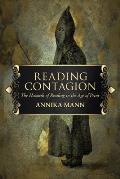
I just learned about this book, but I had a tag all set up for it already.

Reading Contagion: The Hazards of Reading in the Age of Print, by Annika Mann:
Eighteenth-century British culture was transfixed by the threat of contagion, believing that everyday elements of the surrounding world could transmit deadly maladies from one body to the next. Physicians and medical writers warned of noxious matter circulating through air, bodily fluids, paper, and other materials, while philosophers worried that agitating passions could spread via certain kinds of writing and expression. Eighteenth-century poets and novelists thus had to grapple with the disturbing idea that literary texts might be doubly infectious, communicating dangerous passions and matter both in and on their contaminated pages.

In Reading Contagion, Annika Mann argues that the fear of infected books energized aesthetic and political debates about the power of reading, which could alter individual and social bodies by connecting people of all sorts in dangerous ways through print. Daniel Defoe, Alexander Pope, Tobias Smollett, William Blake, and Mary Shelley ruminate on the potential of textual objects to absorb and transmit contagions with a combination of excitement and dread. This book vividly documents this cultural anxiety while explaining how writers at once reveled in the possibility that reading could transform the world while fearing its ability to infect and destroy.
This eighteenth-century worry seems to have resurfaced now that we’re are hunkering down with reading material and mail-order packages while word goes around that those same packages might carry the virus we’re hunkering down to avoid.

However, as science journalist Zeynep Tufekci tweeted: “Future generations will be driven batty by the amount of concern over contamination from cardboard boxes—a tail risk: porous surface, exponential decay—compared with protecting the pathways to OUR RESPIRATORY SYSTEM WITH MASKS FOR A RESPIRATORY ILLNESS WITH ASYMPTOMATIC SPREAD.”

04 October 2017

Years before Lord of the Flies

William Golding’s Lord of the Flies sits in a long line of novels about shipwrecked voyagers stretching back to the beginning of the English novel with Daniel Defoe’s Robinson Crusoe.

Other famous examples of the “Robinsonade” genre include Gulliver’s Travels, The Swiss Family Robinson, Enoch Arden, Haakon Haakonsen: En Norsk Robinson, Treasure Island, The Blue Lagoon, The Black Stallion, and Island of the Blue Dolphins.

The example that Golding cited as inspiration was The Coral Island and a Tale of the South Pacific, by R. M. Ballantyne. He explicitly alluded to that book twice in Lord of the Flies and borrowed two of its main characters’ first names. In Ballantyne’s tale three boys are shipwrecked on an island, look after themselves and friendly natives, fight off pirates and unfriendly natives, and convert natives to Christianity. Really their island’s not that deserted.

One novel resembles Lord of the Flies in its premise a lot more: Deux ans de vacances (Two Years’ Vacation, also titled Adrift in the Pacific, A Two Years’ Holiday, and A Long Vacation), written by Jules Verne in 1888. Verne liked Robinsonades, publishing two others before this one: The Mysterious Island (titled L’Oncle Robinson in its first, discarded version) and Godfrey Morgan.

In Deux ans de vacances, a group of mostly British schoolboys are cast ashore on an uninhabited, unmapped island. They organize themselves into a rudimentary society, the older boys looking after the younger ones. They hunt wild animals. They see no other humans for two years until a ship comes by.

In those respects, Lord of the Flies is more like Deux ans de vacances than The Coral Island or any of its predecessors. And the similarities don’t stop with the thick lines of plot. In the first English edition of Verne’s novel, titled Adrift in the Pacific, the younger boys are frequently referred to as “little ones.” In Lord of the Flies, the younger boys are “littluns.” (The 1967 translation of Deux ans de vacances, titled A Long Vacation, comes up with the jargon “Elbees,” short for “little boys.”)

There’s no evidence that Golding ever read Deux ans de vacances. The 1889 British version was reprinted in 1927, 1934, and perhaps other years, however. Golding said he and his wife shared a number of island adventure stories before he got the idea to write about how boys would really behave on an island. Adrift in the Pacific might have been one of them. If not, then there are some mighty strong coincidences.
