Showing posts with label AUTHOR George Orwell. Show all posts

06 January 2022

“Every statement is an overstatement”
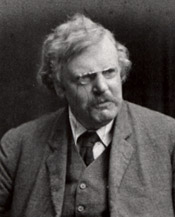
This passage appeared in a an essay by Adam Gopnik that appeared in The New Yorker in 2008. I’ve found it to offer one of the most useful observations of the millennium.

Gopnik was discussing how G. K. Chesterton had gone out of style:
The second big shift occurred just after the First World War, when, under American and Irish pressure, and thanks to the French (Flaubert doing his work through early Joyce and Hemingway), a new form of aerodynamic prose came into being. The new style could be as limpid as Waugh or as blunt as Orwell or as funny as White and Benchley, but it dethroned the old orotundity as surely as Addison had killed off the old asymmetry.

Chestertonian mannerisms—beginning sentences with “I wish to conclude” or “I should say, therefore” or “Moreover,” using the first person plural un-self-consciously (“What we have to ask ourselves . . .”), making sure that every sentence was crafted like a sword and loaded like a cannon—appeared to have come from some other universe. Writers like Shaw and Chesterton depended on a kind of comic and complicit hyperbole: every statement is an overstatement, and understood as such by readers. The new style prized understatement, to be filled in by the reader.

What had seemed charming and obviously theatrical twenty years before now could sound like puff and noise. Human nature didn’t change in 1910, but English writing did. (For Virginia Woolf, they were the same thing.) The few writers of the nineties who were still writing a couple of decades later were as dazed as the last dinosaurs, post-comet. They didn’t know what had hit them, and went on roaring anyway.
In the years since 2008, I perceive, our popular rhetoric has undergone the opposite shift. People now once again speak in hyperbole, especially online. We no longer simply have a fun time; we enjoy “the best Day EVER!” We no longer dislike someone; we say they “deserve to die.” I see people express anxiety about not having enough exclamation points in their business emails.

For someone who learned to write before this shift, I say with characteristic understatement and deflection, it’s a bit disconcerting.

21 July 2009

Wanting It Both Ways for $.99

The latest Amazon brouhaha really started when the store's Kindle section offered George Orwell's 1984 and Animal Farm for $.99. The usual price for an electronic book through Amazon (including an edition of the latter title) is $9.99, a price that many in the publishing industry think is much too low.

Kindle users therefore had to know that buying one of these modern (i.e., copyrighted) classics for 90% off the usual price was a tremendous bargain. Perhaps they thought they were taking advantage of a loss-leader promotion. Perhaps they thought they were just taking advantage. Perhaps they just didn't think. But the basic technique of a con artist is always to make the mark think he's getting away with something.

It turned out that the company which had served as a conduit for those digital texts didn't actually have the right to offer them. In other words, they were pirated editions, with no compensation to Orwell's estate or publisher. No wonder they came so cheap!

When alerted to the situation, Amazon deleted the 1984 and Animal Farm files from its servers, which caused copies to vanish from people's Kindle readers. The company also refunded all those customers their full $.99.

The reaction, as reported by Publishers Weekly, was all too predictable: many Kindle users complained that Amazon should have let them keep the files they hadn't actually been entitled to buy. After all, they didn't know those books were pirated. (They just knew they were getting a tremendous bargain.) Of course, people who wind up in possession of physical stolen goods, even inadvertently, don't get to keep the stuff, and they don't get their money back.

Some Kindle owners expressed resentment about how Amazon's software removed the file from their devices without their explicit consent. Yet the highly touted advantage of the Kindle over other electronic-book readers is that it has a speedy connection to Amazon's servers. ("Auto-delivered wirelessly," the webpages promise.) Apparently these folks wanted that connection to work only one way, and only to their advantage.

In the discussion of this situation on Amazon's Kindle forum, my eye was caught by M. Francis's early comment:

Consider how many posts there have been here where people rant and rave because Amazon doesn't do enough to help owners of lost or stolen Kindles get them back. Now there are complaints because Amazon does make the effort to get stolen (and that's what unauthorized books are) books "returned" to the copyright holders. Talk about a no-win situation. . .
But such perspective doesn't stop the sputtering.

Here's a simple rule: If we stand on principle only when it benefits us, then we're not really standing on principle at all.

13 April 2009

Hunting Down the False Passive

Mark Liberman at Language Log recently had cause to note how modern American prose stylists' dislike of the passive voice has morphed into something more:

In recording the mutation of the term "passive voice", I've been focusing on the way that the word passive has gradually lost its technical grammatical meaning, and taken on a sense crystallizing around notions of passive as "unassertive", "lacking in force", "failing to take responsibility for what happens", "submissive".
Specifically, a New Yorker writer had stated that Bernard Madoff spoke in "passive voice" when he said: "When I began the Ponzi scheme, I believed it would end shortly..." Grammatically, that's active voice (as well as a direct admission of starting a Ponzi scheme). But the second clause does have a bit of "failing to take responsibility."

Jan Freeman, the Boston Globe "The Word" columnist, noted how our relatively recent worry about the passive voice has long been linked to issues of gender:
Linguist Arnold Zwicky [also at Language Log] found the passive first described as a weakness in US writing handbooks of the 1930s and '40s, in discussion freighted "with images of strength, muscularity, and action (that is, symbolic masculinity)."

George Orwell spread the anti-passive gospel in "Politics and the English Language," his famous (and passive-laden) 1946 essay. American students imbibed it from Strunk and [E. B.] White's "Elements of Style," though probably a few of them noticed - as linguist Geoff Pullum did - that the book's section on the passive employs the passive...
Those mid-century decades were when Ernest Hemingway's muscular prose dominated American letters, part of a reaction to the ornate overstatement of the previous century. Naturally a literary technique labeled "passive" would be out of fashion (along with that "pathetic" fallacy).

In his new Chronicle of Higher Education attack on The Elements of Style, Pullum himself (another Language Log regular) noted that three of Strunk & White's four examples of passive constructions to avoid aren't grammatically passive at all. So nearly from the start our prohibition against the passive voice swept up other frequently vague or wishy-washy constructions as well.

Pullum explained the value of the passive voice this way:
We are told [by Strunk & White] that the active clause "I will always remember my first trip to Boston" sounds much better than the corresponding passive "My first visit to Boston will always be remembered by me." It sure does. But that's because a passive is always a stylistic train wreck when the subject refers to something newer and less established in the discourse than the agent (the noun phrase that follows "by").

For me to report that I paid my bill by saying "The bill was paid by me," with no stress on "me," would sound inane. (I'm the utterer, and the utterer always counts as familiar and well established in the discourse.) But that is no argument against passives generally. "The bill was paid by an anonymous benefactor" sounds perfectly natural. Strunk and White are denigrating the passive by presenting an invented example of it deliberately designed to sound inept.
In my writing groups I've noticed some members suffering another misconception about the passive voice: that a "was" or "were" construction is the tip-off to it. Yes, "I was hit by a wombat" is in the passive voice (and properly so according to Pullum, if the wombat is a "newer and less established" element). But "I was hitting the the wombat" is not only active voice, but an image of strength and muscularity.

04 April 2009

“Your Pigs Are Far More Intelligent”

The British press is touting T. S. Eliot's letter rejecting George Orwell's Animal Farm on behalf of Faber & Faber in 1944. This letter was supposedly just "released" by Eliot's widow for a new BBC documentary.

In fact, the letter was printed in the Times of London in 1969 and has been quoted in several books about Orwell and Animal Farm since that date. Marcia Miner has the full text on her Room with a View blog.

The press spin this time is that Eliot and his fellow publishers were leery of offending Stalin because in 1944 he was a British ally. But that's not what the letter says. Though he acknowledges the delicacy of criticizing the Soviet regime, Eliot's political objection was that the only good guy in Orwell's allegory seemed to be Trotsky, and he didn't like Trotsky:

Now I think my own dissatisfaction with this apologue is that the effect is simply one of negation. It ought to excite some sympathy with what the author wants, as well as sympathy with his objections to something: and the positive point of view, which I take to be generally Trotskyite, is not convincing. . . .

After all, your pigs are far more intelligent than the other animals, and therefore the best qualified to run the farm, in fact, there couldn’t have been an Animal Farm at all without them; so that what was needed (someone might argue), was not more communism but more public-spirited pigs.
In sum, Eliot wished the politics in this political allegory were more like his own conservative leanings. Having read Animal Farm, he felt the novel showed that some animals really were more equal than others.