Showing posts with label there will always be a canada. Show all posts

02 July 2026

Can This Marriage Be Saved?

On 1 July, the Comics Beat published an article about the disagreement over fair credit for Rachel Hope Cleves’s Charity and Sylvia in Tillie Walden’s Charity and Sylvia.

That article cites historian Cleves as saying Walden contacted her by email twice as she created her graphic novel: in August 2024 with news that Vermont Humanities had commissioned the project and in spring 2025 with a draft. Cleves’s workload prevented her from studying that material closely. She didn’t raise the question of adaptation rights. The two authors never connected for a phone or video conversation.

Although Cleves had spoken at the Henry Sheldon Museum through a Vermont Humanities grant in 2022, it doesn’t appear that either of those entities ever contacted her about the graphic novel. Nor did Drawn & Quarterly after it agreed to publish Walden’s finished work.

Given the initial understanding that Walden would draw only on documents at the museum, as I quoted yesterday, and given lack of objections from Cleves, people involved in the graphic novel might have convinced themselves that there was no need to seek a formal approval from her. But it’s clear that Walden came to rely on Cleves’s history more than originally planned. Walden and Drawn & Quarterly should have done more before publication. 

Comics Beat reports that Cleves wishes “to see Drawn & Quarterly option [her book] for adaptation and co-credit her, with appropriate compensation.”  

For now (and 1 July was a holiday in Canada), the publisher says it “stands by Tillie Walden’s research for her graphic novel” while drawing attention to her citations and praise for Cleves on the book’s website. In fact, the press says, those citations were too long to be included in the printed book. That may be right from an aesthetic or cost standpoint, but it only shows how Cleves deserves more credit in print than one laudatory line.

I suspect Drawn & Quarterly wants to protect its author from accusations of deliberate plagiarism or downgrading Cleves’s work. And to ensure Walden gets credit for the effort and creativity she put into the graphic novel, which by its nature is quite different from its source material.

Likewise, Cleves deserves credit for all the work she did in unearthing and telling Charity and Sylvia’s life stories, whether or not the graphic novel borrows specific language, which would be the strongest evidence in a copyright case.

Tillie Walden is a comics creator who has delightfully found success at a time when one can actually make a living at that work. Drawn & Quarterly is an artsy independent comics publisher based in Montréal. Rachel Hope Cleves is a respected history professor at the University of Victoria, British Columbia. The development of both versions of Charity and Sylvia was supported by humanities grants.

No one goes into any of those enterprises to make a lot of money. People spend years producing scholarly studies or graphic novels because they think the work is important. Yet that situation makes fair credit all the more important.

A graphic novel and a scholarly biography aren’t competing for the same sales—but the comic could promote the study, just as the study made the comic possible. So I really hope there’s a way for these projects to become mutually supporting.

10 July 2020

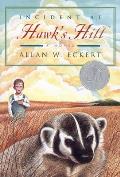
How a Real Story Became Incident at Hawk’s Hill

In 1873, a young boy went missing from his family’s farm in Manitoba. After more than a week, a man of Native and European ancestry found him hiding in a badger hole. That much we can read in nineteenth-century sources from Winnipeg.

In the early 1900s the nature writer Ernest Thompson Seton picked up that story from some Manitobans. He published a version that went into much more detail about how the little boy had actually shared that hole for days with a mother badger that had recently lost its young. Seton or his informants turned the mysterious event into a morality tale, which he published in at least three books.

This 1960 article from the Manitoba Historical Society’s Manitoba Pageant magazine mentions some other local recountings: by Archbishop Samuel Matheson in 1936, in Country Guide in 1951 by Margaret Arnett MacLeod, by the Manitoba Free Press in 1953. I haven’t seen those versions, so I don’t know what new details they provide and what evidence they were based on.

At some point the American writer Allan W. Eckert (1931-2011) came across Seton’s version of the story. Eckert had made himself a specialist in ecological writing, penning most of the scripts for Mutual of Omaha’s Wild Kingdom. He also found a niche writing on Native Americans, including outdoor dramas about Tecumseh and Blue Jacket. (That pairing of nature and Native Americans probably reflects a bias within our culture.)

Eckert’s nonfiction tended toward the imaginative. One of his early magazine sales was an article for the American Legion magazine in 1962 about the disappearance of the US Navy air training mission Flight 19 off the coast of Florida. Eckert appears to have added details not in the documentary record, and that event later became a keystone of the “Bermuda Triangle” legend.

Likewise, Kirkus said of Eckert’s 1992 biography of Tecumseh, A Sorrow in Our Heart, “in its interpretative zeal it strays from, or at least embellishes, the historical record to the point of being suspect.” Even Kirkus’s good review of That Dark and Bloody River noted Eckert’s method of “'reconstituting' credible dialogue among people in briefly reported events.”

On the other hand, Eckert’s fiction was often based closely on historical fact. His first novel was about the extinction of the great auk. Another was based on an event in the life of Daniel Boone. In the late 1960s Eckert started a series of historical sagas about the “Winning of America.”

Eckert saw the skeleton of a novel in Seton’s tale of the lost boy and the badger. The tale offered a chance to write about both the frontier past and the natural world. And it came with the gloss of nonfiction. When Eckert published his novel Incident at Hawk’s Hill in 1971, he stated up front in a short author’s note, “The story which follows is a slightly fictionalized version of an incident which actually occurred at the time and place noted.” Toward the end of the book, Eckert introduced characters who shared the names of two of Seton’s informants.

Eckert changed some details of the story, starting with calling the little boy not Harry (or Willie) Service but Benjy MacDonald. Seton had written that the event took place near “Bird’s Hill,” and Eckert turned that into “Hawk’s Hill,” named after a hawk the MacDonalds see. (The original Manitoba landmark was named after a settler named Bird, not an actual bird.)

Many other details and the plot of Eckert’s story came directly from Seton’s narrative. From the outset, the little boy shows more affinity for animals than for people. Seton’s villain—a nasty neighbor named Grogan—appears under the name of George Burton. He’s not a “half-breed,” however; in fact, he’s cruel to Natives as well as animals. As in Seton’s story, Benjy wanders away after a prairie chicken and needs to take shelter from a storm. A mother badger has been injured in the villain’s trap and lost her babies, leaving her with unfulfilled maternal instincts.

The real boy was lost for about ten days, but Incident at Hawk’s Hill draws that time out to two months. Eventually, Benjy is rescued by a relative rather than (as with the real boy) a stranger; where Seton wrote that that relative was a cousin, Eckert found more drama in making the rescuer a brother.

When Benjy returns, he initially behaves like a badger, but eventually returns to human behavior, stronger for his experience in the wild. Finally, just as in Seton’s telling, the villain shoots the badger, not realizing it has become a family companion, and the family unites to drive him away. The experience brings the MacDonalds closer, particularly father and son. But the family has also decided, with a visiting archbishop’s help, to keep the full story secret so as not to make Benjy appear stranger than people already think of him.

Eckert didn’t write Incident at Hawk’s Hill for children. The point of view skips around among many characters—adults, children, badger, and omniscient narrator. Though six-year-old Benjy is a central character, for many pages Eckert describes him entirely from the outside, and not in appealing terms—he’s small for his age, developmentally odd. It takes several chapters before readers are privy to Benjy’s thoughts, and then only when he’s the only human in the scene. Much of the book follows the drama of the MacDonald family searching for him or reacting to his return.

The early reviews treated Incident at Hawk’s Hill as an adult novel. Critics focused on Eckert’s reputation as a nature writer, with the New York Times calling the book a “folk fable” written “without recourse to undue anthropomorphism.” Kirkus’s reviewer, who could barely stand the story, concluded, “Were it not for Mr. Eckert’s natural history credentials one might think he had been sniffing too much meadow grass.”

Soon, however, people began to view Incident at Hawk’s Hill as a book for children. It was, after all, about a young boy and an animal making friends. It was on the short side, well under 200 pages. And it had pictures. Little, Brown commissioned scratchboard art from John Schoenherr, who had illustrated Sterling North’s Rascal (1963) and Walt Morey’s Gentle Ben (1965)—two novels about boys and animals written for children. (Schoenherr had an earlier career as a science-fiction illustrator. He would go on to win the Caldecott Medal for Owl Moon.)

The Bulletin of the Center for Children’s Books deemed Incident at Hawk’s Hill “An adult novel that should appeal to many young readers.” And in 1972 the novel was named a Newbery Honor Book. That year the judging committee appears to have been unusually generous, naming five Honor Books, more than in any other year in the 1960s and 1970s. From then on, Eckert’s novel was treated as a children’s book.

Disney adapted Incident at Hawk’s Hill into a 1975 television movie called The Boy Who Talked to Badgers. This treatment made Benjy, played by ten-year-old Christian Juttner, more of a likable hero. It switched some episodes around, but the basics of Seton’s and Eckert’s story remained. One notable addition was Denver Pyle as narrator, revealed at the end to be Benjy grown up.

Almost two decades later, in 1998, Eckert published Return to Hawk’s Hill, starting at the end of the first novel and then going over much the same ground. Benjy, a little older, wanders off again. Even the villain returns, despite having been run off before. But the new story had one major difference. This time, instead of a badger Benjy falls in with a community of mixed Cree and French descent who look after him, and his father learns to apologize for his prejudice against these Métis.

Return to Hawk’s Hill thus restored the helpful role of Métis in the real story of the lost boy in Manitoba. As specified in the nineteenth-century sources, a man of Cree and European ancestry rescued the boy from the badger hole. Seton’s early-1900s version had not only erased that rescuer from the story but made the villain a “half-breed.”

I have no idea whether Eckert had learned of those original sources by the time he wrote Return to Hawk’s Hill and set out to fill a deficit in his earlier novel. He may simply have wanted to create a sequel to one of his most successful books and looked to his interest in indigenous North Americans for inspiration. Either way, he added yet more significance in the mysterious story of a lost boy in the badger hole.

TOMORROW: Further meaning for 21st-century readers.

09 July 2020

How a Lost Boy Met a “Kindly Badger”

Yesterday I quoted two period sources about a Manitoba boy who was missing for over a week on the prairie before being discovered in a badger’s hole.

One of those items was a newspaper article from 1873, days after the boy’s return, the other a longer account from a local journalist about the search and discovery published in 1881. Those sources establish the basic veracity of the story of the missing boy.

Those sources also leave a lot of mystery. They have little to say about what the boy experienced. They say nothing about the badger that dug the hole where the child hid. It’s not even clear that there was a badger present—that hole might have been abandoned.

Decades later, in 1909, the nature writer Ernest Thompson Seton (1860-1946) included a version of the same story in his two-volume Life-Histories of Northern Animals. This account was independent of the sources published in the nineteenth century, which Seton probably never saw.

Instead, in 1909 Seton stated: “This was related to me by George Fraser, a native of Manitoba, and corroborated by his mother, Mrs. Fraser, of Kildonan, and Archbishop Matheson.” In publishing a longer version of the tale in 1913, Seton said skeptics could speak to “Archbishop Matheson, Dr. R. M. Simpson, or Mrs. George A. Frazer of Kildonan.” As I noted yesterday, people heard Archbishop Samuel Matheson retelling the story of the boy in the badger hole (including a detail contradicting the earliest accounts) as late as 1936.

Seton presented his version as based on what the little boy told his family after his return, which neighbors then passed down to him. Some of that information might have been garbled, smoothed, or augmented in transmission over the decades. Seton’s date for the event was off by two years, for instance. He called the boy “Harry” while the 1881 account used the name “Willie,” though I haven’t found confirmation of either. Most important, while the earliest sources were about the search for the boy, Seton wrote in confident detail about how the little boy survived outdoors for more than a week.

The 1909 version from Seton stated:
In 1871, a little seven-year-old boy, named Harry Service, wandering from his father’s house at Bird’s Hill, near Winnipeg, was lost for two weeks. When found, he was living in a den with a Badger. His clothes were torn so that he was nearly naked, and his face was all scratched. He told his parents that he had taken shelter in the hole during a rain-storm, and that the Badger came later and scratched his face. At first they fought, but the child was plucky and would not give up the hole. Later the Badger brought some food and, after another quarrel, allowed the child to eat some of it. In the days that followed the Badger brought him food several times. The beast always entered the den by one of the entrances not used by the child.

When found they were on terms of friendship, and the child cried bitterly when taken from his savage friend. The boy’s story, however, was not clear. He said at one time that he lived on mud. His face, mouth, and tongue were black with mud and much swollen. Nevertheless, his description of the Badger was beyond question. He even said it had five toes on one foot and four on the other.
Four years later, Seton published a longer version of the same story in his book Wild Animals at Home and in Boys’ Life. (In 1932 that version reappeared in Seton’s Famous Animal Stories.) In the book the tale was titled “The Story of the Kindly Badger.” In the magazine it became “The Badger Who Was Brother to a Boy,” though Seton was clear that the badger was acting as a mother.

This longer version left little room for what “was not clear” about the incident. It even explained why the number of toes on the animal’s feet mattered.

“The Story of the Kindly Badger” stated at the outset that Harry Service “was a strange child, very small for his age, and shy without being cowardly.” He followed animals, imitating their noises and behavior. Indeed, following a prairie chicken was how Harry got lost.

Another addition to the established tale was a neighbor Seton named as Grogan and labeled “The Evil One” and “The Human Brute.” A week before Harry wandered off, Grogan had killed a father badger and trapped a mother badger until she “chewed off one of her toes” to escape, but by the time she returned to her burrow her children were dead.

Lost on the prairie, Seton said, young Harry took shelter from a thunder storm in a badger hole. Then that mother badger with the missing toe came back. The two refugees fought over the space. Seton quoted Harry as saying, “I scratched the badger’s face and she scratched mine.” But then they accepted one another.

The badger brought in a prairie chicken, an egg, and other food for her dinner, and Harry was able to take some. Seton explained, “The child could not know, but the parents discovered later that this was a mother badger which had lost her brood and her heart was yearning for something to love.” Harry could only drink from mud, and “Possibly the mother badger wondered why he did not accept her motherly offerings,” which is as explicit as Boys’ Life could get about breast-feeding in 1913.

In this telling, Harry saw Grogan ride by and hid from him, as well as from other men. He developed the habit of running on all fours. Finally Harry’s “Cousin Jack” spotted him and dug him out of the hole, bringing him home by force with the mother badger following for a while.

At home, Harry behaved like a wild animal for a while until his mother’s “magic touch on his brow” calmed him and he began to speak. Then the badger appeared in the doorway. “My Badgie, my Badgie,” Harry cried while hugging her. The boy made a pet of the badger for a while, feeding her, sleeping with her, and playing with her on a dirt pile outdoors.

According to Seton, Harry Service said he hated his father because “he passed me every day and would not look at me.” That might be a remnant of the detail from the very first newspaper account, which reported that the little boy had once seen his father ride by and couldn’t get his attention.

But the real villain of this tale was Grogan, who reentered for the final act. Playing off the stereotypes of his time, Seton labeled Grogan a “hulking half-breed.” In fact, according to the nineteenth-century accounts, a “Half breed,” possibly Peter Fidler, Jr., was the hero who found the little boy and brought him back to his parents. Seton’s telling erased that figure from the story and credited one of the boy’s cousins with rescuing him instead.

As Seton recounted it, Grogan spotted the badger in the Services’ yard, assumed it was a wild pest, and shot it. Harry’s father ordered the man away. It took three weeks for Harry to recover from the loss. This tale concluded:
He grew up to be a fine young man, but he took no pleasure in the killing that was such sport to his neighbors’ sons, and to his dying day he could not look on the skin of a badger without feelings of love, tenderness and regret.
The 1913 version of the story was thus invested with much more meaning than all the earlier accounts. It’s impossible to know how much of that meaning came from what the boy actually told people, how much from the intervening informants, and how much from Seton’s recounting. The published tale certainly fit in with his approach to nature writing, which imbued animals with moral motivations. Seton got into debates with other naturalists about this attitude. He even wrote a book called The Natural History of the Ten Commandments (1907), later retitled The Ten Commandments in the Animal World (1925).

Fitting into that pattern, Seton’s 1913 tale had a moral about the importance of kindness to animals, and animals’ capacity to be kind to little humans in return. The Service boy’s survival was an utter mystery in the nineteenth-century stories, but Seton offered answers. The boy was unusually attuned to animals. The badger, missing her young, was “kindly” and “maternal.” Therefore, they got along fine (after a little scratching). Seton’s telling also provided a clear villain, a man who trapped and killed animals cruelly instead of recognizing their worth, and was non-white besides.

In sum, regardless of how much Seton deliberately fictionalized the mysterious 1873 incident of the boy in the badger hole, he assembled an intellectually and emotionally meaningful narrative, which is what we seek in fiction.

TOMORROW: The fully fictionalized version.

08 July 2020

The Boy in the Badger Hole

In June 1873, a young boy living on a farm in Springfield, Manitoba, outside Winnipeg, went missing. His family and neighbors searched the prairie. After a week, people despaired of finding the boy alive.

On 19 July, however, the Manitoba Free Press reported this news:
FOUND.—The little lost boy of Springfield has turned up alive and well, after a ten days subsistence on swamp water and what few strawberries the grasshoppers left for him. A Half-breed who resides in St. Paul’s, whose name we did not learn, discovered the little fellow at Little Lake, some eight miles from his father’s house. On seeing the man coming the little fellow became alarmed and concealed himself in a badger hole which for some time he had made his dormitory. On the day previous to his recovery, and [sic] boy had seen his father (who had been constantly searching for him since he had been lost) passing near, and ran shouting after him, but failed to attract his attention. We don’t know when we heard anything that surprised and pleased us so much as the above piece of news.
In 1881 a reporter for that newspaper, J. F. Galbraith, published a roundup of stories about life in the province under the pseudonym Jeff. Gee. That book, A Sketch of Both Sides of Manitoba, offered more detail about the case of the lost boy, starting:
There is, I have observed, in all very new countries, or sections of country, a bond of sympathy, that unites each man to his neighbor. So, when, one morning in June, a messenger arrived from Springfield with the announcement that a little four-year-old son of Mr. Wm. Service had strayed away from his home two days before, and all efforts to find him had been fruitless, there swelled through the Winnipeg pulse a great throb of sympathy. . . . Would Winnipeg supply fresh search parties? I should say so. Every man, woman and child wanted to turn out: the entire community would respond en masse, if need be.
Six days of searching didn’t turn up Willie Service, as Galbraith called him. The authorities offered a $200 reward. On the tenth day, however, the boy was found.

Galbraith then wrote more than two pages in the voice of the man who found the boy, whom he called a “French half-breed.” According to this account, the man saw cranes fly from a particular spot and decided that something around there must have disturbed them. He persisted in searching that area (with breaks for tea) even after his son and son-in-law gave up. And then he heard a strange noise.
“I get my gun ready and go on e-easy. Hear queer noise again, eight, ten yards off. I look: see dirt like badger hole. I stop. Then I put out my gun and walk close, slow. I point my gun, and look down. Hole dark; can't see nothing. I bend my head and look down, close. See hand—black, black; four fingers, no thumb. I draw back. I not afraid; but queer noise and black hand without thumb—don’t like it. I look again; hand move, and thumb come out from under. Then I make little noise, and two big eyes look up—wild wild. I see face. I drop gun, put out my hands and say,

“‘Oh, my poor little boy, come out, come out. Your father and mother look all over prairie and can’t find you. Come out and I take you to your mother.’

“He say nothing, but look—big eyes, scared. I ask him again come out, but he not move. Then I kneel down, and say,

“‘My poor little boy, come out, and I take you to your mother, I give you plenty bread, plenty tea, you poor little boy, you must be hungry. Come with me—I feed you, I warm you, I bring you home.’

“I reaching down all the time, and then I catch him by the hand, and say,

“‘Now, my little boy, I got you, I bring you to my wife. Don’t be afraid; I not hurt you.’

“He draw back, but I take him out, and put my arms around him, and hold him up tight, and pat him on the head, and he never say nothing. Then I take him to my wife, and my wife, and my daughter, and my son’s wife, hurry up, and make broth, and give him some in cup. My, but he hungry. Want to drink it all; but my wife say,

“‘No, not too much; I give you more after awhile.’

“Then he go to sleep, and my wife wake him soon and give him more broth. Then he sleep again, and my son go and tell his mother, and his mother come and take him away.”
Galbraith didn’t name the man who found the little boy.

According to a 1960 article in the Manitoba Pageant, transcribed here, that rescuer was Peter Fidler, Jr. (1820-1881). I don’t know the basis of that identification and thus how reliable it is. Fidler’s mother Mary was Cree; his father was not French but English by birth.

The same Manitoba Pageant article showed another way the story changed over time as people sought meaning in it:
When Archbishop [Samuel] Matheson told the story of Billy Service in 1936, he stated that Mrs. Fidler was said to have had a dream in which it was revealed to her that the boy could be found in a badger hole and that she induced her husband to go out and look for him.
In the 1880 account, the man who found the boy said nothing about a dream. He noticed unusual bird behavior, meaning he relied on experience in the world, not supernatural guidance.

TOMORROW: Another version of the same story, based on oral traditions.

12 August 2013

“You do Batman stuff all the time.”

As long as I was talking about Ty Templeton’s Batman work, it seemed like a good time to share his autobiographical “Bun Toons” webcomic about being a father of teenagers.

Click through to see what impresses Templeton’s kids even more than dinner with the Governor-General of Canada.

09 March 2013

Steve Murray Illustrates Everyone in Oz

One of the nice effects of the Oz the Great and Powerful opening is how it’s inspired a lot of Oz art. Up in Canada, the National Post’s Steve Murray took on the monumental task of depicting every character in L. Frank Baum’s fourteen Oz novels. Here’s just a slice of the magnificent result.


The scale might look a little off, but that’s because those big folks in the background at top are giants. They tend to cluster in Baum’s late books.

For the full image, with annotations on each character and a key to which books they first appear in, visit the National Post.

08 December 2012

Argo Nots

The movie Argo is a triumph of production design, recreating the look and sound of Teheran, Washington, and Hollywood in 1980. Which is absolutely necessary for the picture to work since the story is so outlandish that without complete realism in everyday details it would seem like Hollywood bullshit.

Director Ben Affleck was nine years old when the Iran hostage crisis began. He was thus recreating the milieu of his childhood, from new Star Wars action figures to grown men in three-piece suits. Early on there’s a scene in which his character watches television, and he made sure to show us the man standing up and clicking the dial from one VHF station to another. Every time the scene shifts to an office, we hear the busy sound of a Selectric typewriter. With no answering machines in sight (though they were on the market), the story’s telephone connections become even more tenuous.

During the closing credits, the filmmakers show off their work, pairing period photographs of the Iranian Revolution or decaying Hollywood with their careful recreations of the same sights.

Those credits also show the fake passports of the real American diplomats at the center of Argo’s story, and their haircuts really did look like that. Again, such details helped immensely to make them seem real since we see little of those characters beyond their plight. Affleck’s own performance as CIA “exfiltration” specialist Tony Mendez consists mainly of looking serious in a beard. The acting energy comes from the pacing and the supporting cast of pros: Alan Arkin, John Goodman, Bryan Cranston, and Victor Garber.

It’s disappointing, therefore, to learn that the movie’s realism in little things masks big liberties with what actually happened. The movie’s basic concept is true: Mendez and the CIA used the production of a science-fiction epic in turnaround called Argo as cover to fly six American diplomats out of Teheran.

But the exciting scenes—the last-minute interventions, the Republican Guards tumbling to what’s happening, the airport chase—are completely fictional. The Tony Mendez character arc, from separation back into his family’s bosom and from professional exile back to being a CIA hero, also doesn’t seem to reflect reality. Argo is a movie about Hollywood bullshit proving useful in the real world that’s actually built of Hollywood bullshit.

In real life, all of the challenges in the movie’s tense, exciting third act had already been cleared away through the least exciting activity American filmmakers can probably imagine: careful, quiet work by Canadian bureaucrats.

One visual element of the real story that didn’t make it into Argo consists of Jack Kirby’s designs for the planned epic and its related theme park, Science Fiction Land. This PDF from the Kirby Museum uses Kirby’s drawings to illustrate interviews about that grand project. The image above is the original announcement that the movie would start filming soon.

10 November 2012

Ahoy! A Little More Teen Boat!

This week I ran up against a short Teen Boat! story that didn’t make it into the collection.

Okay, it’s a promotion for the last Toronto Comic Arts Festival. But it’s got some nice gags and cameos.

27 June 2012

The Voices of Rage and Ruin

For anyone who’s wondered what the Creedence song “Bad Moon Rising” would sound like when performed by British Columbia teenagers singing in chorus and playing ukuleles (and one stand-up bass).

I have to say this arrangement doesn’t preserve the ominous quality of John Fogerty’s song. But the Langley Ukulele Ensemble performs a wide repertoire, and has a thirty-year history.

21 May 2012

Oh, the Irony!

Yesterday I quoted a mention of Men Without Hats, the Canadian New Wave band that had a big hit in 1983, helped by an inexplicably medieval music video featuring Mike Edmonds of Time Bandits.

I can’t let that pass without adding my high-school classmate Randy’s exasperated observation at the time that one of the band often wore a hat.

12 May 2012

The Coolest Coin in the World

We all know that Canadian coins have images of animals on them, right?

Last month the country’s mint issued the first of four quarters featuring images of prehistoric animals that once roamed that part of the continent. The first shows Pachyrhinosaurus lakustai, a dinosaur in the same family as Triceratops.

If that wasn’t already cool enough, in the dark (or in your pocket) the coin’s image glows. Or, to be more specific, the dinosaur‘s skeleton glows in the dark.

The luminosity depends on exposing the coin to some strong light beforehand. Exactly how this works is a proprietary secret, but the effect is supposed to be permanent.

Unfortunately, this coin is meant for collectors, not general circulation. Though it has the legal value of Cdn$.25, it’s bigger than a standard Canadian quarter and is actually being sold at post offices for Cdn$29.95. So, alas, it’s not going to show up in our change.

16 June 2011

Video Killed the Comic-Book Star

From Jean-Paul Gabillet, Of Comics and Men: A Cultural History of American Comic Books, translated by Bart Beaty and Nick Nguyen:
In 1960, 41 percent of boys in the fourth grade in San Francisco read at least nine comics a month; by comparison, ten years earlier, a study based on a sampling of over fourteen hundred young students in Des Moines, Iowa, showed that 75 percent of children of the same age read similar quantities.

A 1961 study had also examined the differences between two Canadian cities, one with television, one without, respectively referred to as Teletown and Radiotown (at the start of the 1960s it was no longer possible to find an American city without television): a third of the sixth-grade students read more than ten comics a month in Teletown as opposed to 87 percent in Radiotown; for high school students, the gap was 6 percent at Teletown versus 49 percent in Radiotown.

Clearly, television consumption among children seemed to be inversely proportional to comic book reading.
I was happy to see studies to support one of my hunches. In particular, the fall of romance comics from market-driving leaders in the late 1940s to a small slice of a shrinking market a decade later strikes me as due to how readers found similar storytelling at greater value on television soap operas. Superhero and science-fiction comics offered stories and visuals that television production couldn’t match, so they kept their audiences relatively well. Now, of course, they’re losing out, too.

All of Gabillet’s citations for this passage go through one essay also cited in many other studies of comic books: Patrick Parsons’s “Batman and His Audience: The Dialectic of Culture,” published in The Many Lives of the Batman. I’ve looked for that book for a while. It came out from a British academic press in 1991, before the study of comics was wide or respected in American culture, and there’s no copy in my local library network. I must make a note to visit a local university.

The Gabillet book is more comprehensible than Thierry von Groensteen’s The System of Comics, translated by the same team for the same university press. Still, there are some maddening passages, such as:
Nineteen fifty-two was the year where the combined printings of comic books reached their historical maximum but there is no data at our disposal that allow us to quantitatively determine this.
If there’s no data to “quantitatively determine” how many comic books were printed in a year, how can we identify a “historical maximum”? Apparently that statement is (a) a relative measurement, based on (b) qualitative impressions by individuals at the time. But one cited witness’s estimate of production in 1952 is twice as much as another’s.

08 March 2011

There Once Was a Verse Form Called Limerick

At World Wide Words this week, Michael Quinion puzzled over the term “limerick.” That type of poem started to appear in print in the 1820s, but it took decades before the label came along.

Among the earliest examples is this, from the picture book Anecdotes and Adventures of Fifteen Young Ladies:

There was a young lady named Ryder,
She shrunk at the sight of a spider;
She once gave a scream,
And leaped into the stream,
When she saw one crawling beside her.
Edward Lear adopted the five-line form for his little-noted-at-the-time Book of Nonsense (1846).

Several Gaelic examples appeared in James Clarence Mangan and John O’Daly’s The Poets and Poems of Munster (1850), tagged to a melody called “The Growling Old Woman.” In his 1904 Pulse of the Bards, after the limerick was a recognized form, P. J. McCall translated “The Growling Old Woman” from the Gaelic like so:
Woman of the House—
I’ve no one to help with the churnin’,
Or bake a slim cake without burnin’,
Or get a bit ready for Nickeen an’ Neddy,
When hay in the meadow they’re turnin’;

That pig never stops with his squallin’;
The boneens go rootin’ an’ bawlin’;
The ducks an’ the hens lay away in the glens,
An' the roof of the cowhouse is fallin’.

The Household—
O, you growlin’ old woman!—
Be aisy—the neighbours are comin’!
Tobacco full ripe we will put in your pipe
To make your heart happy an’ human!

Woman of the House—
Our cow gives her milk to the fairies;
Our calf’s not as handsome as Mary’s;
My bonnet an’ bo are a shame an’ a show,
An’ my gown in the clauber conthraries!

My man takes his time fair an’ aisy;
The boys are light-headed an’ lazy,
The girls ever singin’, when washin’ or wringin’—
Enough to drive anyone crazy!

The Household—
Whisht! you growlin’ old woman!
Be aisy—the neighbours are comin’,
Tobacco full ripe we’ll put in your pipe
To make your heart happy an’ human!

A Neighbour—
Ould woman, I’m thinkin’ you’re jokin’!
You lie by the fire always pokin’,
An’, if any use, you give tons of abuse—
An’ the Ould Boy can’t bate you at smokin’!

Your man works the hardest in Erin;
Your boys are both brave an’ unfearin’;
Your girls are the sweetest, the quickest an’ neatest;
’Tis you are the pig by the mearin’!

The Neighbours—
Whisht, you growlin’ old woman!
Your conduct is most unbecomin’,
Tobacco full ripe—twice the full o’ your pipe,
Wouldn’t make your heart happy an’ human!
(The emphasis on tobacco suggests the Gaelic verse doesn’t go back earlier than the 1600s.)

Early last year scholar Stephen Goranson found a limerick published in the St. John [New Brunswick] Daily News in 1880 with the label: “Tune, wont you come to Limerick.” That’s seems to be the earliest link of the Irish city of Limerick, in the province of Munster, to the poetic form. But it comes with a musical mystery: that tune is a jig, and it’s hard to sing limericks to it. Goranson also documented many examples of “come to Limerick” to mean to surrender or settle differences, which may be totally unrelated.

There are also appearances of the phrase “Limerick rhyme” as early as 1880, without examples to show exactly what the writers meant. By the mid-1890s, however, a “limerick” was clearly the form we expect today.

13 January 2011

More on Max Finder

Further investigation of the Encyclopedia Brown and Max Finder mystery series yields an explanation of why so many characters in the latter seem to be up to no good.

In most of the cases that Donald J. Sobol set in Idaville, the culprit is fairly obvious: Bugs Meany, a recent parolee, the snotty braggart who’s taking Sally out to the movies, and so on. The young detective’s task is usually to spot an incongruous detail in that suspect’s alibi or behavior which cracks open his façade of innocence.

In contrast, the mysteries that Liam O’Donnell concocts for Max Finder are true whodunits. A wrong has been committed, and there are at least two suspects, often more. Readers are challenged to identify not only how the brainy detectives solve the crime, but who committed it. To make that hard, those suspects need to be equally suspicious, and perhaps the culprit should be the least suspicious of the lot. Hence the treacherous employees, frame-ups, and cutthroat competitors.

When I first wrote about this series, I was responding to Snow Wildsmith’s praise for how it gives Max’s friend Alison Santos “moments to shine.” Indeed, that aspiring journalist solves several of the mysteries before he does—though Max still gets top billing.

The town of Whispering Meadows is also notably multicultural. The kids have surnames like Diallo, Chang, Hajduk, and Kanwar. Artist Michael Cho draws Max so readers might be able to interpret him as Caucasian, Eurasian, or even Inuit. The character sketches break kids out of types. Tony, “an all-around athlete,” also “cries at sad movies,” and Nanda, who likes “the latest CDs and clothes,” is “a hockey goalkeeper.”

Only one role seems to be reserved for European-Canadian males: the bully. “Basher” McGintley and Lucas Hajduk are as white as, well, Bugs Meany.

12 January 2011

Whispering Meadows, Den of Thieves

Crime and misbehavior in Encyclopedia Brown’s home town of Idaville tends to come from three sources:

  • Criminals passing through town, or recently out of jail.
  • New kids trying too hard to show off.
  • Bugs Meany and his Tigers.
The bulk of the local young population—the kids obsessed with teeth or animals or lacrosse or whatever—come across as well-meaning and good-hearted. Trouble comes from outsiders, and the community’s recognized bullies.

I found Whispering Meadows, the home town of young sleuths Max Finder and Alison Santos, to be a more treacherous place. The first volume of this series, by Liam O’Donnell and Michael Cho, contains ten short, comics-style mysteries originally published in OWL Magazine.

In three stories, the culprits turn out to be trusted employees of the damaged businesses. In a couple more, one friend victimizes another. Several stories contain red herrings as the guilty person tries to frame an innocent bystander. And whenever there’s a contest, the kids compete in cut-throat fashion.

Punishment for the transgressions tends to be mild. Of the ten cases, only one involves action by legal authorities; in another, a summer camp sends some kids home early. But a more typical dénouement in the back of the book is along the lines of: “Jeremy apologized for breaking Sally’s stereo, and for making the scene look like Hector did it, and after a while they all became friends again.”

Which might make sense, since a lot of the kids in Whispering Meadows have a common interest in bad behavior. In the next story, Hector might well be vandalizing someone’s bike while Sally blames Angela for beating her in the spelling bee.

Whispering Meadows sounds like a horrible place to grow up.

02 December 2010

Weekly Robin Wikileaks Special

Today’s New York Times reported:

A trove of diplomatic cables, obtained by WikiLeaks and made available to a number of publications, disclose a perception by American diplomats that Canadians “always carry a chip on their shoulder” in part because of a feeling that their country “is condemned to always play ‘Robin’ to the U.S. ‘Batman.’”
The same paper also stated:
Asked about a cable that described President Dmitri A. Medvedev as “playing Robin to Putin’s Batman,” [Russian prime minister Vladimir Putin] said the author had “aimed to slander one of us.”
Clearly the US State Department should be shipping more comics from the late thirty years overseas. They show the relationship of Batman and Robin has become far more nuanced than simply the grown-up hero and the kid sidekick of the 1960s TV show. We could start with recent issues of Batman and Robin drawn by Cameron Stewart of Montreal.

25 August 2010

Mythologizing Toronto

Yesterday I started quoting from Chris Randle’s interview with Bryan Lee O’Malley, creator of the Scott Pilgrim books. Late in the conversation they get deep into the meaning of Toronto:

BLO’M: I can tell you my new metaphorical structure for the book [vol. 6, Scott Pilgrim’s Finest Hour], based on last year. Gideon is Edgar [Wright, movie director], and I’m Envy [local girl who’s been made into a singing star]. He came back to town and started this whole industry, and gave people jobs, and pushed everything around to feed ourselves. I was just kind of along for the ride. So yeah, I feel like in this book I identified most with Envy Adams, which is truly disturbing. . . .

I was gonna do a promo strip for the book that was…all these Toronto luminaries gushing about Gideon coming to town…It was gonna be, like, Chris Murphy and all that kind of stuff.

CR: Margaret Atwood.

BLO’M: Margaret Atwood [laughs]. People saying what a genius he is and stuff. I should still do that, it’d be fun. . . .

CR: I’m really interested to see how Toronto reacts to it specifically, because – I think Scott Pilgrim is part of the general comics zeitgeist in this past decade, maybe the representative series from what a younger generation of North Americans are doing. But also I think it was part of a smaller local thing in Toronto, starting around 2002 or 2003…celebrating or mythologizing [the city].

BLO’M: Yeah. Yeah. I kind of accidentally was in the right place at the right time. People always ask me about Toronto, what it is about Toronto, questions like that, and I’ve never really had a statement. I guess Scott Pilgrim is my statement on Toronto. I don’t think it’s conclusive in any way, but…I only lived there for three, four years. I just happened to be there. I was nobody. It was really weird to go back last year and be introduced to Chris Murphy and Broken Social Scene and all those guys, to have them be like: “Where did you hang out? Why didn’t we know you?” Because I was a fucking nerdy cartoonist! That’s why you didn’t know me, I’m not a rock star.

CR: [laughs] That’s great. I think it’s because Toronto is a really big city, but one that didn’t – I mean, it’s not like New York, where there’s whole layers of lore…

BLO’M: It doesn’t have that weird history, that mythologized history that New York has or L.A. . . . I’ve always been intimidated by New York for that reason, because there’s too many stories. It’s been [so] fictionalized that I can’t really comprehend it.

CR: And L.A., in a different sense, the glitzy sense. But Toronto didn’t have – it had boring, conservative Protestantism…

BLO’M: Conservative white people, yeah.

CR: But there was all this raw material.

BLO’M: Yeah, and I feel like I’ve maybe unfairly mythologized Toronto. I’ve definitely seen kids being like: “I want to move to Canada now!” And, um…it’s cool, but it’s just a city.
Is it perhaps characteristically Canadian to feel guilty about making a big, cosmopolitan city look like an interesting place to live?

I feel compelled to tell a story about Honest Ed’s, a Toronto landmark that serves as a major setting in the third Scott Pilgrim volume. Honest Ed’s is a discount and salvage store that looks like a cross between the old Spag’s, the Corn Palace, and a Las Vegas casino. It’s garish and commercial and more than faintly embarrassing. Scott actually needs goggles when he’s inside.

But when I read that scene, I remembered a secret about Honest Ed’s. When my first book was being published, the head of the press told me that firm’s landlord was Honest Ed. He liked having publishers, galleries, and other cultural institutions in the neighborhood, so he gave them good rates on office space. That garish, commercial embarrassment was actually a pillar of Toronto’s art scene.

So what does that say about Toronto? There are plenty of stories under its surface. The real myth of Toronto might be its “boring, conservative Protestantism.”

24 August 2010

They Don’t Teach Subspace in Canadian Schools

One aspect of Bryan Lee O’Malley’s Scott Pilgrim books that I haven’t seen discussed enough is their Canadianness. Not just that the series was started and set in Toronto, and how most of its characters are Canadian, but how it depicts that city and the great nation surrounding it.

Of course, the American media wouldn’t take notice of that quality. And even the Canadian entertainment media skips that stuff mostly. But when Canadian comics journalist Chris Randle gets to publish the unprinted portions of his Toronto Globe & Mail interview with O’Malley on his blog, then it all comes out!

CR: The fact that Gideon opens up his sinister, decadent lair, his Legend of Zelda boss lair, at—

BLO’M: At this homeless shelter.

CR: Yeah, the corner with all the junkies and homeless people at Queen & Bathurst! It plays into all those debates about gentrification, and…

BLO’M: Yeah, totally. And Gideon is, you know, this American guy coming to town and making his own luxury bullshit…
That combination of awe and resentment toward America surfaces in volume 1 when Ramona Flowers brings Scott his Amazon.ca package. He asks how she was in his dream.

Ramona mentions the subspace highway through Scott’s head. “Is this something they don’t teach in Canadian schools?” she asks. “You guys probably just don’t know about them in Canada. I was wondering why they were always so empty up here.”

To which Scott can only reply, “So…um, I guess you’re American?”

Because who else would have such a casual attitude toward awesome power and other people’s space? Roller-skating through Scott’s dreams isn’t just a metaphor for a boy becoming infatuated with a girl. At that moment it also becomes a synedoche for how Canada views its southern neighbor.

But there’s hope for Ramona yet. In volume 6, she’s disappeared. Everyone assumes she’s gone back to Gideon (i.e., America). But at the end she reveals ***yeah, yeah, SPOILER*** that she went to her dad’s on a sort of “wilderness sabbatical”—just as Wallace and Kim told Scott to do. In other words, she’s become a little more Canadian.

TOMORROW: Toronto, city of myth.

19 August 2010

The Scott Pilgrim Movie Spoiled

The movie adaptation of Bryan Lee O’Malley’s Scott Pilgrim comics novel offers a curious lesson. Some scenes are recreated almost exactly, particularly from the first four volumes. But toward the end the movie departs so much from the original that I found it undercut the very themes it was trying to get across. (And speaking of “the end,” be assured that this posting contains SPOILERS.)

Writer-director Edgar Wright made the movie even as O’Malley completed his graphic saga, and the plots diverge more and more as the stories unfold. It’s possible that the screenplay reflects what O’Malley was planning in the middle of his project. Or it might reflect the different sensibility of Wright and co-writer Michael Bacall. A big factor, I’m sure, were the requirements of movie storytelling.

The books take place over many months; the movie compresses the same core story into about a single week. We thus lose the cycle of seasons, the Canadian wilderness retreats, the band’s prolonged attempt to record an album. There’s too little time for Scott Pilgrim’s Big Steps—getting a job, moving into an apartment of his own (albeit paid for by his parents). While that compressed timeframe changes the tenor of the story, however, it doesn’t change its essence.

In one respect, I thought the movie made more of a narrative element than the books. The extra life Scott wins in volume 3 becomes not just a way to survive Gideon’s attack in volume 6, but also a chance for Scott to make things right to his friends, à la Groundhog Day. He gets to play level 7 all over again.

Other changes had diminishing returns. A lot of the secondary characters’ stories had to be sliced away. We don’t see, for example, Stephen Stills at work in the kitchen, recording with Joseph, breaking up with Julie, and so on. [Hey, I’m not spoiling everything.] Such compression is common in adapting novels for the big screen. Alas, the effect of this cutting means fewer reminders that a lot of life goes on around Scott while he doesn’t notice.

The screenplay’s second significant narrative change is to make Scott’s decisions more crucial to how scenes are resolved. In volume 3, Todd loses his vegan powers because he’s an arrogant rock star who never gave up gelato. It’s just a happy coincidence that the vegan police arrive when Todd’s about to finish Scott off. That may seem like a narrative defect, but Scott’s precious little life is founded on happy coincidences that he thinks he deserves.

In contrast, the movie Todd’s powers are taken away after the movie Scott tricks him into drinking coffee with half and half. The book Scott would need a lot longer than a week to come up with such a cunning plan, and would never be able to control his thoughts so effectively.

As another example, Young Neil’s big moment arrives not because Scott blithely drops the “Young” from his name, but because he takes over the bass guitar—he becomes a new Scott Pilgrim. Then Scott overtly declares that from now on the lad will be known as “Neil.”

Only in the movie does main villain Gideon offer the band Sex Bob-Omb a recording contract. That’s an obvious ploy to control them, and Scott alone refuses to sign. The other band members get shrunk into foils for the hero, whereas in the books they’re usually more grounded than he is.

The major characters who suffer most from the changes are Scott’s old girlfriends. Kim Pine loses her best moments in volumes 5 and 6. Knives Chau shows up to help Scott in his final fight (turning a couple’s moment into a threesome), and then dutifully sends him off after his new girlfriend. Envy Adams never makes her curtain call at the Chaos Theatre.

In other words, the movie has become All About Scott. Yet its stated theme, as in the books, is that Scott has to recognize that the world isn’t All About Scott. During the climactic fight in the volume 6, Scott gains the Power of Understanding. At the equivalent moment in the movie, he gains the Power of Self-Respect. But Scott Pilgrim already had more Self-Respect than he deserved.

Toward the end of both books and movie, Nega-Scott shows up—the embodiment of all the evil Scott has unthinkingly done. In the books, Scott must absorb Nega-Scott, accepting the reality of his past behavior. In the movie, Nega-Scott turns out to be “a nice guy.” That’s just wrong.

All told, the changes to Scott Pilgrim combine to produce a smaller, more focused story, appropriate to a two-hour commercial movie—yet a story that ends up working against itself.

10 March 2010

Real Sensations

New Scientist and Chemical and Engineering News have been joking about the boast on redesigned packages of Sensations potato crisps (reportedly Ireland’s most popular brand) that they’re “made with real ingredients.”

“Fears of imaginary ingredients were, apparently, unfounded,” said C&E News.

But look at that logo! The giant S contains a phoenix and a dragon. I’d want to be very sure there wasn’t magic mixed into those Thai Sweet Chili Flavour Crisps.

(Sensations available in North America through A Bit of Home, “Canada’s foremost purveyor of imported Irish and British goods.”)