Showing posts with label the horror the horror. Show all posts

17 November 2023

The Return of “The Fuzzy Ghost”

This week I received my contributor’s copy of The Big Book of Things That Go Bump in the Night: A Collection of Utah Horror.

This anthology of “27 stories, poems, and flash fiction pieces, all geared toward kids” is published by Timber Ghost Press and available here.

My story, “The Fuzzy Ghost,” is much older than its target audience. It’s a tale about a family coming to terms with the death of a relative, and I wrote the first version in the 1990s after the death of my own older brother, Al.

At one point I had interest in the story from a kids’ magazine company, but the editor of the magazine I’d submitted to thought it would work better for the next-younger audience. I wrote another version, half the length to fit the second magazine’s specs. But for a story that depends on mood, that took away too much, and the revision didn’t sell.

Back then, kids’ magazines were practically the only market for such short fiction, and they had very strict limits on word counts. Technology has made internet magazines, micro-press anthologies, and even story vending machines viable, and that in turn has opened up the specs for stories.

Last year, as I continued to process the death of my mother, I spotted Timber Ghost Press’s call for submissions. I dug the latest draft of “The Fuzzy Ghost” out of my hard drive, updated it with specific period details, and sent it in. And now it’s come back to me inside a paperback book.

25 February 2020

Art for “The Axman’s Arm”

At Skookworks, David Lee Ingersoll has just shared his illustrations from the 2006 issue of Oziana magazine, which I edited and produced for the International Wizard of Oz Club.

David created the art for a story I wrote called “The Axman’s Arm,” a horror tale exploring what happened to the Tin Woodman’s left arm after it was chopped off in The Wonderful Wizard of Oz. That arm wasn’t around for the assembly of the character of Chopfyt, introduced in The Tin Woodman of Oz—so where did it go?

I rarely tell horror stories, but the Oz books’ premise that people and animals can survive being sliced up leads inevitably to that mode.

For that issue of Oziana, David also illustrated Adrian Korpel’s poem “Rivals” with pictures of the Scarecrow, Tin Woodman, and Cowardly Lion looking bitter and angry—and yet completely recognizable. I’d seen some of the pictures David drew for the Oz Squad project, so I knew he could do a great job with that challenge. I don’t view those poems as “canonical,” but they offered an interesting alternative view of favorite characters.

31 October 2019

The Deep Roots of Willow Cove

Next summer will bring The Witches of Willow Cove, a new novel for tweens by Josh Roberts, one of my writing group colleagues.

Here are some extracts from Josh's interview at Writers' Rumpus:

Growing up, I lived in a three-story Victorian funeral home, complete with creaky floors, drafty windows, and a secret room sealed off from the rest of the house, so I spent a lot of my childhood making up stories to spook myself and my friends. . . . When I was younger, some of my friends were afraid to sleep over because the house was so spooky. But I have a lot of great memories from living there, too. And obviously it provided some fuel for my imagination.

I’ve always believed that the best spooky stories are the ones that feel like they could be happening to real people in real places. I knew from the beginning that THE WITCHES OF WILLOW COVE would be set in a small New England town like the one I grew up in. I knew I wanted it to be upper-middle grade, too, with characters right on the cusp of their teenage years, caught in that moment of their lives when they’re not quite grown up yet, but also not quite kids anymore. And I knew that my take on it would be: What happens when you find out you’re one of the spooky things that everyone’s afraid of? . . .

I think there’s a sort of comforting thrill that comes along with reading a spooky story—the promise that eventually the scary part will be over and things will generally sort themselves out. That release of tension is just as important as the frightening part. Maybe more so.
The Witches of Willow Cove will come from the appropriately named Owl Hollow Press, and the sequel, I happen to know, is already in the works.

10 November 2014

Hellcat Press Wants Horror Comics from Female Creators

Lindsay Moore, a Boston comics writer who has had several stories published in Hellbound, In a Single Bound, and other local anthologies, and who has shepherded her own pop-music superhero comic The Quartette into print, has announced the formation of Hellcat Press to publish horror comics.

Hellcat’s first anthology, scheduled for publication next fall, will be titled Dark Lady. From the press’s Facebook page, here are extracts from that call for submissions:
Dark Lady is an all-female horror anthology. If you’re a woman with a horror story to tell, then Hellcat Press wants to read it!

All stories must fall under the horror genre. That being said, the horror genre is vast and all-encompassing.

Can I adapt a pre-existing short story (such as “The Black Cat” by Edgar Allan Poe) into comic-book format?
No. We are looking for original work.

If my story is accepted and published, can I still print minis and sell them at conventions?
Yes.

If my story is accepted and published, can I still submit it to other anthologies?
Yes.

What will I get out of this?
In addition to having your work published, you will receive one (1) free copy of the book and ten (10) dollars. As of right now, ten dollars is all that Hellcat Press can provide. You may receive more depending on sales.

What are the specs?
The book will be printed in black and white. The pages are 8.5 x 11 inches (standard magazine size). Keep all type 1/4" away from the edge to ensure that no text is cut off. Please keep your stories ten pages or under.

Is there a submission process?
Yes, there is! Please email me with your pitch before February 1, 2015. Please send in either a detailed outline/synopsis of your story or a full script (if you have one). Anything submitted after February 1, 2015 will not be considered. If your proposal is accepted, you will be notified as quickly as possible.

What is the deadline for finished artwork?
August 1, 2015.

Where will you be selling this book?
Hopefully, at all the conventions that the Boston Comics Roundtable attends (Boston Comic Con, MECAF, MICE, Hartford Comic Con, New York Comic Con, etc). I also hope to get it into a few local stores (Comicazi, The Million Year Picnic, The Outer Limits, Comicopia, etc). Once Hellcat Press’s website launches, we will also sell copies online.

Can you pair me with an artist/writer?
I cannot guarantee anything, but I will try.
Future collections may feature male artists and writers, or other themes.

Here are the technical specs for people preparing files to submit, an announced on the email list of the Boston Comics Roundtable:
The book will be printed in black and white. The pages are 8.5 x 11 inches (standard magazine size). Please keep your stories ten pages or under.
Safe image area: 8" (width) by 10.5" (height)
Full bleed: 8.75" (width) by 11.25" (height)
Trim size: 8.5" (width) by 11" (height)
NOTE: Keep all type 1/4" away from the edge to ensure that no text is cut off.
Please deliver files as .pdf files at 300 dpi, grayscale, at the final size. Please flatten your files before sending them.
These long wintry nights are a fine time to start working on stories for next year.

31 October 2013

Where to Find the Essex County Wax Museum

As a Halloween treat I offer an online pointer to “The Essex County Literary Wax Museum & Menagerie,” a four-page comics story scripted by me and brought to life by Alex Cormack, with an editing assist from Jesse Lonergan.

This story appears in Minimum Paige, a comics anthology published by the Harvard Book Store a couple of years back. It’s also collected in Alex’s new art book.

12 October 2013

A Look at Leroy Lettering

Letterer Todd Klein describes using the Leroy tool used regularly on EC horror comics in the 1940s and ’50s. That lettering was done by Jim and Margaret Wroten, occasionally with assistants.

I’d made the common assumption that those letters were produced by some form of typesetting machine, but Klein explains that they were still drawn by hand:
It has a mechanical look, but is actually pen and ink, made with the Leroy lettering system of scriber and templates manufactured by the Keuffel and Esser company, and created for comics almost exclusively by Jim Wroten and his wife Margaret. The Leroy system was intended for technical artists doing things like machine parts diagrams and architectural drawings.
The letterer drew each letter by following a groove in the template.

According to the Tales from the Crypt collection, Jim Wroten was originally a salesman for Keuffel and Esser, which made tools for architectural and drafting firms. Wroten found a market for the Leroy tool in comics when the industry boomed in the early 1940s. In 1945 he and his wife Margaret joined William Moulton Marston’s Wonder Woman team, according to Bhob Stewart at Potrzebie, who apparently interviewed Margaret Wroten in 1996.

Klein thinks the Wrotens had worked on the earliest Wonder Woman pages; perhaps they’d done so as freelancers, or perhaps someone else was using a Leroy template. That’s the problem with Leroy lettering—it has very little individual style.

Max Gaines, publisher of the Wonder Woman magazines at All-American, gave the Wrotens more business when he started Educational/Entertaining Comics, and his son Bill kept them on after suddenly inheriting the firm. By the 1950s, Klein notes, the Wrotens’ system had become more flexible:
By the time of their work in EC Comics, the Wrotens had a variety of Leroy templates to use for different size lettering. They used vertical letters for regular text and a larger size slanted to the right with a thicker pen point for emphasized words. I believe the Wrotens did only the actual lettering, leaving the balloon and caption borders for the artists of the stories. This accounts for the wide variety of balloon shapes and styles at EC in particular.
Though editor Al Feldstein didn’t care for the Leroy style, it fit well with his approach to writing comics: he scripted the stories, laid out the pages, and had the Wrotens insert the text at the tops of the panels. Only then did the pages go to the illustrators to fill with art. Feldstein’s stories often had a lot of text, and the Leroy characters kept that text clearly legible, if characterless.

22 April 2013

The Twisted Dark Journey Across the Atlantic

Among the comics creators planning to display at this past weekend’s Boston Comic Con was Neil Gibson. Unfortunately, the convention was indefinitely postponed because the metro area, as you probably heard, indefinitely shut down the day before.

Very unfortunately, Gibson and his publishing partner had come all the way from the UK with hundreds of copies of his collection Twisted Dark. And they really didn’t want to schlep those books back across the Atlantic. So instead of tabling at the convention, they spent the weekend visiting various comics shops around Boston and giving away copies of the book for free.

I was at stuffed-to-the-ceiling Comicopia in Kenmore Square when the Twisted Dark crew came through, struggling politely to convince store managers that they should take a dozen copies to give away. So out of solidarity I came away with a copy.

Though I’ve scripted a couple of horror stories lately, I’m not really a fan of that mode of fiction. But twist-ending stories are a fine way to develop and demonstrate one’s comics-writing skills. All the tales in Twisted Dark are scripted by Gibson, but the art comes from several artists: Caspar Wijngaard, Atula Siriwardane, Heru Prasetyo Djalal, Jan Wijngaard, Ant Mercer, and Dan West.

I found the first couple of stories to be competent, with a leisurely pace that emphasized mood over plot twists. Since, as I said, I’m not really fond of the horror mode, I wasn’t sure I’d finish the volume soon until I read Erik Sugay’s review for Spandexless and the Comics Alliance, which suggests that it offers more than meets a first glance.

I also checked out Gibson’s comics website and enjoyed ”Hidden Scribbles,” from a series of autobiographical tales of growing up called “The World of Chub Chub.” That’s more what I like.

13 August 2012

Batman Goes Goth (Again)

I’ve written before about how the Batman: From the ’30s to the ’70s collection was my first sustained exposure to superhero comics. And a selective exposure it was, I’ve since realized.

E. Nelson Bridwell’s introduction described the “New Look” and television-show period of Batman comics (1964-68), but the anthology omitted nearly all stories from those years. Its 1960s section showcased the Caped Crusader’s science-fiction adventures at the start of that decade. That section included three of the seven tales that ever featured Betty Kane as Bat-Girl, leaving me with an outsized impression of her place in the overall saga.

Bridwell presented the 1970s as “the reappeance of the dark, avening figure of mystery called The Batman!!” That section started with “One Bullet Too Many” from December 1969, which showed Dick Grayson heading off to college and Bruce Wayne using forensic science to solve a murder mystery with no costumed criminals. Bruce and Alfred also moved into the headquarters of the Wayne Foundation, beginning a period of overt social activism that would culminate in a brief appointment to the US Senate. The 1970s Batman comics thus promised to become more deeply rooted in the real world.

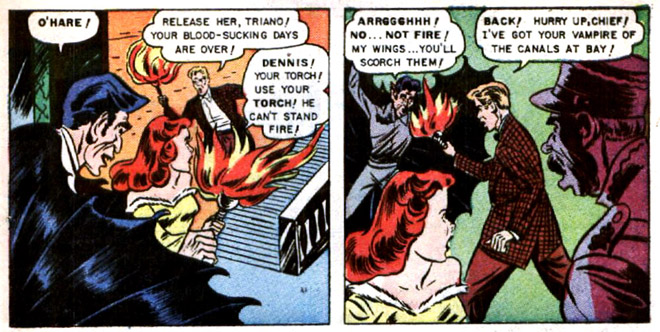
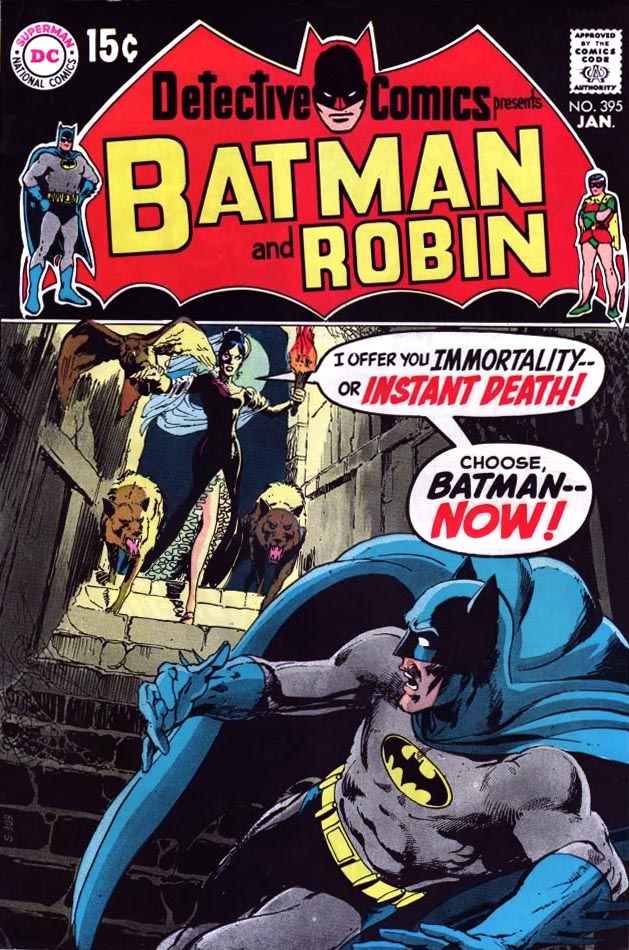
Yet that section of the book also included the highly regarded “Secret of the Waiting Graves,” by Dennis O’Neil and Neal Adams; “Man or Bat?” introducing Man-Bat, by Frank Robbins and Adams; and “The Demon of Gothos Mansion,” by O’Neil and Irv Novick. Those are all Gothic tales of monsters, ghosts, and other spooky things. Though Man-Bat is a creation of science gone wrong, the other two tales clearly rest on the supernatural.

Which left little me confused. If the Batman comics had redeemed themselves from camp by returning him to his roots as a crime-solving detective, why was this volume showing me ghost stories? Mysteries are all about ratiocination, but the “Waiting Graves” and “Gothos Mansion” stories end with Batman realizing the limits of his deductive powers to make sense of the world.

I’ve since learned that Batman’s roots lie just as deep in Gothic horror as in detective stories. Bruce Wayne is dressed as a giant bat, after all. Among the character’s earliest adventures were fights against vampires, monsters, and other supernatural creatures. Those villains flourished again in the 1970s, and in 1982 Gerry Conway even brought the vampirical Monk and Dala from 1939 back to life. But I still prefer the detective stories.

25 July 2012

G. P. Taylor, Vampire Hunter

A posting at Bookshelves of Doom made me look again at the intellectual peregrinations of G. P. Taylor. In 2005 he told the BBC about how concerns about children being attracted to the occult prompted him to write and publish Shadowmancer for children:

“If it wasn’t true that books like Harry Potter, Philip Pullman’s work, Buffy the Vampire Slayer weren’t leading children to the occult, why did the Pagan federation appoint a youth officer to deal with all the inquires from children who wanted to become witches? . . . look in the Buffy books or in some other witch books out at the moment and some of it is genuine stuff…”
For his British audience Taylor rejected the idea that he wrote “to promote the Christian agenda.” However, in 2007 he offered the American public an open letter that claimed:
The reason why I wrote the book and all the others in the series was because of one man and the damage that his books were likely to do to the Christian Church.
I dissected the discrepancies in that letter back here.

Already, however, Stephenie Meyer’s Twilight series was becoming a huge hit, with the Breaking Dawn volume winning a 2008 British Book Award. So what did Taylor do? As he just told the BBC:
“I was going to a lot of schools, I was seeing what kids were writing, and I just thought this is what children want to read,” he said. “So I wrote a book about vampires which was very dark and scary and realistic…”
So much for worries about Buffy! Within a span of ten months in 2010-11 Taylor published three volumes of the Vampyre Labyrinth series.

In October 2010, in the midst of his marketing campaign, Taylor told the Yorkshire Post that he was “having to keep the details of a nationwide school tour secret, for fear of lobbying from Evangelical Christians”:
“I am about to embark on a school tour and talk to 20,000 children. . . . I am concerned that there is a real threat that some people may start lobbying bookshops and schools to stop children buying the book. . . . The book has recently earned the title ‘the most terrifying children’s book ever written’. Many people are saying that it is far too frightening and that children should be warned before opening the pages.”
In fact, a search for the phrase “most terrifying children’s book ever written” doesn’t produce a single Google hit independent of this article. But that complaint about “a real threat” from religious zealots gained Taylor a little press in the UK. (He had made similar claims of “an insidious hate campaign” four years before, except then the undocumented threat was supposedly from anti-religious zealots.)

A year and a half later, and the latest voice to join the chorus against the Vampyre Labyrinth books is—oh, come on, you saw this coming!—G. P. Taylor. In his recent BBC conversation he declared:
“I wrote the Vampyre Labyrinth, it came out, I hadn’t really read it when I wrote the book, and people who were reading it and reviewing it were saying this is the most frightening thing that has ever been written for kids,” said Taylor. ”I have changed my mind: I think children’s literature has gone too far.”
So G. P. Taylor has now come out against a book that he himself wrote. But didn’t really read. Because it went too far. Or so he’s been told. And he’s happy to use the radio to proclaim his own book as “the most frightening thing that has ever been written for kids.” While also positioning himself as a proponent of traditional values.

16 July 2012

Avoiding Research as a Spur for Creativity

I doubt I’ll get to horror author Glen Duncan’s novels soon, but I enjoyed John Williams’s interview with him for the New York Times:
Did commercial considerations play a prominent role in these books?

Yes. I wasn’t making enough money. My original plan was to write a Victorian serial killer novel, “Oliver Twist” meets “The Silence of the Lambs” (which someone reading this will now write and clean up with), but the research was a drag. Nineteenth-century English literature I know; 19th-century sewage systems not so much.

Then, on New Year’s Eve 2009, a friend asked me what I was “hoping to achieve” in the next 12 months. Resisting the urge to break a bottle over his head, I said — for no reason I can now remember — that I was going to write a novel about the last surviving werewolf. Agreement that this was a good idea was slurred but unanimous. Moreover, it still seemed a good idea when I woke up the next morning.
In my workshop at the SCBWI New England conference last spring, I asked the attendees, “How do you kill a vampire?” After we accumulated a bunch of replies, I gave my answer: “Since vampires aren’t real, you can kill them any way you want.”

Of course, you have to acknowledge your readers’ expectations in some way and establish the rules of your vampire early in the story.

Williams’s continued curiosity about research led Duncan to talk about how he put that rule (or lack of a hard rule) into practice:
What kind of research did you do for these novels? How did you balance loyalty to the details of the vampire and werewolf myths with making them your own?

No research at all. The balance was determined partly according to taste (death by silver is cool; I was definitely keeping that) and partly according to thematic utility. Some versions of the myth allow for voluntary [werewolf] metamorphosis, but that doesn’t present the same dilemma of conscience. The lunar enslavement forces a choice between murder and death — a much richer moral quandary.
As long as the choices serve the story, an author can get away with nearly anything.

12 July 2012

Another Hellbound II Review

At High-Low, Rob Clough had some nice things to say about my contribution to Hellbound II:
JL Bell and Andy Wong's "RobMeBlind.com" takes a clever idea (a website that compiles facebook and twitter statuses indicating that someone is going out of town so that people can rob them) and gives it a horror twist. The initial idea is interesting enough on its own to follow through on, even as the reader knows that the robbers will not meet a kind end.
Hough also praises Caitlin Plovnick’s “Eye Contact,” Joshua D. Hoaglund’s “Mt. Auburn Night,” Ansis Purins’s “Slappy,” and (Ms.) Gabriel Robinson’s “The Red Calf,” plus the art in Patrick Flaherty and E.J. Barnes’s “The Plague” and Clayton McCormack’s “The Breath of Life.”

24 May 2012

More Creeped-Out Hellbound II Reviews

More Hellbound II reviews, starting with Roz Young at Sequential Tart:
As a fan of the horror genre, I am impressed by the passion of the group to create and compile such a wonderful set of frighteningly fiendish stories. Hellbound 2 is a wonderful homage to things that go bump in the night, and our affection for what terrifies us the most. . . .

For anyone interested in the art and crafting of horror tales, this is a terrific collection. I’m particularly a fan of "Eye Contact" and "Dolly," because I am totally creeped out by both eyeballs and dolls. Demon lovers will enjoy "Necrocomicon" and "Eugene," and the smiles of "robmeblind.com" gave me a serious case of the heebie jeebies.
Those smiles are the creation of artist Andy Wong. My script for “RobMeBlind.com” suggested S&M devotees. Andy saw that and raised with what he called “flesh mummies.”

The next review from Brigid Alverson at Robot 6:
The craftsmanship in this volume is impressive, especially given that none of the creators are full-time cartoonists. John Hilliard’s “Eugene” is the story of a hairy, vampire-like monster stalking innocent victims, but the cheerful storytelling style makes it seem charming–right up until the surprise ending. Joshua D. Hoagland’s “Mt. Auburn Night,” set in the Cambridge cemetery, is a beautiful romp of skeletons and gravestone statuary, drawn with strong blacks and white in a style reminiscent of Aubrey Beardsley. Both are wordless stories (well, “Eugene” has one word balloon) that use strong visuals and creative panel layouts to pull the reader in and tell the story. I have to mention “Robmeblind.com,” written by my MoCCA travel companion J.L. Bell and drawn by Andy Wong, a clever story about burglars who use the web to scout out potential victims.
Thanks, Brigid!

Hellbound II is on sale at some Boston-area comics shops and from Ninth Art Press.

22 May 2012

Darkside Is Coming, Now Nothing Is Real

The Morton Report recently featured Bill Baker’s online conversation with artist Tommy Castillo about a book called The Art of The Darkside of Oz. The second capitalized T in that title is the tip-off that this book is a teaser for Castillo’s comics series called The Darkside of Oz.

Most of the drawings shown with the interview have appeared on Castillo’s earlier collections and website, so I’m not completely sure how they represent the ultimate product. Baker writes of Castillo’s plans:
…if the images and ideas he’s slowly begun to reveal are any indication, we’re about to see Dorothy, the Scarecrow, the cowardly Lion and the Tin Man in a whole new twilight.
And Castillo says, among other things:
How do you tell an epic tale of woe and love, desire and greed, wars and betrayals? How do you tell of revenge and have all of it wrapped up in the idea of redemption? And how can you do this all with the highest amount of respect for the creator of Oz, Frank Baum?
To be frank, I’m not impressed with the respect for Baum displayed so far. It’s details like:
  • Misspelling Glinda’s name as “Glenda.”
  • Using the MGM movie (still protected by copyright and trademark) as the basis of plot comments instead of Baum’s books (in the public domain).
  • Promising not to render Dorothy as “some scantily clad teen with giant boobs,” but dressing her in a very short skirt.
Furthermore, the notion that “everything we knew about our beloved Oz was a lie” isn’t that new, especially in comics form. After The Oz Squad, Dark Oz, Woe Is Oz, and so on, it’s no surprise to see Dorothy and her companions panelized in grim and gritty ways. It looks like Castillo will show us another Tin Woodman as a robot with a giant axe, another Scarecrow with a sinister slant to his eyes, another Lion as an anthropomorphic warrior, and so on.

Of course, Castillo could still create a compelling, eye-opening story out of those elements. Gregory Maguire certainly did with Wicked. But it would require knowing Baum’s work deeply, and intervening reinventions as well. Deciding to take a myth in the exact opposite direction may seem revolutionary, but it doesn’t really take as much imagination as digging deeper, or going off at an angle.

21 April 2012

Another Hellbound II Review

I’ll shortly start my workshop at the SCBWI New England conference, but I’m logging in to quote my favorite part of Emi Gennis’s review of Hellbound II:
While some of the pieces in this anthology are eerie and ominous tales, others were a bit more lighthearted and silly. Logan Faerbers “Grampire,” comes to mind… a story about what you may have already surmised – a very old vampire! JL Bell and Andy Wong‘s “RobMeBlind.com” also stood out as one of the more humorous pieces. Funny and creative from the set up all the way through to the ending, this story takes a more tongue-in-cheek approach to the horror theme and is well complimented by a cartoony, and maybe even cute (although perhaps that’s not the right word in the context of this subject matter) visual style.
The review offers praise and thoughts on other stories in the anthology, plus sample illustrations. Here’s Steve Cartisano’s interview with me and Andy about the story and horror in general. (Neither of us really like it. Maybe that’s why we tried to be funny.)

19 April 2012

(Not) At the Boston Comic-Con This Weekend

Because I’ll speak at the SCBWI New England conference this weekend, and don’t have the option of an alternate life, I won’t be at the Boston Comic-Con. Physically, that is.

In spirit, I’ll be represented by two publications. First, the Boston Comics Roundtable has issued Hellbound II, its anthology of horror comics, as a handy paperback. Heretofore the collection was available only in an “art edition,” with handmade paper covers and box. The new paperback has all the chills of the first state at a fraction of the price.

Among the stories in Hellbound II is “RobMeBlind.com,” by me and Andy Wong. Formally I’m the scripter and Andy’s the artist, but this was a true collaboration. The inspiration was an anecdote that Andy told at a roundtable meeting. I went home and wrote a script spinning off that. Andy drew my script, turning four pages into five. I suggested ways to clarify the word balloons and darken the art, and Andy inserted what worked for him. (And finally I used my leverage as the book’s proofreader to push for the last page to be hidden by a page turn.)

Jen Vaughn at the Center for Cartoon Studies’ Schulz Library just reviewed the collection, and I’ll quote my favorite passage:
Often the failing of a horror anthology is that you you read WITH the intention of being scared and thus, thumb through the pages bravely. A well-written comic is not necessarily terrifying until at night, it twists itself in the dark of your room, and you can suddenly recall images.

A particular story that follows that logic is RobMeBlind.com, which is about thieves who utilize location-based smart phone apps to figure out when people are gone from their homes. The clever crafting by J.L. Bell and Andy Wong left me awake blinking at my ceiling (possibly at the easy ability people have of giving away information for temporary celebrity). And the dark woodcut panels of E.J. Barnes in Patrick Flaherty’s story The Plague exemplify a great use of comics to set the mood for the story. Hellbound 2 is perfect for the horror fan or lover of hand-made objects, especially if those objects are a skin suit made from their victims.
Also at Boston Comic-Con, Jesse Lonergan will be offering a samizdat collection of images of robots from Boston Comics Roundtable members and other friends. I sent him a sketch of a robot singing, “R. U. R. or R. U. Ain’t My Baby?” Cartooning is outside my comfort zone, but how often will I have the chance to honor Karel Capek and Louis Jordan in one image?

18 March 2012

The Mysteries of I, Werewolf

After DC Comics introduced Tim Drake as the next Robin in late 1989, he became popular quite quickly. Of course, he had the good fortune of being introduced just as Tim Burton’s first Batman movie gave the Caped Crusader and superhero comics in general a huge boost in sales.

In 1992, DC tried a miniseries showing Tim as he became a full-time costumed hero. That was the first comic book to be titled Robin. It sold so well the company did another short series, and a third, all within two years.

Those miniseries got caught up in the speculative overproduction of the early 1990s. Robin II’s battle with Anarky and the Joker had only four issues but fourteen different covers, some including holograms. Copies of the Robin/Huntress team-up are still available in sealed polybags for very little money.

But those magazines sold just fine at the time, even though a relatively scrawny adolescent determined to use non-lethal methods was the antithesis of the overly muscled, overly armed, ruthless title characters of the day.

One measure of Robin’s popularity was how projects were massaged to sell under that brand name. One example of this was Robin in I, Werewolf, a short prose novel for young readers that DC published through Little, Brown in 1992. (It probably wasn’t coincidence that Little, Brown’s parent corporation, Time, Inc., had merged with DC Comics’s parent, Warner Communications, in 1989.)

The author of I, Werewolf was Ed Gorman, who also contributed short stories to DC’s Further Adventures of Batman mass-market paperbacks published with Bantam to coincide with the Burton movies. The 64-page book about Robin doesn’t show up on every list of Gorman’s prodigious writing, but Fantastic Fiction caught it. While Gorman’s blog remains active, his website has been taken over by flimflam artists, so there’s no endorsed title list there.

I, Werewolf had spot illustrations by Angelo Torres, who did a lot of work for MAD magazine. Paul Kupperburg (another Further Adventures contributor) has explained:
The secret is, these books used to be edited by the department overseen by the late, great Joe Orlando, an original EC Comics and MAD contributor for whom many great talents did some really strange commercial jobs.
I suspect that Gorman wrote I, Werewolf before the character of Tim Drake was established. And I’m not the only one to think so. A commenter at iFanboy said: “It seemed like they had already written the book and then just inserted Robin in at the end. Like Find > Replace.”

It’s not that Tim Drake acts contrary to his usual character in the book. He’s got the same hard-working, self-sacrificing, and slightly anxious personality as in the comics. But the text refers only to “Robin,” and nothing in the novel is particular to Tim: having a father to worry about, being a tech nerd, and so on. If Torres hadn’t used the character design for Tim Drake, we wouldn’t connect this Robin of this novel to Tim (and even there, Kupperburg complains that this Robin looks like he’s in his early twenties).

Furthermore, the book starts off with “Fifteen-year-old Tim Dayton,” who becomes the victim Robin protects. That name would have been found-and-replaced immediately if book’s editors had been concerned about making Tim Drake stand out. But all they were concerned about, I suspect, was getting the name and character of Robin on the cover.

I wish I knew more about the genesis of I, Werewolf. Was it a story about Dick Grayson or Jason Todd, held until the market and corporate partnerships lined up right? Was it commissioned when DC was still unsure on details of the new Robin? Was it planned to coincide with Batman Returns, which at one point was going to include a Robin who was neither Dick Grayson nor Tim Drake? Or did the editors figure that the kids this book was meant for wouldn’t care which Robin it was?

18 February 2012

Apparently It’s Art

The New England Journal of Aesthetic Research has listed the art edition of Hellbound 2, a horror-comics anthology produced by Riverbird Studios for the Boston Comics Roundtable, as a nominee for its 2011 New England Art Award in the Book category.

A story that Andy Wong and I created, “RobMeBlind.com,” is in that collection, along with many other originals from local artists and writers.

Voting is open until 24 Feb 2012. I’m just saying.

I must admit, however, that I’m even more excited to see the journal’s page on Worst Public Art in New England, and particularly that the godawful Irish Famine Memorial near Old South is at the top of that list.

09 November 2011

Finding Inspiration for Hellbound II

Hellbound II is an anthology of independent horror comics being published by the Boston Comics Roundtable. It’s currently available in a “Limited Art Edition,” and later will appear as a conventional paperback. The deluxe version consists of two softcover volumes in a box, both covers and the box itself made from handmade paper with silkscreened cover art by Jesse Lonergan.

Andy Wong and I created a story in Hellbound II titled “RobMeBlind.com.” Here’s a bit from a joint interview by Steve Cartisano, one of a series with Hellbound II creators:
John, what inspired you to write this story?

At a BCR meeting, Andy Wong was chatting with a small group—Lindsay Moore, Carl Tsui, and me—about a website called StealMyStuff.com. That’s a real website which works a lot like the one in our story, connecting people’s Facebook updates about going out of town with their street addresses as a warning to manage your privacy settings. I joked about how that could lead to something worse. That evening I typed out a first draft of the script to send back to the little group. Andy said he wanted to draw it, which struck me as right and proper because he’d served the ball to begin with.

Andy, is that what drew you to this story?

I enjoyed the fact it spouted from a conversation I had with John. I wanted to try my hand at the horror genre, since I usually draw silly slice of life comedies. There was also this growing hunger to draw some crazy monster designs.
It looks like StealMyStuff.com is no longer active, but you can get the same idea from ICanStalkU.com. Or this New York Times article about the personal information embedded in some digital snapshots. Isn’t it wonderful how the modern world offers opportunities for chills that previous generations never knew?

21 September 2011

Working for Minimum Paige

Tomorrow the Harvard Book Store celebrates the publication of Minimum Paige, its first anthology of comics from around Massachusetts and the country.

Four of those pages are a horror story that I scripted and Alex Cormack drew and lettered, called “The Essex County Literary Wax Museum & Menagerie.”

Alex is also preparing that short story as a mini-comic to sell at the Massachusetts Independent Comics Exposition this weekend. He’s designing a cover, making copies, stapling—this is called “independent comics publishing.” (I offered to pay half the costs and haven’t done any of the physical work. This is called “the traditional publishing model” from the publisher’s perspective.)

28 July 2011

Something Wicked This Way Comes

The Boston Comics Roundtable publishes three comics anthologies: Outbound, featuring science fiction; Inbound, covering everything else on a given theme, such as local history or food; and Hellbound, devoted to horror.

I read hardly any horror, and I write just a little more. Nevertheless, the 2011 issue of Hellbound will contain a comics story I created with artist Andy Wong, called “RobMeBlind.com.”

More info to come around (naturally) Hallowe’en.