Showing posts with label BOOK Road to Oz. Show all posts

14 November 2023

“In the Land of Oz they use no money at all”

In The Road to Oz (1909), L. Frank Baum wrote:
“Money! Money in Oz!” cried the Tin Woodman. “What a queer idea! Did you suppose we are so vulgar as to use money here?” . . .

“If we used money to buy things with, instead of love and kindness and the desire to please one another, then we should be no better than the rest of the world,” declared the Tin Woodman. “Fortunately money is not known in the Land of Oz at all. We have no rich, and no poor; for what one wishes the others all try to give him, in order to make him happy, and no one in all Oz cares to have more than he can use.”
That contradicts this detail in The Wonderful Wizard of Oz (1900):
…a man was selling green lemonade, and when the children bought it Dorothy could see that they paid for it with green pennies.
And also The Marvelous Land of Oz (1904), in which a ferryman asks for money before rowing Tip across a river, the Emerald City and the Winkie castle have treasuries, and all the characters recognize “dollar bills—and two-dollar bills—and five-dollar bills—and tens, and twenties, and fifties.”

Apparently something happened after Ozma came to the throne of Oz at the end of the latter book, producing an entirely different economic system that Baum explained more fully in The Emerald City of Oz (1910).

However, I was surprised to see that the very first mention of Oz doing without money actually appeared outside the series, and outside the canon. The Woggle-Bug Book, a storybook Baum wrote in 1905, contains this paragraph:
You see, in the Land of Oz they use no money at all, so that when the Woggle-Bug arrived in America he did not possess a single penny. And no one had presented him with any money since.
That book doesn’t offer any ethical lesson to go along with the lack of money, as the Tin Woodman would volunteer in The Road to Oz. It’s just another way that the Woggle-Bug’s native land differs from America.

While featuring a character from Oz, The Woggle-Bug Book is set in America, where we use money. It’s one of what I call Baum’s urban fantasies, taking place in a contemporary, multiethnic American city which nonetheless has magic (in that way contradicting the rules of the Oz books he wrote in the same period).

The Woggle-Bug Book and the Queer Visitors from the Marvelous Land of Oz comic page that preceded it were never listed as part of the Oz series, and Baum never referred back to them in his later stories. Thus, fans don’t treat whatever those books say about Oz as reliable for the rest of the series. Nonetheless, in that book Baum first tried out what would become a crucial detail of the Ozian utopia.

19 March 2013

Inspiration Bubbling Up

Even with the relatively awkward special effects of 1939, Glinda’s pink bubble in The Wizard of Oz is an American icon. So much so that the Wicked stage show reproduced that entrance.
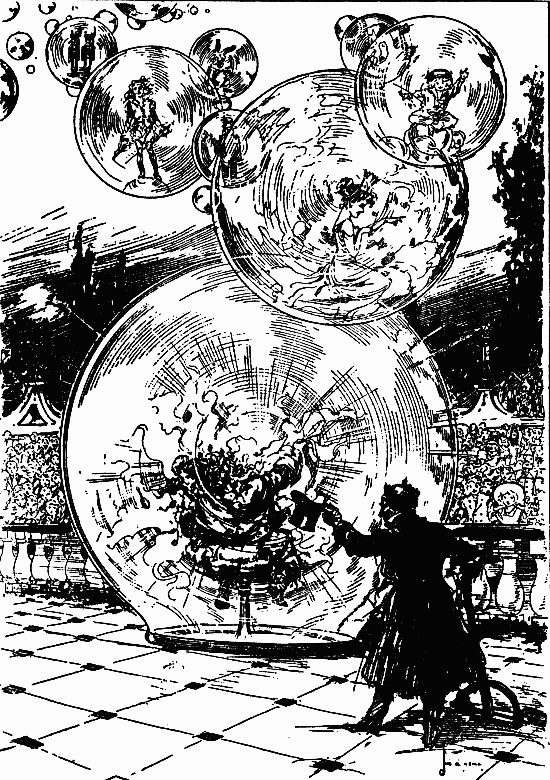
The new Oz the Great and Powerful movie is not supposed to infringe on the 1939 film’s copyright, however. Fortunately for its makers, L. Frank Baum and John R. Neill portrayed travel in giant bubbles at the end of The Road to Oz. (Curiously, it’s one of the few adventures Dorothy turns down.)
With that book in the public domain, Sam Raimi and company could show people in bubbles, and even make them Glinda’s thing, as long as they weren’t perfectly round and pink. In fact, with CGI animation they could show the Wizard’s weight bending his bubble out of its spherical shape. But there’s really no doubt those bubbles are supposed to evoke the 1939 movie, not Baum’s lesser-known 1909 sequel.
For the next couple of days I’ll discuss the sources of Oz the Great and Powerful—the official sources and the real ones.

25 December 2012

Who Brings Dad His Neckties and Stockings?

The last act of The Road to Oz is basically cross-marketing, with L. Frank Baum bringing in characters from most of the other fantasies he’d published in recent years as guests at Ozma’s birthday party.

Among those titles was The Life and Adventures of Santa Claus, whose title character makes a grand entrance, as I’ve quoted before:
“The most Mighty and Loyal Friend of Children, His Supreme Highness—Santa Claus!” said the Chamberlain, in an awed voice.

“Well, well, well! Glad to see you—glad to meet you all!” cried Santa Claus, briskly, as he trotted up the long room.

He was round as an apple, with a fresh rosy face, laughing eyes, and a bushy beard as white as snow. A red cloak trimmed with beautiful ermine hung from his shoulders and upon his back was a basket filled with pretty presents for the Princess Ozma.

“Hello, Dorothy; still having adventures?” he asked in his jolly way, as he took the girl’s hand in both his own.

“How did you know my name, Santa?” she replied, feeling more shy in the presence of this immortal saint than she ever had before in her young life.

“Why, don’t I see you every Christmas Eve, when you’re asleep?” he rejoined, pinching her blushing cheek.

“Oh, do you?”

“And here’s Button-Bright, I declare!” cried Santa Claus, holding up the boy to kiss him. “What a long way from home you are; dear me!”

“Do you know Button-Bright, too?” questioned Dorothy, eagerly.

“Indeed I do. I’ve visited his home several Christmas Eves.”

“And do you know his father?” asked the girl.

“Certainly, my dear. Who else do you suppose brings him his Christmas neckties and stockings?” with a sly wink at the Wizard.

“Then where does he live? We’re just crazy to know, ’cause Button-Bright’s lost,” she said.

Santa laughed and laid his finger aside of his nose as if thinking what to reply. He leaned over and whispered something in the Wizard’s ear, at which the Wizard smiled and nodded as if he understood.
Santa displays his magical power in two ways:

  • by awing not only Ozma’s chamberlain but Dorothy Gale herself. She hasn’t acted “shy” or “meek” since her first meeting with the Wizard.
  • by knowing where Button-Bright lives—something I’m not sure even Baum had settled on by that time.

On the other hand, even Santa’s power has limits: he can’t think of any better presents for Button-Bright’s dad than neckties and stockings. Dads can be like that.

06 November 2012

Shanower on the State of Kids’ Comics, In and Out of Oz

Back in September, Newsarama interviewed comics creator Eric Shanower about the embarkation of the Marvel comics adaptation of The Road to Oz, which he scripted and Skottie Young drew.

Eric had this to say about the field of comics for younger readers:
There are great children’s comics out there. But there are a ton more that just aren’t in print and I’m sure there would be more reprints and more new stuff if the market were different. But there aren’t many places that children generally see comic books and graphic novels, so those things aren’t on most children’s radar. Children don’t have the spending power of adults, so why should any publisher market to children, why should any distributor figure out how to get product to children? This situation is exemplified by the fact that Disney comics haven’t sold in any major numbers since the 1970s. How crazy is that? Disney comics, simply through name recognition, ought to be top sellers. . . . But I don’t think most kids go into comics stores or even care about comics.

It’s merely anecdotal evidence, but time and time again adult readers of the Marvel Oz comics tell me that their kids love them. But the kids know about them because a parent discovered them first. I can only remember meeting one child who found the Marvel Oz comics on his own — and that was because he was an Oz fan first. As I said, anecdotal evidence, and centered on one project, but I think it’s a valid representation of the broader comics culture.
In this conversation Eric seems to be speaking of magazines and books from comics publishers, as opposed to extremely similar books in graphic form sold by mainstream book publishers. The latter seem to be reaching kids better than ever through bookstores and libraries.

Around the time I read this interview, Prof. Jay Hosler told me that he and his sons are enjoying the Oz comics a lot. But of course he’s the creator of the wonderful Clan Apis graphic novel about honeybees, so he was already visiting the comics stores.

Elsewhere in the interview Eric mentioned that the Road to Oz adaptation will be shorter than its predecessors: “Marvel has started cutting our page count and issue count, so it’s becoming a challenge to fit everything in.” That book doesn’t have much of a plot, but it has a lot of incident. The next volume in the series, The Emerald City of Oz, is quite episodic and therefore possibly flexible.

But I really hope sales for those volumes stay high because L. Frank Baum’s next Oz book, The Patchwork Girl of Oz, was his longest, one of his most full, and one of his best. It would be much harder to boil that one down, and the results would be disappointing.

11 September 2012

Little Ragdoll

This is one of the variant covers for Marvel’s The Road to Oz, #1, by Eric Shanower, Skottie Young, and colorist Jean-François Beaulieu, adapted from the story by L. Frank Baum.

Somebody’s clearly looking ahead two whole books to The Patchwork Girl of Oz. Indeed, in this interview at Comic Book Resources, Young mentioned Marvel’s head of sales, David Gabriel: “He’s dying to see me draw the Patchwork Girl, so I’d like to make it that far so he can see that happen.”

If sales hold up, this won’t be the only scrap of that book we’ll see.

21 August 2012

Ozma, the Birthday Girl

Though L. Frank Baum probably never intended to convey this information, today is the birthday of Ozma, fairy queen of Oz. Some passages in The Road to Oz mention that her birthday is on the 21st of the month. Another passage says that the month is August. So there we go.

One of Baum’s longest descriptions of Ozma comes in The Magic of Oz, his penultimate novel:
Ozma, the beautiful girl Ruler of the Fairyland of Oz, was a real fairy, and so sweet and gentle in caring for her people that she was greatly beloved by them all. She lived in the most magnificent palace in the most magnificent city in the world, but that did not prevent her from being the friend of the most humble person in her dominions. She would mount her Wooden Sawhorse, and ride out to a farm house and sit in the kitchen to talk with the good wife of the farmer while she did her family baking; or she would play with the children and give them rides on her famous wooden steed; or she would stop in a forest to speak to a charcoal burner and ask if he was happy or desired anything to make him more content; or she would teach young girls how to sew and plan pretty dresses, or enter the shops where the jewelers and craftsmen were busy and watch them at their work, giving to each and all a cheering word or sunny smile.

And then Ozma would sit in her jeweled throne, with her chosen courtiers all about her, and listen patiently to any complaint brought to her by her subjects, striving to accord equal justice to all. Knowing she was fair in her decisions, the Oz people never murmured at her judgments, but agreed, if Ozma decided against them, she was right and they wrong.

When Dorothy and Trot and Betsy Bobbin and Ozma were together, one would think they were all about of an age, and the fairy Ruler no older and no more “grown up” than the other three. She would laugh and romp with them in regular girlish fashion, yet there was an air of quiet dignity about Ozma, even in her merriest moods, that, in a manner, distinguished her from the others. The three girls loved her devotedly, but they were never able to quite forget that Ozma was the Royal Ruler of the wonderful Fairyland of Oz, and by birth belonged to a powerful race.
Ozma is clearly devoted first to her ideals and second to the protection and rule of her country. I think those priorities present a challenge for people who want to write adventures for her. Ozma leaves her capital for extended periods in order to carry out what she sees as important duties (e.g., Glinda of Oz, The Magical Mimics of Oz), she can be kidnapped (e.g., The Lost Princess of Oz, Grampa in Oz, Kabumpo in Oz, The Hungry Tiger of Oz), and she can even suffer amnesia about her duties (e.g., The Forbidden Fountain of Oz). But I don’t see it as in her character to “go off on an adventure” the way Dorothy does. She’s got things to do.

05 June 2012

Oz Museum and Opera in the Works

This Boston Globe interview with illustrator Bob Staake alerted me to work on an opera based on L. Frank Baum’s The Road to Oz. Googling brought me to the website for the National Oz Museum, a project of Oz collector supreme Willard Carroll.

About the opera, the website says:

Together with the prestigious performing-arts organization Bay Chamber Concerts, the Museum is developing a live multi-media musical based on Baum’s book “The Road to Oz.” The production is being written and will be directed by Willard Carroll, with sets and costumes designed by acclaimed author and illustrator Bob Staake. The concept is to create a one-hour, one-act musical work based on L. Frank Baum’s fifth Oz book.

The approach to the music is not envisioned in a conventional operatic or musical-theater/show-tune way, but to find a unique slant from which to tell the story through character and music. Baum’s characters in this book – Shaggy Man, Polychrome, Button Bright the Rainbow’s Daughter [whoops—Button-Bright seems to have gone missing from his proper place in that sentence], etc. – each offer up imaginative starting points for songs to tie together the story; a story about loss, love, reconnection, hope - and joy deferred and joy attained.
Those are indeed some of the themes of The Road to Oz. The book’s main weakness is its story, both thin and cut short. Yet it’s also immensely pleasing, and that simplicity might benefit adaptations into elevated media. A few years back, for instance, I saw Eric Shanower’s adaptation of the basic tale as an amateur ballet, cut down to focus on the Shaggy Man’s transformation, and it worked.

As for the museum, Carroll’s collection seems still to be mostly in boxes after his move across the country, but this spring students at the Rhode Island School of Design worked on designs for the institution.

24 January 2012

Developing the Deadly Desert

The new issue of The Baum Bugle, the International Wizard of Oz Club’s main journal, includes two articles about the Deadly Desert that surrounds and protects Oz.

The desert wasn’t deadly at first; like a lot of details about Oz, L. Frank Baum developed the desert gradually as ideas and plot points occurred to him. In The Wonderful Wizard of Oz, a sandy waste cuts Oz off from the rest of the world, particularly that odd place (the Midwest) where the Wizard and Dorothy came from.

In The Marvelous Land of Oz, the Scarecrow, the Tin Woodman, and their companions fly over that desert out of Oz, where they find a country that apparently uses paper money denominated in dollars. As Michael O. Riley pointed out in Oz and Beyond, Baum’s first two books implied that Oz was nestled somewhere in arid southwestern North America.

But then in Ozma of Oz, Baum had Dorothy travel to Oz by starting in the Pacific Ocean, landing in a fairyland called Ev, and finally crossing the desert on an unrolling carpet. So the countries beyond the desert from Oz are definitely not America. In fact, they seem far from America. Furthermore, while the previous book showed characters standing on the desert, this one implied that doing so would be harmful, or at least unpleasant.

A couple of books later, Baum introduced the alliterative phrase “Deadly Desert.” He quoted this sign erected in front of it:
ALL PERSONS ARE WARNED NOT
TO VENTURE UPON THIS DESERT

For the Deadly Sands will Turn Any Living Flesh
to Dust in an instant. Beyond This Barrier is the

LAND OF OZ

But no one can Reach that Beautiful Country
because of these Destroying Sands

Curiously, that signs stands in an inhospitable, unpopulated spot, so we have to assume that either (a) it was placed there for the benefit of Dorothy and her companions at that moment, or (b) there are a lot more signs elsewhere along the edge of the sand.

Thereafter, the Deadly Desert is always said to be deadly, even when characters like the Wise Donkey manage inexplicably to cross it. In Baum’s penultimate book, The Magic of Oz, it even gives off nauseating fumes that force birds to fly at high altitudes.

And yet, for all the desert’s deadliness, in the entire Oz series no one ever dies on it.

TOMORROW: Tossing out a theory.

24 September 2009

“I naturally thought of Oz”

There may even be a rule that the closer American children’s books come to Kansas, the more they have to allude to The Wonderful Wizard of Oz and/or its sequels. Case in point: Matt Phelan’s graphic novel The Storm in the Barn, set in Kansas in 1937.

Phelan wasn’t a childhood Oz fan. He told the comics website Newsarama, “I didn’t actually read the first Oz book until I took a college class on children’s literature. I was surprised about how truly weird it is.” But once he decided to tell a story inspired by Donald Worster’s Dust Bowl, Phelan felt a need to bring in the Oz books:

Since the story is set in Kansas, I naturally thought of Oz, so I named his sister Dorothy. I thought that a girl named Dorothy who lived in Kansas at that time would naturally be interested in the Oz stories, so having her read the books seemed natural.
That quotation comes from Kelly R. Fineman’s conversation with Phelan, and she went on to write:
Whereupon I praised Matt’s knowledge of the Oz stories and confessed that I’d only read two, maybe three of the books as a kid, and Matt confessed that he’d pretty much done the same, but that plot summaries on Wikipedia drew his attention to Ozma of Oz because of its reference to a desert.

Initially, Matt read the book “just to read it”, but the references to the Deadly Desert turned out to be perfect for incorporation into The Storm in the Barn, which is set in Dust-Bowl Kansas where it hasn’t rained for years. Add to that the benefit of the Oz books being subject to fair use, and text from Ozma found its way into Jack’s story as well. Says Matt, “I just lucked out that it worked.”
(Actually, all books are subject to fair use, even when they’re under copyright. L. Frank Baum’s Oz books are in the public domain, and thus subject to any use, even “unfair.” Not that this use is unfair. It’s quite a nice use indeed.)

Ironically, the “references to the Deadly Desert” in the Wikipedia article and in The Storm in the Barn itself (Jack’s mother looks at the book and uses the phrase) don’t actually come from Ozma of Oz. That 1907 book refers to “the deadly, life-destroying sands of the desert” around Oz. The phrase “Deadly Desert” appears first in The Road to Oz (1909). The author David Alvin composed Wikipedia’s entry on Ozma of Oz using facts established in subsequent books.

21 August 2009

The Twenty-First of This Month

Today is the birthday of Princess Ozma, ruler of Oz after the events of The Marvelous Land of Oz, the second book in the series.

L. Frank Baum almost certainly never intended people to know that Ozma had a birthday on 21 August. Throughout The Road to Oz, published one hundred years ago, characters refer only to the party planned for “the twenty-first of this month." But earlier in the book Dorothy mentions that it's August, and Oz fans put the two statements together. (Baum later used Ozma's birthday to motivate two of the three plotlines in The Magic of Oz, but never mentioned the date in that book.)

The lovely modern drawing above, titled "Ozma the Great," was posted by ~cilyconcar on deviantART.

10 July 2009

Dorothy Meets Her Match

From L. Frank Baum's The Road to Oz, the focus of the Winkie Convention that starts today in California. While on a hike that will eventually take her to Oz, Dorothy meets a younger child.

In the shade sat a little boy dressed in sailor clothes, who was digging a hole in the earth with a bit of wood. He must have been digging some time, because the hole was already big enough to drop a football into.

Dorothy and Toto and the shaggy man came to a halt before the little boy, who kept on digging in a sober and persistent fashion.

"Who are you?" asked the girl.

He looked up at her calmly. His face was round and chubby and his eyes were big, blue and earnest.

"I'm Button-Bright," said he.

"But what's your real name?" she inquired.

"Button-Bright."

"That isn't a really-truly name!" she exclaimed.

"Isn't it?" he asked, still digging.

"'Course not. It's just a--a thing to call you by. You must have a name."

"Must I?"

"To be sure. What does your mama call you?"

He paused in his digging and tried to think.

"Papa always said I was bright as a button; so mama always called me Button-Bright," he said.

"What is your papa's name?"

"Just Papa."

"What else?"

"Don't know."

"Never mind," said the shaggy man, smiling. "We'll call the boy Button-Bright, as his mama does. That name is as good as any, and better than some."

Dorothy watched the boy dig. . . . "What are you going to do?" she inquired.

"Dig," said he.

"But you can't dig forever; and what are you going to do then?" she persisted.

"Don't know," said the boy.

"But you must know something," declared Dorothy, getting provoked.

"Must I?" he asked, looking up in surprise.

"Of course you must."

"What must I know?"

"What's going to become of you, for one thing," she answered.

"Do you know what's going to become of me?" he asked.

"Not--not 'zactly," she admitted.

"Do you know what's going to become of you?" he continued, earnestly.

"I can't say I do," replied Dorothy, remembering her present difficulties.

The shaggy man laughed.

"No one knows everything, Dorothy," he said.

"But Button-Bright doesn't seem to know anything," she declared. "Do you, Button-Bright?"

He shook his head, which had pretty curls all over it, and replied with perfect calmness:

"Don't know."
And by the end of the book, we still don't know Button-Bright's real name, home, or how he came to be by the side of that road.

19 June 2009

The Road to Oz at 100

At next month's Winkie Convention in Asilomar, California, the theme will be The Road to Oz. That's the Oz novel authored by L. Frank Baum and illustrated by John R. Neill a century ago this year.

To the right is the cover for the convention program, created by organizer David Maxine, also editor of Oz-Story and the Hungry Tiger Press. Beyond the cover art by Michael Herring, the booklet features illustrations by Skottie Young, Steve "Ribs" Weissman, Joe Phillips, Eric Shanower, Tommy Kovac, and Jed Alexander, and essays on The Road to Oz by Gregory Maguire, Peter Hanff, Judy Bieber, John Fricke, Edward Einhorn, Anil Tambwekar, Paul Miles Schneider, Michael O. Riley, Shanower, and (ahem) me.

On Wednesday I mentioned my recent article on the big plot problem in Baum's previous Oz book, Dorothy and the Wizard in Oz. That adventure puts Dorothy and her companions in terrible danger, then rescues them magically with no preparation.

In The Road to Oz Baum avoided the same mistake by barely putting Dorothy and her friends in danger at all. Yes, they all get lost, but only one member of the group seems to care. Little Button-Bright is inconvenienced by having his head transformed; Baum apparently liked that plot point so much he had the same thing happen to the Shaggy Man. About two-thirds of the way through the book, those problems are solved, and it becomes evident that Ozma is looking after Dorothy every step of her journey and will send her home whenever she wants to go.

And yet I love The Road to Oz. And I've seen other Oz fans also say that it is (or, when they were children, was) one of their favorite books in the series. My essay is on how that could possibly be.

25 December 2007

Don't I See You Every Christmas Eve?

The protracted climax of The Road to Oz depicts Princess Ozma’s birthday in Oz. It also gave L. Frank Baum a chance to cross-promote most of his other fantasy novels for children by bringing their characters to the Emerald City.

One guest in particular awes even Dorothy.

"The most Mighty and Loyal Friend of Children, His Supreme Highness--Santa Claus!" said the Chamberlain, in an awed voice.

"Well, well, well! Glad to see you--glad to meet you all!" cried Santa Claus, briskly, as he trotted up the long room.

He was round as an apple, with a fresh rosy face, laughing eyes, and a bushy beard as white as snow. A red cloak trimmed with beautiful ermine hung from his shoulders and upon his back was a basket filled with pretty presents for the Princess Ozma.

"Hello, Dorothy; still having adventures?" he asked in his jolly way, as he took the girl's hand in both his own.

"How did you know my name, Santa?" she replied, feeling more shy in the presence of this immortal saint than she ever had before in her young life.

"Why, don't I see you every Christmas Eve, when you're asleep?" he rejoined, pinching her blushing cheek.

"Oh, do you?"

"And here's Button-Bright, I declare!" cried Santa Claus, holding up the boy to kiss him. "What a long way from home you are; dear me!"

"Do you know Button-Bright, too?" questioned Dorothy, eagerly.

"Indeed I do. I've visited his home several Christmas Eves."

"And do you know his father?" asked the girl.

"Certainly, my dear. Who else do you suppose brings him his Christmas neckties and stockings?" with a sly wink at the Wizard.

"Then where does he live? We're just crazy to know, 'cause Button-Bright's lost," she said.

Santa laughed and laid his finger aside of his nose as if thinking what to reply. He leaned over and whispered something in the Wizard's ear, at which the Wizard smiled and nodded as if he understood.
Santa and the Wizard eventually collaborate to return Button-Bright to his home, without ever revealing the little boy's private information.