Showing posts with label SERIES Chrestomanci. Show all posts

09 April 2012

Defining a Sequel, for Marketing Purposes

Godson’s Father James Treadwell’s fantasy novel Advent has been published in Britain, and is getting some fine reviews.

He’s still working out the marketing process, though:
I was invited last week to appear on the BBC News 24 channel “Meet the Author” slot. Sadly, I didn’t get to meet any authors, but I did have a pleasant chat with BBC’s effortlessly genial and knowledgeable Nick Higham.
James was just on an Olympus (Eastercon) panel on the topic “Sequel-itis,” but says on his home page that he’s finishing the “second novel,” not the sequel:
I don’t think [“sequel”] quite describes the relation between Advent and the story that’s falling into its final shape now. Sequels are really the same thing again, aren’t they? — the timescale and events may be subsequent to the first book/film/whatever, but basically they exist to repeat what’s already been achieved. The case of Advent won’t work like that. Presumably you can’t have advents twice, anyway. There has to be an arrival after a coming.
But aren’t sequelae simply things that follow? Advent is an open-ended story, and its last pages set up a story in quite a different place. The result may be as different as The Dark Is Rising from Over Sea, Under Stone, or Witch Week from Charmed Life. But for marketing and saga-construction purposes, those are surely sequels.

26 March 2011

Remembering the Stories of Diana Wynne Jones

This morning brought news of the death of Diana Wynne Jones. Though she started publishing fantasy novels in the 1970s, they didn’t make a splash in the American market for years. I therefore didn’t read my first Jones novel until after college and a few years of work, when Harry Potter was making U.S. publishers once again see lucre in British children’s fantasy.

That first book was Charmed Life, the launch of Jones’s Chrestomanci stories. (Chronologically, it became the third—at least.) And I was delighted by the find. The storytelling seemed to effortlessly combine quaint, quotidian details with high magic and powerful personalities. Jones didn’t take a classical approach to plot, so her stories could make sudden turns—e.g., suddenly replacing one apparent protagonist for another—so as a reader you had to stay on your toes.

Jones’s storytelling grew out of an emotionally deprived childhood. Born in 1934, she grew up in the Depression, World War 2, and Britain’s postwar lean years, but suffered most from her parents’ child-rearing. This Guardian profile explains:

Utterly neglected by their parents, she and her sisters, Isobel and Ursula, lived in a shack apart from the main house. They ran wild, washed seldom and grew very close. Because of the damp, Diana contracted juvenile rheumatism, a trial to her mother who declared: “Sympathy damages me”. Her father, who according to Diana “could beat Scrooge in a meanness contest”, did not allow the girls many books. He kept an entire set of Arthur Ransome’s Swallows and Amazons books locked up, giving his daughters one to share each year. Desperate for books, Diana wrote two epic novels herself, aged 12.
Troubled families and demanding institutions (her parents were busy managing a conference center) run through many of Jones’s stories. Her fictional families are messy and full of secrets, and inheritances—of traditions, property, powers—are a burden. After coming back from a Jones conference Penthe wrote of her stories:
Lots of the action is driven by children having to cope with the fairly unpleasant events set in train by their elders - parents, grandparents, uncles and aunts. The kids often end up taking the consequences and solving the problems because the adults are too self-absorbed, stubborn or lazy. Or just lack the imagination to understand what they are doing, which I think is the worst sin of all in the Jonesiverse.
The “Jonesiverse” is actually made up of many dimensions. I’m most fond of the novels rooted in modern England, with balky television sets and council flats, like The Homeward Bounders, Eight Days of Luke, and especially Archer’s Goon. I haven’t dug fully into the high fantasy of, say, the Dalemark Quartet and Howl’s Castle series. But of course the power of Jones’s imagination lies in how those levels of reality are never far apart.

25 February 2008

Models of Magical Law Enforcement

My recent return to the world of Artemis Fowl left me thinking about magical law-enforcement. It's widely recommended that fantasy authors figure out how magic works in the worlds they create, communicate those processes and limits to readers, and then stick to them. So rules of magic are part of nearly all fantasies.

But rules against magic that characters could do but shouldn't are another matter. These, too, have a long history, back to the sorcerer's apprentice and beyond.

Sometimes such laws are given the force of government, as when Princess Ozma of Oz forbids her subjects from practicing magic, excepting only Glinda and the Wizard--and herself--and Dorothy, when she needs to--and her other friends, come to think of it. Hmmm.

Diana Wynne Jones's Chrestomanci is also a magical law enforcer and fixer, though his source of authority is not exactly clear. This is an aristocratic model of government: a carefully educated strong man chosen for his power, passing down his title and property (though not within his family).

In recent years, magical regulation has become more bureaucratic. We met the feckless Ministry of Magic in J. K. Rowling’s Harry Potter series, a branch of the British civil service headed by a politically minded wizard. Harry and his friends get a close-up look at its workings in HP7, when they penetrate its headquarters in disguise, and that book's epilogue tells us that as adults they basically seize its levers of power.

We also encountered an entire magical government of Great Britain in Jonathan Stroud's Bartimaeus trilogy. In these books, wizards don't serve a non-magical Prime Minister but hold the ministries themselves, oppressing the commoners who can't work magic and the genies who actually perform all the spells.

All these models of magical law enforcement involve human magicians regulating other humans. Magical creatures, even sentient ones, basically remain above (or below) any law but nature's. A genie or giant might have to be suppressed here and there, but no one expects magical creatures to significantly adapt their behavior to society. After all, such creatures are basically embodiments of mysterious natural forces.

Which brings me back to Artemis Fowl. In that novel Eoin Colfer shows us all the bureaucratic rivalries and back-biting of the Bartimaeus books, the abject concern for public relations and petty rules of the Ministry of Magic. But in Colfer's world, the law enforcers are fairies themselves. They have natural laws they must follow, but they also have rules they've decided on for their protection and enforce ruthlessly. Far from being beyond human-style politics, they're in the thick of it. No wonder the series leaves some readers dyspeptic.

03 November 2006

Summary Thoughts on The Pinhoe Egg - SPOILER edition

Here's more of my thinking about The Pinhoe Egg, this time with no concern about giving away the ending. So I start with the ***SPOILER*** label.

Diana Wynne Jones's portrait of senile dementia in Gammer Pinhoe is frighteningly true to life, even if Gammer can also use magic to root herself to the ground and cloud people's minds. This produces an opening as claustrophobically scary as any of her previous starts. Those scenes also establish how one of the book's two main, intersecting plots (Marianne's story) will play out within a family.

As for the end, I think endings are usually the weakest parts of Diana Wynne Jones's novels. Often the action seems to slow down instead of speeding up. In Witch's Business, for instance, the kids are all frozen in place for a while. In Conrad's Fate, there's a long wait for a creature to shamble out of a magical distance.

The Pinhoe Egg has a big, riotous battle between two magical families, as in The Magicians of Caprona, but then the real plot resolution comes with Chrestomanci gathering everyone in a room like suspects at the end of an Hercule Poirot mystery and talking a lot. Chrestomanci likes talking, of course, but that's no reason to indulge him. And then follows a chapter of all the kids ending up in a happy place, as I discussed on the 1st.

Furthermore, for all his talk about who did what when they shouldn't have, Chrestomanci doesn't address the emotional depths of the family betrayals. Of course, that's not a topic he's good at addressing (and we see why in The Lives of Christopher Chant). That makes the end seem a bit perfunctory, fizzing out after the real issues have been dealt with but before they've been resolved.

It would have been nice to see Cat, who knows a bit about family betrayal, talk this over with Marianne, just as he told her about her powers. As it is, she has discovered that her father and many other relatives have been involved in horrible family dysfunction--at the level of early Greek myths, that bad--but seems to move straight from the horrified first reaction to pleasure at being able to go to a different school. The book's two main protagonists might have benefited from working through their feelings together. But then we don't know what the future holds for Cat and Marianne, do we?

One final observation: Chapter 1 mentions three magical clans in this part of Chrestomanci's England, the third being "the Cleeves in Underhelm." But all the action seems to be played out by Pinhoes and Farleighs alone. I kept waiting for the Cleeves to play a bigger role. Are they still out there?

[Past postings--
18 May 2006: whispers of a new Chrestomanci book.
10 Oct 2006: first impressions.
12 Oct 2006: enter the horse.
14 Oct 2006: Joe bears watching.
16 Oct 2006: Cat escapes a cliché.
19 Oct 2006: enter the griffin.
31 Oct 2006: a Gump in the works?
1 Nov 2006: how it stands in a series.]

01 November 2006

Summary Thoughts on The Pinhoe Egg

I realized I should get around to some remarks on Diana Wynne Jones's The Pinhoe Egg, or else people might think I'd never finished it.

This is the first true sequel in Jones's Chrestomanci series of novels--the first to pick up shortly after a previous volume (Charmed Life), and to reuse a young protagonist from that volume (Cat). The Lives of Christopher Chant was a prequel, Witch Week and The Magicians of Caprona are set far from Chrestomanci Castle (in so many ways), and Conrad's Fate fits in the middle but doesn't immediately follow or precede any title, not to mention having a very different narrative style. Only some of the short stories in Mixed Magics are closely tied to the same time and place as Charmed Life and The Pinhoe Egg.

And The Pinhoe Egg makes me think more strongly that we have to consider series novels considered differently from standalone novels. In this book Jones assumes that her readers will know about Chrestomanci's job; about Cat's difficult family history and peculiar sort of sinister magic, so much stronger than his classmates'; and about Lady Chrestomanci's immense powers and mothering skills. She wastes no space reintroducing them.

Furthermore, The Pinhoe Egg offers the pleasure of the familiar more than the pleasure of the new discovery. Chrestomanci appears not as an intimidating stranger or a last-ditch rescuer but as an eccentric father and guardian. We learn nothing new about him or his wife--but that's all right. In this sort of sequel, the pleasure arises in the reassurance that they're the same.

In this context, annoying behaviors can become beloved quirks. Of course Roger would think that because he had the idea to patent Cat's mirror game that he can claim to have invented it, and of course Cat keeps quiet. Similarly, in the Oz books Button-Bright is endearingly dim. We don't need these characters to grow and change. We don't want them to change!

Similarly, the plot echoes the basic structure of past Chrestomanci novels: Young person is oppressed by family/society, turns out to be immensely powerful magician, gets to learn even more magic in Chrestomanci Castle. In a like way, most of the Oz books finish with a party in the Emerald City. Who could complain?

Well, that castle classroom is getting awfully crowded, isn't it? Cat, Roger, Julia, Janet (despite having no magic), Marianne, Joe, and a griffin who can be expected to grow to dinosaur size. Of course, the only danger in that pattern is that there might not be room for another sequel.

[Past postings--
18 May 2006: whispers of a new Chrestomanci book.
10 Oct 2006: first impressions.
12 Oct 2006: enter the horse.
14 Oct 2006: Joe bears watching.
16 Oct 2006: Cat escapes a cliché.
19 Oct 2006: enter the griffin.
31 Oct 2006: a Gump in the works?]

31 October 2006

Gump in The Pinhoe Egg?

So what's Diana Wynne Jones's latest fantasy doing on the right, the spot I usually reserve for Oz-related images? And why is that the British cover of the book instead of the American?

Today I received a comment from Gili in Israel. She wrote:

I take it you read the American edition of this book, and I don't know if that contains the chapter heading illustrations drawn by Tim Stevens. But if it does, go back to the illustration for chapter 18. Look! It's the Gump!!
The Gump, for the unitiated, is a character from L. Frank Baum's The Marvelous Land of Oz. Originally it was a wild horned ruminant, like an elk with a goat's beard, but then it heard a loud noise and all went black. When the Gump regained life and consciousness, it found that its body had been replaced with a roped-together hodgepodge of sofas, palm leaves, and a broom for a tail.

Here's a picture of the Gump by John R. Neill, the moosy version from the Return to Oz movie, and a latter-day image.

But I can't see the image by Tim Stevens that Gili wrote about because his illustrations aren't in the US edition of The Pinhoe Egg!

14 October 2006

Progressing Further through The Pinhoe Egg

Diana Wynne Jones's last Chrestomanci novel, Conrad's Fate, was a departure in being written in the first person, and thus exclusively from Conrad's point of view.

In The Pinhoe Egg, Jones is back to using the third person with the point of view shifting among the various children in the story: mostly Marianne Pinhoe and Eric (Cat) Chant, but also Janet, Roger, and Julia. Even Joss Callow, a young man, gets a passage. Only one child has been left out so far: Marianne's brother Joe.

Therefore, Joe bears serious watching.

[Past postings--
18 May 2006: whispers of a new Chrestomanci book.
10 Oct 2006: first impressions.
12 Oct 2006: enter the horse.

More Bloggers' Reviews I Have Refrained from Reading--
Startredder
My Lady Tongue
La Guinevere
Rowana]

10 October 2006

The Shape of Fantasy Novels Today

Working at a book publisher spoils one's pure enjoyment of books. When publishing vets open new volumes, they don't start off by reading. That would be too natural. Instead, they look at the copyright page for printing data, scan the acknowledgments for familiar or unfamiliar names, sniff to see if it's a POD copy (yes, they have distinctive smell--not that there's anything wrong with that).

So yesterday I bought my copy of The Pinhoe Egg, the latest Chrestomanci novel by Diana Wynne Jones. And the first thing I noticed wasn't the focus
on adolescents having to work as household servants (continued from Conrad's Fate, the last in the series) or on sibling relationships (continued from practically all Jones's books). No, I looked at the leading.

"Leading" is book-design jargon left over from the era of type set by hand. Between each line of words printers placed a thin strip of lead to keep the letters in place. The more strips or the thicker the lead, the more space appeared between lines. That amount of space is called the "leading" (rhymes with "sledding"). The term has survived because typewriting's "line-spacing" isn't quite as precise.

The Pinhoe Egg has a lot of leading. It also has a slightly larger size of the same typeface--Granjon--that Harper used in its 2001 reissue of The Lives of Christopher Chant. As a result, the older book has 4.77 lines per inch while Pinhoe has 3.66. Furthermore, the new book has a smaller trim size, so its text block (the amount of space covered by the main text) is smaller. All of which means that a novel which might be about the same word count as its predecessor fills over 500 pages instead of 330.

Not too long ago, publishers thought readers would balk at the bulk and expense of such a thick book. That's why Christopher Chant is a tall, willowy volume, relatively speaking. But now in this post-Rowling world, fantasy readers seem to want thick books that they can dive into, and leading is one way to indulge them.

18 May 2006

Diana Wynne Jones and Conrad's voice

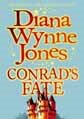
This cover of Conrad's Fate, by Diana Wynne Jones, comes from the British edition. Last year I was in Kew to do research in the British National Archives, stopped into a bookshop, and found the jacket shining in my face. I hadn't known there was a new Chrestomanci volume, but of course I had to put down the pounds. (If you pretend you're paying in dollars, the price is less scary.) The British trim doesn't match my other Jones books, but the US hardcover design for this book turned out to be trying too hard. The paperback cover strikes me as more attractive all around, but I already had my copy.

Series are most often written in the same narrative voice, though the narration might follow different characters. After all, we readers don't want series titles to be too different. One current counterexample is Lee Child's Reacher series, which tells stories about the same man from a variety of perspectives.

Conrad's Fate departs from Jones's previous
Chrestomanci books by coming to us in the voice of the title character. Some folks at Barbelith weren't so taken with this choice. I thought it worked fine for two reasons:

  • The book is about Conrad's understanding of his fate and thus himself, and how that understanding changes as he discovers [surprise!] that he has magical powers. Thus, we have to see the world from inside him, rather than get an outside view of the character. Of course, in this respect Conrad isn't that different from Cat in Charmed Life or Tonino in The Magicians of Caprona, and those series volumes were in the third person. So...
  • From a practical point of view, Conrad ends up working closely with another teenager, Christopher Chant. Jones thus had to differentiate between two teenaged boys with names beginning with C who have the same job and even have to dress alike (though of course Christopher takes better care of his clothes). In third-person, they'd both be "he." But narrating through Conrad means one is "I" and the other "he." I don't know if Jones could have been thinking of that chore, but sometimes a choice in narrative voice rests on simple clarity.
As for the other disappointments at Barbelith, I think endings are often the weakest point in Jones's plots, independent of voice or point of view.

All of which leads to...The Pinhoe Egg, to hatch in September. (My thanks to Elizabeth Waniewski of Dial for a comment at the SCBWI New England conference that sent me scurrying for news of this new Chrestomanci novel.)