Showing posts with label AUTHOR Scott Peterson. Show all posts

09 September 2012

Batgirl’s Unresolvable Foundational Conflicts
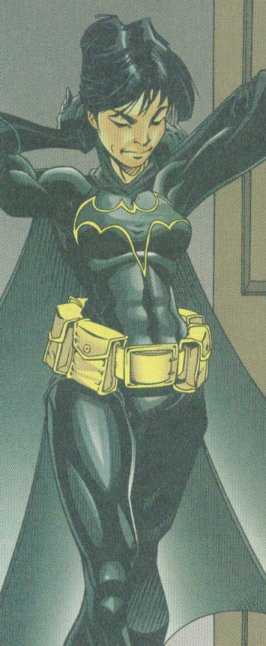
Last week I started quoting from former DC Comics editor Scott Peterson’s recollection of the creation of the second Batgirl in the late 1990s. At first he was reluctant, but his boss insisted.
And then somewhere on the way back to my office I had this crazy vision of a new Batgirl. She was young—late teens, I thought—and Asian, because, well, at the time we had an awful lotta white faces in the DCU, and I thought, if we’re creating a brand new character in the DCU, why on earth would we make her white when other races are under-represented? And in my vision, she was cheerful and chipper and always up and good-natured and she had a complete and total death wish.

This did not seem like a good idea. In fact, it didn’t seem to even make any sense. But it wouldn’t go away.

So I called [writer and former editor] Kelley Puckett. And I said, “Hey, new Batgirl. Young—late teens, I think—and Asian. And cheerful and chipper and always up and good natured and she has a complete and total death wish.”

“But,” he replied reasonably, “that doesn’t even make any sense. . . . That’s completely contradictory.”
But the built-in contradiction was, as Peterson probably realized, the point. In serial fiction the best characters are fueled by contradictions. As I’ve written before, they face an Unresolvable Foundational Conflict that provides distinct characterization and an ongoing overall story arc.

Peterson’s original conception of Batgirl having “a complete and total death wish” but being “cheerful and chipper and always up” had to potential to be an Unresolvable Foundational Conflict. As it turned out, Puckett dropped the “cheerful and chipper” part.

Instead, the character he imagined, Cassandra Cain, was totally serious most of the time. She rivaled Tim Drake for being earnest and Bruce Wayne for being unsmiling. Which made the moments when she did smile or laugh or enjoy life all the more surprising and special.

But Puckett did give Cass Cain an Unresolvable Foundational Conflict—at least one. She was ridden with guilt for having been raised as a child assassin, but indefatigable about making up for that. Her upbringing gave her an extraordinary ability to read body language, useful in fights, but she had trouble with spoken language and couldn’t read at all. Physically she was small and slight and of course a girl, but she could beat Batman in hand-to-hand combat.

Cass Cain debuted in the mighty “No Man’s Land” crossover, Dennis O’Neil’s grand exit from the Batman desk. Having taken the mantle of Batgirl but in a new costume, in 2000 she started to appear in her own magazine, scripted by Puckett and drawn in a strikingly idiosyncratic style by Damion Scott. As protagonist of her own serialized story, she went about fighting criminals, and she went about wrestling with her Unresolvable Foundational Conflicts.

COMING UP: And how did that work out?

02 September 2012

Batgirl as an Editorial Mandate

A while back, the DC Women Tumblr offered former DC Comics editor Scott Peterson space to reveal “The Secret Origin of Batgirl”. This was Cassandra Cain, the third crime-fighter to take that name, after Betty Kane (active as “Bat-Girl” in spurts from 1961 to 1986) and Barbara Gordon (Batgirl from 1967 to 1988).

Three things struck me about Peterson’s recollection. The first was an aspect of his editorial job at DC in the 1990s:
I was, among other things, the Batoffice’s designed heavy, the guy tasked with saying “no” to people who wanted to use Batman or one of the other Batcharacters. My job title was Editor/Batman Group Liaison, which meant that as the liaison, I was the guy who looked at everything from toothbrushes and lunchboxes to posters and novels and beach towels and, yes, the scripts and pencils when other editors borrowed a Batcharacter. The feeling was that even a character as great as Batman could be overused, so that most requests had to be turned down. Which meant I said “no” a lot. You can guess how popular that made me.
Of course, saying that other departments or licensors couldn’t use Batman and his supporting cast is different from limiting one’s own department. By mid-1999 the Batman desk was carrying Batman, Detective, Robin, Nightwing, Batman: Legends of the Dark Knight, Batman: Shadow of the Bat, Azrael: Agent of the Bat, Catwoman, and Anarky. In addition, prominent members of the bat-family were appearing in JLA, World’s Finest, and Young Justice. And for the kids, there was Batman: The Gotham Adventures, with scripts by Peterson (by then a freelance writer).

Plus a magazine called Birds of Prey. Launched from the Batman desk in late 1998, it featured Barbara Gordon, that former Batgirl, and Black Canary as a team of female crime-fighters. This was a new approach, and its sales exceeded the company’s (modest) expectations. DC Comics executives became strongly interested in more female superheroes.

The creation of Batgirl was thus an editorial mandate. And not even from within the Batman office—from a higher manager. Peterson begins his article with the news:
“Create a new Batgirl. Or I will.”

So said then DC Universe Executive Editor Mike Carlin in his always cute and cuddly way.
Peterson writes that Carlin had been suggesting a new Batgirl “for years” before he turned that suggestion into a demand. He might have seen value in a recognized name, or a corporate need to keep the Batgirl trademark alive and valuable. Peterson resisted out of nostalgic fondness for the Barbara Gordon version (and Carlin was merely the Superman group editor until 1996). But once the company realized it might be leaving money on the table, Carlin’s idea became a mandate.

COMING UP: The new Batgirl’s Unresolvable Foundational Conlfict.