Showing posts with label distinctive dialogue. Show all posts

26 August 2020

Christie Exercises the Little Grey Cells
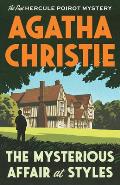
Reading Agatha Christie’s first novel, The Mysterious Affair at Styles, for the first time, I was struck by how she used dialogue to give hints about action that she never described.

Examining those passages further, it seems clear that Christie uses that technique to make readers’ brains work a little harder—to different purposes.

During an early visit to a pharmacy department of the sort Christie herself was working in, the pharmacist says:
“If you people only knew how fatally easy it is to poison someone by mistake, you wouldn’t joke about it. Come on, let’s have tea. We’ve got all sorts of secret stories in that cupboard. No, Lawrence—that’s the poison cupboard. The big cupboard—that’s right.”
By making us perform a little extra effort to understand that Lawrence is interested in the poison cupboard, Christie implants him in our minds as a suspect. Actual culprit or red herring? We find out in the end.

About midway through the book comes another example of the same technique as our narrator, Col. Hastings, interviews a local rustic.
“Why, do the gentlemen from the Hall come here often?” I asked, as carelessly as I could.

He winked at me knowingly.

One does, mister. Naming no names, mind. And a very liberal gentleman too! Oh, thank you, sir, I’m sure.”
Christie never tells us outright that Hastings has responded to the farmer’s hint by giving him a little tip for his information. We have to recreate that bit of business from the farmer’s words.

And our brains are so occupied with reassembling that interaction from clues that we don’t notice the farmer hasn’t actually specified which gentleman from the hall has been visiting. Hastings is sure he knows, but, of course, he’s barking up the wrong tree entirely.

12 November 2014

Writing Advice from Leonard and Busiek

In 2001, Elmore Leonard published an essay in the New York Times’s “Writers on Writing” series headlined “Easy on the Adverbs, Exclamation Points and Especially Hooptedoodle”.

Leonard offered advice like:
3. Never use a verb other than ”said” to carry dialogue.

The line of dialogue belongs to the character; the verb is the writer sticking his nose in.
Eventually that article was the seed of Elmore Leonard’s 10 Rules of Writing.

Last August, when Leonard died, the comics scripter Brian Michael Bendis featured that on his Tumblr site. In the way that Tumblr works, the scripter Kurt Busiek quoted it on his but added these comments:
I disagree with almost all of Elmore Leonard’s rules for writing, largely because any time someone says “never do X,” I immediately try to think of times it works.

But all of his rules are worth thinking about, and can be extremely useful in thinking about whether to use them. If you decide not to use a rule because you’re aware of the hurdle Leonard’s warning of but have overcome that hurdle another way, then the rule was still useful, because it got you to think about how to avoid the problem.

27 June 2013

Big-Budget Action Movies Losing Their Wit

Last night I saw Man of Steel. It reminded me of Oz the Great and Powerful in that both movies are carefully made to trigger our memories of modern American myths, and in doing so both put spectacle over coherence, character, or wit.

Man of Steel does a fine job of showing us exactly what, say, a punch-out between two superpowered humanoids on a satellite would look like. Likewise, Oz the Great and Powerful swoops all over its digital locations, making them more convincing than the plot twists.

But does either of those movies have more than three quotable lines? (Check out these attempts to muster a quota of quotes.)

There’s no wit in either movie’s screenplay. Almost all their dialogue sounds like it was the first choice of tired screenwriters at the end of a long day. Most characters speak in simple, unimaginative ways, stating their emotions or desires baldly. (All the better, perhaps, for easy translations for the international market?) And the actors usually deliver that dialogue slowly, either to fill time or to ensure that no one in the audience can fall behind.

Consider Oz’s arrival in the strange fairyland:
Oz: Where...Where am I exactly?
Theodora: Where do you think you are?
Oz: I have no idea. It’s...It’s like no place I've ever seen.
Theodora: You’re in Oz.
And compare that to the hero’s lines from the parallel scene in MGM’s 1939 film:
Dorothy: Toto, I’ve a feeling we’re not in Kansas any more. . . . We must be over the rainbow! [Glinda arrives in her bubble.] Now I...I know we’re not in Kansas!
Okay, Dorothy’s speech includes #4 on the American Film Institute’s list of all-time best movie quotes. But those words are powerful because they’re understated and fresh. They could therefore be delivered with emotion instead of stating emotion. And the next line is actually metaphorical.

Even throwaway lines in the 1939 movie are evocative: “Now you go feed those hogs before they worry themselves into anemia!” “Of course, some people do go both ways.” “And the last to go will see the first three go before her.” Yes, sometimes the vaudeville shtick underlying that script shows through, but the words are still entertaining. It’s not just that repeated viewings have made the movie memorable. Rather, lines with verve have made it possible to view the movie over and over.

Last year’s big-budget popcorn movies showed that they don’t have to lack wit: The Avengers and Skyfall are powerful action movies with good scripts. They offer a lot to look at, but also a lot to hear besides explosions. Oz the Great and Powerful and Man of Steel offer only half that package.

02 April 2013

“He wasn’t so much of a Wizard as he might have been.”

This is how Tip, the young hero of L. Frank Baum’s second Oz book, explains the first to his creation Jack Pumpkinhead:

“Where are we going?” asked Jack, when they had resumed their journey.

“I’m not exactly sure,” said the boy; “but I believe we are headed South, and that will bring us, sooner or later, to the Emerald City.”

“What city is that?” enquired the Pumpkinhead.

“Why, it’s the center of the Land of Oz, and the biggest town in all the country. I’ve never been there, myself, but I’ve heard all about its history. It was built by a mighty and wonderful Wizard named Oz, and everything there is of a green color. . . And in the Country of the Munchkins, over at the East, everything is blue; and in the South country of the Quadlings everything is red; and in the West country of the Winkies, where the Tin Woodman rules, everything is yellow.”

“Oh!” said Jack. Then, after a pause, he asked: “Did you say a Tin Woodman rules the Winkies?”

“Yes; he was one of those who helped Dorothy to destroy the Wicked Witch of the West, and the Winkies were so grateful that they invited him to become their ruler,—just as the people of the Emerald City invited the Scarecrow to rule them.”

“Dear me!” said Jack. “I’m getting confused with all this history. Who is the Scarecrow?”

“Another friend of Dorothy’s,” replied Tip.

“And who is Dorothy?”

“She was a girl that came here from Kansas, a place in the big, outside World. She got blown to the Land of Oz by a cyclone, and while she was here the Scarecrow and the Tin Woodman accompanied her on her travels.”

“And where is she now?” inquired the Pumpkinhead.

Glinda the Good, who rules the Quadlings, sent her home again,” said the boy.

“Oh. And what became of the Scarecrow?”

“I told you. He rules the Emerald City,” answered Tip.

“I thought you said it was ruled by a wonderful Wizard,” objected Jack, seeming more and more confused.

“Well, so I did. Now, pay attention, and I’ll explain it,” said Tip, speaking slowly and looking the smiling Pumpkinhead squarely in the eye. “Dorothy went to the Emerald City to ask the Wizard to send her back to Kansas; and the Scarecrow and the Tin Woodman went with her. But the Wizard couldn’t send her back, because he wasn’t so much of a Wizard as he might have been. And then they got angry at the Wizard, and threatened to expose him; so the Wizard made a big balloon and escaped in it, and no one has ever seen him since.”

“Now, that is very interesting history,” said Jack, well pleased; “and I understand it perfectly all but the explanation.”
A number of touches show the influence of the Wizard of Oz stage extravaganza that debuted to great crowds in 1902:

  • the vaudeville crosstalk of the conversation itself. Baum’s first Oz book has relatively little dialogue, and much of it is straightforward and declaratory. With this sequel he began writing patter. That offered more chance to distinguish his characters, but also more chance to stretch for cheap laughs.
  • the omission of the Cowardly Lion as one of Dorothy’s companions, just as Baum omitted him from this book. The big stars of the stage show were the Scarecrow and the Tin Woodman, and this sequel was designed to give the public more of them. 
  • the portrayal of the Wizard as a villainous fraud, as he appeared in the stage show, rather than a good-hearted humbug. In The Wonderful Wizard of Oz, the Wizard builds a balloon in a sincere attempt to take Dorothy home to Kansas, but he can’t stop it once it’s launched. As Tip retells the story, the Wizard built the balloon simply to escape before Dorothy and her companions could reveal his secrets.

Or is that actually how the people of Oz came to look upon the Emerald City’s former ruler?

12 March 2011

Stan Lee’s Dialogues

Bleeding Cool just published a long transcript of Stan Lee’s deposition about the emergence of the Marvel superhero universe back in the early 1960s, as part of a lawsuit between Jack Kirby’s heirs and Disney/Marvel.

Most of Lee’s deposition consists of stories he’s told before, in much the same fashion. I saw no surprises about the “Marvel method” of comics storytelling, the creation of specific heroes, or Lee’s long personal respect for Kirby as an artist. That doesn’t change how in the 1960s comic-book creators all signed work-for-hire deals.

One of the issues in the lawsuit appears to be how much dialogue Kirby might have composed in the margins of his artwork. Here’s a pertinent exchange from Lee’s deposition about the notes on one surviving page of original art:

STAN LEE: Well, that’s Jack’s handwriting. That’s the way he wrote them. Yes.

Q. And could you tell us, for example, in this instance I see that there’s a dialogue that’s actually in the different blocks. Tell us who did that dialogue. How was the process done?

STAN LEE: Well, I wrote the dialogue and the captions, but Jack would give me notes. For example, in panel 4 of that page, the next to the last panel –

Q. Right.

STAN LEE: — Jack wrote what he suggested the dialogue might be. “I will rule. My years underground will end.” That was to let me know what he felt the fellow should be doing or saying.

So I wrote, “My conquest will be complete. I, the Mole Man, banished from my fellow men half a lifetime ago, will return at last as Master of the Earth.”
Yeah, that’s the way Stan wrote them. And I suspect the published version had more exclamation points.

A similar deposition with artist John Romita, Sr., addresses the same question. Romita would pencil possible Spider-Man dialogue for Lee, with the result:
He invariably would not use them, and I asked him once “why wouldn’t you use — why wouldn’t you let him” — he said something similar. He said, “because I can’t speak in somebody else’s vernacular.” He says, “when I am writing my characters, I am writing in Peter Parker’s personality and Aunt May’s personality and I write the captions in my personality. If I start putting your personality in there, I am going to confuse the reader.” So he used to — he told me — he invariably did not use anything that was in the margins that was cleverly suggested by the artists, because he said he did not want to stray from his normal approach.

He had a dialogue going with the reader. Saying “dear reader, this is your editor speaking right now.” He used to do that. It used to drive me crazy. I used to tell him “you are puncturing the illusion.” It’s like opening a door in the theater and letting the sunlight in and everybody realizes they are watching a movie now. I said “you are ruining” — he said, “it doesn’t matter. I am talking to my readers.”
I think Stan Lee took the idea of a snarky conversation between the comic company’s “bullpen” and its loyal readers from similar messages in the EC comics of the early 1950s. It was certainly a hallmark of the Marvel superheroes comics he co-created in the 1960s. And that dialogue never punctured the illusion. Rather, it drew readers into a fun-filled conspiracy to suspend disbelief.

27 March 2009

The Reasons Why

From Bookgasm, a few of Alan Mott's "50 Reasons No One Wants to Publish Your First Book":

2. There’s this thing called punctuation. You might want to look into it.
...
7. It probably wasn’t a good idea to base the main character on yourself, considering how much most people seem to hate you.
...
15. It’s not technically a novel until you’ve written it down first.
...
31. There’s a fine line between writing authentic regional dialogue and making all of your characters sound like stroke victims.

29 September 2008

A New Use for Single Quote Marks?

My final posting for this Oz and Ends PUNCTUATION WEEK concerns a use of quotation marks in fiction that's not standard, as far as I can tell, but might become so.

In a few books, when the text quotes words that no character is saying in the present scene--words that a character has said before, or often says, or that another character imagines being said--that dialogue appears in single quote marks instead of the regular (American) double quote marks.

I first noticed this usage in Scott Turow's Presumed Innocent, published in 1987. Since then, I've kept my eyes open for other books using the same style, and the earliest book in which I've spotted it is Madeleine L'Engle's A Wind in the Door (1973), the first sequel to A Wrinkle in Time. (It may not be coincidence that both those titles came from Farrar, Straus & Giroux.)

Here are a couple of passages from A Wind in the Door, chapter three, showing this style in action:

The children were all fond of Dr. Louise, and trusted her completely as a physician, but they were not quite sure that she had their parents’ capacity to accept the extraordinary. Almost sure, but not quite. Dr. Colubra had a good deal in common with their parents; she, too, had given up work which paid extremely well in both money and prestige, to come live in this small rural village. (‘Too many of my colleagues have forgotten they are supposed to practice the art of healing. If I don’t have the gift of healing in my hands, then all my expensive training isn’t worth very much.’) She, too, had turned her back on the glitter of worldly success.
And a page later:
“You haven’t proven them to me,” Dr. Louise said. “Yet!” She looked slightly ruffled, like a little grey bird. Her short, curly hair was grey; her eyes were grey above a small beak of a nose; she wore a grey flannel suit. “The main reason I think you may be right is that you go to that idiot machine--” she pointed at the micro-electron microscope--“the way my husband used to go to his violin. It was always a lovers’ meeting.“

Mrs. Murry turned away from her ‘idiot machine.’ “I think I wish I’d never heard of farandolae, much less come to the conclusions--” She stopped abruptly, then said, “By the way, kids, I was rather surprised, just before you all barged into the lab, to have Mr. Jenkins call to suggest that we give Charles Wallace lessons in self-defense.”
I wouldn't have used single quote marks in those passages. (And I wouldn't have included the sixth comma in the first passage, or punctuated the clause about the micro-electron microscope within Dr. Louise’s dialogue like that, either.)

I’ve looked in style guides to see if any state this usage is standard, or even a common option, and haven’t found one that recommends treating some quotations differently from others this way. The closest guideline is a Chicago Manual of Style stipulation that in philosophical and linguistic texts certain terms might be enclosed in single quote marks (14th edition, 6.67 and 6.74).

To prepare for this posting, I kept watch for an example of standard use of quote marks in the same situation, and found one in Gail Gauthier's The Hero of Ticonderoga (2001):
Mom sighed one of her “I’m trying to keep from killing you” sighs. “No, it does not.”
The dialogue that start “I’m trying...” would be within single quote marks in the system L'Engle and Turow used. That might even be clearer about what's spoken aloud in that scene and what the narrator is recalling from earlier moments. But until that system becomes standard, and readers know how to interpret it on the fly, I think it risks being confusing instead of clarifying.

Has anyone else come across this quirk of punctuation? Has it gotten into any style guides? Does anyone use it all the time?

17 May 2008

Dot Dot Dot

You folks have probably figured out that PUNCTUATION WEEK at Oz and Ends is really an excuse for me to grouse about the deficiencies of my word-processing program or common glitches I see in manuscripts. But why stop now? Today I address the burning question of ellipses!

When a character is interrupted or breaks off suddenly, that character's dialog should end with an em dash (or its equivalent), as in the alleged last words of Union general John Sedgwick:

"They couldn't hit an elephant at this dist--"
(I'm annoyed to see that, according to Wikipedia, Sedgwick got that whole sentence off--twice!--and only then was felled by a Confederate sharpshooter. The dialog is much more dramatic with the interruption, isn't it?)

On the other hand, when a character's speech trails off into silence, or the narrator doesn't care to pay attention any more, a writer should use an ellipsis, which is Greek for "three little dots."
"No, Mommy, we're not sleepy at..."

"And so, as I wrote on this next slide, the incremental increase in the past fiscal quarter is greater than the corresponding quarter of last year, but smaller than the intervening..."
Every so often I see a new writer tempted to stretch out an ellipsis into four or five periods, apparently to indicate more time passing. That's not standard yet, which means that it's wrong.

Scholarly writing makes a useful distinction between two types of ellipses. That style uses the traditional three periods (or, in proportional typefaces, one ellipsis mark) when a quotation is missing a phrase from within a sentence.

And there's what I'll call (in allusion to James Thomson's "Seasons") a "long ellipsis": three periods with spaces in between them to indicate when a sentence or more has been removed.

I'll take an example from Boston 1775, a quotation from Prof. David Blight, Director of Yale's Gilder Lehrman Center for the Study of Slavery, Resistance and Abolition, on the recent legend of a "quilt code" on the Underground Railroad:
The reason your student is not finding primary material on quilting in the Underground Railroad is because in all likelihood there isn’t any. This is “myth” of the softest kind that serves the needs of the present for people who prefer their history as lore and little else. . . .

The quilt story...will survive and thrive as long as it serves real needs in the desires many people have from history--to convert tragedy into something triumphal, suffering into progress, complexity into curiosity, nitty gritty social and political history into material culture we can touch and see.
The first, long ellipsis represents the removal of more than a sentence. (Since it follows a period, the result is four spaced-out dots. But that's the maximum number of dots a writer can pile up.) The second, short ellipsis in the second paragraph occurs within a single sentence.

Tendentious scholarly writing, defined by a previous version of the MLA Style, requires that ellipses added by the writer be signaled with brackets: [...]. Most fields outside literature don't deal with texts that already have their own ellipses, so readers in other disciplines can basically assume that all ellipses have been added by the present writer.

Once again, I suspect, British typesetting is different from American. Some styles dictate a space on either side of an ellipsis mark, and no distinction between the long and short forms.

08 May 2008

Speech Balloon Variety in Oz: The Manga

In its use of the comics form, David Hutchison's Oz: The Manga didn't impress me quite as much as Michael Cavallaro's adaptation of the same novel, which is also manga-influenced. But I found one element of Hutchison's graphic storytelling very interesting: the speech balloons.

(Bear with me here.)

For this comic, Hutchison developed a complex system of using different balloon shapes and different type treatments for his various characters' speeches. The full system doesn't kick in until halfway through chapter/issue 4. (That's also the first point where I saw him cutting and pasting art electronically to save time; perhaps that coincided with a shift to all-digital production.)

Ordinary human and animal speech appears in tall oval balloons. At first those balloons appear hand-drawn, but after chapter 4 they're exactly elliptical. There are some standard balloon variations that we see in many other comics, such as a jagged shape for a yell, a dashed outline for a whisper, and a cloud shape for the rare expressed thoughts.
This panel shows the balloon variation among Dorothy's three companions. The Cowardly Lion has an ordinary, smooth oval balloon. The Scarecrow's balloons are more rectilinear, especially after chapter 4. The Tin Woodman's balloons are shaped like elliptical gears, reflecting his mechanical makeup. (The Lion's balloons turn a bit wavery as he feels the effects of the poppy field and the Wizard's courage in a bottle.)

When the Wizard appears in a different incarnation to each traveler, each guise has its own balloon style:

  • The giant head's balloons have dark borders and Sand type.
  • The pretty lady has ordinary human balloons--with drop shadows behind them.
  • The beast has craggy balloons and boldface italic lettering.
  • The fireball has a wavery balloon and rounded lettering with long serifs.
When the humbug Wizard speaks from a hiding-place, his balloons have wavery outlines, with bubbles attached. But as soon as Dorothy lays eyes on the little man, he starts to speak in the same simple balloons as she.

Among the books' antagonists, the wildcat in the poppy field has a fanged or hairy balloon. The wolves' balloons have ragged black borders and a special typeface while the bees speak inside a different type of jagged border. The Winged Monkeys' speeches appear in white lettering on irregular black fields; these balloons don't have tapering tails like all the others, just spattery trails of black leading to the speakers.

The Wicked Witch of the West is set off from other human characters by her speech balloons. After the book's chapter 4, she's the only human character whose oval balloons are hand-drawn, and her words appear in a different font, with more variations in stroke thickness and a hint of serifs. Oz: The Manga is a veritable tutorial in creating different speech balloon formats.

12 February 2008

The Marx Fantasy Dialogue Scale

In her book Writing for Animation, Comics, and Games, Christy Marx writes, “Creating the right fantasy dialogue depends a great deal on how you use contractions, on your word arrangement and sentence structure, and on the vocabulary you employ.”

And she provides a handy table of possibilities--

I came up with the Marx Fantasy Dialogue Scale to differentiate the various ways in which fantasy dialogue could be spoken, ranging from colloquial/modern (No. 1) to High Epic/Poetic (No. 5). Here’s an example:
1. He doesn’t know what he’s doing.

2. He does not know what he is doing.

3. He does not know what he does.

4. He knows not what he does.

5. He knows not what his purpose is, for confusion lies heavy upon him.
I imagine a Level 6 as well, called Yoda-Prime: “His purpose he does not know, for upon him confusion lies heavy.”

The first step up Marx’s scale is getting rid of contractions, a trick that writers of historical fiction also use to signal that characters are not of the readers’ time and place. The problem is that approach is that the people of the past used contractions, sometimes the same ones we use and sometimes different (“’tis” instead of “it’s”; “I’ll not” instead of “I won’t”). Presumably, characters in a fantasy world would use contractions, too. And people’s speech patterns vary according to their personalities, education, class background, situations, and so on.

So while I suspect Marx’s scale can be handy for spurring thought about how to make an individual character sound (and sound different from the author), I’m wary about relying too much on simple tricks with contractions and participles.

25 May 2007

Distinctive Dialogue

Last Sunday, in my workshop on dialogue and dialogue tags at SCBWI New England's annual conference, I promised to post some material from one of my PowerPoint slides here on the blog. And now, five days after I started this entry, I'm finally finishing it.

I propose that the key to creating distinctive speech patterns is to focus on little things: habitual sentence structure, word choices, exclamations and questions. If we make those touches distinct for each character and keep them consistent, then readers will pick up characters' speech patterns and be able to follow a complex conversation, even with several speakers and changes in the emotions or opinions that individuals are expressing.

I put up a slide listing several ways that speech patterns often vary. Some involve the content of a character's speech (what she says) and others the form (how she says it):

  • Contractions v. Full words
  • Metaphors v. Plain language
  • Originality v. Clichés
  • Grammatical constructions v. Non-standard
  • Long sentences v. Short
  • Anglo-Saxon words v. Latinate expressions
  • Complete sentences v. Sentence fragments
  • Interruption and apposition v. Directness
  • Sarcastic v. Sincere
  • Joking v. Serious
  • Negative v. Positive
  • Hemming and hawing v. Smooth speech
  • Slang v. Formality
  • Qualifying (e.g., rather, quite, very, sort of) v. Bald
  • Overstatement v. Understatement
  • Direct address (i.e., using the other character's name) v. None
  • Repetition v. Terseness
  • Catch Phrases v. Generic language
This is by no means an exhaustive list. These variables are just those I came up with as I prepared my talk, probably far too late at night. But I hope it's a useful starting-point.

One workshop participant talked about having three characters who are all scared--which in certain scenes makes sense. How could each character's dialogue sound individual when they're all expressing the same emotion? One might be prone to overstatment ("We're all going to die!"), another to sarcasm ("Oh yeah, yelling will help."), and the third to asking questions ("But what are we going to do?"). If readers recognize those traits from calmer times, then they'll remember when the tension rises.

I must admit to getting a special kick out of distinctive speech patterns, particularly in my somewhat elevated if not exactly "high" fantasies. I just looked at chapter 10 of one of my manuscripts, and I see seven speaking characters:
  • A cross little dog, all snappish interjections and barks.
  • An old-fashioned American farmgirl, prone to saying things like "Gracious" and "I’m jes’ fine, ’member?"
  • A corporal who speaks so tersely he tends to leave the subjects and articles off the start of his sentences. Doesn't need them. Gets along fine.
  • A contented hippopotamus with his mouth full. “Oo ehuh ahh oo hi ih!”
  • A cottonmouth snake with a lisp.
  • Two alligators who speak in a somewhat formal style, frequently addressing each other as "brother" and "sister."
Those speaking styles send my word processor's "Spelling and Grammar..." tool into a tizzy--nothing but red and green underlines. And for a more realistic, serious story, such a variety of speech patterns might well be too flashy. But I guarantee you, readers won't lose track of who's saying what.