Showing posts with label AUTHOR Fabian Nicieza. Show all posts

19 April 2014

What Will “On Your Left” Mean?

In the discussion of the political implications of Captain America: The Winter Soldier, Greg Carpenter at Sequart found a key in the movie’s strong opening scene. Steve Rogers and Sam Wilson are jogging around the reflecting pool in Washington, the former (having been injected with the super-soldier serum) much faster than the latter:
Each time Rogers approaches Wilson, he gives the same cautionary warning: “On your left.” They are the first words spoken in the new film, Captain America: The Winter Soldier, and they lay the groundwork for much of the political perspective of the film. While this Captain America may sneak up on you—you’ll find him “on your left.”
Not everyone caught that, as Alyssa Rosenberg shows in the Washington Post:
“Captain America: The Winter Soldier” returns time and time again to the idea that the biggest issue in national security is who controls the apparatus, rather than whether we should use certain technologies or techniques at all.
To be sure, there’s an inherent tension between the superhero narrative, or any hero narrative that focuses on an individual or small group of individuals, and spread-out popular power. As a result, some critics have trouble noting the moments built into superhero films that celebrate the crowd: the scenes in the first two Spider-Man movies in which groups of ordinary New Yorkers stand up to villains when Spider-Man is in trouble, for example.

In Winter Soldier, the conflict ends with the spy agency’s (unspecified) secrets being dumped out onto the internet. The directors, Joe and Anthony Russo, noted that as they were filming Edward Snowden released some secret files from the National Security Agency with the same idea. Of course, Wikileaks and Bradley/Chelsea Manning had done something similar already.

Granted, heroic narratives aren’t good at exploring the actual challenges of broad-based decision-making. Jonathan Stroud’s original Bartimaeus trilogy gets to that at the end of the third volume. George Lucas’s Star Wars films and J. K. Rowling’s Harry Potter series declare the superiority of democracy over dictatorship, but they show actual politicking as pretty feckless. L. Frank Baum’s Oz and other magical kingdoms tend to settle for benevolent dictatorships. But the larger the fictional universe, the more stories bottom-up authority allows.

In an article for Business Insider, Jeff Gomez and one-time Robin/Red Robin scripter Fabian Nicieza analyzed how developments in Winter Soldier open up possibilities for Marvel’s overarching movie narrative:
Feige faced a daunting creative challenge for his thriving film series: while Nick Fury and SHIELD served as the perfect impetus for uniting a disparate band of dysfunctional superheroes [in The Avengers], now the filmmakers were stuck with global icons like Hulk, Thor, and Iron Man effectively bowing to a secret American military organization. That had to end, but the choice of making Captain America cut the umbilical cord? Genius. . . .

The result is the fall of SHIELD, and the vast U.S. military-industrial complex no longer stands as the leash-holder to Captain America and his superhero allies. Steve Rogers becomes apolitical, while still representing the world’s perception of American selflessness, justice, and heroism dating back to World War II.
Already the Agents of SHIELD television show is reflecting the new situation (not that I’ve watched it since the pilot). We’ll see if the next set of Marvel moviemakers can fulfill that promise.

10 June 2012

Stephanie Brown: The Final Fight

The last weekly Robin closed with a hint that it was actually good that the Robin storyline titled The Final Fight, scripted by Chuck Dixon, was never produced.

That’s not because Fabian Nicieza’s Search for a Hero was stellar. (I thought Nicieza was kept from exercising his fine understanding of the character of Tim Drake because of difficult scheduling.) And it’s certainly not because that canceled volume would have impeded Tony Daniel’s Battle for the Cowl.

Rather, the key to that sentiment rests in how DC Comics’s description of that volume concluded: “Robin also has his hands full with a not-so-happy family reunion between his lady love [Spoiler] and her father, Cluemaster!”

Dixon created Stephanie Brown, the Spoiler, as an antagonist for the Cluemaster, a second-rate Riddler introduced in 1966. When fans wanted to see more of her, Dixon wrote stories of Stephanie as Tim’s other woman, then his main girlfriend. But since Tim was the protagonist of those stories, Stephanie mainly posed problems for him: a crush on her when he was seeing someone else, her pregnancy, her father moving back in, her replacing him as Robin, her temporary death, and so on. Stephanie was, as TV Tropes said, a walking Afterschool Special of teen woes.

The Final Fight description promises further adventures in that mode. It describes Robin with “his hands full” once again because of Spoiler and Cluemaster. And as the protagonist in his own magazine, Tim Drake would have once again helped to fix Stephanie’s troubles for her.

But being the child of a minor supervillain was Stephanie’s problem, not Tim’s. So the cancellation of this Robin storyline meant that problem was available to Bryan Q. Miller to address in his Batgirl series, collected in three volumes: Batgirl Rising, The Flood, and The Lesson.

And those volumes are really good. Miller wrote funny dialogue. He created a solid supporting character in a young homicide detective who becomes Stephanie’s special contact on the police force (every hero seems to need her own) and possible love interest (ditto). He had the advantage of a clear narrative arc as Stephanie took over the role of Batgirl with the help of predecessor Barbara Gordon.

As Miller was telling his stories, Christopher Yost and Nicieza were showing Tim Drake fighting crime overseas and in cyberspace. That left Stephanie with the challenges that Dixon used to give Tim in Robin: trying to keep up the life of a normal Gotham City student while also fighting powerful criminals. So Stephanie has to deal with midterms, campus crime, a teenage witch-boy, and a suspicious mom.

It’s clear that Miller had to shape his storytelling around some editorial mandates. Barbara Gordon gets yanked out of the action when DC needed her to appear in another series. Another supporting character, Wendy from Teen Titans, is just settling in when she suddenly disappears. One issue in the last volume was written to set up an issue of Batman Incorporated that wasn’t even published until months later. But the series’ overall narrative arc stands up to all that.

Like Nicieza in his second opportunity with Tim Drake, Miller had to finish his run much faster than he planned to make room for DC’s reboot. I thought Nicieza’s climactic storyline suffered from being crammed into one issue, but Miller was able to overcome that problem. In a terrific last issue, he simultaneously showed Stephanie confronting her oldest problem—her dad, of course—and looking ahead to possible glorious futures. And she achieves those triumphs for herself.

It would still have been possible for Tim and Stephanie to confront the Cluemaster in Dixon’s Final Fight and for her later to confront him again in her own magazine. Parental issues never go away, after all. But for Stephanie Brown to come of age, she had to be more than support for another title character. Tim makes some appearances in Batgirl, but the much more significant crossovers of this period are when Stephanie appears in Red Robin, showing him how she can stand on her own.

In DC’s rebooted universe, Stephanie Brown’s role—and even existence—is uncertain. She was never a Robin, even briefly. It’s unclear whether she was ever Batgirl. Her larger story for all practical purposes appears to be over.

COMING UP: But that may not be a bad thing.

08 April 2012

The Quick End of Red Robin

Now that DC has published the two Red Robin volumes largely scripted by Fabian Nicieza, The Hit List and Seven Days of Death, I thought it would be interesting to review comments he made when he took over that series from Christopher Yost.

Nicieza had written Tim Drake’s transition from Robin to Red Robin in the issues of Robin collected in Search for a Hero. I felt that volume suffered from being forced to squeeze into the schedule dictated by Grant Morrison’s “Batman RIP” storyline. In interviews Nicieza clearly liked the Tim Drake character; in the magazines, he didn’t have enough pages to demonstrate that.

Taking over Red Robin in 2010 gave Nicieza a second chance with Tim Drake, this time with no end in sight. At that time, he told Newsarama:
He is “the smart one” of the Bat-family, the thinker and planner. I mean, of course Bruce Wayne/Batman is what he is, and Tim isn’t quite there yet, but Tim at 17 has a more developed intellect than Bruce at 17 did. That’s not to say Dick Grayson or Barbara Gordon are dumb, of course they’re not, but Tim’s level of thinking is a bit... thicker... than theirs. For me, Dick is about superior reflexive thinking, Barbara about superior operational thinking and Tim is about superior comprehensive, or all-encompassing, thinking.
What I love about Tim is that he shares some of the strongest traits of various Bat-family members. The intellect and detective skills of Bruce, the ability to lead others and be a friend to others like Dick has and even the ability to make cold, harsh decisions like Jason does.
Those qualities are certainly on display in Nicieza’s Red Robin stories as Tim maneuvers and manipulates, planning ways to take down villains and threats proactively. That created the storytelling challenge of a first-person narrator who’s been planning several steps ahead of the action being shown—but of course can’t spoil the story for us readers.

Within the DC Universe, Tim got the cyberspace beat. Several of Nicieza’s stories involve an evil digital network called the Ünternet, with his old rival Anarky as a touchy ally in that virtual world. Another couple of issues bring on the Mad Men, electronically fueled tricksters who challenge Tim’s logical thinking.

At the end of that interview, Nicieza threw out some teaser questions that referred to a plot thread that Yost had left hanging for him:
“Who[m] has Ra’s al Ghul ordered to take away Tim’s v-card – and will she succeed?”
“And if she doesn’t succeed, who else is on that ever-growing line looking to draw that card?”
As calculated, that talk of sex caught fans’ attention. But Nicieza soon stated: “I only drew the V-card gag answer as a direct result of a thread running that day on the Robin DC Boards. . . . I hadn’t even THOUGHT of [it] much until that thread.”

As Nicieza noted, over the years DC’s storytellers established several young women as romantic interests, and thus potential first sexual partners, for Tim Drake. Nicieza spun out some of those threads. He created a notable cliffhanger with Ra’s al Ghul’s half-sister trying to get pregnant by Tim whether he wants to or not, only to show him saved by another possible partner.

But contrary to some readings of those issues I’ve seen, Nicieza wasn’t trying to turn Tim into a suave playboy. He recently told Comic Book Resources:
Any relationship with a woman is one where Tim is never fully in control. Maybe that’s one reason he doesn’t have any successful ones under his belt—then again, how many 17-year-olds do? I like how Tim is so competent in so many other aspects of his life, but he is still an awkward doof when it comes to dealing with girls.
Tim’s anxious face when he sees what al Ghul is up to fits into the line of anxious faces he’s made when he thought Lady Shiva might sexually initiate him (first Robin miniseries, #4); when his first girlfriend, Ariana, suggested sex (Robin, #40); when he had to face Stephanie Brown’s pregnancy (Robin, #58); and even when Rose Wilson of the Titans made a play for him (Teen Titans: All Around the World). This DC Universe ends with Tim still awkward, still a virgin, and unattached. Nicieza really does know the character’s history.

Back in 2010, Nicieza was looking ahead to another Red Robin storyline based in Tim’s past:
Nrama: It seems Tim would have quite the reaction to Digger Harkness being brought back from the dead but not his own father [since Harkness, better known as Captain Boomerang, killed his father in Identity Crisis]...

Nicieza: …we will certainly touch on Digger’s return very early in my run—with a face to face meeting that will brew and percolate into a larger storyline down the road.
However, that larger storyline never came to pass. DC’s management chose to revamp its entire line for a simpler “New 52” continuity, in which Tim Drake has a new Red Robin costume and a new mission of forming the new Teen Titans. And there was a strict timetable for launching that.

Nicieza therefore had to wrap up his storylines very quickly. He squeezed a visit to Hong Kong and a big fight with a new young villain into a single page in order to leave the series’ final issue for the face-off with Captain Boomerang. What Nicieza planned as “a larger storyline” depended on Tim’s careful, extended planning—indeed, such planning is crucial to the story’s theme.

Logically, the result is an appropriate culmination for this Tim Drake’s character development from 1989 to 2011. Unfortunately, because the action had to be compressed into a single issue, it didn’t pack the emotional punch that Nicieza had no doubt initially hoped for. In addition, the last issues of Red Robin and nearly every other DC series were swamped by fan interest in what the publisher planned next. This saga ended not with a bang but with an “eep.”

25 September 2011

“I could be Robin, but I didn't think I could be Batman”

As DC Comics wound down its first Batman series with issue #713, it turned to writing stalwart Fabian Nicieza to script a final story. I think Nicieza has a particularly good understanding of the place of Robin in the Batman mythos (i.e., he agrees with me on lots of points), so this was a good choice.

Comic Book Resources interviewed Nicieza about that story, and his fondness for Dick Grayson:
When I first came to this country [from Argentina], we watched the Batman TV series on ABC and I immediately got into the character. I don't know if it was the costume or the fact I felt I could be Robin, but I didn't think I could be Batman—same reason I thought I could be Chekhov but not Kirk! I don't know, it's dorky, but I always thought any kid in shorts and green pixie boots (have we mentioned he wore pixie boots?) who could hold his own up against Batman, much less all the villains in Gotham, was cool by me.
The tale Nicieza wrote is framed around Damian Wayne telling three younger boys a Grayson-centered history of Batman, at the same time sharing the valuable lessons he’s learned from being Robin.

The story reminded me a bit of “The Batman Nobody Knows” from 1973, also about boys telling each other stories of the legendary Batman. That tale is supposed show that children are too innocent to be scared of Batman like that cowardly, superstitious lot of criminals. (It actually shows the boys as jaded enough to quickly believe that millionaire bachelor Bruce Wayne likes to jump out at children on camping trips in a skin-tight costume and mask. But I digress.)

In Batman, #713, those three little boys are named Bob, Jerry, and Bill—obvious allusions to Bob Kane, Jerry Robinson, and Bill Finger, the team that created Dick Grayson back in 1940.

Little Bill later talks about a story he’s going to write. Readers’ response to these kids seems to depend on their tolerance for schmaltz. But a “last” issue of a magazine published since 1940 might deserve a bit of schmaltz.

Do I read too much into the fact that the Bob Kane analogue is a step behind everyone else?

12 December 2010

Our Little Boy Has Grown Up

Fabian Nicieza, the current scripter of Red Robin, has a very perceptive understanding of that magazine’s hero, Tim Drake, and the entire Robin mythos. And by “very perceptive” I mean “we agree on a lot of things.”

Nicieza just did an interview with Newsarama to promote the magazine’s issue #18. Along with the usual praise for collaborators and hints at exciting things to come, he reminded readers of how this comic book differs from the Robin series of 1991-2009:

The Red Robin book is no longer about the training of a young hero, like the original Robin series was. It’s about the decisions and actions that an established young hero takes in learning how to best wield the power and intelligence he has.
In sum, Tim has gone through the same passage that Dick Grayson did in the mid-1980s, establishing a new, non-sidekick identity. But he’s doing it in a solo book, not as part of the Titans.

Two of the traits that set Tim apart from Dick Grayson and Bruce Wayne for most of Robin‘s run were:
  • He wasn’t an orphan: his father was still alive, and he also had to keep secrets from a housekeeper and a stepmom. (Long-time writer Chuck Dixon talked about that storytelling choice back here.)
  • Tim kept insisting he would be Robin for only a while, and not fight crime in a mask and cape his whole life. He never really talked about any other career, though, and as time went on (and the character maintained its economic value) I found those statements less and less convincing.
Nicieza speaks explicitly about the change in his hero’s outlook:
Tim’s motivation, in my mind, changed a little after his father died [in Identity Crisis]. Whereas he originally became Robin to help Bruce Wayne become a better Batman, his father’s death has spurred him to embrace his costumed identity as his life’s mission and become a better Red Robin so that no one ever endures what he did.

For better or worse, Tim Drake is a crimefighter 24/7 now and we’ll explore when it’s for the better and when it’s for the worse as an ongoing aspect of his series. I’ve read some interesting comments on some message boards by a few people claiming that with Bruce’s return, there is “no purpose to the Red Robin” book, which I found almost sad in how little an understanding they had of the character they were reading every month.

Tim Drake carried 183 issues of his own series as Robin and the entire maturation process for him has been to show the purpose he has on his own, without the need for Batman as the reason to do what he does.

He is unique in his approach to his mission, just like Dick Grayson is and now Stephanie Brown.

I think the stage we’re at now with Tim is almost equivalent to watching your kid go from High School to living away at college. There is an independence, a process of learning responsibility, making choices on your own, making mistakes, etc. . . .

I don’t necessarily think it’s a new role, just an extension of the role he’d been playing, the difference being, now that he can do this as his “full time job” without the worries of school (or truthfully, worrying over his father and that family dynamic), he will be quite the little Machiavellian master chessman.
Nicieza is also usually frank about the technical aspects of superhero-comics storytelling. Here are his comments on building up Tim Drake’s “rogues gallery”—the recurring villains whose comebacks have some deeper meaning than “Oh, I guess she wasn’t dead after all” because their symbolic meanings complement the hero’s.
I broke down all of Tim’s attributes as a character, his personality traits, archetypes, etc. then I created a list of potential opposites of those trains, or similarities to hone the roster of antagonists for Tim. For example, Tim is all about rational thought and reason, so a great opposite to that would be a group of chaos-mongers like the madmen would make great foils for him (and they do in Issue #21!).
Nicieza also alludes to “a larger storyline between #22-25,” showing how far ahead he’s working. Contrast that with his last-minute, seat-of-the-pants assignment to finish the Robin magazine, and he’s clearly in a better position to tell well-thought-out stories about Tim Drake.

14 November 2010

The Return of Red Robin Reviewed

The great strength of scripter Christopher Yost’s twelve issues of Red Robin, as I discussed in the last weekly Robin, arises from how they fit into DC’s larger story for Tim Drake over the last several years.

That integration into the larger DC Universe also creates the biggest hole in Yost’s story, now collected in volumes subtitled The Grail and Collision.

As usual, there were crossovers between this magazine and others. Collision includes a necessary issue of Batgirl, and reads better if you also know the Superboy tale in Adventure Comics, #3. Between the two Red Robin volumes came DC’s “Blackest Night” saga, which doesn’t affect Tim’s story, despite all the times he refers to it.

But the big hole opened up because of a non-crossover. Red Robin has to fit into DC’s main storyline for Batman. For the last several years the person driving that bus has been scripter Grant Morrison. He came up with the ideas for Damian Wayne as a new Robin, Bruce Wayne being cast back in time, Dick Grayson taking over as Batman, Bruce coming back, and more. And it’s only fair that Morrison’s gotten to tell that big story.

Morrison doesn’t show much of a feel or feeling for Tim Drake, however. He’s been drawing inspiration from pre-1971 Batman stories and from friendly rivalry with highly touted tales by Frank Miller, Alan Moore, Mike W. Barr, and others. As for Tim, introduced in 1989 and not appearing in those graphic novels, Morrison has hardly used him at all.

Certain traits set Tim off from other Robins: computer savvy, detective skills, earnestness, particular friends. Some Batman stories feature Tim without showing any of those characteristics. Batman: City of Crime, for example, is a thought-provoking story of Gotham with a generic Robin in Tim’s costume. (The artist Ramon Bachs worked both on that book and some issues of Red Robin.)

The few times Grant Morrison has used Tim in his Batman tales fit that pattern. Morrison’s character fulfills several of the “Reasons for Robin” storytelling needs—sounding board, boy hostage, emotionally open contrast—but he’s not individuated. It’s been up to other writers to carry Tim Drake’s story along.

In Red Robin, #1, Yost shows Tim becoming convinced that Bruce Wayne isn’t dead, but the magazine doesn’t—can’t—show us why. We readers have to trust that Tim’s relying on clues, not wishful thinking. In issue #4, he comes across hard physical evidence that Bruce has been cast back in time. Those tidbits provide a motivation for Tim’s quest in Eurasia, and provided DC’s readers timely hints about how Bruce would return.

That beginning sets up Red Robin as a quest to find Bruce Wayne through detective work and rooftop combat, but Yost couldn’t follow through. Morrison was writing the main story of solving the mystery and retrieving the victim over in Batman and Robin and The Return of Bruce Wayne.

The result includes some awkward storytelling. Throughout Collision Tim’s narrative voice talks about not telling Dick of the evidence he’s found in the Mesopotamian desert, about how the knowledge that Bruce is stuck in time might die with him. Tim’s illogical silence was necessary to keep the mystery going in Batman and Robin.

In Red Robin, #12, on reuniting with Dick for the third time, Tim finally announces: “Bruce is alive. He’s lost in time, and I can prove it.” To which Dick answers, “...Okay. We’ve got a lot to talk about.” Because he’s already made the same discoveries, just a few months after Tim. One page at the end of that magazine confirms that back in issue #1 Tim saw the same clue Dick spotted in Batman and Robin, #10.

And by then the hole is wide open. Tim sets out on a quest, and never gets to fulfill it. Instead, he’s knocked off course by a collision with villain Ra’s al Ghul. In this twelve-issue saga, Tim succeeds in saving the lives of the people closest to Bruce, and Bruce’s fortune, but he doesn’t save Bruce, or even play a major role in doing so. There’s a gap between the story’s satisfying internal arc of character growth and change and its more constricted external arc.

That said, in follow-up magazines Tim plays a more important role in Bruce Wayne’s actual return, marshaling fellow heroes to help. And after taking over Red Robin, scripter Fabian Nicieza and artist Marcus To were free to show the moment when Tim welcomed back his adopted father.

17 October 2010

The Robins’ Recurring Problem of the Future

The last weekly Robin discussed how the glimpses of the future in Grant Morrison’s Batman scripts show life in Gotham City getting more grim and ruthless, despite Dick Grayson being a relatively friendly Batman.

Of course, that’s only one possible future, but it’s still cause for worry—which is, after all, what superhero comics are designed to make us do in the middle of a story.

But I think the quality of life in the future has particular importance for the character of Robin, especially as embodied by the two longest-tenured Teen Wonders, Dick Grayson and Tim Drake. As Fabian Nicieza, currently scripting Red Robin, has explained:

The concept of Robin defines the nature of the legacy in the DCU and with that, implies hope for the future…
Put another way, if Robin inherits a lousy future, the DC Universe at large has a lot of pain to look forward to as well.

One example of this pattern appeared in the Titans magazines of the early 1990s. In an one-off annual, Marv Wolfman introduced a possible future in which the world will turn evil, and Dick Grayson/Nightwing will be the only familiar hero still fighting. This Nightwing will lack his friends, his lover, his mentor. He’ll be an outlaw against an oppressive state. And because so many comics readers identify with Dick Grayson, that future feels especially bad.

But it can get even worse. How? If Dick Grayson himself will get worse. That’s where Wolfman went next, after DC asked him to expand on that storyline. The second-tier Team Titans magazine showed that future Nightwing turning evil. He will take a new name: Deathwing. And in case that won’t be evil enough, he will also adopt an edged weapon, long straggly hair, and a costume that exposes his nipple rings.

Deathwing comes back to the present and helps to break up the familiar Dick Grayson’s wedding to his longtime girlfriend Koriand’r. Eventually that whole unsuccessful storyline imploded, and that future was mercifully canceled. DC declared that Deathwing wasn’t actually Dick Grayson at all, and shuffled the character off to bureaucratic oblivion. Some people still wonder where he’s gone.

But the short, unhappy career of Deathwing had served its purpose of telling readers how awful that alternate future would be, how glad we should feel that it won’t come to pass. Because if one of the beloved Robins will turn evil, the whole DC Universe is messed up.

Other writers have gone to the same well. Frank Miller’s The Dark Knight Strikes Again (2001-02) was a sequel to his beloved but out-of-continuity The Dark Knight Returns. As far as I can tell, Miller set out to mess up the DC Universe as much as possible. So the sequel tells us that the first story’s new Robin, Carrie Kelley, will give up that identity and go around in a catsuit. Superman and Wonder Woman will have aerial sex. Many other heroes will become dejected or depowered.

At the end, Miller had only one place to go, only one more card to play: make Dick Grayson evil. I suppose that’s a SPOILER, but this whole tale has the sour taste of spoiled milk from the start.

In the early 2000s, Geoff Johns wrote a story about the Teen Titans group that included Tim Drake meeting their possible future selves. Embittered by their losses, those young heroes will become ruthless tyrants, oppressing villains and the western US as a whole.

And the leader of that future team? It will be Tim, taking the mantle of the late Batman—but as a murderous, gun-toting vigilante. Later, Sean McKeever wrote a follow-on to this “Titans Tomorrow” storyline. Both tales gain their power from the notion of a corrupted Robin, and the young Tim has to prevent that future from happening. Because if Robin doesn’t grow up well, there’s no hope for the rest of us.

The most recent example of this pattern is the current Batman Beyond limited series, set in the future and inspired by the past TV cartoon. This story, scripted by Adam Beechen, has just shown that its villain Hush is Dick Grayson, who will—wait for it—become evil! (Or will he? This is a six-part story, and it’s only up to issue #4. There’s no way the series’s big reveal and final twist happens only two-thirds of the way through.) On the plus side, once a DC storyline shows a future Dick Grayson (or Tim Drake) as evil, there’s nowhere further down we can go.

06 June 2010

Red Robin’s Sales

Back in 2008, when DC Comics leaked their plans to “kill” Bruce Wayne, have Dick Grayson take over as Batman, and end the runs of the Nightwing and Robin magazines, I posted a sales analysis to analyze why the company was ready to make such a gamble.

The Robin magazine had appeared monthly since 1993. But in the most recent year its sales through the Diamond distributor were stuck at about 26,000 copies a month (except for two issues that were part of heavily promoted crossovers with the Batman stories).

In the following two years, the character of Tim Drake took up a new costume and identity as Red Robin, and a magazine of that name was launched. Twelve issues have now appeared—inaugural writer Chris Yost’s complete run—and the first collection is in stores. We can now evaluate how successful DC’s gamble was.

This graph compares the sales of the first eleven issues of Red Robin (those for which the Comics Chronicles has calculated sales) with the equivalent eleven issues of Robin before DC announced its big plan. There were big sales for the #1 issue, as to be expected, and a drop-off as readers made up their minds about the book. Red Robin sales have now leveled off at a little over 36,000, or more than a third better than Robin. And that’s without the benefit of crossovers, since the point of that first run was Tim Drake being off on his own.

It’s no wonder that Batman group editor Mike Marts told the CBR site in a publicity interview:

“Red Robin” I think was far and away the book that not only met our expectations quickly, but exceeded our expectations. We knew that we had great ideas from Chris Yost. We knew we’d have solid artwork from Ramon Bachs and Marcus To. But the book really took off with the readers, and they embraced it very quickly. I think that book was a surprise within the “Batman Reborn” titles.
Fabian Nicieza has now taken over writing Red Robin from Chris Yost. I thought Nicieza’s closing innings on Robin showed the strains of taking over suddenly, catching up to deadlines, and having to fit into the company’s larger plans. But his fondness for and understanding of the character is clear, and now he has space to spread his wings.

29 April 2010

The 99’s Name Is Legion

The Atlantic Monthly is devoting a lot of pixels and ink to The 99, a comic book about young Muslim superheroes. In addition to the print article, there’s a slide show of characters and an interview with creator Dr. Naif al-Mutawa.

The 99’s website offers a free download of the series’s “Origins” issue, written by Mutawa and Fabian Nicieza (who has once again taken up the mantle of writing former Robin Tim Drake for DC Comics). That issue also shows the emergence of one young hero, but eventually the series promises ninety-nine, each with a distinct power.

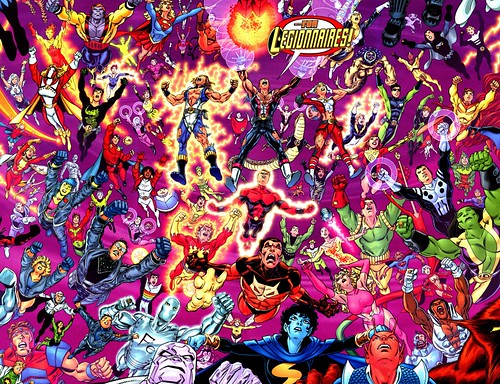
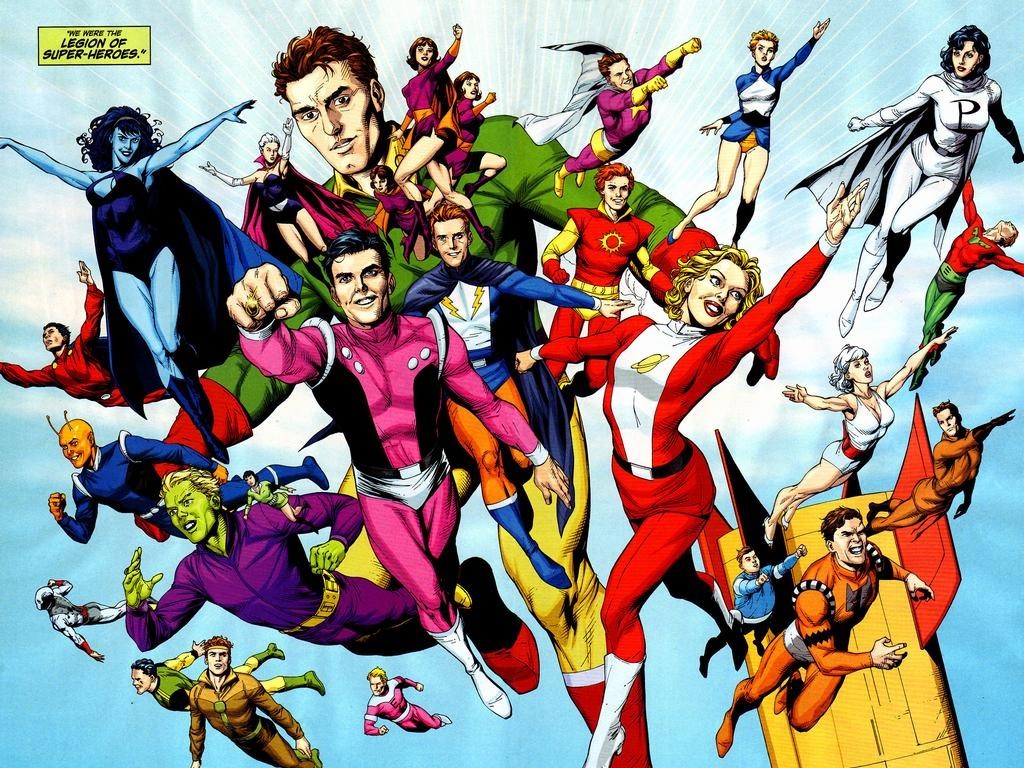
Which makes me think that Dr. Al-Muttawa has basically reinvented DC’s Legion of Super Heroes. Originally conceived for a Superboy story, this is a group of young people from the future who develop various powers and band together to fight…well, that varies somewhat depending on which “continuity” one reads. As does the lineup of heroes, beyond a core handful.

The 99 offers some innovations, to be sure. One character appears to be a superpowered grant writer. And the kid with circuit lines on his face? He’s not green like Brainiac 5. Most significant to its launch, all of the 99 are Muslim; each is supposed to represent a different Islamic virtue. Though those virtues look very much like the virtues of other belief systems.

In one way, this approach is a good fit for the symbolic nature of modern superheroes, as Douglas Wolk discusses in Reading Comics. Each character offers a chance to explore what his or her defining power and virtue mean. In practice, however, The 99 faces some big storytelling challenges.

One is that such a large group presents too many heroes for most readers to track. The Legion of Super Heroes has the same problem. Some fans argue that its characters are simple to keep straight since their professional names state their powers: Lightning Lad, Triplicate Girl, Invisible Kid, Bouncing Boy, Shadow Lass, and so on. That worked fine back when the comics showed them addressing each other by those names every other balloon. Now, in the cause of realism, stories show more of the characters’ private lives, and they address each other by their given names. For most readers a new Legion issue is like tuning into a long-running soap opera they’ve never watched before.

For its established fans, in fact, the Legion’s size appears to be a plus. They apparently go gaga over pictures of the whole group, judging by the number of images available. Can The 99 build to that level of following without half a century of gradual growth?

The second challenge is the tension between collective and individual heroism. Al-Muttawa is trying to make a point about worldwide unity. He sends his characters out on adventures in teams of three or four. (Batch-processing seems inevitable when you’ve got ninety-nine heroes to introduce.) Though readers might identify with favorites, they’re supposed to follow the entire group.

But superhero fans the world over might be seeking a different sort of story. The Atlantic found a “a 36-year-old [Muslim] filmmaker, photographer, and comic-book enthusiast” who said he’s looking for something else:

“I like the image Dr. Naif is bringing with The 99, but unfortunately it’s not very successful here,” he said. Al-Duwaisan still preferred his Batmans to The 99—and not because of too little Islamic subtext, but too much. Al-Duwaisan felt that groups of heroes working collectively missed the very point of the Western comics he adores: the triumph of the individual.

“In the West, there’s one hero,” he said with visible longing. “If there are too many of them, you can’t idolize anyone. I don’t feel the heroism. I am reading Batman because I see part of myself in it.”

11 October 2009

Reason for Robin, #9

Having laid the groundwork by quoting Douglas Wolk’s manner of reading American superhero comics, I return to my series of reasons for Robin.

Reason for Robin, #9: Robin is still a kid.

That statement may seem more than obvious. Youth is the quality that unites all the characters who’ve served as Batman’s partner: Dick Grayson (nineteen years old when he finally gave up the colorful costume), the two Jason Todds, Carrie Kelley, Tim Drake, Stephanie Brown, and now Damian Wayne (who’s all of ten). But that youth is also the key to most of the previous reasons for Robin.

Furthermore, Robin being a kid gives a different meaning to the three other “reasons for Robin” I’ve listed so far: giving Batman someone to talk to, giving Batman someone not to talk to, and comic relief.

A supporting character doesn’t need to be young to bring those last three benefits to an adventure story. Plastic Man’s Woozy Winks, the Spirit’s Ebony White, and the Fighting Yank’s girlfriend Joan are adults who offer the same narrative benefits.

But when adult sidekicks can’t figure out a mystery, botch a chase, or get captured, they look irredeemably incompetent. In fact, the Flash’s hangers-on made that quality explicit: they were called the Three Dimwits. And when such a sidekick happened to be black, or female, the unfortunate implications were clear.

In contrast, when Robin has such problems, they don’t render him or her an incorrigible fool. Readers know Robin is still growing up, so it makes sense that he or she still has stuff to learn.

And that brings us to the symbolic importance of Robin still being a kid. As I quoted yesterday, in Reading Comics Wolk suggests the best way to make sense of American superhero stories is to interpret the main characters as “bold metaphors for discussing ideas or reifying abstractions into narrative fiction.”

Robin, as the original kid sidekick in superhero comics, represents youth and, therefore, potential. The various young people who’ve served as Robin all had different skills and personalities, thus hinting at different sorts of potential, but they all embodied the process of growing up. In contrast, Batman, Superman, Wonder Woman, and other adult heroes appear as fully formed; we expect them and their principles to be tested, but not to develop further.

What the Robins symbolize gives them what Wolk calls “particular allegorical values,” which make them “meaningful parts of the master ‘universe narratives.’” When Fabian Nicieza was tapped to bring the Robin magazine to a close, he expressed the value of the character in just such terms:
the Robin concept is just as vital to the foundation of the DC Universe [as Batman] and has been a bedrock of the mythology since its inception.

The concept of Robin defines the nature of the legacy in the DCU and with that, implies hope for the future, stability coming from the next generation of hero, and on a societal level, it harkens to the need for proper parenting, education and stimulation to help guide the next generation to fruition.
The idea that Robin represents a future generation of crimefighter has been part of the character from the beginning, as this panel from 1940 shows.

More recent Batman comics portray Bruce Wayne as obsessed and emotionally damaged—which only increases the significance of Robin growing up. Here’s how Wolk sums up the meaning of the longest-serving Robins in Reading Comics:
[Batman’s] drive is the kind that parents often pass on to their children; hence his parental relationship with Robin, whose symbolic value is as a son trying to learn from his father’s experience and wisdom without making his father’s mistakes.
We’re seeing that tension play out in DC’s current magazines about the characters. Dick Grayson has taken on the role of Batman with a new style and a new Robin whose mistakes he must correct. Tim Drake has become Red Robin, and is edging toward being as obsessive and cut off as his adoptive father.

NEXT WEEK: If Robin represents youth, what does it mean when Robin gets old?

30 August 2009

Robin: Search for an Ending

As I mentioned last week, the magazines collected in Robin: Search for a Hero show the end of Tim Drake’s career as Robin, which started in 1989. The character has aged about five years in those two decades, and is now ready to move on to a new crime-fighting identity: Red Robin. (Okay, he’s not moving on that far.)

The final issues of Robin are therefore a self-conscious wrap-up of the magazine’s main threads. We can see that in the cover art, especially the first and last issues. The cover of the book (also of Robin, #183) is an homage to the art on the first issue of the Robin miniseries, back in 1991. (Though I don’t actually like that cover, shown below, thinking that it makes Tim look much older than fourteen.)

Likewise, the cover of Robin, #175, shows Tim cradling the wounded body of Bruce Wayne during the “Batman: RIP” arc, just as Bruce had cradled the body of the previous Robin, Jason Todd, on the cover of Batman: A Death in the Family from 1989.

Fabian Nicieza’s task as scripter was made more challenging by some circumstances:

  • He was hired suddenly to replace the magazine’s founding writer, Chuck Dixon--so late that some covers had already been shown to the world.
  • The Robin storyline had to fit alongside the momentous events of Batman: RIP and Final Crisis, in which Bruce Wayne goes crazy and dies (kind of).
  • The story had to lead into DC’s plans to give Tim his new identity as Red Robin--something I suspect the company was working toward since it dropped the green from his costume in 2006.
And of course those issues would also have to tell an entertaining story.

In this arc, therefore, Tim faces versions of three of the teenaged antagonists who showed up early in the magazine’s run: Lynx, Anarky, and the General, having all grown up badly in different ways. He confronts, bests, and eventually reaches an understanding of sorts with his predecessor as Robin, the bitter and recently dead Jason Todd. Robin defeats the villains and brings some peace to Gotham after Batman's disappearance--but at a cost.

Most important for the future, Robin, #181, motivates Tim to put on the Red Robin costume for the first time: he needs its increased cranial protection, having burned the back of his scalp.

In the next issue, the end of the arc, Tim has a falling-out with Stephanie Brown--his ally, occasional girlfriend, and brief-lived replacement as Robin. He tells Stephanie that he doesn’t want to see her Spoiler costume again, opening the door for her choice this month to become Batgirl.

The final page of Robin, #182, shows Tim swinging through the city, a Robin signal having replaced the Bat-signal. The last captions (which serve as Tim’s narrative voice) read:
No guarantees for tomorrow...but come what may--

--the possibilities are endless.
This sentiment matches Nicieza’s perceptive understanding of what the medium’s oldest kid sidekick represents in the DC Universe: “The concept of Robin defines the nature of the legacy in the DCU and with that, implies hope for the future, stability coming from the next generation of hero...”

(Ominously, the early issues of Red Robin suggest that Tim Drake has become rather unstable. We’ll see how that turns out.)

But DC decided it needed another issue of Robin. So #183 shows Tim back in his previous costume facing Lady Shiva, his deadly martial-arts trainer in the Robin miniseries of 1991.

That month DC also mandated that all its magazines have a six-page “Origins & Omens” backup story. In Robin, Tim defeats the Haitian villain who poisoned his mother even earlier in Detective, #621, bringing his adolescence full circle.

I appreciate how DC and its talent approached these issues with a sense of their character’s history. Nonetheless, to my taste this story arc seems frenetic and shallow, with vague villains and lots of unresolved issues. The deaths of two children at the climax are supposed to be tremendously significant for Tim, but it’s barely established that they’re on the scene, much less that they’re characters we should care about. And of course the final chapter/issue steps back from the developments of the preceding story arc.

I also wish DC took advantage of today’s digital production to make their collected editions better than the magazines. In Robin: Search for a Hero no one bothered to fix the misdirected word balloons on page 32 that fuddle up a conversation between Tim and Dick Grayson. And on page 173 three out of the six panels show the same image of Red Robin and Spoiler on a rooftop, copied and pasted like a Wondermark strip. (Andy Schmidt tells me the technical term for this is a “stat panel.”) A monthly magazine deadline makes such shortcuts necessary, but the paperback edition offers the chance to give readers something better.

23 August 2009

Nightwing’s Great Leap to the End

Nightwing; The Great Leap and Robin: Search for a Hero, both published this month, are unusual among collections of superhero comics because they’re both the last of a series.

Normally an ongoing comic book, or any other type of serial fiction, is structured not merely to tell its story, but also to bring readers back for the next issue. The character’s fundamental situation is threatened, but always restored so as to maintain his appeal. The ongoing stories offer an “illusion of change,” a phrase apocryphally attributed to Stan Lee. A profitable magazine’s overall story can’t end even if a “story arc” does.

These collections couldn’t work that way. They take place during and after the events of Batman: RIP, which ends with Bruce Wayne dying, and Final Crisis, which ends with Bruce Wayne dying (don’t ask). That is a fundamental change, albeit a temporary one. DC Comics decided to end the Nightwing and Robin magazines and move their central characters into new identities: Dick Grayson as Batman, Tim Drake as Red Robin. In addition, this month made clear that the company planned to make Stephanie Brown, an important supporting character in Robin, into a new Batgirl.

Thus, scripters Fabian Nicieza (Robin) and Peter J. Tomasi (Nightwing) had to break the usual patterns of their vocation. They had to put their characters through true changes, prepare readers for those characters’ new roles, and provide satisfying wrap-ups to storylines that had rolled along month after month since the 1990s.

On top of all those challenges, it’s evident that DC’s plans were a bit squishy when it came to scheduling the series’ final issues. The scripters didn’t know at the start which issues would be the last. Nicieza talked about this in an interview at Big Shiny Robot:

The truth is the final issue was coming, but which issue would be was not yet set in stone. There were discussions that varied from ending it with #182 and the conclusion of [the arc] “Search for a Hero” or as high as #185 or #186.
I’ll address the results of his effort in Robin: Search for a Hero next week.

In the last Nightwing collection I felt Tomasi struggling to an end. The first four chapters/issues comprise an arc called “The Great Leap.” Dick Grayson confronts Two-Face, established as his particular bête noir among Batman villains back in Robin, #0 (1994), and the Robin: Year One miniseries. Plus, we get to see Nightwing fight half a dozen other iconic Batman villains, though they’re only hallucinations. And on the personal side, Barbara Gordon, Dick’s off-and-on crush since the late 1960s, shows up to boost his computer security and reestablish their friendship. So the story feels like a culmination of his Nightwing career.

That arc came to an end in issue #150 (which also came with a collectible variant cover!). On the last page our hero, having single-handedly saved New York from an attack by a line of acid-spraying blimps, looks up gratefully at the Statue of Liberty. And wouldn’t 150 be a fine number for the last of a series?

But DC needed another issue. So in Nightwing, #151, Tomasi provided an “Epilogue” to “The Great Leap,” with a happier ending for the story’s female lead and another extended conversation with Two-Face (adding little to what the characters already said while kicking each other in the face). Tomasi wraps up some loose ends from his previous arc, collected in Nightwing: Freefall: Dick and his new girlfriend break up, Nightwing confers with Superman and a Green Lantern, Dick goes for a skydiving record.

That issue #151 ends with a lovely three pages showing an evening at Wayne Manor. Working fluidly and wordlessly, Dick, Tim, and Alfred make strawberry shakes and watch The Magnificent Seven. The last page shows Bruce’s empty chair. The movie dialogue provides an ironic comment on crime-fighting. Dick clicks the remote, and the final panel is black. This chapter of his life is over; his life as Batman can begin.
But DC needed another issue. So Nightwing, #152, shows Dick in the batcave, recalling how he became Robin. Suddenly scores of ninjas attack him, demonstrating the Conservation of Ninjutsu. Nightwing must confront another fundamental Batman villain, Ra’s al Ghul. Symbolically, this short tale shows Dick sinking into his legacy as Batman’s heir, ready to step into his new life as Batman.

But DC needed another issue. So Nightwing, #153, shows Nightwing moving out of New York with the help of the Justice Society (it took them one page to move him in, two to move out). In Gotham, Robin and Alfred restore the giant penny to the batcave. Dick and Alfred talk inconclusively about Bruce’s death. A six-page coda shows Dick taking Barbara for a skydive, closely echoing a sequence that appears in Nightwing: Love and War. It’s all perfectly acceptable, but slow and anticlimactic.

And finally the Nightwing series comes to an end. As I said, there are lovely moments along the way, and Tomasi shows how well he understands the character’s roots, strengths, and appeal. But the second half of the Great Leap collection feels like the end of Beethoven’s Fifth Symphony, when the orchestra keeps working up to a dramatic conclusion, only to go back to pumping out chords.

10 May 2009

Fabian Nicieza on Robin

Last month Newsarama offered a somewhat elegiac summary of the character Tim Drake's career as Robin, followed by an interview with Fabian Nicieza, the final scripter of the Robin magazine (at least for now).

Nicieza had the unenviable assignment of picking up that magazine on the fly after DC Comics's sudden break with Chuck Dixon. Dixon developed the Tim Drake character more than any other writer, and his return to the magazine in early 2008 had come with great fanfare. Adding to the challenge, Nicieza had to work around the company's big plans for Batman, including Bruce Wayne's madness and apparent death.

When Nicieza took on that job, the comics press focused on the big plans ahead and who would succeed Wayne as Batman (at least for now), as in this article from Comic Book Resources. There were encouraging hints that he saw the importance of the assignment, such as Nicieza's admission that:

I am feeble enough to have a Robin shelf in my office filled with Robin collectibles, not the least of which is the picture of me dressed as Robin before leaving for a Halloween party in college. Trust me, it’s there, but I don’t think I’ll let anyone see it unless I see some big bucks.
Nicieza's issues received generally good reviews, though of course internet comics fandom is never fully satisfied. Now that the run is done and he has no more issues to pump or plot twists to conceal, he can look backward instead of forward.

I think the Newsarama interview shows how well Nicieza understood the symbolic place of Robin in the Batman saga and the DC Universe. In other words, his ideas agree with mine:
Newsarama: In a single sentence--if you can--summarize Tim Drake’s journey from amateur detective discovering Batman’s identity to his role as a potential successor to Batman in Battle for the Cowl.

Fabian Nicieza: Tim Drake's journey from adolescence to young adulthood has shown the evolution of an individual who has gone from wanting to do the right [thing] with his life to an individual who is living his life in order to do the right thing.

Now, I could say a million things that build on that sentence, but you do have your rules and I must respect them. . . .

Tim's initial desire to become involved in the Bat-verse was never motivated by a need to balance the scales of his own life, it was to help balance the scales in someone else's life, namely Batman.

Though his mother died soon after his journey began, even then, his motivation was never really about balancing those scales and certainly not about revenge.

Tim was simply interested in doing the right thing, making a difference and righting wrongs. I also feel there was a little bit of cocky ego involved too, just a teeny bit, considering here's a kid who figured out Batman and Robin's identities. . . .

NRAMA: Tim Drake’s character was introduced with the premise that Batman needs Robin. After more than a decade of Tim filling that role, does Batman still need Robin?

FN: In my opinion, yes. Others will argue against the point, but I think the role of Batman, as depicted since the post-TV show era of the late 60's, requires a temperance for the character's obsession, or he would drive himself nuts. That doesn't mean that Robin needs to be in every Batman story, just that the character, the concept, needs to be a presence in Bruce Wayne's life.

Robin provides a light to Batman's dark, along with a need to teach and parent. This helps humanize Bruce, which to me, makes for a far more interesting Batman than the obsessive gravelly voiced guy who hides in his cave until it's time to beat someone up. . . .

we also know that the Robin concept is just as vital to the foundation of the DC Universe and has been a bedrock of the mythology since its inception.

The concept of Robin defines the nature of the legacy in the DCU and with that, implies hope for the future, stability coming from the next generation of hero, and on a societal level, it harkens to the need for proper parenting, education and stimulation to help guide the next generation to fruition.
Nicieza also discusses what sets Tim Drake apart from his major predecessor as Robin, Dick Grayson, despite how their characters have occupied the same symbolic space. Those final (at least for now) Robin issues will be published in paperback this summer as Robin: Search for a Hero.

10 August 2008

If the Secrets Must Be Told

Newsarama's interview with current Robin scripter Fabian Nicieza shows how assembly-line comic books are a collaborative, deadline-driven, and sometimes improvisatory storytelling medium:

NRAMA: Okay, by the end of #175, Tim [Drake, the current Robin] has somewhat convinced himself, thanks to Bruce [Wayne]’s journals, that Batman may have gone nuts, and if that’s the case, he’s going to take him down...again, take us inside his head. That seems like a rather hasty conclusion to jump to in light of no evidence that he has, or that he may be lying in an alley, bleeding to death somewhere...

FN: Well, if the secrets behind the comics must be told, [artist] Joe Bennett did a great job under incredibly tight deadline pressure on both these issues, but in #175, he gave me a little more of a superhero dramatic pose than I’d expect for that last splash page, so I had to change my script, which resulted in a little more testosterone on the page--and my dialogue--than I’d intended.

That being said though, I don’t think Tim is jumping to conclusions based on everything that’s been going on the last few months in the Batman title. He is stating possibilities. Of course he’s concerned about Bruce’s safety, but he’s also concerned about what a mad-dog Batman could do to the people of Gotham.

And Tim’s a smart guy. He knows he was drawn puffy-chested on a cliffhanger splash page, so he has to say something appropriately Eastwoodian to carry us over to the next issue. He is very helpful to writers that way. [laughs]
The artwork above is for that issue #175 of Robin. DC's announcement of the magazine still carries the initial credits for scripter Chuck Dixon and artist Chris Batista, who were suddenly replaced this spring.

The cover art, which didn't change, is by Freddie Williams II. Shown above, it's an obvious visual echo of Jim Aparo's cover for A Death in the Family, which chronicled the death of the second Jason Todd, the Robin before Tim, back in 1988. And that in turn was a visual echo of Michelangelo's Pietà.

The new comic book's subtext, in both story and art, is that this Robin might be more mature than Batman.