Showing posts with label COMIC Captain America. Show all posts

02 October 2019

Ray Bradbury’s Rocket
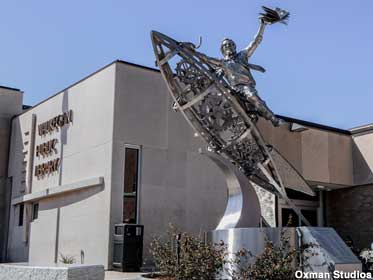
I am not taken with the Ray Bradbury sculpture erected in his native town of Waukegan, Illinois, and unveiled this summer.

Zachary Oxman sculpted the figure of a young Bradbury riding the outline of a rocket, steampunk gears inside. The steel figure waves a copy of Fahrenheit 451.

The design is deliberately “retro” to fit with the mid-20th-century library building nearby, where Bradbury bequeathed his book collection. But the result strikes me as cheesy, diminishing the themes he wrote about instead of celebrating them. “I send my rockets forth between my ears,” Bradbury wrote in a poem, and this turns that metaphor into something solid and heavy again.

I also wouldn’t recognize Bradbury from this statue. I picture him from photos and TV appearances in my youth as a somewhat rounded bespectacled middle-aged man, a chatty dean of American science fiction.

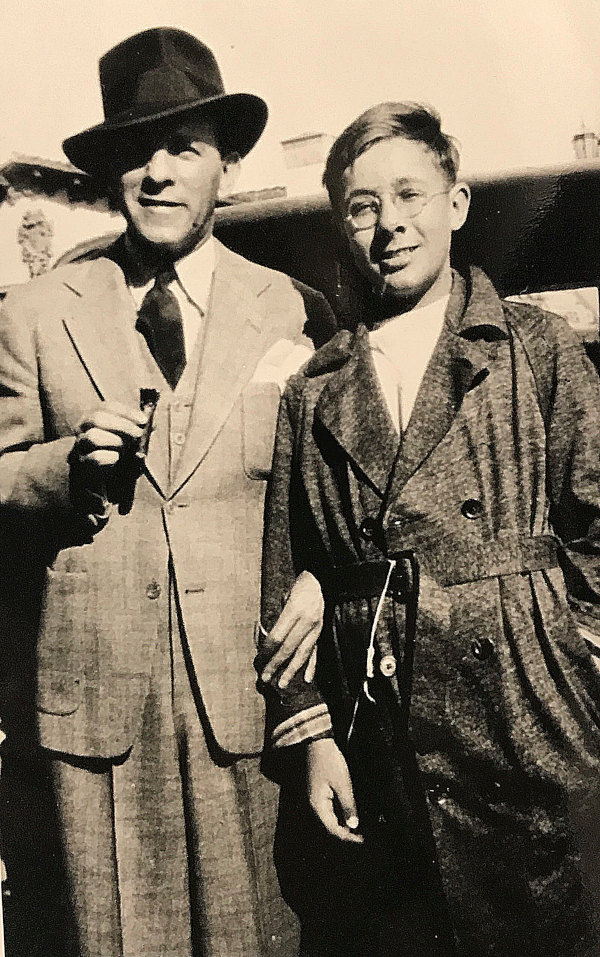
It would make sense for a Bradbury statue in Waukegan to depict him as he looked when he was living in Waukegan. That would be a little kid since the family moved to Arizona when he was six. A young boy dreaming of the future could be iconic but not recognizable. Here’s Bradbury at age three, from the Knopf collection of the Harry Ransom Center. Here he is again, said to be in 1923 but probably a couple of years later.

By age 14, Bradbury was a working writer in LA with hints of how he’d appear as an adult. But I haven’t found any photo of Bradbury looking like the young man in that sculpture. He didn’t wear his glasses for photos in the 1940s, and he had a crew cut through the 1950s. The statue’s combination of spectacles, floppy hair, and svelteness seems like a composite. (Or perhaps Oxman worked from family photos I haven’t seen.)

Lastly, I have to admit, when I see someone clinging to a rocket like that, I can’t help but think of Bucky Barnes about to be blown up by Baron Zemo.

25 November 2018

“I think he should have a kid buddy”

The Library of Congress has a new exhibit featuring a recent donation, Steve Geppi’s vast collection of American comics and pop culture.

George Gene Gustines reported on the display for the New York Times. Many of the items reflect the interplay of comics and other media. For example, there’s the sheet music of a song inspired by the Yellow Kid. There’s the first mockup of the G.I. Joe action figure alongside one of the G.I. Joe comic books. There’s the storyboard for a Mickey Mouse cartoon.

But for the theme of the weekly Robin, the most important item is Joe Simon’s first drawing of Captain America, even before the hero started using a circular shield ( reportedly under pressure from the publisher of an earlier patriotic crime- and Nazi-fighter, the Shield). Created for Timely Comics publisher Martin Goodman, it labels some traits of his costume and logo.

At the bottom of the paper is this note:
Simon created this art in 1940. It shows how the popularity and practicality of the “kid buddy” was already evident to the superhero comics industry, only months after the debut of Robin the Boy Wonder.  And Simon recognized the principal benefit of a sidekick: giving the hero someone to talk to.

13 July 2017

What the New Spider-Man Comes Home to

Back in 2014, it was widely reported that Captain America: The Winter Soldier was a superhero movie crossed with a 1970s political thriller. That’s why the sight of Robert Redford, star of Three Days of the Condor, All the President’s Men, and Brubaker, in the film was so resonant.

In the same way, I think Spider-Man: Homecoming as a superhero movie crossed with a 1980s high-school romantic comedy. The sort of movie on which John Hughes made his name. The genre that such other talents as Cameron Crowe, Martha Coolidge, Amy Heckerling, and Savage Steve Holland contributed to.

In the midst of the usual superpowered action and angst, there are a lot of laughs about the culture of high school, as seen from the student perspective. Adults are either petty tyrants or ineffectual scolds (even Captain America). High-school rituals like the morning news bulletin, homecoming dance, and academic decathlon are both laughable and life-or-death important. Everyone else seems to be having more fun.

In many ways, the high school in Spider-Man: Homecoming is a welcome update to the schools in those earlier movies and in the original Spider-Man comics. Peter Parker attends a high school devoted to science and technology, so by older standards everyone’s already a nerd. His rival Flash Thompson isn’t the football captain; he just has a big mouth and sharp tongue. And the student body is very ethnically diverse.

Spider-Man: Homecoming doesn’t seem shy about its cinematic pedigree. The movie even includes a clip from Hughes’s Ferris Bueller’s Day Off, an iconic example of the genre. The soundtrack features the Ramones, the English Beat, and A Flock of Seagulls. The homecoming dance has an ’80s theme, which would be exotic for characters born in this century but is nostalgic for some of this movie’s target audience.

My friend Dan Mazur has said that he used to enjoy Spider-Man comics and their common theme of “With great power there must also come—great responsibility!” But eventually he noticed that almost every story came back to “With great power there must also come—great responsibility!” And he began to think that comics should find more to say. [More on that here.]

That’s not the theme of this Spider-Man movie, however. It’s not an origin story, as in Amazing Fantasy, #15. We don’t see Peter Parker bit by the spider, we don’t see him try pro wrestling, we don’t see him ignore the burglar who kills his uncle. At no point does he really think about tossing everything away or just showing off, as Peter has occasionally done in the comics and previous movies.

Instead, when Spider-Man: Homecoming starts, Peter is already determined to take on great responsibilities as a costumed crimefighter. Indeed, he’s too eager. The major moment of character growth is actually stepping away from big, flashy responsibilities in favor of staying home. The Homecoming subtitle refers to how the story immediately follows from Captain America: Civil War, the high school dance, and Peter’s decision to focus on his own neighborhood.

The main theme of this Spider-Man is thus the same as those earlier high-school movies: stay true to yourself and your real friends, and you’ll get through this.

19 April 2014

What Will “On Your Left” Mean?

In the discussion of the political implications of Captain America: The Winter Soldier, Greg Carpenter at Sequart found a key in the movie’s strong opening scene. Steve Rogers and Sam Wilson are jogging around the reflecting pool in Washington, the former (having been injected with the super-soldier serum) much faster than the latter:
Each time Rogers approaches Wilson, he gives the same cautionary warning: “On your left.” They are the first words spoken in the new film, Captain America: The Winter Soldier, and they lay the groundwork for much of the political perspective of the film. While this Captain America may sneak up on you—you’ll find him “on your left.”
Not everyone caught that, as Alyssa Rosenberg shows in the Washington Post:
“Captain America: The Winter Soldier” returns time and time again to the idea that the biggest issue in national security is who controls the apparatus, rather than whether we should use certain technologies or techniques at all.
To be sure, there’s an inherent tension between the superhero narrative, or any hero narrative that focuses on an individual or small group of individuals, and spread-out popular power. As a result, some critics have trouble noting the moments built into superhero films that celebrate the crowd: the scenes in the first two Spider-Man movies in which groups of ordinary New Yorkers stand up to villains when Spider-Man is in trouble, for example.

In Winter Soldier, the conflict ends with the spy agency’s (unspecified) secrets being dumped out onto the internet. The directors, Joe and Anthony Russo, noted that as they were filming Edward Snowden released some secret files from the National Security Agency with the same idea. Of course, Wikileaks and Bradley/Chelsea Manning had done something similar already.

Granted, heroic narratives aren’t good at exploring the actual challenges of broad-based decision-making. Jonathan Stroud’s original Bartimaeus trilogy gets to that at the end of the third volume. George Lucas’s Star Wars films and J. K. Rowling’s Harry Potter series declare the superiority of democracy over dictatorship, but they show actual politicking as pretty feckless. L. Frank Baum’s Oz and other magical kingdoms tend to settle for benevolent dictatorships. But the larger the fictional universe, the more stories bottom-up authority allows.

In an article for Business Insider, Jeff Gomez and one-time Robin/Red Robin scripter Fabian Nicieza analyzed how developments in Winter Soldier open up possibilities for Marvel’s overarching movie narrative:
Feige faced a daunting creative challenge for his thriving film series: while Nick Fury and SHIELD served as the perfect impetus for uniting a disparate band of dysfunctional superheroes [in The Avengers], now the filmmakers were stuck with global icons like Hulk, Thor, and Iron Man effectively bowing to a secret American military organization. That had to end, but the choice of making Captain America cut the umbilical cord? Genius. . . .

The result is the fall of SHIELD, and the vast U.S. military-industrial complex no longer stands as the leash-holder to Captain America and his superhero allies. Steve Rogers becomes apolitical, while still representing the world’s perception of American selflessness, justice, and heroism dating back to World War II.
Already the Agents of SHIELD television show is reflecting the new situation (not that I’ve watched it since the pilot). We’ll see if the next set of Marvel moviemakers can fulfill that promise.

18 April 2014

Captain America and the Threat of OIP Derangement Syndrome

As I noted yesterday, some right-wing media organizations responded to The Lego Movie with complaints that it was anti-business. (Others, to be sure, saw it as simply anti-government, and they were fine with that. Critics on the left saw it as about the danger to people of business and government intertwining, as they often warn. In fact, it’s about commercialism taking over entertainment.)

What about the other big superhero adventure of the spring, Captain America: The Winter Soldier? The directors of that film, Joe and Anthony Russo, said months ago that they were modeling it on the political thrillers of the 1970s, with a few over-the-top action sequences thrown in. They cast Robert Redford as a high official because his filmography includes Three Days of the Condor and All the President’s Men. They even dressed him in a 1970s-style three-piece suit, and he still looks good.

Both Christian Toto at Breitbart on the right and Asawin Suebsaeng at Mother Jones on the left picked up on that anti-authority theme by saying the film wouldn’t be screened at the White House soon. Nor, they could have added on the same speculative grounds, in Congress, the FISA court, the Pentagon, or other pillars of the political center and the security establishment.

But John Nolte at the Breitbart site went off the deep end, calling the movie “a blatant $175 million ‘screw you’ to Barack Obama's surveillance state.” One might be concerned about Nolte watching a PG-13 movie without a parent since he doesn’t appear to remember anything earlier than six years ago. But his response is just a symptom of OIP Derangement Syndrome.

The big danger in Captain America: The Winter Soldier is that a government agency wants to launch worldwide preemptive strikes against what it sees as threats to America or democracy. Preemptive action was the core of the “Bush Doctrine,” which Nolte cheered on his old website, now left to drift into the aether.

The “surveillance state” that Nolte blames on President Obama was in fact built by the Bush-Cheney administration. Nolte really should know that because he’s written, for example, about the Washington Post’s coverage of the NSA’s PRISM program, which clearly stated that program was established in 2007. As soon as the Obama administration came into office in 2009, it started to reveal more about the programs it inherited and to put more limits on them.

The disclosures of Bradley/Chelsea Manning and Edward Snowden show that there’s much more we the people have to know. Nolte offered notable praise for Glenn Greenwald for helping to share the Snowden files. Of course, that happened during the Obama administration.

Based on Nolte’s stated support for some of the most egregious Bush-Cheney policies, such as waterboarding, and his decision to become a right-wing media voice (at first pseudonymous, then openly) because he disliked opposition to the Iraq invasion, I can’t help but think that his position on security leaks would have been quite different under a right-wing President.

Likewise, if Captain America: The Winter Soldier had been released under an administration he supported, Nolte would have complained that it was Hollywood’s usual attack on anything good and conservative. That’s been his professional hobbyhorse for years.

In making the security state its major threat, Winter Soldier echoes a common theme of the American left—a theme the American right takes up only when it’s not in power.

TOMORROW: And does the movie really tackle that threat?

15 April 2014

What Captain America Missed Around the World

At one point in the Avengers movie, Captain America is excited to finally recognize one of the pop-culture references people are throwing around: “Flying Monkeys.”

You see, Captain America was trapped in ice at the end of World War 2 and thawed out only recently. When I was a lad, “only recently” meant the early 1960s, which was no longer that recent, but the basic conceit was established.

The new movie series allowed the corporate storytellers to move the date of Cap’s thawing up to the twenty-first century. Chris Evans plays him as a refugee from the 1940s trying to keep up with modern times. He knows the MGM Wizard of Oz but not much since.

The new Captain America: The Winter Soldier movie carries on that theme by showing how Cap keeps a to-look-up list consists of topics he’s missed and needs to look into. These include I Love Lucy, the Moon landing, the Berlin Wall’s rise and fall, and someone named Steve Jobs.

However, As Comics Alliance reported, a Reddit user collected screenshots from different versions of Captain America: The Winter Soldier from around the world, showing that Marvel/Disney tailored the hero’s to-look-up list for different audiences.

For Russian audiences what’s self-evidently important about the last seventy years are Yuri Gagarin, Vladimir Vysotskiy, the USSR breakup, and Moscow Does Not Believe in Tears.

For South Koreans, it’s Dance Dance Revolution, Ji-Sung Park, Old Boy, and the 2002 World Cup in soccer.

For Mexicans, it’s the Chilean miners, Maradona’s “hand of God,” Shakira, and Neri Vela.

And so on. It would make an interesting social-studies lesson for teams to identify what all those variant items are, and why they’re as important to other culture as I Love Lucy is to ours. Every nation has a different perspective on space, it appears, and almost every nation but the US is mad about soccer.

03 February 2012

Romney’s OIP Derangement Syndrome by Proxy

Captain America's ShieldLast month in his State of the Union address (PDF download), President Barack Obama said (among other things):

Tonight, I want to speak about how we move forward, and lay out a blueprint for an economy that’s built to last – an economy built on American manufacturing, American energy, skills for American workers, and a renewal of American values.

This blueprint begins with American manufacturing.

On the day I took office, our auto industry was on the verge of collapse. Some even said we should let it die. With a million jobs at stake, I refused to let that happen. In exchange for help, we demanded responsibility. We got workers and automakers to settle their differences. We got the industry to retool and restructure. Today, General Motors is back on top as the world’s number one automaker. Chrysler has grown faster in the U.S. than any major car company. Ford is investing billions in U.S. plants and factories. And together, the entire industry added nearly 160,000 jobs.

We bet on American workers. We bet on American ingenuity. And tonight, the American auto industry is back.

What’s happening in Detroit can happen in other industries. It can happen in Cleveland and Pittsburgh and Raleigh. We can’t bring back every job that’s left our shores. But right now, it’s getting more expensive to do business in places like China. Meanwhile, America is more productive. A few weeks ago, the CEO of Master Lock told me that it now makes business sense for him to bring jobs back home. Today, for the first time in fifteen years, Master Lock’s unionized plant in Milwaukee is running at full capacity.

So we have a huge opportunity, at this moment, to bring manufacturing back. But we have to seize it. Tonight, my message to business leaders is simple: Ask yourselves what you can do to bring jobs back to your country, and your country will do everything we can to help you succeed.
A few days later Mitt Romney, after buying a solid primary victory in Florida, translated that for people who suffer from OIP Derangement Syndrome:
Like his colleagues in the faculty lounge who think they know better, President Obama demonizes and denigrates almost every sector of our economy.
Which prompted Daily Beast columnist Andrew Sullivan’s immediate response to Romney:
8.44 pm. Everything this man says is a lie. He's doubling down on the big lies I tried to counter in that Newsweek piece. The president Romney is describing does not exist. Obama is demonizing and denigrating every sector of the economy? That is a pure lie. As is the repeated lie that Obama is an appeaser. Has Romney understood what has happened to the Iranian economy these past few months? Does he think Osama bin Laden thinks he was appeased?

Let me just say right now: this speech is the most dishonest, manipulative, disgusting series of lies I've heard in a very long time. And its core premise: that the president hates this country, whereas Romney believes in it. As I said: disgusting. I'm with Newt on this. The man will say anything to gain power.
And that’s both the saddest and the most disturbing part. I don’t think Mitt Romney suffers from OIP Derangement Syndrome. He doesn’t actually believe what he says about the President. He knows that as governor of Massachusetts he championed many things he now says are horrible. He understands that his campaign ads and speeches quote Obama out of context even as he demands that people consider his own words in context (which doesn’t actually help him).

But Romney is convinced that he has to sell this line to the Republican electorate in order to become their nominee. In doing so, he both reassures those voters that he’ll play dirty in the fall and confirms a portion of them in their delusions. Romney doesn’t suffer from OIP Derangement Syndrome, but he’s a carrier.

(Photo illustration above by Dean Trippe.)

06 November 2011

Robin Around the Web This Week

At Comics Should Be Good!, Brian Cronin asked for reader suggestions of the Greatest Tim Drake Stories Ever. That evolved into the Greatest Robin/Red Robin Stories Ever.

Some patterns stood out:
  • Six of the top ten were written by Chuck Dixon.
  • Only two of those ten appeared in the last ten years. Most date from the early and mid-1990s.
  • Many crucial events in Tim Drake’s career (his mother’s death, meeting Spoiler, joining Young Justice, joining the Teen Titans, his father’s death, shift to Red Robin, deducing that Bruce Wayne was lost in time) don’t appear in any of these stories. 
Cronin doesn’t include vote counts, and I may be projecting here, but the level of commentary on those posts makes me suspect fans had a hard time coming up with top ten lists. Yet the same website had another fan poll that placed Tim Drake as DC’s eighth best character this year. (Dick Grayson, coming off a year in the batsuit, came in a solid #3.)

The character of Tim Drake, as a symbol and as a member of the shifting casts of people around Batman and/or of DC’s young heroes, may well be better and more beloved than individual stories about him.

Elsewhere, the artists at Comic Twart focused on Damian Wayne; the panel above comes from Evan Shaner. It looks like some contributors knew much more about the character going in than others. (“Gerads told me this is all that kid says.” “So apparently Damian Wayne is 10.”) The resulting exercise might therefore be less successful than it could have been.

The group’s tribute to Bucky Barnes seems more sure-footed. I especially like Tom Fowler’s mash-up of the finale of Dr. Strangelove with Baron Zemo’s rocket.

04 July 2011

The First Avenger Overseas

The New York Times reported somewhat surprising news about the marketing of the new Captain America movie:
Marvel and Paramount Pictures, which is distributing "Captain America: The First Avenger," figured they would simply release the film as the truncated "The First Avenger" in foreign countries. But in a surprise, Paramount's overseas operation objected, arguing that Captain America had too much brand value, even in spots like France that are leery of embracing Team America too readily. . . .

In the end, the studios decided that Captain America would keep his name in all but three countries: Russia, Ukraine and South Korea. 
Ironically, this movie is set during World War 2, when the US and USSR were allies. There are tales of Captain America fighting against the Nazis alongside the Soviet Army. Of course, the 1950s version of the character was anti-communist, but those years were officially written out of Steve Rogers’s life story when Stan Lee and Jack Kirby revived the character in early 1964.

Since that resurrection, Captain America has usually represented the struggle between America’s high ideals and the realities of our culture and foreign policy. He’s not just chest-beating; sometimes he’s proud and sometimes he’s embarrassed for us all. I suspect Europe respected that idealism.

I’m still surprised about South Korea, though.

23 June 2011

“Just an amazingly good looking guy.”

Folks in the Boston Comics Roundtable alerted me to a new blog by Jim Shooter, editor-in-chief at Marvel Comics during the late 1970s and 1980s, when the company overtook DC not only in innovation but in sales. He began work in the industry at thirteen, scripting stories for DC’s Legion of Super Heroes.

After work at other companies, DC hired Shooter to script some new Legion stories in the past decade. Among the assignments was to take a stab at creating a new Superboy since the courts might assign the copyright of that character to the heirs of co-creator Jerry Siegel. (Long story.) Shooter shared his response in a posting titled “Super Lad.”

I’m among the many people who can’t keep the Legion straight, and I don’t care about the original Superboy. What interested me about Shooter’s posting is what he, as an industry vet, saw as the necessary essence of Superman. In other words, what DC had to retain for a “Super” character if they couldn’t use any of the character history that would become the intellectual property of the Siegel family:
If a Super were anything but a noble being with an iron will and tremendous self control, impervious to the failings bad writers nonetheless foisted upon him or her, the Super would have been a villain. Period. And all the rest of the heroes, all the world for that matter, would have had nothing on their minds, and nothing else worthy of devoting their efforts to than destroying the Super. Period. 
. . .

I see him as a genuine good guy. Someone who does the right thing, who has tremendous willpower and courage, who is smart and reasonable. Smart about using his powers, as he learns how. The nicest, best guy you ever met. NOBLE, in the best senses of the word. Not that he can't make mistakes, not that he doesn't have humanity--but he's the best of humankind, one of the few survivors of his particular kind, determined, therefore, to give a good account of himself. 


Elliot S! Maggin once wrote an imaginary story in which Kal-el did not become Superman. Since that didn't occur, he was chosen as the Green Lantern of his sector because he among all beings there had the greatest courage, greatest will and noblest spirit. Right on. That was ES!M's finest hour.

Fair enough. But comics are a visual as well as verbal medium. How would that character be embodied in art? Shooter wrote:
- A strong, young man's physique. NOT overbuilt, NOT Hercules. Strong-looking but slim. Like Ditko's early Spider-man. An ATTAINABLE build. He's Kryptonian. He doesn't have to be absurdly musclebound.


- Handsome. A really, really good looking guy. No lantern jaw, no jock sensibility. Just an amazingly good looking guy. 


- Haircut: timeless. A haircut that wouldn't look out of place in almost any era. I wouldn't mind something pretty close to Superman's. Nothing dated or trendy. No mullet, no crew cut, no high-and-tight, no long hair, no Pet Detective, no spike-y do, no dreads, no curls, no mop. Timeless.
In sum, a good superhero has to look good. Really good. Even if he’s not musclebound or lantern-jawed, he has to be “amazingly good looking.” Or, as critic Douglas Wolk put it in Reading Comics:
The default style of the superhero mainstream [is] designed to read clearly and to provoke the strongest possible somatic response. You’re supposed to react to it with your body before you think about it. Most of its characters, especially the heroic ones, are drawn to look as “sexy” as possible…
The result is that the most underrepresented group among superheroes isn’t women, or non-white ethnic groups, or sexual minorities—not that those people aren’t underrepresented relative to their proportion of the general public. It’s people who are plain or unattractive.

Male or female, young or old, whatever color or orientation, superheroes are almost all drawn as physically attractive people. The main alternative is physically attractive people who turn into wildly exaggerated monsters.

Comics readers have long pointed out how artists routinely draw female heroes with big busts and little costumes, but are there any female heroes who aren’t conventionally attractive to begin with? As for men:
This is, after all, a genre in which Peter Parker was created to represent nerdy guys.

20 February 2011

Willingham’s oh-so-Brave Stand Against “Superhero Decadence”

Back in January 2009, comics scripter Bill Willingham offered the world a long grumble about superheroes not being as great as they were when he was a child: “The ‘super’ is still there, more so than ever, but there seems to be a slow leak in the ‘hero’ part.”

The essay appeared on one of Andrew Breitbart’s websites, so it’s no surprise that it contained factual omissions and right-wing spin. Willingham’s complaint about lesser heroism turned out to really be about fewer explicit links to America, particularly jingoistic America. “Superman…no longer seems to be too proud of America,” for example.

Unmentioned was how the Marvel comics that Willingham read in his youth also included grumpy heroes, reluctant heroes, and even a Watergate-era Captain America who took another identity after being disillusioned by a right-wing government conspiracy. He had a lot to say about the unsuccessful movie Superman Returns, but nothing about the successful All Star Superman comic.

As commenters pointed out, Willingham was part of the team that plotted War Games, one of the grimmest Batman crossover sagas. It ended with the apparent death of Stephanie Brown, the fourth Robin. Perhaps that experience helped to sour Willingham on “superhero decadence,” but he continued scripting the same series for years afterward.

The essay’s only mention of the Dynamic Duo was:

In my run writing the Robin series (of Batman fame), I made sure both Batman and Robin were portrayed as good, steadfast heroes, with unshakable personal codes and a firm grasp of their mission. I even got to do a story where Robin parachuted into Afghanistan with a group of very patriotic military superheroes on a full-scale, C130 gunship-supported combat mission.
Willingham thus equated being a “good, steadfast hero” with going on a “combat mission” in a country where US troops were also fighting. The actual purpose of that mission matters less than that it’s “gunship-supported.” (It involved monsters. Really.)

In my eyes, that stopover in the military, which appears in the collection Robin: Days of Fire and Madness, was:
  • not an example of Tim Drake’s “firm grasp of [his] mission”; it pivoted on him trying to figure out what his mission should be as he looked ahead to adulthood.
  • out of character for Tim, a Gotham-based crime-fighter sworn to a no-killing ethos.
  • unnecessary as a way of showing Tim to have old-fashioned heroic values. As Robin, he always showed those. His challenge wasn’t morality but capability, given that he was the littlest guy in the fight.
This story came near the end of Willingham’s assignment on Robin. To me it came across as an indulgence of the writer’s own interest in the military; Willingham grew up in a military family, served himself, and routinely addresses martial issues in his series Fables.

Willingham ended his essay with a peroration that worked up the Breitbart crowd, including some who expressed dislike of how “DC went around ‘multiculturizing’ much of their characters” or asked, “Is it America’s fault Belgium doesn't produce comic books?”:
No more superhero decadence for me. Period. From now on, when I write within the superhero genre I intend to do it right. And if I am ever again privileged to be allowed to write Superman, you can bet your sweet bootie that he’ll find the opportunity to bring back “and the American way,” to his famous credo.
Personally, I’d prefer for “the American way” to always align with “truth and justice,” and to let other nations make truth and justice their way as well. But some folks have always preferred the simplicity of “my country right or wrong.”

Having been told by huge media corporations on the political right that huge media corporations are hostile to right-wing ideas, some commenters expressed worry that Willingham would lose his job in comics publishing. I think that’s exactly the wrong way to view this essay.

In January 2009, as Willingham published, he had just started writing Justice Society of America, anchored by DC Comics’s older generation of heroes (i.e., white male heroes invented in the 1940s). I see his essay as the equivalent of promotional interviews on comics websites, the sort in which writer and artist discuss how exciting the upcoming stories will be. It simply spun that buy-the-next-issue message for a different audience: right-wing American men who believed that comic books (and everything else) had gone downhill since their youth.

This essay was simply part of the mainstream comics industry’s entertainment and marketing efforts—which doesn’t mean Willingham wasn’t sincere in his statements. He continued to write Justice Society for years, and his Fables remains the star on DC’s Vertigo list.

Willingham’s abjuration of “superhero decadence” came back to my mind this month as I read some of his latest Fables stories, using characters from the Oz books.

TOMORROW: How is the Fables universe using Oz?

01 August 2010

Reader Response to Robin Removal—Really?

DC Comics’s decision to invite Batman fans to vote via 900-number calls on whether Jason Todd lived or died got a lot of attention within the comics industry, much of it unfavorable.

The fact that fans voted for Jason to die and DC was going through with it got attention outside the industry, particularly a 10 Nov 1988 New York Times article headlined “Holy Bomb Blast! The Real Robin Fights On!”

Reporter Georgia Dullea’s unfamiliarity with her subject surfaced in her repeated reference to Frank Miller’s portrayal of Batman as “The Black Knight.” For quotations, she relied on people within the comics industry.

Sylvia Lamar at the Forbidden Planet store explained fans’ preferences: “Dick Grayson they liked, but Jason Todd was not as popular.” Don Thompson of the Comic Buyer’s Guide criticized the telephone poll itself: “It smacks of the Roman arena, with thumbs up and thumbs down.”

Dullea dug up the requisite voices on either side of the Jason Todd debate. Here’s the pro-Robin statement:

“I voted 10 times to save Robin, and I’ve got the $5 phone bill to prove it,” said Robert Ingersoll, a 36-year-old assistant public defender in Cleveland. “If I had known the margin would be only 72 votes, I would have voted 73 more times.”
Bob Ingersoll wasn’t just any public defender who happened to like Robin. He was writing a column on legal issues in superhero stories for the Comic Buyer’s Guide. Eventually he got into scripting comics himself, and also cowrote the prose novel Captain America: Liberty’s Torch. A year ago, Cuyahoga County basically bought out Ingersoll’s contract to lower its budget. He’s active on cowriter Tony Isabella’s website, but hasn’t resumed his “The Law Is a Ass” column, even as a cranky blog like this one.

On the anti-Robin side was “Rick Schindler of White Plains, who voted to ‘waste’ the Boy Wonder,” but also suspected that Jason would come back from the dead. Is this the same Rick Schindler who wrote for HBO, TV Guide, and now Todayshow.com? If so, the Times reporter interviewed no one outside the popular-culture media.

Finding non-professional opinions of Jason Todd from the late 1980s isn’t easy since that was well before the web made everyone’s opinions available everywhere. Last week I quoted one letter published in Batman, #424, criticizing the character. For the Times comics editor Dennis O’Neil cited others that called Jason a “twerp,” a “wimp,” and a “vindictive, vengeful little brat.”

Other coverage of this controversy in such papers as the LA Times, Chicago Tribune, Boston Globe, and St. Petersburg Times used those same quotations, leading me to suspect they were written off the Times article, not additional reporting. Which leads to the question: what did comics readers from outside the industry say about Jason Todd’s death in 1988?

COMING UP: Two letters from young readers.

11 April 2010

Gerry Conway on Robin in 1981

In December 1981, The Comics Journal published an interview with comics scripter Gerry Conway. This conversation took place during the period when, as recent weekly Robins have traced, Conway was helping to move Dick Grayson out of the shadow of Batman’s cape.

In the interview Conway stated, “I’m tentatively scheduled to write the Robin backup feature in Batman.” Depending on when the interview took place, this might be an early reference to the mid-1981 three-part story about Dick returning to a traveling circus that I described last week. Or it might refer to plans for an ongoing feature that never came about.

Conway expressed a traditional view of Robin, as well as Captain America’s boy sidekick:

Bucky ideally should be about 15 years old, just as Robin ideally should be about 15 years old. They should be on the verge of manhood, they should be on the verge of taking on the responsibility for their own lives, and they should be looking toward Captain America or Batman or whoever as the model on which they want to build their own lives. . . .

Robin now is almost a college graduate in his early 20s, I would guess, or late teens; at the very earliest he’d be 19. So you’ve lost that essential connection.
Conway thus helped to bring Dick Grayson to independence without having a clear sense of what the character would represent after that. No wonder the conclusion to his three-part story—“I am myself!”—is tautological. The question remained: Who is Dick Grayson to be?

Of course, most young people face that question as they enter adulthood. Finding his priorities and confirming his values helped to define Robin’s symbolic value for the next couple of years—but within the pages of the New Teen Titans magazine by Marv Wolfman and George Pérez.

Conway was already scripting most issues of Detective Comics, and he took over Batman with issue #348, in mid-1982. That story brought the Caped Crusader back to Wayne Manor and the bat-cave, returning the saga to its pre-1969 settings. Robin helped moved Batman home, but did Conway have more in mind for him?

As it turned out, he didn’t. Titans artist Pérez described the situation in a 1984 interview archived at the Titans Tower website:
Gerry Conway, who was handling the Batman series at the time, had priority over Robin. Since he was the leader of the Teen Titans, it put us in a compromising position. Marv was being complimented on his characterization, I was being complimented on making Robin look like an adult at last. Yet we couldn't do anything more than just maintain a certain facade; we'd just make a very virile Robin. but couldn't do anything with his personality or his basic character. That was all the responsibility of whoever was writing Batman.

It wasn't until Gerry Conway said that he had no intentions of using Robin that we were given carte blanche. Then, there was talk that they wanted to give Batman a new kid sidekick, in order to bring back the father image of the character.
Conway’s vision that Robin “should be on the verge of manhood” thus opened the door for an older Dick Grayson to become Nightwing, affirming his step into adulthood. Conway went on to introduce the first Jason Todd who, in Detective Comics, #526, first went into a fight as the new Boy Wonder.

29 September 2009

The Psychological Distance of Noninteractive Media

Seth Schiesel sat down to review a slam-bang-punch-’em-out videogame for the New York Times. He ended up having to consider the differences in how stories differ from interactive entertainment in the psychological distance they offer consumers.

Schiesel’s review lays out the premise of the game Marvel: Ultimate Alliance 2:

In a panic, Congress passes and the president signs the Superhero Registration Act, requiring all heroes to submit to government oversight and monitoring. The fearful public approves.

And so the heroes are split between the pro-registration loyalists led by Iron Man, who believe that submitting to the government will increase security, and the anti-registration rebels led by Captain America, who believe that the act is fundamentally, uh, un-American.

You, the player, must choose a side. . . .

This story arc, known as Civil War, was first explored in a series of print Marvel comic books written by Mark Millar a few years ago. I’m not a comic-book expert, but after playing Ultimate Alliance 2 I read the main Civil War books. What I found was a nuanced, probing examination of the interplay between freedom and security that has always defined Americans’ discussion of civil liberties. . . .

Noninteractive media like books and movies allow the viewer some psychological distance from the characters. That sense of remove is a big part of how linear media can explore complex topics of morality: by depicting characters you are not expected to agree with, but merely understand. Great tragedies, after all, are propelled by characters who believe they are doing the right thing, not those trying to be villains.

For instance, a depiction of the psychological struggle of a Nazi soldier as he tries to reconcile his genuine patriotism with a realization that he is serving an evil regime could make a great novel. Books and films are filled with poignant characters who believe they have to do the wrong thing for the right reason. In a civil liberties plot like Marvel’s Civil War, the noninteractivity of print may allow readers to empathize more easily with the motivations of a character they disagree with.

But a game forces the player to occupy a character. That psychological distance is eliminated. And so the other side must be reduced merely to the Enemy. The story of that Nazi soldier would make a culturally uncomfortable, and politically impossible, video game because the player would probably have not merely to witness but also to act out the killing of Allied soldiers and possibly civilians.
One of the benefits of reading fiction, critics have long said, is that it allows us to experience other people’s lives for a time, increasing our understanding and empathy. But can there be too much empathy? Is that effect overwhelming when we’re not simply reading about someone, even reading that someone’s thoughts, but actually making decisions for him?

28 August 2009

What Happened to Jack Kirby’s Panels?

Today is the anniversary of the birth of comics artist Jack Kirby. [Strictly speaking, as I type that was yesterday, but a deadline meant I didn’t get around to this post then. Rest assured, every other blog that even mentions superhero comics commemorated Kirby’s birthday on 28 August.]

I take the occasion to ask a question that often occurs to me when I look at the artist’s earliest and later work:

What happened to Kirby’s panels?

In Kirby’s early superhero comics work with Joe Simon, most famously in Captain America, the panels danced and twisted with the action. Here’s a page from Marvel Mystery, #25, featuring a hero named the Vision. The panels basically follow a 2x4 grid, but their interior borders curve and shimmy, and the fighting figures burst out of the panels in every interior direction.
By the late 1940s, however, Simon and Kirby’s layout style had grown more sedate. The Kirby Museum notes this in an entry on the team's pioneering romance comics:
by the time Simon and Kirby began working on romances they had already abandoned devices they had previously used to make their pages more exciting. Largely gone were the variously shaped panels and in their place would be a pretty standard comic grid. Also the extension of figures outside of a panel into other panels was no longer done.
Of course, romance comics were a different genre from superhero fight scenes. So here’s an example of the latter from Simon and Kirby’s Fighting American in 1953. The panel borders are straight and stuck to a regular 3x3 grid. Though the flailing figures still break through those borders, they didn’t intrude on neighboring panel space nearly as much.
Finally, here’s a page by Kirby alone from 1967, showing Captain America in battle with Batroc. Stan Lee wisely chose not to add any witty banter during these fisticuffs. In this 3x3 grid, the action is wholly contained within the panels, with the possible exception of a slice of the villain’s fist in panel 1. We see the same wide swings and punches as in the Fighting American’s fight, but they’re all cut off at the panel borders.
Perhaps Kirby liked working on regular grids all along, and Simon argued for breaking that frame. In an article on Simon’s early solo work in Silver Streak Comics, January 1940, the Kirby Museum says:
Simon does not seem to be satisfied with a standard panel grid and uses variously sized panels instead. Unfortunately it becomes a bit confusing and Joe sometimes had to add arrows to indicate the proper reading sequence.
Of course, every artist was learning the form back then, so this might not reflect Simon’s long-time preference.

Another possibility is that Kirby’s lean 1950s made him eager to be as productive as possible, and sticking to a grid saved him time in laying out pages. Perhaps different publishers preferred different styles. And finally, there’s the possibility that Kirby just came to like working within his panels instead of smashing them open. As Bully noted yesterday, Kirby knew very well how to break from his usual 2x3 grids for dramatic effect.

02 May 2009

Your Tax Dollars at Work on Comics

This posting is Oz and Ends's observation of Free Comic Book Day. Last month Publishers Weekly's Comic Week brought news that the University of Nebraska at Lincoln has a website of government-issued comics, free for downloading. These include instructional booklets, hortatory stories, and advice about safety on everything from disposing of chemical waste to surviving nuclear war.

As far as I can tell, the earliest example of a government comic in this collection is a 1918 booklet called The Cartoon Book, designed to sell Liberty Bonds. It collects many drawings from political cartoonists of the era, most of them single panels. But two artists used sequential images, like this.
Other examples cover a broad range of topics:

My favorites are, of course, two of the three very special anti-drug issues of The New Teen Titans from 1983. Tomorrow's weekly Robin will look at corporate influence on these comics, and why the Titans were missing their leader.

As government documents, all these comics are in the public domain, and eminently downloadable. But be warned: the pages have been scanned into TIFF format, so a 36-page color comic fills nearly 100 MB.

16 December 2008

Losing Sight of the Mission

From Wired magazine comes word of Eisenhower's military industrial complex morphing into what sounds like a military public relations complex:

A Defense Department project, supposedly designed to support U.S. troops, was used instead to channel millions of dollars to personal friends and allies of its chief. The "America Supports You," or ASY, program was led in a "questionable and unregulated manner," according to a Department of Defense Inspector General report, obtained by Danger Room. At least $9.2 million was "inappropriately transferred" by the project's managers. . . .

"Instead of focusing on its primary mission of showcasing and communicating support to the troops and their families, the ASY program focus [turned to] building or soliciting support from the public," the Inspector General's report notes. In 2006 and 2007, for instance, more than $600,000 was spent ginning up support for America Supports You among schoolchildren. . . .

By mid-2007, allegations began to surface that the Pentagon official in charge of the program, Armed Forces Information Service chief Alison Barber, was improperly redirecting millions of dollars in public funds.

From fiscal years 2004 to 2007, the Inspector General's report notes, Barber funneled $8.8 million in contracts to the public relations firm Susan Davis International--to set up the myriad events, and to promote the ASY "brand." The work was incredibly lucrative; Davis' executives made as much as $312,821 to $662,691 per year. "Paying a public relations contractor annual salaries approaching three-quarters of a million dollars does not appear to be a cost-effective means to support the ASY program and the war fighter," the report observes.

But what made it even harder to stomach was that Davis was a friend of Barber's, and a well-known Republican operative, according to former Defense Department lawyer Diane Beaver.
The institution most hurt by this initiative appears to be Stars and Stripes, which is known for its independence but was used to park funds for public-relations efforts. Stars and Stripes itself noted:
Friday’s report comes on the heels of a separate audit released Thursday which found problems with the internal controls separating Defense Department public affairs activities from American Forces Information Service, Stripes’ now defunct parent organization.
That office was also under Barber's purview.

"Support the Troops" should mean supporting American soldiers--e.g., making the best use of their willingness to serve, not misleading them or giving them illegal orders, equipping them well, ensuring their care if wounded. As this report shows, this Pentagon office wasn't supporting American troops so much as supporting the idea of supporting the troops. And if $8 million went to a friend's public-relations firm instead of body armor or medical care? Well, stuff happens.

The photo above, from the US Department of Defense, shows Barber at a 2005 ceremony with Donald H. Rumsfeld, Rob Steffens of Marvel Comics, Peter Parker, and Steve Rogers.

01 March 2008

Following the Money with Captain America

One of my theories of life is that a surprising amount of what we'd like to consider as artistic change is driven not by individual creativity or cultural trends, but by hidden financial incentives.

This "Follow the money" theory of literature reminds us not to forget that Dickens was paid by the word, or that Twain edited a chapter from Huckleberry Finn because he wanted to make it look better in a set with the shorter Tom Sawyer.

As another hidden financial incentive, I just read this example in the Comics Should Be Good column's periodic rundown of comics urban legends:

In the early days of comic books, one of the more intriguing aspects of comics was the presence of text pages in the midst of comics. . . . The truth of the matter is, to qualify for the second class bulk mailing rate (the same rate given to newspapers and magazines), periodicals were forced to include at least two pages of text.

Therefore, an amusing side effect occured. Desperate for text strips, the publishers would often print whatever was given them, which has led to some DREADFUL fiction over the years (this was Stan Lee’s first work in comics, churning out text pages for Timely when still in his teens).
Indeed, Lee's first professional publication was a two-page story in Captain America, #3, titled "Captain America Foils the Traitor's Revenge." He reprinted it--for nostalgia's sake--in Captain America, Sentinel of Liberty in 1979. It's a dreadful bit of prose, worthy of a eighteen-year-old who thought he was slumming under a pen name. The story leaves no emotion not spelled out, actually uses the word "interestedly," and has a typo in the final sentence. The pacing is only slightly better than Penrod's.

Such stories were long gone from comic books by the time I saw them. Why? The urban legends article explains what took their place:
However, as time went on, and fans became more involved in comics, publishers realized that letters pages could just as easily serve this purpose, so that is why comic books all went to include letters pages - so to achieve their mailing rate.
Marvel comic books also contained the "Bullpen" page in which Lee hyped other titles, praised "the mighty Marvel marching society" for our good taste, indulged in unmatched alliteration and superlatives, and generally dashed off the best prose of his career. And all because of postal regulations.

Those regulations changed in the 1990s, and fan commentary moved to the internet. However, superhero prose still tends to be poor.

(Comic book cover from the Grand Comic Book Database.)