Showing posts with label westerns and other colonial narratives. Show all posts

06 August 2020

Hondo from Story to Screenplay to Novel

In a collection of Louis L’Amour stories, I came across this passage in Jon Tuska’s introduction, explaining how L’Amour’s first sale in the western genre eventually produced his first bestseller:
L’Amour sold his first Western short story to a slick magazine a year later, “The Gift of Cochise” in Collier’s (7/5/52). Robert Fellows and John Wayne purchased screen rights to this story from L’Amour for $4,000 and James Edward Grant, one of Wayne’s favorite screenwriters, developed a script from it, changing L’Amour’s Ches Lane to Hondo Lane. L’Amour retained the right to novelize Grant’s screenplay, which differs substantially from his short story, and he was able to get an endorsement from Wayne to be used as a blurb, stating that Hondo was the finest Western Wayne had ever read. Hondo (Fawcett Gold Medal, 1953) by Louis L’Amour was released on the same day as the film, Hondo (Warner, 1953), with a first printing of 320,000 copies.
Making the Hollywood connection was clearly important to L’Amour’s career path, which at this critical point hardly followed the model of a lone author sticking to his creative vision, unswayed by money and celebrity.

The movie Hondo couldn’t match up to George Stevens’s Shane, a masterpiece released a few months earlier. Jack Schaefer’s novel Shane is quite good as well. As with L’Amour, it was Schaefer’s first successful foray into the western genre, and it defined his career.

10 July 2020

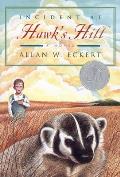
How a Real Story Became Incident at Hawk’s Hill

In 1873, a young boy went missing from his family’s farm in Manitoba. After more than a week, a man of Native and European ancestry found him hiding in a badger hole. That much we can read in nineteenth-century sources from Winnipeg.

In the early 1900s the nature writer Ernest Thompson Seton picked up that story from some Manitobans. He published a version that went into much more detail about how the little boy had actually shared that hole for days with a mother badger that had recently lost its young. Seton or his informants turned the mysterious event into a morality tale, which he published in at least three books.

This 1960 article from the Manitoba Historical Society’s Manitoba Pageant magazine mentions some other local recountings: by Archbishop Samuel Matheson in 1936, in Country Guide in 1951 by Margaret Arnett MacLeod, by the Manitoba Free Press in 1953. I haven’t seen those versions, so I don’t know what new details they provide and what evidence they were based on.

At some point the American writer Allan W. Eckert (1931-2011) came across Seton’s version of the story. Eckert had made himself a specialist in ecological writing, penning most of the scripts for Mutual of Omaha’s Wild Kingdom. He also found a niche writing on Native Americans, including outdoor dramas about Tecumseh and Blue Jacket. (That pairing of nature and Native Americans probably reflects a bias within our culture.)

Eckert’s nonfiction tended toward the imaginative. One of his early magazine sales was an article for the American Legion magazine in 1962 about the disappearance of the US Navy air training mission Flight 19 off the coast of Florida. Eckert appears to have added details not in the documentary record, and that event later became a keystone of the “Bermuda Triangle” legend.

Likewise, Kirkus said of Eckert’s 1992 biography of Tecumseh, A Sorrow in Our Heart, “in its interpretative zeal it strays from, or at least embellishes, the historical record to the point of being suspect.” Even Kirkus’s good review of That Dark and Bloody River noted Eckert’s method of “'reconstituting' credible dialogue among people in briefly reported events.”

On the other hand, Eckert’s fiction was often based closely on historical fact. His first novel was about the extinction of the great auk. Another was based on an event in the life of Daniel Boone. In the late 1960s Eckert started a series of historical sagas about the “Winning of America.”

Eckert saw the skeleton of a novel in Seton’s tale of the lost boy and the badger. The tale offered a chance to write about both the frontier past and the natural world. And it came with the gloss of nonfiction. When Eckert published his novel Incident at Hawk’s Hill in 1971, he stated up front in a short author’s note, “The story which follows is a slightly fictionalized version of an incident which actually occurred at the time and place noted.” Toward the end of the book, Eckert introduced characters who shared the names of two of Seton’s informants.

Eckert changed some details of the story, starting with calling the little boy not Harry (or Willie) Service but Benjy MacDonald. Seton had written that the event took place near “Bird’s Hill,” and Eckert turned that into “Hawk’s Hill,” named after a hawk the MacDonalds see. (The original Manitoba landmark was named after a settler named Bird, not an actual bird.)

Many other details and the plot of Eckert’s story came directly from Seton’s narrative. From the outset, the little boy shows more affinity for animals than for people. Seton’s villain—a nasty neighbor named Grogan—appears under the name of George Burton. He’s not a “half-breed,” however; in fact, he’s cruel to Natives as well as animals. As in Seton’s story, Benjy wanders away after a prairie chicken and needs to take shelter from a storm. A mother badger has been injured in the villain’s trap and lost her babies, leaving her with unfulfilled maternal instincts.

The real boy was lost for about ten days, but Incident at Hawk’s Hill draws that time out to two months. Eventually, Benjy is rescued by a relative rather than (as with the real boy) a stranger; where Seton wrote that that relative was a cousin, Eckert found more drama in making the rescuer a brother.

When Benjy returns, he initially behaves like a badger, but eventually returns to human behavior, stronger for his experience in the wild. Finally, just as in Seton’s telling, the villain shoots the badger, not realizing it has become a family companion, and the family unites to drive him away. The experience brings the MacDonalds closer, particularly father and son. But the family has also decided, with a visiting archbishop’s help, to keep the full story secret so as not to make Benjy appear stranger than people already think of him.

Eckert didn’t write Incident at Hawk’s Hill for children. The point of view skips around among many characters—adults, children, badger, and omniscient narrator. Though six-year-old Benjy is a central character, for many pages Eckert describes him entirely from the outside, and not in appealing terms—he’s small for his age, developmentally odd. It takes several chapters before readers are privy to Benjy’s thoughts, and then only when he’s the only human in the scene. Much of the book follows the drama of the MacDonald family searching for him or reacting to his return.

The early reviews treated Incident at Hawk’s Hill as an adult novel. Critics focused on Eckert’s reputation as a nature writer, with the New York Times calling the book a “folk fable” written “without recourse to undue anthropomorphism.” Kirkus’s reviewer, who could barely stand the story, concluded, “Were it not for Mr. Eckert’s natural history credentials one might think he had been sniffing too much meadow grass.”

Soon, however, people began to view Incident at Hawk’s Hill as a book for children. It was, after all, about a young boy and an animal making friends. It was on the short side, well under 200 pages. And it had pictures. Little, Brown commissioned scratchboard art from John Schoenherr, who had illustrated Sterling North’s Rascal (1963) and Walt Morey’s Gentle Ben (1965)—two novels about boys and animals written for children. (Schoenherr had an earlier career as a science-fiction illustrator. He would go on to win the Caldecott Medal for Owl Moon.)

The Bulletin of the Center for Children’s Books deemed Incident at Hawk’s Hill “An adult novel that should appeal to many young readers.” And in 1972 the novel was named a Newbery Honor Book. That year the judging committee appears to have been unusually generous, naming five Honor Books, more than in any other year in the 1960s and 1970s. From then on, Eckert’s novel was treated as a children’s book.

Disney adapted Incident at Hawk’s Hill into a 1975 television movie called The Boy Who Talked to Badgers. This treatment made Benjy, played by ten-year-old Christian Juttner, more of a likable hero. It switched some episodes around, but the basics of Seton’s and Eckert’s story remained. One notable addition was Denver Pyle as narrator, revealed at the end to be Benjy grown up.

Almost two decades later, in 1998, Eckert published Return to Hawk’s Hill, starting at the end of the first novel and then going over much the same ground. Benjy, a little older, wanders off again. Even the villain returns, despite having been run off before. But the new story had one major difference. This time, instead of a badger Benjy falls in with a community of mixed Cree and French descent who look after him, and his father learns to apologize for his prejudice against these Métis.

Return to Hawk’s Hill thus restored the helpful role of Métis in the real story of the lost boy in Manitoba. As specified in the nineteenth-century sources, a man of Cree and European ancestry rescued the boy from the badger hole. Seton’s early-1900s version had not only erased that rescuer from the story but made the villain a “half-breed.”

I have no idea whether Eckert had learned of those original sources by the time he wrote Return to Hawk’s Hill and set out to fill a deficit in his earlier novel. He may simply have wanted to create a sequel to one of his most successful books and looked to his interest in indigenous North Americans for inspiration. Either way, he added yet more significance in the mysterious story of a lost boy in the badger hole.

TOMORROW: Further meaning for 21st-century readers.
05 May 2020

Rio Grande and Roman Riding

Rio Grande is the third western that John Ford made about the US Cavalry with John Wayne as one of the stars. Ford made it only because the head of the Republic studio demanded another western before financing the movie Ford really wanted to make, The Quiet Man.

As such, Rio Grande was quickly shot, with even more continuity lapses than usual. (Ford always delivered minimal footage so the studio couldn’t edit his movies into something he didn’t want.) There are a few too many musical numbers, and the central story of a cavalry colonel, the wife he won during the Civil War, and the son he barely knew who becomes one of his recruits gets played out but not deeply explored.

At the same time, Rio Grande works. Shot in the Moab Valley of Utah, its visuals are amazing. Wayne and Maureen O’Hara are strong in their roles, and Ford’s usual cast of supporting players enact their usual parts well. The jokes land. The final action sequence is set up by just a couple of shots in the opening montage. The movie might have been a masterpiece if its makers had put more into it, but it’s as entertaining as it needs to be.

One of the most impressive scenes comes early as a sergeant, played by Victor McLaglen, challenges the new cavalry recruits to do “Roman riding,” standing astride two galloping horses. There’s no reason for this to be in the movie but spectacle. That skill never comes back later in the action, but it looks good on screen. And it looks even better when you realize that the actors—Ben Johnson, Harry Carey, Jr., and Claude Jarman, Jr.—performed the Roman riding themselves.

Now I knew Johnson got into the movies as a horseman, supplying horses and then doing stunts before becoming an actor. But Jarman started out as a child star in The Yearling. I had to go back in the video to confirm that yes, there’s one unbroken shot of him vaulting onto two horses, standing, and riding off. So I went hunting for the story behind that sequence.

A few years back, Arthur Arnell posted excerpts from a conversation with Carey on a John Wayne discussion site. Carey recalled his and Johnson’s first conversation with Ford about the movie:
The old man sat there for a while, and finally said, “You guys know how to Roman ride?”

I said, “No, sir,” and Ben said, “No, sir,” and Ford said, “You’re going to have to learn it; we’re going to have Roman riding!”

We knew what it was, and Ben being real careful said, “Well, Mr. Ford, how long before we have to know how to do it?”

And he said, “A month.” So Ben looked at me and I looked at him and we both thought, “Oh, s**t!”
The two actors started training. At first it was so difficult that after riding sessions they “had to go to a nearby town to visit a physiotherapist,” Arnell reported. But after three weeks they could show off their new skill to the director.

Ford was pleased. In fact, Carey recalled, “I’d never seen the old b******d so happy.” And he decided, a week before filming, that Claude Jarman should also ride that way.

Jarman was only fifteen years old at the time, though tall enough to play a West Point dropout. According to Carey:
Now he looked like he barely rode at all, but he came out, croupered those horses, jumped up on my team, and went down the road no practice.
So basically the scene in the movie played out just like real life.
Ben said, “Well, Jesus Christ.” We wanted to crawl under a board. And old man Ford said, “Well, Jesus, it took you guys three weeks, for Christ’s sake.”

Ben said, “He’s never been hurt before, Mr Ford.”

Ford said, “What?” He made you repeat everything.

“Well, he’s never been mashed up or hurt, he’s not afraid.”

“You’re goddam right, he’s not afraid!”

So Claude rode, too. He used my team since we only had two. It was unusual for people who had critical parts in a movie to do that kind of stunt, but Ford would do it. We shot that Roman riding sequence right in the middle of the picture, and we were even out Roman riding every morning on location.
Carey added that Jarman, unlike his adult castmates, “felt no ill effects whatever” from standing on horses.

A man named William T. Brooks, who had been on extra on Rio Grande, added some moviemaking details on that discussion site:
They were not attached to the horses, but they did have on black rubber sole tennis shoes. But if you look close the next time that you watch the film, you might see that the horses have “trace straps” holding them together so they would not go in different directions.
And the final word from Jarman’s autobiography:
They seemed as surprised as I was when I stood up without a hitch on my first try! Ben even seemed a little chagrined that I took to trick-riding so easily and was heard to mutter, “The reason that kid did it so easy is that his feet are so goddamned big they just wrapped around the horse’s back!”

06 April 2020

The Truth of True Grit

Charles Portis’s True Grit is a straightforward manhunt story elevated into a great American comic novel by the narrative voice.

The narrator is Mattie Ross, a fourteen-year-old determined to track down the man who killed her father and bring him to justice—at an affordable price. To do this she hires one-eyed deputy marshal Rooster Cogburn and forms an awkward alliance with Texas ranger LaBoeuf.

The very first paragraph ends with an accounting of the money Mattie’s father had on him when he was killed. Mattie knows that figure because she manages the business of the family farm. She speaks with the fiercest emotion when striking a financial bargain with horse traders, bounty hunters, and other men. At the end of the novel we learn that she’s grown up to run a private bank.

But Mattie Ross doesn’t want money for its sake, or for luxuries. She’s ready to endure privation and danger, defying the bounty hunters’ commands that she go home and leave the tracking to men. Money matters to Mattie because it’s how she measures fairness in the world, and fairness is her real concern.

Mattie is not out to make friends. She speaks bluntly and judgmentally to everyone she meets. She exasperates Cogburn and LaBoeuf until eventually they realize her integrity, and that they’re not getting rid of her. By the end of their trek, they risk their lives to save her. Then the three characters go their separate ways, never seeing each other again.

Others perceive the potential sexual tensions in a young girl traveling through unsettled territory with older men. LaBoeuf tells Mattie that he first thought she was pretty. But Mattie herself never shows any feel for sexual or romantic attractions. As an adult, she is a contented maiden lady.

I came to view the character of Mattie Ross through the lens of autism spectrum disorder, and I’m not the first to do so. Caroline Narby wrote such an interpretation for Bitchmedia. This Goodreads member named Stephanie did the same.

When Portis wrote True Grit in 1968, pretty much only psychiatrists knew about autism, and the syndrome was widely attributed to “refrigerator mothers” and other nonsense. The term “Asperger syndrome,” which seems to be the closest category to describe Mattie’s character, wasn’t coined until 1976. The recognition that some people with autism function well in certain fields, such as financial analysis, while having trouble with everyday social relations was well in the future.

But goldurnit if Mattie Ross doesn’t come off as one of the most incisive portraits of a character on the autism spectrum. While she looks for “true grit” in Cogburn, she demonstrates that integrity, drive, and unwillingness to compromise in herself.

There have been two movie versions of True Grit, the first made in 1969 when the book was still new. John Wayne played Rooster Cogburn as a semi-parodic version of his usual persona and won an Oscar for his troubles. However, writer Marguerite Roberts, director Henry Hathaway, and actress Kim Darby never seem to have a handle on Mattie Ross’s character, portraying her as a teenager with the stubbornness of a child.

In contrast, Joel and Ethan Coen’s 2010 version of True Grit is built around Mattie. The scene of the ferry crossing shows the difference: in the first movie, we arrive at the ferry with Cogburn and LaBoeuf and view Mattie’s crossing at a distance. In the second film, it’s the other way around.

Portis’s narrative voice and dialogue fit right into the Coens’ usual combination of high and low rhetoric. Hailee Steinfeld played Mattie with the right exasperating exactitude, her determination not childish but single-minded.

Parts of the first True Grit movie are entertaining, but the second is really good. And the novel is a masterpiece.

21 January 2020

The First Whiff of Gunsmoke

In the late 1940s the head of CBS, William Paley, asked his staff to develop a radio drama based on the concept of “Philip Marlowe in the early West.”

At the time, most western shows on the radio were aimed for kids, in the mold of The Lone Ranger. In contrast, this show was supposed to air in the evening and appeal to adult listeners.

CBS executive Harry Ackerman, who produced the Philip Marlowe radio show, had writers Mort Fine and David Friedkin take one of their scripts from Mike Shayne, another hard-boiled detective show, to create a pilot called “Mark Dillon Goes to Gouge Eye.”

The influence of Raymond Chandler on that script is obvious. Dillon serves as narrator as well as protagonist, his voiceover is full of elaborate metaphors. The plot checks off several requirements of the hard-boiled genre, such as the detective being knocked out for a while.

In the summer of 1949 Ackerman recorded two versions of the pilot with different actors playing Mark Dillon. But then the project stalled over contract issues.

A short time later, Philip Marlowe producer Norman Macdonnell and writer John Meston also started to develop an adult western radio drama. They produced an episode of their series Romance called “Pagosa” featuring a lawman named Jeff Spain. Macdonnell and Meston proposed a “Jeff Spain” show.

Ackerman told Macdonnell and Meston that CBS was ready to air their adult western, but it had to grow out of the network’s existing pilot. And it had to be called Gunsmoke.

With a hole opening in the network’s schedule in early 1952, Macdonnell and Meston had only a couple of weeks before going on the air. They changed the lawman’s name to Matt Dillon, cast busy radio actor William Conrad in that role, and recorded the first episode in time to air in April.

Gunsmoke had little to no narration after the first episodes, but the voice of the protagonist introduces each show in full Chandleresque mode:
I’m that man, Matt Dillon, United States Marshal–the first man they look for and the last they want to meet. It’s a chancy job, and it makes a man watchful…and a little lonely.
The first episode starts with the murder of a man who has just robbed a bank out of desperation and gets darker from there, with Dillon shooting the dead man’s brother when he comes leading a lynch mob. The marshal snaps at friends and locks up an innocent man on little evidence. The town doctor is gleeful over the number of corpses to autopsy.

Yet the most direct signal to listeners that this was not your kid’s western might come in the character of a young runaway whom Marshall Dillon tries to take under his wing. Billy was played by Dick Beals, an actor who had a glandular condition that meant his voice never deepened, so he played a lot of child roles on radio and in cartoons.

As the shows ends, Dillon realizes that young Billy knifed that bank robber to steal his gun. But by then the boy has grabbed a horse and ridden off to a life of crime under the name of, as the episode title says, “Billy the Kid.” So not only was this not a kids’ western, but the cute little kid was the most hard-boiled of them all.

(All episodes mentioned here available through the podcast OTR Westerns.)

29 August 2019

Thundering Herds

The Thundering Herd was another Zane Grey novel made into a movie by Paramount, and then remade by the same studio with the young Randolph Scott. (Later still it was retitled for television as Buffalo Stampede.)

In this case, the reason for the remake was the advent of sound pictures. The first version was a silent made in 1925.

The 1933 sound version slipped into cinemas before the Hays Code took real effect. We thus get to see that the villain has unmistakably lascivious aims on his stepdaughter. We get to see a morally ambiguous older woman do away with three men.

As with The Fighting Caravans/Wagon Wheels, footage from the earlier movie was reused and became some of the best material in the new film. The screen shows us actual thundering herds of stampeding buffalo! Stage coaches and wagons chasing across the plains! Scores of Native Americans and European settlers riding into a fight!

The main disadvantage of reusing the old footage is that Randolph Scott had to wear a thin mustache to match the star of the earlier movie. Other players such as Noah Beery, Sr., and Raymond Hatton simply had to look a little younger since they played the same role in both versions.

Among the supporting cast were Buster Crabbe, then on his way up to stardom, and Harry Carey, who was descending back into supporting roles as he aged. Like Beery, Carey had a namesake son who would also go into pictures and eventually costar with Randolph Scott.

24 August 2019

The Journey from Fighting Caravans to Wagon Wheels

In 1929 Zane Grey published The Fighting Caravans, a novel about a scout who leads wagon trains across Native American lands to the Oregon Territory. Grey was already a best-selling, brand-name novelist with a deal at Paramount, and that studio came out with a movie version of the book in 1931.

Aside from the basic situation, however, the Fighting Caravans film had little to do with Grey’s novel. The book follows hero Clint Belmet from childhood to a career as a cross-country “freighter” driving wagons. He loses his mother, childhood sweetheart, father, best friend, dog, childhood sweetheart’s adoptive father, and childhood sweetheart turned fiancée to various groups of Indians. At the end [SPOILER] he finds his childhood sweetheart again.

In contrast, the movie focuses on the movement of a single wagon train. Gary Cooper plays Clint Belmet, a scout rather than a freighter. Orphaned as a child, he’s been raised by two grizzled scouts; those characters come not from the novel but from a previous Paramount western, The Covered Wagon (1923). At the start of the story, Belmet and a French woman meet cute in Independence, Missouri. They pretend to be married, he to get out of jail and she because she thinks single women aren’t allowed in the wagon train.

A lot of the movie’s comedy involves Belmet trying to enjoy the benefits of that sham marriage. Meanwhile, his two dads try to keep him away from women. Also along on the journey is a wagon of what are obviously, if not explicitly, prostitutes. [SPOILER: Those women all marry men from the wagon train at the end of their journey.]

The most striking parts of The Fighting Caravans come from the second unit, which filmed an actual long train of wagons moving up and down hills, across snowy plains, and over rivers. Those long shots show where the movie’s budget of close to a million dollars went. I assume the men moving the wagons in those scenes had actually done that work as a living not too long before.

In 1933 Paramount released a second adaptation of Grey’s novel, this time titled Wagon Wheels. Why so soon? Evidently because of the Hays Code. Though the major Hollywood studios officially adopted that set of moral guidelines in 1930, the first couple of years of enforcement were a joke. Indeed, in 1931 The Hollywood Reporter quoted a screenwriter saying, “The Hays moral code is not even a joke any more; it’s just a memory.” But more public pressure forced the studios to strengthen the system, and by 1934 it had become a rigid set of rules. The Fighting Caravans had no chance to get past the censors into theaters again.

Wagon Wheels was just as far from Grey’s novel as The Fighting Caravans was, but it was almost as far from its cinematic predecessor. The hero was still scout Clint Belmet, now played by Randolph Scott. He was still working with two grizzled older scouts, but there’s no suggestion those men constituted a family. And the new movie had an entirely different attitude toward marriage.

The female lead was Gail Patrick, not yet typecast as the overly respectable other woman in screwball comedies but respectable enough. She played a young widow with a little boy—actual four-year-old Billy Lee, enjoying himself immensely. There’s no fake marriage. Instead, she and Belmet start out at odds and become close over time. The old scouts don’t try to get in the way of that relationship; in fact, one of them marries another woman in the train. There’s no wagon full of ladies of the evening, to be redeemed or not. What’s more, there are multiple musical numbers.

The major overlap between The Fighting Caravans and Wagon Wheels is the footage of the wagons on the move. And that’s because it’s the same footage, simply recycled and redubbed into the new movie. That’s why Paramount could make Wagon Wheels for only a quarter of the cost of the earlier picture. And, now that the Hays Code was in force, it could play in theaters and later on TV.

19 August 2019

Rethinking a Decision at Sundown

I thought I’d watched all seven movies in the “Ranown Cycle” of westerns directed by Budd Boetticher and starring Randolph Scott, most produced by Scott and Harry Joe Brown and written by Burt Kennedy. But I’d missed Decision at Sundown—until last week.

As in most of the cycle, Scott (almost sixty years old in 1957) plays an experienced westerner on a mission of revenge. In this case, he comes to the town of Sundown to call out a man he holds responsible for his wife’s suicide.

A hallmark of these westerns is that their villains can be as charismatic and more rounded than Scott’s protagonists. Indeed, sometimes the villain in one movie even echoes the lines of the hero in another. They’re all men who refuse to change, heading for a collision.

Decision at Sundown takes that mirroring to its furthest point. Scott’s character first appears stopping a stagecoach at pistol point. Meanwhile, his antagonist, played by John Carroll, is treating the whole town to drinks to celebrate his wedding.

Of course, that antagonist is a crooked town boss. He’s throwing over his long-time lover for this advantageous marriage. Yet he’s also in love with his new bride. Most striking, he doesn’t hide his past or his methods—he’s one of the movie’s truth-tellers.

Scott’s character interrupts the wedding and winds up besieged in a livery stable. The boss sends his hand-picked sheriff and deputized gunmen after the interloper as the cowed townspeople wait out the conflict in the saloon.

As the action rises, however, the main characters decline. Of course, in this sort of story we expect the villain to be cut down. But the action reveals Scott’s character as more petty than principled, and he gets his only friend killed to preserve a delusion. In the end, both main characters ride out of Sundown diminished.

Boetticher considered Decision at Sundown to be a failure. Certainly other films he made with Scott and Brown, such as Seven Men from Now and Ride Lonesome, are more stirring. But this one is an effective, character-driven story, not to be missed in the bunch.