Showing posts with label BOOK Patchwork Girl of Oz. Show all posts

04 April 2022

The Opening of the Emerald City

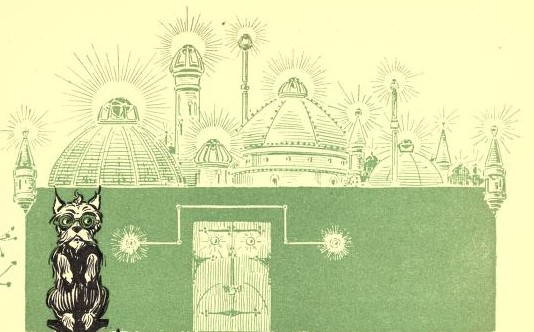
My last posting explored the location of the original gateway into the Emerald City, the one Dorothy and her friends use in L. Frank Baum’s The Wonderful Wizard of Oz.

The travelers come to an emerald-studded gate at the end of the Yellow Brick Road. That outer gate leads to a room inside the thick wall with an inner gate on the other side. The little man inside is therefore called the “Guardian of the Gates” even though there is only one opening the in wall. (With his typical inconsistency, Baum also called this character the “Guardian of the Gate,” sometimes within the same chapter.) Thus, the many early references to the city “gates” don’t mean there’s more than one gateway through the wall.

When characters arrive at the city in The Marvelous Land of Oz, Baum describes their experiences in much the same way as in the first book. The Guardian of the Gates greets them and hands them off to the Soldier with the Green Whiskers. Characters speak of “the gate” of the city.

At the same time, it’s clear that there have been changes in the Emerald City. While before the gate was studded with emeralds, the jewels inside the city only appeared to be emeralds because people wore green spectacles. In Land the city contains some real jewels. General Jinjur and her soldiers don’t fear blindness without the spectacles.

More pertinent to this inquiry, in Wizard the Guardian tells Dorothy and her friends there’s no road to the west because no one ever travels that way for fear of the Wicked Witch. In Land the Sawhorse follows “the road to the West.” It’s not clear whether this path begins at the same gate where the Yellow Brick Road ends.

Finally, toward the end of Land Baum tells us that “Jinjur had closed and barred every gateway” into the city. While other passages in that book refer to “the gate” as if there’s still only one, the phrase “every gateway” definitely implies that by the time of Jinjur’s brief rule the city had more entrances.

Once again, this fits with what we know about overall politics in Oz. When the Scarecrow becomes ruler of the Emerald City at the end of Wizard, the Wicked Witches of the East and West have been eliminated. He’s on good terms with Glinda to the south. His friend the Tin Woodman will now govern the west. It would be safe to welcome visitors to his city.

I therefore surmise that between Wizard and Land the Scarecrow began the process of building more gates into the Emerald City walls. Perhaps not as large as the original gate, or perhaps (given the peacetime conditions) larger. Likewise, the Scarecrow and Tin Woodman probably promoted the new road from the city to the west.

Commerce and travel between the parts of Oz was probably still slow in this period. The Scarecrow met Gillikins so rarely that by the time of Land he hadn’t learned they speak his language. Yet General Jinjur could assemble an Army of Revolt of young women from all four outer realms of Oz. (Indeed, Jinjur’s uprising might have been the first pan-Oz movement, at least for several decades.)

Another sign of Oz opening up to travelers appears when we consider the “road to the South” to Glinda’s castle. At the time of Wizard, that route ran into the Fighting Trees, the walled China Country, a dark and boggy forest, and the Hammerheads, who refused to let anyone hike over their hill. None of those obstacles ever appear in the Oz books again, and characters make many easy land journeys from the Emerald City to Glinda’s home. 

What could produce that change? The most likely answer is Glinda the Good Sorceress. With the Wizard in power, she might well have appreciated having several difficult obstacles between his power base and her castle. But once the Emerald City was under a friendly straw-man regime, Glinda probably preferred easier travel.

In The Emerald City of Oz we learn that Glinda has established several protected little communities in Quadlingland and even manipulates the weather over one of them, Miss Cuttenclip’s village. At the end of that book she unilaterally cuts all of Oz off from our Great Outside World. Tik-Tok of Oz shows us Glinda’s moving a mountain pass to divert a hostile army outside of Oz—and so casually she doesn’t bother to remember that she’s done so.

Given that record, it’s easy to imagine Glinda magically shifting the road from the Emerald City to her castle to be straighter or safer, or shifting the Fighting Trees, Hammerheads, and other relentlessly hostile obstacles away from it.

The process of connecting the Emerald City to the rest of Oz no doubt accelerated after Princess Ozma took the throne at the end of Land. Unlike the Scarecrow, she claimed dominion over all of Oz. Her realm is largely peaceful and her rule increasingly secure. It’s no surprise, therefore, that years later The Patchwork Girl of Oz assures us there are four gateways into the city, one for each quadrant of Oz.

02 April 2022

Seeking the Original Gateway into the Emerald City

For fictive purposes, I’ve been trying to figure out the location of the original gate to the Emerald City and when more gates were added.

L. Frank Baum’s The Wonderful Wizard of Oz makes clear the city has only one gateway, which Dorothy and her companions use to enter and exit. That makes sense historically. Oz the Wizard built the Emerald City as a citadel against the witches, especially the Wicked Witches, so he wanted to minimize the entry points. He claimed no authority over the lands of the Munchkins, Winkies, Quadlings, and Gillikins and therefore didn’t need to welcome them.

Several adventures later, The Patchwork Girl of Oz states that by then there are four gates in the city walls, one pointing in each cardinal direction. Presumably one of the four gates of the later city was the Wizard’s original. That means the original gate faces north, south, east, or west—but which one?

We know that it doesn’t face to the west or south because when Dorothy and her friends leave the gate to head in those directions, Baum wrote that they “turned toward the West” and “turned their faces toward the Land of the South.” Turning would be unnecessary if they were already facing either of those directions as the gate opened.

Baum described the travelers’ first glimpse of the gate this way:
As they walked on, the green glow became brighter and brighter, and it seemed that at last they were nearing the end of their travels. Yet it was afternoon before they came to the great wall that surrounded the City. It was high and thick and of a bright green color.

In front of them, and at the end of the road of yellow brick, was a big gate, all studded with emeralds that glittered so in the sun that even the painted eyes of the Scarecrow were dazzled by their brilliancy.
Likewise, in The Marvelous Land of Oz travelers from the Gillikin Country to the north follow another Yellow Brick Road to what appears to be the same gate. And in The Patchwork Girl of Oz we learn there’s another Yellow Brick Road in Munchkinland.

We must presume that when there was only one gateway into the city, all those roads merged at some place in the green country surrounding the city. That leads to the possibility that one or more of the Yellow Brick Roads didn’t head straight to the city from east or north but first led to the merge point—perhaps why Dorothy’s approach seeemed to take so long.

In contrast, the Sawhorse and Jack Pumpkinhead’s arrival at the gate from the north in Land seems more direct. To me that gives a slight edge to the original gateway being at the Emerald City’s north.

Again, that seems to fit with what we know of the history of Oz’s reign. Wicked Witches ruled to the east and west, so the Wizard wouldn’t have built an entrance in either of those directions. The most powerful magician in Oz, Glinda, controlled the south; though she was not a hostile power, she was still a threat to the humbug ruler.

In contrast, the Good Witch of the North dominating the Gillikin Country was a lesser danger to the Wizard. And as for the wicked witch in that territory, Mombi, he actually had personal dealings with her. A gateway to the north would have made the most sense to the great Oz.

COMING UP: Adding more gateways.

15 September 2020

Turning Ojo into Woot

A recent online discussion about the relative ages of L. Frank Baum’s young male protagonists took me back almost twenty years to when Oziana magazine published my story “Woot Meets Yoop.”

Woot the Wanderer is one of the heroes of The Tin Woodman of Oz. He hikes around Oz, looking for distraction without danger—which of course makes it easy for a storyteller to get him into danger. In this story I had him run into Mr. Yoop, the caged and carnivorous giant from The Patchwork Girl of Oz.

As I recall, this issue of Oziana was being assembled in a rush to catch up to its annual schedule, so I offered to create illustrations for the story by digitally manipulating some of John R. Neill’s illustrations.

Most of the pictures I worked with came from The Tin Woodman of Oz and showed Woot. But one I wanted to use came from The Patchwork Girl of Oz and showed that book’s young hero, Ojo. This is where Neill’s tendency to draw the children in the Oz stories with quite similar faces became an advantage.

Here’s the picture of Ojo.


My oldest edition of The Patchwork Girl of Oz has no color printing, just line art, which was easier to work with. I removed Ojo’s Munchkin ruff and drew in Woot’s more ordinary Gillikin lapels. I shortened the tails of Ojo’s jacket to approximate Woot’s and added Woot’s knapsack.

Just as important, I stretched out the boy’s legs and body a little. Removing the ruff left plenty of room for a long neck. Because as Baum wrote him, and as Neill drew him, Woot is a bit older than Ojo, further into adolescence.

Here’s the resulting picture of Woot.

I just went back and superimposed these pictures to confirm the differences. With Neill’s standard young-person face at the same level, Woot is a little taller with longer legs. A teenager instead of a boy—at least as I picture him.

21 August 2018

Discovering Lost Tales of Oz

Joe Bongiorno’s Royal Publisher of Oz releases its latest book today: the short-story anthology Lost Tales of Oz, featuring illustrations by the multiple-Eisner winning artist Eric Shanower. This volume contains eighteen stories—over 500 pages of new fiction in all—inspired by and adhering to the Oz book series.

One of those stories is a little piece by me called “Ojo and the Woozy.” For folks who haven’t read The Patchwork Girl of Oz, in the jacket art above Ojo is the boy dressed in Munchkin blue and frills near the left side, and the Woozy is the cubist blue creature at the far left.

In the same year that he released The Patchwork Girl of Oz, L. Frank Baum wrote six short books collectively titled Little Wizard Stories of Oz. Each was about two established characters, such as Dorothy and Toto, or Jack Pumpkinhead and the Sawhorse, having a brief adventure together.

Several years back, I set out to create a new story along those lines, using some pair of characters Baum didn’t get to. Ojo and the Woozy felt like a natural choice. In Baum’s seventh Oz book they travel together to the Emerald City. The Woozy is almost always calm, cheerful, and straightforward while Ojo is a moody fellow, so their personalities can play off each other.

My “Little Wizard” story ended up never leaving the vicinity of the Emerald City. The drama of Ojo and the Woozy’s adjustment to life there after having spent years in isolated forests was too interesting. As a result, this tale offers its heroes no greater challenge than being a shy new boy who doesn’t know how to play the local sports.

Which is, of course, a great challenge indeed. I may have given Ojo some of my own childhood experiences.

Lost Tales of Oz is available in hardcover and paperback via Lulu.

03 November 2015

zO fo paM suoiretsyM ehT

At the Hungry Tiger Talk blog, David Maxine has been presenting his research into the many maps of Oz. In his latest, he shares information about the map that appeared in Tik-Tok of Oz (1914), as shown above.

David quotes material showing that L. Frank Baum:
  • sketched a map of Oz for a young reader while working on the musical that became Tik-Tok of Oz, according to his composer, Louis F. Gottschalk.
  • sketched a supplemental map depicting the adventure in The Lost Princess of Oz (1917) based on the first.
He thus reaches the convincing conclusion that Baum himself sketched the preliminary version of the Tik-Tok map.

The main mystery of that map is why its compass is reversed, with east shown on the left and west on the right. Baum’s texts are consistent about east and west—the Winkie Country is always to the west of the Emerald City, for example, and traveling west in the Winkie Country takes one to the edge of Oz. Likewise, the Lost Princess map is consistent with the earlier Tik-Tok map, with west on the right. But if one were to hover in the air over Oz in a balloon facing north, would it look like that map?

For David, the consistency suggests that Baum actually pictured Oz that way, with east to the left and west to the right. I'm not so sure that’s the only explanation.

Even in its early years, the Reilly & Britton publishing firm seems to have been a bit slapdash in how it assembled the Oz books. A couple of years ago I wrote an article about the art program for The Patchwork Girl of Oz, which included reusing many of John R. Neill’s illustrations, including at least one that Baum had rejected.

I therefore think there’s a possibility the Tik-Tok map ended up with a reverse compass because no one noticed that mistake till all the hand-lettering was done. Then, with the book ready to go to the printers, everyone (including Baum) just decided to live with the oddity. As for the Lost Princess map, Baum clearly based that off the earlier one, and it would have been much easier for him to maintain its orientation than to redraw the borders in reverse.

Unfortunately, correspondence between Baum and his publisher during the time when the map was created appears to be lost. We therefore don’t know what Baum asked for or settled for. But it’s clear that he accepted the map as published, with its unorthodox orientation.

02 September 2014

Did The Economist Solve a Winkie Con Mystery?

The Prospero blog on The Economist’s website filed a report on this month’s Winkie Convention last month, taking note of the extensive schedule of panel discussions that I helped to put together and other activities.
This year, propelled by the publicity for the anniversary of the MGM film, Winkie Con moved from the mid-California Monterey peninsula down to San Diego. The relocation was due in part to San Diego’s proximity to neighbouring resort town, Coronado, where [L. Frank] Baum wintered and wrote several novels. It was also the first year the usually humble Winkie Con expanded to offer a broad conference-style schedule, with concurrent panels discussing subjects such as the strong feminist characters in Baum's books and the rise of fantasy and sci-fi fan culture. Attendance spiked to over 350; many attendees were newer fans, who had found their way down the yellow brick road via the musical "Wicked" or "Oz the Great and Powerful", the new Oz film released in 2013.

Prospero, a first-time festivalgoer, was shown plenty of “ozpitality” and welcomed into many exclusive but never exclusionary events. On the opening day, Aljean Harmetz, a journalist and historian whose mother worked in the MGM costume department for 20 years, screened "The Wizardry of Oz", a 1979 documentary follow-up to her exhaustively detailed book, "The Making of the Wizard of Oz". On the second afternoon, a tightly packed audience strained to hear a Q&A with Priscilla Montgomery Clark, one of the munchkins in the MGM film, who is now in her 80s. A family reunion-style slideshow gave regular Winkie Con organisers and participants a chance to reminisce about the years of lighter programming and more intimate festivities. “There’s Dan again,” someone murmured as the slides shuttered past. “He was a marvellous Dorothy.”

Nearly two-dozen of Baum’s The Wizard of Oz books are in the public domain in America, as is the 1925 film. This makes for a rich ecosystem of Oz-related fan culture that continues to snatch up new graphic novels and support reinterpretations of the original characters. At the swap table, a Winkie Con tradition, one could pick up or drop off gently used books and artwork, or borrow stapled short stories from a stack of unpublished fan-fiction.
Oh ho! In fact, one was not supposed to borrow those short stories but to read them in that room. My story “Post-Transformative Stress” disappeared for several hours during the convention, prompting some anxious “no questions asked” announcements. Eventually it reappeared on the table with no questions answered. Had Prospero mistakenly taken it for a closer read?

No harm done. This year’s contest judges had already done their work and chosen which essays, stories, and artwork should win prizes. “Post-Transformative Stress” came away with one. It throws together Dr. Pipt from Baum’s Patchwork Girl of Oz (shown above) and Iva the kitchen boy from Ruth Plumly Thompson’s The Wishing Horse of Oz. No wonder it might have been so compelling.

14 January 2014

Leaving Us Wishing for More

Marvel Comics has halted its series of adaptations of L. Frank Baum’s Oz books at the end of Baum’s first series: The Emerald City of Oz, which [***SPOILERS***] brings Dorothy Gale and her family to the Emerald City and cuts Oz off from the Great Outside World.

Alas, that means we won’t see Eric Shanower’s and Skottie Young’s retellings of The Patchwork Girl of Oz, Rinkitink in Oz, The Magic of Oz, or other volumes in Baum’s second series, at least anytime soon.

This isn’t a surprise, given the natural sales decline over the life of a series and the smaller number of issues that Marvel allotted to the most recent books. Young announced the development last October.

Is it too optimistic to see Marvel.com’s own interview with Shanower and Young as leaving the door open for future volumes?
Marvel.com: Are than any remaining stories in the Oz line you'd like to explore at some point?

Eric Shanower: Yes. I think it would be great to adapt the rest of the Baum Oz books to comics; I’d especially like to see comics adaptations of “The Patchwork Girl of Oz” and “Rinkitink in Oz,” and maybe some of Baum’s Oz-related fantasies like “Sky Island” and “Queen Zixi of Ix.” But I’d want to work with an artist of Skottie’s caliber. I’ve been working on one Oz project or another my whole career, and I know these Marvel Oz adaptations won’t be the last. Some sort of Oz material is always popping up on my radar.

Skottie Young: I definitely want to draw that Patchwork Girl. I actually wish that would’ve come up sooner. It’s bittersweet because I really want to play with the character, but I also know it’s good to take a break. Ah, we’ll see what happens!
These comics have sold well in book form (that’s how I buy them), so continued strong sales could make a new volume look like a good economic bet. Meanwhile, both Eisner Award-winning creators are busy on new projects.

11 September 2013

A Shirt Is a Terrible Thing to Waist

Yesterday I quoted L. Frank Baum’s description in The Patchwork Girl of Oz of a Munchkin boy wearing “a blue ruffled waist.” When I first read that book, I must have glossed over the phrase because:

  • John R. Neill’s pictures show Ojo wearing a white shirt with a ruff around his neck.
  • I had no idea what a “ruffled waist” might be.
This year, thanks to Google Books, I solved that mystery for myself. In 1897, the American Home Magazine published this picture of a ruffled waist.
Elsewhere in the magazine are examples of a shirt waist, blouse waist, silk waist, Norfolk waist, tucked waist, full waist, draped waist, and military waist.

The magazine also used “waist” to mean a person’s midriff or its circumference, as we still use the term (and once in a metaphor for how “the Chesapeake, like a great arm, reaches up and entwines itself about the waist of Maryland”). But obviously turn-of-that-century readers understood that the word could mean a garment of the sort we’d call a shirt.

Thus, Baum described Ojo wearing a blue ruffled shirt, perhaps with vertical ruffles like this lady. And Neill chose instead to draw Ojo with a ruff around his neck and a plainly sewn, if floppy, white shirt.

Baum used “waist” in similar ways in his other fantasy novels. In Sky Island he described the boy Button-Bright this way: “He wore a blouse waist, a short jacket, and knickerbockers.” And in The Scarecrow of Oz, Button-Bright looks like this: “He was dressed in a brown velvet jacket and knickerbockers, with brown stockings, buckled shoes and a blue shirt-waist that had frills down its front.”

Baum always portrayed Button-Bright as an upper-class, fairly precious (though indestructible) little American boy. His mother or governess (he had both) therefore dressed him in loose, frilly shirts. Or, as his contemporaries would say, waists.

10 September 2013

Ojo’s “Ruffled Waist”?

This is the cover of The Patchwork Girl of Oz as redesigned and redrawn by Dick Martin, based on John R. Neill’s art for the first edition’s dust jacket. (See David Maxine’s masterful dissection of this edition at the Hungry Tiger Press.) This is the cover art of the edition I read as a boy.

In chapter two, L. Frank Baum described the young Munchkin hero Ojo’s appearance this way:
He wore blue silk stockings, blue knee pants with gold buckles, a blue ruffled waist and a jacket of bright blue braided with gold. . . .
I don’t recall being held up by the phrase “blue ruffled waist,” though if I’d thought about it, it wouldn’t have made any sense to me. I could see in the illustrations that Ojo wore an elaborate ruff around his neck, not his waist. In fact, how could anyone wear a “waist” since that’s part of the body?

TOMORROW: What a waist was.

26 June 2013

“Tottenhots” in the Baum Bugle

The new issue of The Baum Bugle, which arrived today, includes my article “The Troublesome Tottenhots.” It discusses a set of people L. Frank Baum wrote about in The Patchwork Girl of Oz and briefly in Rinkitink in Oz whose name is obviously based on the “Hottentots” of southern Africa.

Most of the article explores how Baum didn’t just play on the Hottentot name but also invoked a centuries-old tradition in British and American thought that cast Hottentots as the lowest form of humanity, perhaps even a separate species. This article is the first time I’ve been able to cross-pollinate my Oz writing with my research on eighteenth-century history.

The last part of the essay discusses how Baum, despite building on racist stereotypes, also provides his Tottenhots with a voice and a place in Oz. I don’t think he was consciously arguing for racial equality and inclusion. Rather, he couldn’t help having his greatest strength as a writer, the ability to portray different points of view sympathetically, come through for the Tottenhots.

11 December 2012

Gentlemen of the Jury

I’m partway through writing an article that will end up with this scene from The Patchwork Girl of Oz, the 1914 movie adaptation of L. Frank Baum’s novel that he oversaw as co-founder of the Oz Film Manufacturing Co. of Hollywood, California.

The figure seated farthest on the right, in minstrel-show blackface, is both shamefully racist and reassuringly progressive. That’s the paradox I’m trying to explore in this article.

06 November 2012

Shanower on the State of Kids’ Comics, In and Out of Oz

Back in September, Newsarama interviewed comics creator Eric Shanower about the embarkation of the Marvel comics adaptation of The Road to Oz, which he scripted and Skottie Young drew.

Eric had this to say about the field of comics for younger readers:
There are great children’s comics out there. But there are a ton more that just aren’t in print and I’m sure there would be more reprints and more new stuff if the market were different. But there aren’t many places that children generally see comic books and graphic novels, so those things aren’t on most children’s radar. Children don’t have the spending power of adults, so why should any publisher market to children, why should any distributor figure out how to get product to children? This situation is exemplified by the fact that Disney comics haven’t sold in any major numbers since the 1970s. How crazy is that? Disney comics, simply through name recognition, ought to be top sellers. . . . But I don’t think most kids go into comics stores or even care about comics.

It’s merely anecdotal evidence, but time and time again adult readers of the Marvel Oz comics tell me that their kids love them. But the kids know about them because a parent discovered them first. I can only remember meeting one child who found the Marvel Oz comics on his own — and that was because he was an Oz fan first. As I said, anecdotal evidence, and centered on one project, but I think it’s a valid representation of the broader comics culture.
In this conversation Eric seems to be speaking of magazines and books from comics publishers, as opposed to extremely similar books in graphic form sold by mainstream book publishers. The latter seem to be reaching kids better than ever through bookstores and libraries.

Around the time I read this interview, Prof. Jay Hosler told me that he and his sons are enjoying the Oz comics a lot. But of course he’s the creator of the wonderful Clan Apis graphic novel about honeybees, so he was already visiting the comics stores.

Elsewhere in the interview Eric mentioned that the Road to Oz adaptation will be shorter than its predecessors: “Marvel has started cutting our page count and issue count, so it’s becoming a challenge to fit everything in.” That book doesn’t have much of a plot, but it has a lot of incident. The next volume in the series, The Emerald City of Oz, is quite episodic and therefore possibly flexible.

But I really hope sales for those volumes stay high because L. Frank Baum’s next Oz book, The Patchwork Girl of Oz, was his longest, one of his most full, and one of his best. It would be much harder to boil that one down, and the results would be disappointing.

11 September 2012

Little Ragdoll

This is one of the variant covers for Marvel’s The Road to Oz, #1, by Eric Shanower, Skottie Young, and colorist Jean-François Beaulieu, adapted from the story by L. Frank Baum.

Somebody’s clearly looking ahead two whole books to The Patchwork Girl of Oz. Indeed, in this interview at Comic Book Resources, Young mentioned Marvel’s head of sales, David Gabriel: “He’s dying to see me draw the Patchwork Girl, so I’d like to make it that far so he can see that happen.”

If sales hold up, this won’t be the only scrap of that book we’ll see.

12 June 2012

The Sawhorse and the Guardian of the Gates

I found this thin little Oz story in a twelve-year-old file on my hard drive.

The Sawhorse clattered to a halt beside the city gate. “Unlock the doors!” he called.

The Guardian of the Gates around the walled metropolis regretfully replied, “Believe me, all this afternoon I’ve tried. The iron bar that holds the doors is stalled, and nobody can leave the Emerald—”

“Who let this happen?”

“I,” the Guardian sighed. “I took a wishing pill to be a bard, completing verses for my tunes. But fate has barred me from the post I was assigned.”

The Sawhorse pawed the ground and pondered hard. “What tune?” he asked.

The Guardian sang. The gates swung free. “But how?”

“You sang your opening line.”
This Guardian is presumably the one in The Patchwork Girl of Oz, who plays the title character a tune on his mouth organ. I’ve theorized elsewhere that he’s not actually the same Guardian of the Gates in The Wonderful Wizard of Oz, The Marvelous Land of Oz, and other books (as shown above, depicted by W. W. Denslow), but rather a temporary substitute. The usual Guardian seems much more dedicated to his job than the one who composes music.

TOMORROW: The secret of this story.

17 March 2012

Mrs. Baum Speaks to the Press

From the 24 Oct 1914 Duluth News Tribune:
Mrs. L. Frank Baum of Hollywood, Cal., who has been the guest of her sister, Mrs. H. L. Gage, left yesterday for various points before returning to her home. In itself, the announcement seems a simple one, but Mrs. Baum is none other than the wife of the well-known writer of children’s stories, one of which, “The Patchwork Girl of Oz,” has just been shown as a motion picture at the Rex. “The Wizard of Oz” is the most famous of Baum’s books.

“I have enjoyed my short stay in Duluth,” Mrs. Baum said yesterday, just before her departure, “but I would not live anywhere except in California. I am a New Yorker bred and born. Formerly Mr. Baum and I made the trip back and forth every year or so, but when our boys grew older we decided to make our permanent home in California, and now I feel that I could not be happy anywhere else. I left three chrysanthemum plants just beginning to bloom when I came away, and I must see how they are progressing. Besides, I want to see Mr. Baum.

“He wants to see me, too, I am sure,” she continued with a pretty laugh. “You know our ‘Baby’ has married recently, and that leaves us alone. We are more dependent on each other’s society than we were before. Then there is my club work. I think the salvation of a woman when her children have married and gone out into the world is plenty of work. Club work in California is both delightful and exacting, and Mr. Baum has his writing. So we are both provided for.”

Mrs. Baum will go first to Chicago to see a son, leaving about Wednesday for Joliet to see another son. Then she will return to her beloved Hollywood. She said yesterday that the motion picture scenes of “The Patchwork Girl of Oz” were taken in and around Hollywood.
This article is headlined “‘Oz’ Author’s Wife Ends Visit Here; Believes in Work.”

I found it in a search of a newspaper database for the phrase “patchwork girl.” Most of the articles related to the 1914 movie, not Baum’s novel. They were generally positive. Several, it was interesting to see, referred to the movie as adapted from Baum’s “extravaganza,” which was the term for a stage show like the popular 1902-03 Wizard of Oz, but there had been no stage version of The Patchwork Girl of Oz.

13 October 2011

Art from Oz

The Australian picture-book artist Ben Wood is aiming to post an Oz illustration every day of this month. Above is his take on Ojo the Lucky, the Munchkin boy at the heart of L. Frank Baum’s The Patchwork Girl of Oz, as well as the Glass Cat. I also particularly like his Cowardly Lion and Wogglebug.

My reading of Ojo is that he’s a bit bipolar. For most of Patchwork Girl, he’s prone to crying jags and complaining about bad luck. In Ojo of Oz (1933), Ruth Plumly Thompson even refers to him at times as “depressed.”

Yet in books where he’s not the star, just one of the crowd, as in Glinda of Oz, Ojo tends to be as chirpy as he appears above. The first mood is a lot easier to make interesting, especially since he also has a habit of overstepping rules that people have specifically warned him about.

In other Oz-art news, Bill Campbell at The Oz Enthusiast has opened a Zazzle store.