Showing posts with label COMIC Green Lantern. Show all posts

21 August 2014

How Syncretism Made DC Stretch

In 1960 the DC Comics editor Julius Schwartz wanted to add a new superhero to his line of comics, a supporting character in the Flash magazine. Schwartz was four years into his project of reviving DC’s old trademarks, starting with the Flash himself and then moving on to Green Lantern, Hawkman, the Atom, and so on.

The company’s new character had to be distinct from those other heroes, to have some roots in science fiction, and to fit into crime-fighting stories but provide some comic relief.

Working with writer John Broome and artist Carmine Infantino, Schwartz came up with Ralph Dibny, the Elongated Man. His power was that he could stretch his body in superhuman ways, making himself tall, thin, bouncy, table-shaped, and so on.

That was also the power of Quality Comics’s leading superhero of the 1940s, Plastic Man, created and usually drawn by Jack Cole. Schwartz hadn’t realized that since 1956 DC had owned Quality’s comics trademarks, including Plastic Man. He later told colleagues that if he’d known that, he would simply have revived the Plastic Man name.

But it was too late: DC now owned two crime-fighting superheroes with stretching powers, both on the funny side. From the start, knowledgeable comics fans saw the similarities. When Schwartz took over the Batman line in 1964, he made the Elongated Man a backup feature in Detective Comics, raising his profile further. And two years later DC launched a new Plastic Man magazine. So what could make the two stretchy guys distinct?

Such overlaps were a drawback to how DC Comics grew through syncretism, as I described yesterday. Different companies created the same types of heroes to star in the same types of stories, but once those heroes were put into the same universe they lost their special qualities.

Fortunately, that need to distinguish characters opened the door for more creative storytelling. In the case of the Elongated Man, he ended up doing things that went against the typical superhero tropes. He married his girlfriend, Sue. He dropped the mask and secret identity. He announced himself as a professional detective for hire. Though he never had his own series, Ralph Dibny became a unique character in the DC Universe with his own following.

As for Plastic Man, DC’s creative teams recognized that Jack Cole had written his crime stories mostly for laughs, so they went further in that direction. Plas became the most wackadoodle hero of the whole line. He could be in the Justice League with Batman, and writers could play off their contrasts for laughs. Creators also made clear that Plastic Man was more topologically powerful and invulnerable than the Elongated Man.

None of that would have happened if Julius Schwartz had simply revived the Plastic Man trademark to create a supporting character for the Flash. Having two similar characters in the same universe forced him and his colleagues to think in new directions.

COMING UP: Syncretism and the Batman.

20 March 2014

Crisis on Multiple Podcasts

This week comic-book writer and editor Dennis O’Neil showed up on two of my podcasts.

I’d expected to hear his voice on Fat Man on Batman because Kevin Smith had promised a multi-part interview about O’Neil’s career in comics, particularly as writer and editor of the Batman magazines.

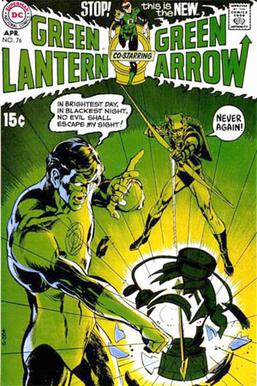
But I was surprised to also hear O’Neil pop up on Back Story, the best radio show/podcast about American history. The St. Patrick’s Day theme was “green,” and producer Andrew Parsons interviewed O’Neil about the Green Lantern/Green Arrow series starting in 1970.

That series was also a big part of Smith’s interview, which is longer and more detailed. It’s a milestone in “relevant” superhero comics, marred only by the fact that it didn’t win over enough readers at the time to keep the Green Lantern magazine from being canceled within two years.

22 December 2013

Christmas Colors

For some unaccountable reason, this snapshot is included among the embarrassing family photos in the You’ve Got to Be Kidding blog’s posting titled “Wal-Mart Called—Your Christmas Photos Are In.” I think you’ll agree that it’s hardly embarrassing at all, especially in the context of the rest.

18 August 2013

Spotting a Familiar Name

A few months back there were a lot of pictures of Damian Wayne with Death from Neil Gaiman’s Sandman, but I don’t recall having seen this one in my feeds. (Of course, there were a lot.)

This picture comes from Luciano Vecchio, an artist from Argentina. I first saw his work when I was editing the International Wizard of Oz Club’s Oziana fiction magazine, and art director Marcus Mébès recruited him to illustrate some stories. When I contacted him directly a while later, Luciano told me he’d gotten too busy with paying jobs to do more volunteer fan work, and I told him that was the best news an aspiring professional artist could share.

I ran across Luciano’s name in the second collection of comics spun off the Young Justice TV show. He drew a couple of issues of that magazine, as well as cartoon-style comics about the Avengers and Green Lantern. Earlier work includes the Sentinels, about a second-generation superhero team, from Drumfish. Here’s Luciano’s Deviant Art page.

Starting soon, Luciano will be the regular artist on the new Beware the Batman! magazine written by Ivan Cohen, which DC promoted this spring with a free preview comic scripted by Scott Beatty.

27 January 2013

Kyle Higgins’s First Version of Nightwing

Kyle Higgins, current scripter of DC's Nightwing magazine, studied filmmaking at the University of Iowa and Chapman University. Before he got into comics, Higgins and his friend Alec Siegel co-wrote and directed the short film “The League” with a lead character inspired by Nightwing. As its website says, it’s available through iTunes.

“The League” starts in 1946. Chicago’s heroes include the Blue Blaze, the Gray Raven, and the latter’s chirpy teen-aged sidekick Sparrow; any resemblance to the Green Lantern, Batman, and Robin is purely intended. Their nemeses are Cold War villains with scowls and Russian names.

The action then jumps forward to the early 1960s. Sparrow, having been badly wounded, has broken from the Gray Raven and become the Wraith (though I didn’t realize his new crime-fighting name until the closing credits). As the League prepares to go national, someone is killing off the Windy City’s old villains, and the Wraith returns to investigate that mystery.

Like Nightwing in the standard DC mythos, the Wraith is an athletic detective but has no other special powers. His relationship with his old mentor is strained. But, and this is very important in the story, the Wraith isn’t evil.

The film’s special effects are very good, especially considering its $40,000 budget. Higgins’s specialty as a filmmaking student was in sound design and other postproduction skills, so the movie has a gratifyingly professional look and sound. I found the story hard to follow at times, such as the role of the character named Eclipse, but the overall plot is clear.

I learned about “The League” from Higgins’s conversation with Kevin Smith on the Fat Man on Batman podcast, which is also well worth a download. The poster shown above is by artist Eoin Colgan.

29 August 2012

Mogo Doesn’t Plagiarize

A colleague in the Boston Comics Roundtable told a story of someone seeing his Green Lantern T-shirt and asking, “Hal, John, or Kyle?” To which he was pleased to answer, “Guy.”

Evidently that’s how Green Lantern fans talk. A few years ago, I wouldn’t have been able to make head or tails of the conversation. But now I could answer: “Mogo.”

Mogo is the planet-sized Green Lantern who debuted in the six-page story “Mogo Doesn’t Socialize,” published in Green Lantern, #188 (1985). That back-up feature, written by Alan Moore and drawn by Dave Gibbons, is collected in DC Universe: The Stories of Alan Moore.

As an Alan Moore character, however, Mogo almost perforce has a longer literary pedigree. Duy Tano just noted this panel from “The Bounty Hunters,” a story by Moore and artist John Higgins published in the British comics magazine 2000 AD in 1982.

One character says, “I read this story once where these guys are looking for an alien, not realising that the alien is really the planet they’re standing on…” That panel appears in The Complete Alan Moore Future Shocks. It shows Moore was already mulling over the idea that became Mogo.

By having his character allude to a “story,” I think Moore was hinting that he himself had read such a tale. Or two or more. Back in 1963, as Bob from Cartoonacy pointed out on Duy Tano’s site, a Green Lantern story featured a sentient planet: “The Strange World Named Green Lantern,” written by John Broome and drawn by Gil Kane. Marvel Comics had its own living planet, Ego, created by Jack Kirby and Stan Lee in 1966.

But Moore’s clearest comics antecedent is “Dead Planet,” published in Tales to Astonish, #27, with a cover date of Jan 1962. Scripted by Lee and drawn by Steve Ditko, this story is only five pages long. Nathan Mahney synopsizes it like so:
The Komok race travels from planet to planet, as each one of its warriors conquers a planet single-handedly. But if any one Komok fails, all of them will be forced to return home in disgrace. Mopox is dispatched to conquer his planet, but he can find no sign of life on its barren surface, despite what his instruments tell him. He dies of loneliness, not knowing that the life on this planet takes the form of sentient rocks.
See more panels on Bully’s Tumblr.

“Mogo Doesn’t Socialize” has the same plot as “Dead Planet”: a character bent on conquest comes to a planet and searches in vain for a foe to fight because he can’t recognize what he’s looking for. Like the Green Lantern in 1963, he eventually discovers he’s up against an entire planet.
Of course, Moore does the story better than his predecessors. He ties the episode into the larger DC mythos. He uses the Green Lantern symbol as part of the big reveal. His prose is lively.

Still, this is one of many examples of how Moore builds many of his best stories on preceding writers’ creations—combining them, building on them, twisting them in new ways. Without, however, rendering the sources unidentifiable.