Showing posts with label ARTIST Skottie Young. Show all posts

18 February 2014

Illustrating Picture Books versus Drawing Comics

Toward the end of his conversation with Skottie Young on the Stuff Said podcast, artist Gregg Schigiel asks about Young’s experience illustrating his first picture book, Fortunately, the Milk by Neil Gaiman. (A lot of Schigiel’s interviews seem to be digging for career counseling, but that’s another story.)

Young sounds almost amazed as he reports how much easier illustrating a picture book was compared to drawing a comic. Jef Czekaj said the same thing on a panel I moderated a while back. I wouldn’t be surprised if other artists who’ve worked in both fields feel the same way. That’s not to say picture-book illustration is easy; but relatively it seems to be a more pleasant experience.

For one thing, picture books don’t require so many pictures. A 32-page picture book might require 20 separate images, which could fill as few as four pages of standard comics. True, those images have to be bigger and more detailed so that they reward multiple readings. On the other hand, they don’t have to be so tightly squeezed together on a page with captions and word balloons impinging on them.

More important, however, is how picture-book publishers treat artists. Editors and art directors choose an artist based on his or her past work and reputation, and they see their job as assisting the writer’s and artist’s visions come to fruition, not to move the corporation’s larger story along. They don’t try to exercise so much editorial control. They set more generous deadlines.

Schigiel’s book experience has come with licensed titles (i.e., those that are part of a corporation’s larger story). So he starts out asking Young what his Art Director told him. But Art Directors for picture books are far more hands-off than people with the same title in other parts of publishing. Young found himself surprised at how few “notes” he received back on his sketches.

The biggest difference between the mainstream book business and other forms of publishing is visible on the covers. On a book, the author’s and illustrator’s names are almost always the biggest; on Fortunately, the Milk, Gaiman’s name is huge, Young’s rather small. But the publisher’s name is usually smallest of all, slipped onto the bottom of the spine and the back. In a comic book or other magazine, the magazine’s name is the biggest; its employees are in charge, and its intellectual property and reputation is what mainly drives the sales.

14 January 2014

Leaving Us Wishing for More

Marvel Comics has halted its series of adaptations of L. Frank Baum’s Oz books at the end of Baum’s first series: The Emerald City of Oz, which [***SPOILERS***] brings Dorothy Gale and her family to the Emerald City and cuts Oz off from the Great Outside World.

Alas, that means we won’t see Eric Shanower’s and Skottie Young’s retellings of The Patchwork Girl of Oz, Rinkitink in Oz, The Magic of Oz, or other volumes in Baum’s second series, at least anytime soon.

This isn’t a surprise, given the natural sales decline over the life of a series and the smaller number of issues that Marvel allotted to the most recent books. Young announced the development last October.

Is it too optimistic to see Marvel.com’s own interview with Shanower and Young as leaving the door open for future volumes?
Marvel.com: Are than any remaining stories in the Oz line you'd like to explore at some point?

Eric Shanower: Yes. I think it would be great to adapt the rest of the Baum Oz books to comics; I’d especially like to see comics adaptations of “The Patchwork Girl of Oz” and “Rinkitink in Oz,” and maybe some of Baum’s Oz-related fantasies like “Sky Island” and “Queen Zixi of Ix.” But I’d want to work with an artist of Skottie’s caliber. I’ve been working on one Oz project or another my whole career, and I know these Marvel Oz adaptations won’t be the last. Some sort of Oz material is always popping up on my radar.

Skottie Young: I definitely want to draw that Patchwork Girl. I actually wish that would’ve come up sooner. It’s bittersweet because I really want to play with the character, but I also know it’s good to take a break. Ah, we’ll see what happens!
These comics have sold well in book form (that’s how I buy them), so continued strong sales could make a new volume look like a good economic bet. Meanwhile, both Eisner Award-winning creators are busy on new projects.

11 September 2012

Little Ragdoll

This is one of the variant covers for Marvel’s The Road to Oz, #1, by Eric Shanower, Skottie Young, and colorist Jean-François Beaulieu, adapted from the story by L. Frank Baum.

Somebody’s clearly looking ahead two whole books to The Patchwork Girl of Oz. Indeed, in this interview at Comic Book Resources, Young mentioned Marvel’s head of sales, David Gabriel: “He’s dying to see me draw the Patchwork Girl, so I’d like to make it that far so he can see that happen.”

If sales hold up, this won’t be the only scrap of that book we’ll see.

07 December 2011

Looking for Evrob

The detail above comes from one of the panels of the Marvel Comics adaptation of Ozma of Oz, drawn by Skottie Young. It shows the royal family of Ev soon after they’ve been disenchanted.

The big lunk in the lower left, with the single curly hair atop his dome, appears to be future king Evardo. At least that’s who is looking for cake in the royal pantry several pages later, as L. Frank Baum described.

However, an earlier page had the label “Evardo” on the smaller adolescent with the purple mantle and the even worse haircut. Either way, it’s quite a shift from John R. Neill’s portrait of a conventional young adolescent.

As in Baum’s novel, the prince we see most in this comic is Evring, the little prince whom Dorothy rescues. He’s also the most normal-looking of the boys that Young draws. Evring wears gloves on his spindly arms; since he’s not trained for manual labor like Tip in Young’s Marvelous Land of Oz art, the effect is to make him look more like a—gasp!—character in a cartoon.

Baum wrote that Evring is the baby of the family. I’m guessing that detail didn’t make it into Eric Shanower’s script because Young drew three other siblings as infants.

I’ve spent an abnormal amount of time thinking about the royal family of Ev because a few years back I wrote a story called “Evrob & the Nomes,” about one little prince’s second visit underground. It was published by the International Wizard of Oz Club in Oziana 2004; Sam A. Milazzo reviewed the story here.

That story required filling in more details about the royal family of Ev while staying close (in my mind) to those left by Baum and Neill. I liked the idea of the family as somewhat impoverished royals from the Edwardian period, wearing the medieval-style dress on the most formal occasions but early-twentieth-century military uniforms at other public events and early-twentieth-century bathing suits at the beach.

I kept Evring as the baby, but tried to show him through the next oldest boy’s eyes: as a mewling focus of resentment. I tried to paint King Evardo as an uptight adolescent stumbling his way through family responsibilities. The rest of the siblings were blank enough that I didn’t worry so much about being true to Baum.

One common element of the upper-class lifestyle of that time was domestic servants from colonized people: Indian and Chinese amahs, Southern mammies. So I gave the royal family of Ev an aged nanny from their country’s ethnic minority, the Wheelers.

In some ways I meant that story to upend readers’ assumptions about adventures in the Oz world, particularly Dorothy’s role in putting everything right. Like Young’s cartoons of the royal family of Ev, it’s an aggressively new look at an old tradition.

29 November 2011

Kaliko Vision

In L. Frank Baum’s Ozma of Oz, Roquat the Nome King is served by a Nome introduced this way:
Meantime the King ordered refreshments to be served to those waiting, and at his command a rudely shaped Nome entered, bearing a tray. This Nome was not unlike the others that Dorothy had seen, but he wore a heavy gold chain around his neck to show that he was the Chief Steward of the Nome King, and he assumed an air of much importance, and even told his majesty not to eat too much cake late at night, or he would be ill.
Later, thinking himself out of the hearing of the guests, the Chief Steward tells the king, “You are a fool to waste so much time upon these people” from Oz.

Baum next visited the Nomes in The Emerald City of Oz, and in that book stated that the king’s steward was named Kaliko. He’s “frightened” by his master, “trembling and white with fear.” Baum offers this exchange:
“Fetch my pipe!” yelled the King.

“Your pipe is already here, your Majesty,” replied Kaliko.

“Then get my tobacco!” roared the King.

“The tobacco is in your pipe, your Majesty,” returned the Steward.

“Then bring a live coal from the furnace!” commanded the King.

“The tobacco is lighted, and your Majesty is already smoking your pipe,” answered the Steward.

“Why, so I am!” said the King, who had forgotten this fact; “but you are very rude to remind me of it.”

“I am a lowborn, miserable villain,” declared the Chief Steward, humbly.
Obviously that exchange shows a interpersonal dynamic very different from the earlier one.

In Who’s Who in Oz, Jack Snow stated that Kaliko first appeared in Ozma—in other words, that he was the Chief Steward in that book as well as the later one. As a young reader, I adopted that interpretation without question. It suggests that the Nome King’s anger over losing his Magic Belt in the earlier book makes it much more dangerous to talk back to him in the later.

More recently, however, such Oz scholars as David Hulan convinced me that might be too much of an assumption. What if the Nome King got rid of the first Chief Steward between the two books? In that case, Kaliko didn’t change his behavior drastically; rather, he could be obsequious enough to manage the angry monarch. What happened to the earlier Chief Steward? Based on what the Nome King orders for some Nome army officers in Emerald City, it would be nothing good.

The Marvel Comics adaptation of Ozma of Oz comes down firmly on the first interpretation, with the Chief Steward being named “Kaliko.” Scripter Eric Shanower’s choice makes for a smaller, more unified cast of characters for the series, and there’s certainly tradition behind it.

Artist Skottie Young also makes an interesting choice in how he designed the Nomes. His Nome King looks much like John R. Neill’s, with a human face, hair, and beard; five-fingered hands; and a caricatured but recognizably humanoid body. In contrast, Young draws the rest of the Nomes as little imps, basically isosceles triangles with tiny limbs and snappish personalities. And Kaliko is among them, as the picture below shows.
Looking ahead, will we see this little Kaliko assuming the Nome Kingdom’s throne?

22 November 2011

The Tin Woodman’s Head on My Mind

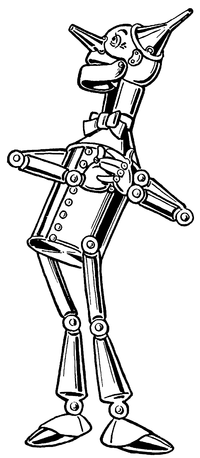
In The Wonderful Wizard of Oz, W. W. Denslow gave the Tin Woodman a skull-shaped head.

Of course, the long nose and ears riveted on that dome, as well as the lively eyes, make it possible to overlook the resemblance most of the time. But the rounded cranium and hinged jaw are quite reminiscent of fleshless human anatomy.

John R. Neill followed Denslow’s model in his illustrations for Ozma of Oz and Dorothy and the Wizard in Oz. As in the series’s first book, the tin man’s head bulges out at the back.

However, in The Marvelous Land of Oz, published before those two titles, and in all the Oz books that followed them, Neill used a different character design, with a cylindrical head. The neck varied at first, but eventually settled on the vague sort of attachment Denslow has used.

In most of those books, when the Tin Woodman takes off his funnel cap, we see that the top of his head is a rounded dome. Neill used the same design for Captain Fyter, the tin emperor’s doppelgänger in The Tin Woodman of Oz (1918).

Toward the end of his career, starting with Ozoplaning with the Wizard of Oz (1939), Neill made yet another variation: he drew the tin man’s head as flat on top, like a tin can. I suspect Neill was out of practice drawing his Tin Woodman; Ruth Plumly Thompson made little use of Baum’s more mature male characters.

I review this history to acknowledge that even within the Oz books there’s a significant variation in the Tin Woodman’s character design. On top of that, we have the costumes created for David Montgomery and Jack Haley, which have to allow a man to fit inside. Thus, people can imagine many things when they think of Nick Chopper.

Lots of comics artists like to depict the Tin Woodman as a robot. That’s doesn’t really fit his origin, in which he’s a living man whose body is gradually replaced with tin parts, and it leaves less room in the saga for Tik-Tok, an actual robot. But some artists just love drawing robots.

One example of that trend is David Hutchison in his Oz: The Manga series, as shown at right. His Tin Woodman’s head is a smokestack, and the robotic characterization extends to gear-shaped speech balloons.

Skottie Young avoided that temptation in helping to adapt the series for Marvel Comics. Indeed, his character design plays up the characters’ old-fashioned, rural beginning. (The man harvested wood, after all.) The tin mustache is reminiscent of L. Frank Baum himself.

And I have a hard time warming to the result. I think the problem for me is that as colored in a pale, tinny way, the mustache looks white. The character’s smooth round head and old-fashioned style reinforce that impression. As a result, this Tin Woodman always looks to me like an old man.

Based on Neill and Denslow’s art, and Baum’s writing, I think of Nick Chopper as a man in his twenties, preserved agelessly by being made into tin (and by living in Oz). Though the Tin Woodman has excellent and kind instincts, and matures somewhat over the series, he’s not old enough to have become wise. He makes mistakes and still regards his appearance with more than a little vanity.

I have trouble imagining the Tin Woodman as a Richard Farnsworth type, much as I admire that actor and some of the characters he’s played. Of course, it’s better than a robot.

15 November 2011

Cartoon Art Museum Has Gone to Oz

Last week the Cartoon Art Museum in San Francisco opened an exhibit on Oz comics. It draws heavily on the collection of Peter Maresca, publisher of Sunday Press (which would be a small press except that its books are so big).

Early comics artists in the exhibit include Walt McDougall (working with L. Frank Baum), W. W. Denslow (competing with him), and John R. Neill (before becoming Baum’s main illustrator). More recent ones include Eric Shanower, Skottie Young, Anna-Maria Cool, and Ramona Fradon.
Among the pages on display is one Eric Shanower drew for Oz-Story magazine a while back, showing moments in the Oz series illustrated in the styles of different famous cartoonists.

I visited the Cartoon Art Museum on my last trip to San Francisco beyond the airport, and admired how much good stuff it displayed in a small space. Definitely worth a visit. [Hey, there’s Jerry Robinson!]

11 October 2011

One of These Things Is Not Like the Others


For each of the four Oz-book adaptations he’s scripted for Marvel Comics, Eric Shanower has drawn a variant cover for at least one issue.

For the first four of those covers, Shanower mainly followed the character designs that Skottie Young created for the series, adapting them slightly to his own style.

On this season’s Dorothy and the Wizard in Oz, however, we see Eric’s own characterizations, in the style he developed for Adventures in Oz, as influenced by John R. Neill.

Or, as we traditionalists like to think, the way those characters really look.

05 October 2011

The Danger with Giving Her Sharp Objects

From the opening chapter of L. Frank Baum’s Dorothy and the Wizard in Oz:

The little girl stood still to watch until the train had disappeared around a curve; then she turned to see where she was.

The shed at Hugson’s Siding was bare save for an old wooden bench, and did not look very inviting. As she peered through the soft gray light not a house of any sort was visible near the station, nor was any person in sight; but after a while the child discovered a horse and buggy standing near a group of trees a short distance away. She walked toward it and found the horse tied to a tree and standing motionless, with its head hanging down almost to the ground. It was a big horse, tall and bony, with long legs and large knees and feet. She could count his ribs easily where they showed through the skin of his body, and his head was long and seemed altogether too big for him, as if it did not fit. His tail was short and scraggly, and his harness had been broken in many places and fastened together again with cords and bits of wire. The buggy seemed almost new, for it had a shiny top and side curtains. Getting around in front, so that she could look inside, the girl saw a boy curled up on the seat, fast asleep.

She set down the bird-cage and poked the boy with her parasol.
Image from the opening pages of the Marvel Comics adaptation of Dorothy and the Wizard in Oz, drawn by Skottie Young from a script by Eric Shanower.

28 September 2010

What Do We Mean by “Kids’ Comics”?

Yesterday Marvel-Oz artist Skottie Young wrote about the supposed lack of comics for young readers:

The most popular complaint seems to be that not enough comics are made for kids. I have to disagree with this thought. There may not be a ton of comics made SPECIFICALLY for kids, but I think that a good majority of comics are very close to kid friendly.

In fact, I've been drawing comics for Marvel going on 10 years now and every single comic I've drawn can be read by most ages. Of the Spider-Man, Human Torch, Venom, New Warriors, X-Men, Runaways, Monster of Frankenstein, and Oz books, only one of those titles is aimed directly at kids. That's 10 years worth of monthly comics that almost any kid could read, only one being called a "kid comic."
Young’s next paragraph reveals that his perspective comes from having started to read comics in bulk in his early teens—i.e., “kids” start at the golden age of twelve. There’s much more of a continuum in mainstream American comics between books for teens and those for adult readers, with more sex and profanity in the books for adults and a lot of violence everywhere.

I think the “kids’ comics” people are talking about are meant for pre-teens. There are significant differences in reading level, maturity, and interests between those young readers and their teenaged siblings, as prose-book publishers and retailers have acknowledged.

Nevertheless, Young is correct that there are many comics being published for the younger group: Bone, G-Man, Mouse Guard, all the Oz comics from Young and Eric Shanower, the TOON titles, Amulet, Amelia Rules!, and so on. The problem for the comics-publishing industry, especially the “big two” of DC and Marvel, is that they aren’t doing most of that publishing, or the most successful parts.

Except in one area: DC and Marvel’s reprints are big hits with the kids I know, as well as the companies’ main products for sales outside of comics stores. In the 1940s through the 1970s, the companies saw kids as a big part—maybe the better part—of their audience. For most of that time they also hewed to the Comics Code Authority on subject matter. Yes, those stories reflect the sexism, racism, and classism of their times, so we have to read with care, and finding non-white characters is next to impossible. But there’s a huge supply of material.

DC’s new Editor-in-Chief comes from the company’s Collected Editions department, which is where the growth has been in recent years. (He was also Editor-in-Chief at Marvel in the late 1990s.) That could presage more attention from the company to collections and sales outside of comics stores.

09 April 2010

The Eisner Award Nominations of Oz

Among this year’s nominees for Eisner Awards for excellence in American comics are three with an Oz connection.

Eric Shanower and Skottie Young’s adaptation of L. Frank Baum’s Wonderful Wizard of Oz was nominated for Best Limited Series or Story Arc, and for Best Publication for Kids. Shanower has won two Eisners for his Age of Bronze series, but for Young, judging by his reaction on Twitter, this is an exciting new honor.

Philippe Ghielmetti’s design for the Queer Visitors from the Marvelous Land of Oz collection from Sunday Press was nominated for Best Publication Design [and, the Wonderful Blog of Oz points out, for Best Archival Collection/Project—Strips]. This is a giant-size reissue of the newspaper comic page Baum wrote in the early 1900s, along with a competing series from his former colleague W. W. Denslow.

And, though it’s several steps off the Yellow Brick Road, the magazine Fables received nominations for Best Continuing Series and Best Writer in Bill Willingham. A young magic-worker named Ozma has been appearing in this comic book’s recent storylines.

David Small’s Stitches received nominations for Best Reality-Based Work and Best Writer/Artist–Nonfiction. It’s notable that this book was not nominated as Best Publication for Kids or Best Publication for Teens. Within the comics community, there’s no assumption that the comics form automatically makes a work suitable for younger readers.

17 October 2009

Five Observations on The Wonderful Wizard of Oz Comic

As Eric Shanower and Skottie Young’s comics adaptation of The Wonderful Wizard of Oz continues its sojourn on the hardcover “graphic novels” bestseller list, I’m sharing some miscellaneous thoughts on how it retells Dorothy’s first adventure.

  • This comic was originally published as eight issues of a magazine, each of which needed its share of satisfying ups and downs to keep readers coming back for more. I read many such comic-book collections, and usually it’s apparent where one installment ends and the next begins (and not just because of a reprinted cover or placeholder page). There’s a shift in rhythm, and often a few panels to catch readers up with the story. I didn’t have that experience this time: the whole book felt seamless. I’m going to have to reread again to figure out how.

  • The only detail from L. Frank Baum’s book that I missed was how the great and powerful Oz is exposed. In this adaptation, the Lion roars so ferociously he blows open a curtain hiding the little man.

    In the book, the Cowardly Lion’s roar is “so fierce and dreadful that Toto jumped away from him in alarm and tipped over the screen” in front of Oz. (In the MGM movie, Toto deliberately pulls open a curtain. Frank Morgan then yanks it back while delivering his immortal “Pay no attention to the man…” line. You can watch Toto get yanked back as well since the curtain was apparently attached to his collar.)

    It may seem illogical for Oz to protect his vital secret with a screen so light that a startled terrier can knock it over. Nevertheless, I like the symbolic aspect of that moment: Toto makes things happen for Dorothy.

  • I saw one addition to this version which seemed to come from the MGM movie. After the Lion’s earlier, solo interview with the Wizard (appearing as a great ball of fire), the frightened beast runs out of the throne room and breaks through a door (“SCRUNCH”!). Quite reminiscent of the candy-pane window that Bert Lahr’s stunt double jumped through. But the book simply says:
    The Lion was angry at this speech, but could say nothing in reply, and while he stood silently gazing at the Ball of Fire it became so furiously hot that he turned tail and rushed from the room. He was glad to find his friends waiting for him, and told them of his terrible interview with the Wizard.
  • There are two double-page spreads in the book, both meaningful. The first comes when Dorothy and her companions are first allowed inside the Emerald City and take in the marvelous capital. Because it’s a walled city, however, the view feels as hemmed-in as it is expansive.

    The second spread comes toward the end of the book as the party approach Glinda’s castle. The MGM movie leaves out that entire leg of Dorothy’s journey, and many adaptations treat it as an anticlimax. But that trip is a very important part of the story. It allows Dorothy’s companions to prove their new abilities, and it’s important for her to reach a place of real magic, not humbuggery. Shanower knows that Glinda and her castle remain major centers of power in the Oz saga, and he scripted a grand entrance for them.

  • Months back, I wrote about how Oz: The Manga used many variations of word balloons for different characters’ speeches. This adaptation is more restrained in that regard. Each of the Wizard’s disguises has a different style of balloon and typography. And the field mice all speak in little letters.
  • 14 October 2009

    “Oz could do that easily enough.”

    Yesterday I quoted a passage from L. Frank Baum’s Wonderful Wizard of Oz describing Dorothy’s arrival at a farmhouse outside the Emerald City. In that book and later ones, she and other travelers in Oz often pass a meal or a night at ordinary homes like these.

    When I first read the series, that aspect of life in Oz was just another pleasant, welcoming detail. But gradually I realized how Baum had managed to make nearly all those “ordinary” families distinct. The farmer might have a sarcastic wit, or the old couple might be too deaf to communicate, or the husband might be lazy and the wife understandably short-tempered, or the couple are perfectly nice pigs. When we meet “ordinary” husbands and wives in Oz, they usually act like a couple who’ve really been together for years, and the woman is rarely a secondary partner in the relationship.

    In the household outside the Emerald City, the most distinct detail is that the husband is laid up with an injury. Above is a portrait of him based on W. W. Denslow’s original illustration, here courtesy of Piglet Press. (In the new graphic novel adaptation, Skottie Young draws the man in an elaborate wheelchair; most likely that unexpected detail caught my attention and made me think over this scene again.)

    I suppose Baum might have made that character lame so that he could be home to give Dorothy information. But it wouldn’t have been that difficult for him to be a craftsman whose workshop is just next door. As it is, the man’s injury makes life in Oz seem more realistic even as he speaks of the Wizard’s magic:

    The man had hurt his leg, and was lying on the couch in a corner. They seemed greatly surprised to see so strange a company, and while the woman was busy laying the table the man asked:

    “Where are you all going?”

    “To the Emerald City,” said Dorothy, “to see the Great Oz.”

    “Oh, indeed!” exclaimed the man. “Are you sure that Oz will see you?”

    “Why not?” she replied.

    “Why, it is said that he never lets anyone come into his presence. I have been to the Emerald City many times, and it is a beautiful and wonderful place; but I have never been permitted to see the Great Oz, nor do I know of any living person who has seen him.”

    “Does he never go out?” asked the Scarecrow.

    “Never. He sits day after day in the great Throne Room of his Palace, and even those who wait upon him do not see him face to face.”

    “What is he like?” asked the girl.

    “That is hard to tell,” said the man thoughtfully. “You see, Oz is a Great Wizard, and can take on any form he wishes. So that some say he looks like a bird; and some say he looks like an elephant; and some say he looks like a cat. To others he appears as a beautiful fairy, or a brownie, or in any other form that pleases him. But who the real Oz is, when he is in his own form, no living person can tell.”

    “That is very strange,” said Dorothy, “but we must try, in some way, to see him, or we shall have made our journey for nothing.”

    “Why do you wish to see the terrible Oz?” asked the man.

    “I want him to give me some brains,” said the Scarecrow eagerly.

    “Oh, Oz could do that easily enough,” declared the man. “He has more brains than he needs.”

    “And I want him to give me a heart,” said the Tin Woodman.

    “That will not trouble him,” continued the man, “for Oz has a large collection of hearts, of all sizes and shapes.”

    “And I want him to give me courage,” said the Cowardly Lion.

    “Oz keeps a great pot of courage in his Throne Room,” said the man, “which he has covered with a golden plate, to keep it from running over. He will be glad to give you some.”

    “And I want him to send me back to Kansas,” said Dorothy.

    “Where is Kansas?” asked the man, with surprise.

    “I don’t know,” replied Dorothy sorrowfully, “but it is my home, and I’m sure it’s somewhere.”

    “Very likely. Well, Oz can do anything; so I suppose he will find Kansas for you. But first you must get to see him, and that will be a hard task; for the Great Wizard does not like to see anyone, and he usually has his own way. But what do YOU want?” he continued, speaking to Toto. Toto only wagged his tail; for, strange to say, he could not speak.
    As it turns out, the Wizard does have a sawdust-filled heart lying around, and his courage does come in liquid form, though he pours it out of a bottle instead of a “great pot” with a golden lid. I get the feeling that when Baum wrote this scene, he was thinking ahead to how he’d have the Wizard appear in different guises and ultimately solve the travelers’ dilemmas.

    However, Baum makes clear later that the Wizard just improvises those gifts. Furthermore, it’s clear even in this scene that he’s lived a secretive life since building the Emerald City, and there’s no link between him and this man recuperating on the couch. So, even though the fellow’s information is pretty good, he must be speaking through his hat. Which gives a whole new cast to the scene.

    06 October 2009

    Wizard of Oz Back on Bestseller List

    This time it’s the graphic novel adaptation by Eric Shanower and Skottie Young.

    The original novel appeared before modern book bestseller lists, but it was clearly the children’s-book hit of 1900. The musical extravaganza adapted from it for Broadway in 1903 was the boffo stage show of that time. The 1939 movie, often said to have been a money-loser, was the second biggest grosser of that year, (way) behind only Gone With the Wind.

    More recently, in the last few years the second edition of Michael Patrick Hearn’s Annotated Wizard of Oz and Robert Sabuda’s pop-up adaptation both made the New York Times Book Review lists. And now the Marvel comics adaptation is on the graphic-novel bestseller list, most recently #3.

    I’ll quote from the perceptive review (i.e., I agree with its points) from The Graphic Classroom:

    Shanower took care in this adaptation by giving us details that have – for most people anyway – been lost because of the celluloid translation. In fact, so many details were left out of the movie that many parts of this book give the reader new insight – new teeth – with which to chomp into this new-old story. From the green goggles worn in the Emerald City to Dorothy’s magic kiss, to the fact that Oz sees each of the four individually (and always in a different form), or the fact that the flying monkeys only did the Wicked Witch’s bidding because they were forced to, it is to the reader’s delight that the old story is fresh.
    And another from Sequential Tart, which looks at comics from female fans’ perspectives:
    Best of all, Dorothy maintains her status as an ‘every’ girl, brave and kind, to whom all children can relate. It is Young’s portrayal of her that brings the visual realism to the story. If we can believe in Dorothy, then we can believe in Oz, the Munchkins, and a talking Lion!
    And of course we can believe in Dorothy Gale.

    31 August 2009

    The Disney-Marvel Mania, and Why We Should All Calm Down

    The comics websites went wild today with news that Disney is buying Marvel for $4 billion. (Or, as the British-based Bleeding Cool News put it, $4,000,000,000--pronounced “four thousand million" or "four billion," take your pick.)

    A great deal of the internet chatter consisted of:

    • Tepid jokes about mergers of classic Disney and Marvel storylines.
    • Uninformed speculation about how Disney would manage its new division and what would happen with certain enterprises (e.g., Iron Man movies from Sony, Muppets comics from BOOM!).
    • Laments about Disney's control over Marvel creativity.
    And it was remarkable how few people talking about the corporate merger showed any knowledge of how corporations work.

    The last point was best addressed by artist Skottie Young, now drawing Marvel's adaptation of The Marvelous Land of Oz, as he wrote on Twitter:
    A lot of peolple asking me about "creative freedom" now under Disney.

    They didn't buy a indy black and white publishers, guys.

    It's Marvel.
    'Nuff said.

    As for the second point, it's true that Disney has (or had, as of a few years ago) a vice president in charge of synergy. The corporation's online strategy brings many disparate divisions under one web domain: go.com. And of course Disney likes to get the most profit out of its holdings--like any other corporation. But that also means not trying to change how profitable divisions, such as Pixar, run themselves.

    As for Marvel's deals with other media conglomerates, and Disney's with other comics publishers, those deals are governed by contracts. Unless we can read those contracts, we don't know anything about them.

    Multinational multimedia corporations make deals with rivals all the time. For instance, Disney's television department produced Scrubs, but for the first several seasons it was on NBC, owned by GE. After NBC chose not to renew that contract, Disney's ABC network (which had originally declined the show) scheduled more episodes because it still saw profits to be made.

    The jokes, as lame as they quickly became, show the real basis of this deal. They reflect the power of the Disney and Marvel brands, so familiar and so emotionally affecting that (like celebrities) they bend ordinary rational behavior.

    When we hear the name "Disney," we think of certain icons (Mickey Mouse, Sleeping Beauty's castle) and a certain style of family entertainment. But the Disney corporation moved beyond that brand long ago. It includes ABC and its affiliated networks. It includes the Weinsteinless Miramax, Touchstone Pictures, and Hollywood Pictures for movies that don't fit the "Disney" label. It includes ESPN. It includes (as a small part of one subdivision) the publisher Hyperion.

    Similarly, when we hear "Marvel," people familiar with American comic books quickly envision its major brands: Spider-Man, the Hulk, Captain America. Most of those icons were created by Stan Lee, Jack Kirby, Steve Ditko, and other employees during a vigorous run in the 1960s. The most recent character with that level of popularity is Wolverine, created in 1974 and developed over the next few years.

    And yet those brands are so powerful that Disney values the company at $4,000,000,000.

    20 June 2009

    "I like when Dorothy landed in Oz"

    Last December young comics reviewer Liam's even younger brother Ethan explained what he liked about the first issue of Marvel Comics's Wonderful Wizard of Oz adaptation:

    I like how Dorothy was playing outside with her dog and a big tornado was coming and the farmer told her to get inside so Dorothy went inside and the house got picked up and thrown away. I like how the house was flying around in the air and the dog almost fell out of the bottom of the house and Dorothy had to catch him.

    I like when Dorothy landed in Oz and the good witch came out and showed her that the house crushed the bad witch. I like how the bad witch was crushed and the sun made her legs turn to dust and all that was left were the silver shoes.

    I like when the munchkins came out and they were all happy that the witch was dead. They wanted to celebrate because the witch was dead and they were happy because they said that Dorothy killed the witch because she had the silver shoes.

    I like when Dorothy met the Scarecrow and he woke up and winked at her and started talking. It was funny that the Scarecrow said that he doesn’t have a brain and wants to find the wizard with Dorothy and maybe he’ll get a brain. And the Scarecrow says because he is made of straw he doesn’t get hurt and he doesn’t get tired.

    I like the pictures a lot. I like how the meaner wicked witch is drawn and I like the way the munchkins are drawn and I think it’s cool how the dead witch was drawn under the house and then how she was drawn only with the shoes left.
    It's no dishonor to scripter Eric Shanower to point out that every single narrative detail that Ethan liked first appeared in L. Frank Baum's book. Eric did a thorough and successful adaptation. And of course Ethan also liked Skottie Young's art.

    I can't resist quoting the brothers' thoughts on the new Robin:
    Ethan: Damian is a real jerk to Alfred.

    Liam: He’s a jerk to everyone. It’s funny that he tells Dick that he can become Batman himself and not have to be Robin. He thinks he’s the best hero ever and he really doesn’t do much. But he is good with building things, at least. I think that the only reason that Dick is letting Damian be his partner is because he's Bruce's son. He has to be nice to him for that reason. . . .

    Ethan: I like that in the preview for the next issue it shows Robin getting beat up and all bloody.
    (Original tip from the Batman Examiner.)