Showing posts with label museumgoing. Show all posts

01 July 2026

“The possibility of rendering Bryant and Drake’s relationship in a graphic novel”
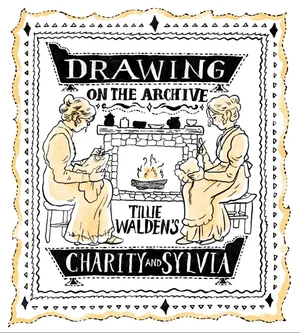
Looking at the history of the new Charity and Sylvia graphic novel by Tillie Walden might shed light on the brewing controversy over its debt to the older Charity and Sylvia history by Rachel Hope Cleves.

In February 2024, Seven Days reported on the upcoming project this way:
Christopher Kaufman Ilstrup, the executive director of Vermont Humanities, first learned about the Weybridge couple [Sylvia Drake and Charity Bryant] from [Rachel Hope] Cleves’ book. Then the senior philanthropic adviser of the Vermont Community Foundation, he awarded a grant to the [Henry] Sheldon Museum to sponsor an exhibition of the Bryant-Drake archive and a lecture by Cleves at Middlebury College.

Kaufman Ilstrup saw the possibility of rendering Bryant and Drake’s relationship in a graphic novel. He thought the story of the two 19th-century women, who lived openly as a married couple before the vocabulary existed to describe their relationship, deserved a wider audience. When [Tillie] Walden, who teaches at the Center for Cartoon Studies in White River Junction, became the state’s cartoonist laureate last year, “it was like a bolt of lightning for me, frankly,” Kaufman Ilstrup said.

He emailed Walden and asked if he could pitch her an idea.
As a marker of how Vermont a story this was, their conversation took place at the King Arthur Baking Company in Norwich.

At the end of that same month, the Middlebury Campus newspaper announced announcing the start of Walden’s residency in that town. (A Bluesky user with the handle Queerkitty spotted this article, which led me to the one above).

The Middlebury article reported:
Tillie Walden, Vermont’s renowned cartoonist laureate, will take up residency at the [Henry Sheldon] museum beginning in May in order to write a graphic novel about the couple’s life. . . .

Walden’s upcoming book will differ from the only previous narration of Bryant and Drake’s lives, “Charity and Sylvia: A Same-Sex Marriage in Early America,” written by Rachel Hope Cleves, a professor at the University of Victoria in British Columbia, in 2014. While Cleves used records from places outside of Vermont and focused on the couples’ intimate relationship, Walden will exclusively rely on the Sheldon museum archives to tell the story of Bryant and Drake’s years living together in Vermont, according to Garcelon-Hart.

Walden’s project was commissioned by nonprofit arts organization Vermont Humanities and the Vermont branch of the National Endowment for the Humanities.
There’s no question, therefore, that Cleves’s history led to the graphic novel, with everyone involved aware of the earlier book. The museum’s YouTube page offer Cleves’s lecture from 2022, also supported by Vermont Humanities.

Yet the comic was supposed to be entirely independent of that history book, whether to avoid the issue of derivative rights, to highlight Vermont resources, or to provide Walden with free rein to interpret the sources at the Sheldon Museum.

However, according to Cleves, portions of the comic are based on material not in the museum collection, material she found and described in her book. Walden’s online bibliography acknowledges how she consulted Cleves’s book regardless of the initial plans in February 2024.

The news articles also show how Walden produced her Charity and Sylvia in an amazingly short time: it was just over two years from when she started the museum residency to its publication. That shows what a hard-working graphic novelist can produce with financial support. But that schedule might also have raised the pressure to follow an established narrative rather than develop a new one.

30 July 2024

“The Dorothy Paintings” and More in South Yarmouth

The Cultural Center of Cape Cod is hosting a summer celebration of The Wonderful Wizard of Oz.

The executive director of the institution, Molly Demeulenaere, says: “The Wonderful Wizard of Oz is more than just a story; it's a timeless exploration of what it means to find and appreciate the complex emotions around the concept of home. Dorothy’s journey, alongside her wonderfully loyal and caring friends, mirrors the universal quest for belonging and self-discovery, making it a story that truly resonates across generations.”

Its description of the event says:
At the beating heart of this enchanting exhibition is Christina Schlesinger’s “The Dorothy Paintings.” This compelling collection of thirteen mural-sized canvases reimagines Dorothy’s adventures with a freshness of perspective that aptly portrays her as the symbol of youthful resilience and independence. Schlesinger’s work demands attention while simultaneously depicting a delicateness and vulnerability rarely seen successfully in combination.
Some of Schlesinger’s paintings can be seen here. The Cape Cod Times offers additional photographs of the space, showing how there are hands-on activities for families, inside and out.

This exhibit will be at the center’s Flagship Bass River Campus, 307 Old Main Street in South Yarmouth. The gallery is open Tuesday through Friday from 10 to 5, and Saturday from 10 to 3. The show will run through 7 September.

17 April 2024

“Outside the Box” Opening Reception in Jamaica Plain, 21 April


With friends from the Boston Comics Roundtable, I’m helping to organize an exhibit of comics art in the gallery of the Footlight Club, America’s oldest continuously running community theater. It’s on Eliot Street in the Jamaica Plain neighborhood of Boston.

A few weeks back, a volunteer at that theater contacted our group about assembling a show. Its current production is Tuck Everlasting, a family musical based on Natalie Babbitt’s novel, so he wanted to showcase art that would appeal to kids.

Many B.C.R. members have created comics for kids, and co-founder Dan Mazur published Boston Powers, a comic book with short, local superhero stories. So there was a good talent pool to choose from.

The exhibit has ended up featuring thirteen artists, including Boston Powers contributors, folks publishing on their own on paper or the web, a couple of graphic novelists (Jonathan Todd, Jerel Dye), and even a picture-book artist who works in comics form (Lindsay Leigh).

I’m represented through the work of Brendan Tobin, with pages from our “Stupendo and Secret Girl” collaboration.

This Sunday, 21 April, at 1:00 PM we’ll have a reception to celebrate the exhibit before a matinee performance of the musical. The art will remain up before, during, and after every show for families to enjoy. 

22 October 2020

The “Thomas Nast” Art Team, Part 3

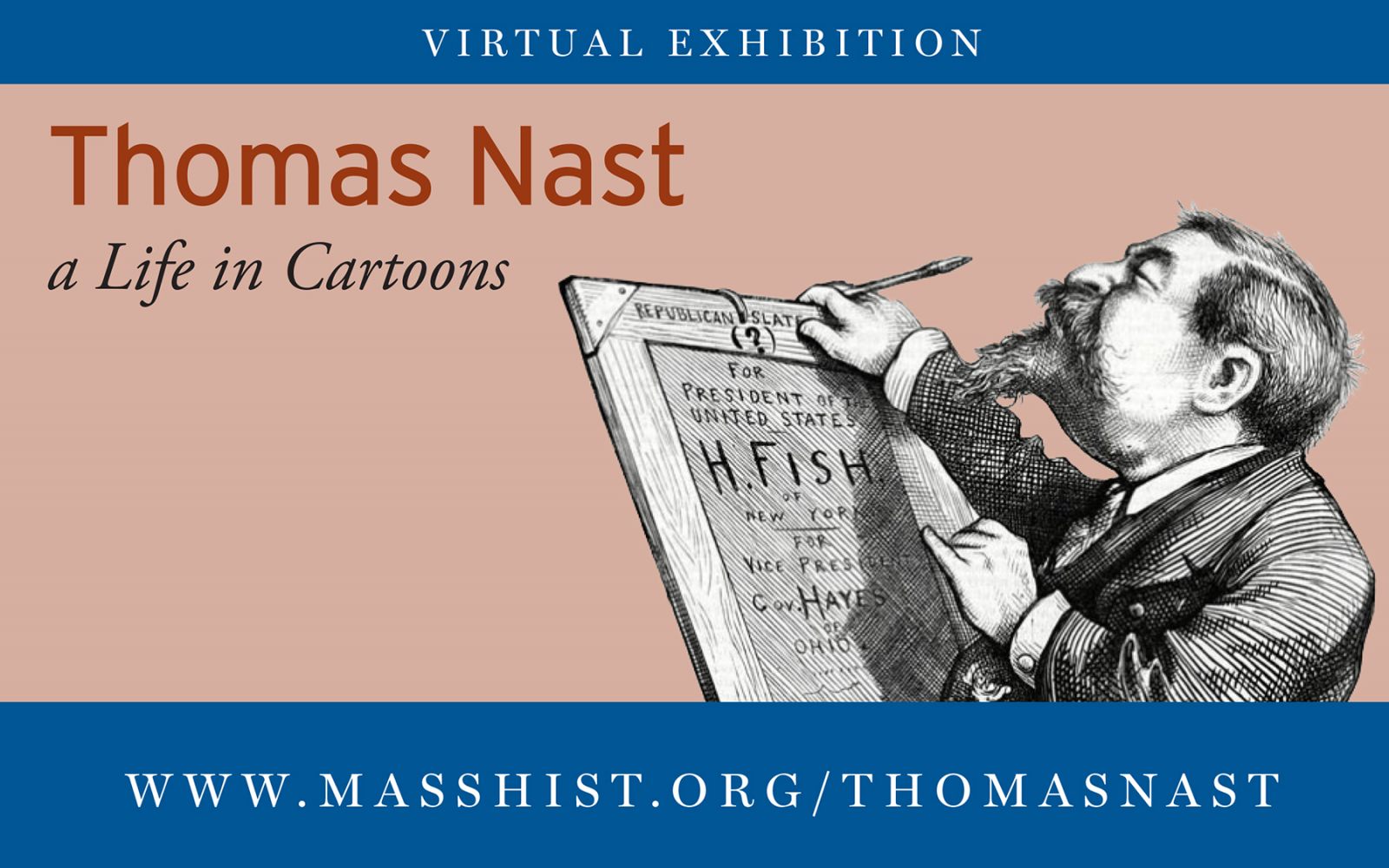
Yesterday’s Boston Globe praised the approach of the Massachusetts Historical Society’s “Thomas Nast: A Life in Cartoons” online exhibit: “In a nice twist, the exhibition doesn’t emphasize Nast’s own work (though it offers links to many of his cartoons). Instead, nine contemporary cartoonists illustrate episodes from Nast’s life.”

I discussed six of those artists in the two preceding postings. Here’s the rest of the team.

Under Harper’s Weekly publisher Fletcher Harper, Nast had editorial freedom in the topics he chose and how he approached them. That often put him at odds with the magazine’s political editor, George William Curtis, who was more gentle and loyal to the Republican Party as a whole rather than just President U. S. Grant. We illustrated that conflict in what I later realized was yet another Nast-speaking-to-his-editor scene. But hey, his job was speaking to editors, and it’s a scene I know well.

The line “hit the enemy between the eyes” line came straight from Nast. The historical society understandably wanted more Massachusetts content, so this cartoon includes Nast’s unflattering caricatures of two Bay State politicians, Benjamin Butler and Charles Sumner.

The artist for this panel is Sam Cleggett. When the core team were thinking of cartoonists to recruit, two of the qualities we looked for were political work and visual style reminiscent of Nast. I pointed out, “Sam knows hatching,” and this energetic cartoon shows that he sure does. Sam also creates animation art for television and video games.

On top of his political cartoons, Thomas Nast’s biggest contribution to American culture was to popularize a certain look for Santa Claus. He had grown up with a German Christmas tradition of “Pelze-Nicol,” which he used to illustrate the Dutch tales of ”St. Nick” preserved in New York. Nast’s Santa was round and jolly, the size of a child, and swathed in fur.

For years Nast drew black and white pictures of Santa Claus for Harper’s. They became so popular that McLoughlin Bros., a pioneering picture-book publisher, offered to publish a book of Nast’s pictures converted to color lithographs. That technique approximated brown by printing black lines and highlights on a red field, with the result that the fur tinged toward red—and a red suit became what we expect Santa to wear.

Dan Mazur produced the cartoon of a McLoughlin brother showing Nast his page proofs for Santa Claus and His Works. As usual, he loaded it up with historical detail, hunting for the right sort of press and Pelze-Nicol himself.

Dan was also one of the organizers of this project, and he was one of the founders of both the Boston Comics Roundtable and the Massachusetts Independent Comics Expo. His latest comic as a publisher is the Boston Powers series, and his upcoming comic as an author-illustrator is Lunatic.

After losing his editorial independence, Thomas Nast left Harper’s Weekly. He launched his own magazine, which lasted only a few months. He went on the lecture circuit, but that was exhausting. He produced history paintings looking back on the Civil War. His investments went bust, leaving him in a precarious financial state.

For our final cartoon, I imagined a cheeky take on the moment when Nast accepted a post in the U.S. diplomatic corps under Theodore Roosevelt. Artist Nick Thorkelson chose to render that in three panels to enhance the timing of the vaudeville dialogue. Unfortunately, it wasn’t so funny when Nast caught yellow fever only a few months after arriving at his first assignment. (We didn’t illustrate that moment.)

Nick Thorkelson has made political cartoons for the Boston Globe and many other outlets. One of his specialties is graphic biography, with his latest being Herbert Marcuse: Philosopher of Utopia (2019).

So that’s our look at the career of American cartoonist Thomas Nast, from his childhood immigration to his death overseas.

17 October 2020

The “Thomas Nast” Art Team, Part 2

With the next set of pictures for “Thomas Nast: A Life in Cartoons,” we got into the political part of his career. And the three cartoonists drawing those moments all have experience in political art.

Nast joined the staff of Harper’s Weekly in 1859, just in time for the US Civil War. Some of the magazine’s artists, such as Winslow Homer, drew battle scenes from life. Nast, though he took some trips to camp, preferred symbolic scenes with unmistakable pro-Union messages. His images could be so powerful that the Republican Party adopted them as campaign material.

We illustrated that connection with a symbolic meeting between Nast and President Abraham Lincoln, drawn by Shea Justice. Lincoln voices oft-quoted praise for Nast’s work in front of three of his most famous works from the war years. I suggested adopting elements from two cartoon traditions: making Lincoln and Nast into a “Mutt and Jeff” pair, and borrowing Tom Toles’s technique of adding commentary on the main scene from a couple of characters in the corner.

As for that commentary, that grew from my inability even in the age of Google to find any source for Lincoln’s praise before A. B. Paine‘s 1904 authorized biography of Nast. Fiona Deans Halloran wrote the same in her modern biography, expressed in the polite language of a footnote.

Stated more bluntly, this “Lincoln quotation” seems to have come from, or at least through, Nast himself. After consulting with Halloran, we made her the voice of doubt (or reason) while Nast speaks up for printing the legend.

Shea Justice, MFA, is a teacher at Lincoln-Sudbury Regional High School and a member of the African-American Master Artists in Residence Program. His portraits of figures from African-American history have been collected in this volume.

To hear from Dr. Fiona Deans Halloran herself, check out this video of her far-ranging conversation with longtime political cartoonist Pat Bagley for the Massachusetts Historical Society.

The next cartoon looks at Nast’s campaign during Reconstruction for basic equality for all Americans, built around his iconic cartoon “Uncle Sam’s Thanksgiving Dinner.” Nast’s vision of equality was limited, though. His take on, and caricatures of, non-white Americans could be quite disparaging. And he particularly disliked Irish Catholics, as this cartoon highlights.

Originally I had Nast saying, “Except for the Irish Catholics!” But then my artistic colleagues noticed that one of the figures at Uncle Sam’s table—on the right, near where his finger rests—had the profile that Nast typically gave to his Irishmen. So I tweaked the wording to acknowledge that Nast even gave an Irish couple a seat at Thanksgiving.

E. J. Barnes drew this panel, as well as serving the whole project as art director. She did admirable work assembling all the images, a job that turned out to include not only cajoling the cartoonists but also securing workable reproductions of Nast’s drawings and inserting them into our modern drawings in the midst of the pandemic shutdown. E. J. sells her artwork and comics stories through Drowned Town Press.

The next panel dramatizes one of the most famous episodes in Nast’s career, the second time he helped to bring down William “Boss” Tweed of Tammany Hall. Nast drew a lot of cartoons about Tweed, rousing public opinion enough for other legal authorities to move in. When Tweed fled US custody to Spain, police there recognized him as a wanted man from a cover of Harper’s Weekly—though they weren’t clear about what he was wanted for. Information from across the Atlantic is easier to come by these days, as I found when I sought period images of Spanish police uniforms.

The artist for this panel is Heide Solbrig, another colleague from the Boston Comics Roundtable. With a doctorate in communication from UCSD, Heide has taught arts and media studies at various colleges in New England. She’s working a graphic memoir called The Dandelion King and a series of comics journalism reports about the US-Mexico border. I see a reflection of her interest in immigration at the center of her panel as people line up in front of that transatlantic ship.

COMING UP: Part 3.

15 October 2020

The “Thomas Nast” Art Team, Part 1

Here’s commentary on the “Thomas Nast: A Life in Pictures” web exhibit and how the pictures came together.

The exhibit starts with a portrait of that nineteenth-century political cartoonist by Paul Szep, twentieth- and twenty-first-century political cartoonist. He also did a video interview about political cartooning for the Massachusetts Historical Society this fall.

Szep was the Boston Globe’s cartoonist during the 1970s when I was growing up. I enjoyed finding his picture in each day’s paper, learning about what news stories he was addressing, looking for his daughter Amy’s name hidden in the hatching. I even remember getting his autograph on a Watergate-era collection at a book festival when I was about nine. I suppose Szep was the first professional cartoonist I ever met. So it’s nifty to see him involved in this exhibit.

The first cartoon my team created for the exhibit covers Thomas Nast’s childhood immigration from Bavaria to the US. Initially I imagined a single panel of a little boy in stereotypically German costume on a ship’s deck or a dock, mixed in with other immigrants. But I couldn’t find a Nast print of a nautical scene as a model.

Instead, I alit on a “diary comic” that Nast drew on his first trip across the Atlantic the other way when he was a young journalist, not published until Alfred Bigelow Paine’s 1904 biography. That page provided the structure. The impressionistic memories of the trip that Nast recounted to Paine provided the content—each vignette reflects a real recollection from early childhood.

Catalina Rufin, who’s creating stories about growing up, daily life, and fairies, made a great match for the concept of this cartoon.

The next panel shows Nast as a teenager handing in his first assignment to magazine publisher Frank Leslie. In looking for a Nast picture of an immigrant-crowded dock, I came across a print of the Hoboken ferry landing on eBay. From an anecdote and a little image in Paine’s book, I realized that was Nast’s first published work. So that print is now part of the Massachusetts Historical Society collection, and it became the focus of this cartoon.

Both artist Jerel Dye and I hunted for visual references to provide a reasonably accurate representation of Leslie’s workspace, down to that desk calendar. We used this panel to show how Leslie used assembly lines of artists to produce art for the press. At first Jerel drew Tommy Nast with a little wispy beard, but I objected that he was only fifteen at this time—he didn’t grow a little wispy beard until the next cartoon! Nast’s own caricature of his first meeting with Leslie appears here.

Jerel Dye drew the art for the graphic novel Pigs Might Fly, written by Nick Abadzis, and has created several short comics on his own. In healthy times he teaches at the Eliot School of Fine & Applied Arts. One day I hope to fly on one of Jerel’s spaceships.

COMING UP: Part 2.

09 October 2020

Taking Thomas Nast’s Life Online

It was disappointing to learn, as I described recently, that the cartoon biography of Thomas Nast I’d worked on since this spring would not be displayed in the Massachusetts Historical Society as originally planned. But frankly, in this needlessly calamitous year, that change in plans felt like a minor glitch.

At the time, I was researching visual references for the artists: What did Nast’s editors look like? What about their workspaces? How did Spanish police officers dress in the 1870s? As I did, I tried to imagine our new pictures in an online environment. How would they come across on people’s computer screens instead of up on the wood-paneled walls? Most important, what could a digital exhibit do that a material one could not?

Online, the cartoons would be smaller than they would be when displayed on a wall. But the webpages could give viewers links to the Nast images they played off of—and to many more images than the physical room had space for. I began to reimagine the exhibit as a series of webpages with supplemental webpages offering additional information.

There were still some challenges caused by the pandemic. The M.H.S. is looking after its employees by making sure only a few are in the building at a time, which meant that it took longer to digitize some of the Nast images we needed. There was no chance for all the people involved in the exhibit to sit down in a room, lay out the material, and discuss how it fit together. But again, compared to what else was happening in America, those weren’t big problems.

My colleague E. J. Barnes did a terrific job rounding up all the cartoonists’ drawings, keeping track of the necessary Nast artwork, assembling the hybrid images, and then going back to the artists to ensure they supplied all the info they needed to be credited and paid. And she drew one of the new cartoons as well!

“Thomas Nast: A Life in Cartoons” made its online debut a few days ago. It’s an adjunct of a larger digital exhibit on political cartoons in American history, “Who Counts: A Look at Voting Rights through Political Cartoons.” With the country in the middle of a crucial election, and access to the ballot at issue more than anytime for decades, this is a very timely exhibit. I’m proud that I was able to be part of it, and to help provide a forum for so many talented cartoonists. (More about them coming up.)

On Thursday, 15 October, Nast’s modern biographer, Fiona Deans Halloran, and political cartoonist Pat Bagley will give a virtual talk about the man through the M.H.S. Sign up here.


06 October 2020

Making Space for Thomas Nast

Early this year, folks at the Massachusetts Historical Society contacted me and colleagues in the Boston Comics Roundtable and invited us to help create part of a new exhibit on political cartoons in American history. 

Our role would be to depict the life of Thomas Nast, the leading American political cartoonist of the late nineteenth century, in a series of new drawings. A particular room in the MHS’s handsome building on Boylston Street was reserved for this part of the exhibit. 

That room is round. It has two doors, three large windows, and a fireplace. There’s handsome wooden paneling up to about chest height. In other words, it’s not a simple box with off-white walls ready to be a neutral enclosure for art.  

Measuring the room and the available materials, I mapped out a display customized for that space. There would be nine rectangular panels around the edge of the room, one with introductory text and eight with cartoons tracing Nast’s life. Each new cartoon would incorporate Nast’s own artwork, either within the scene or as inspiration, showing the course of his career. 

As for the room’s quirks, I made them part of the display. The three cartoons set in the tall window spaces, depicting the height of Nast’s influence, would be augmented above and below with reproductions of his own caricatures and icons. Beside the fireplace would stand a cut-out of one of Nast’s famous drawings of Santa Claus. In the center of the room, a display case would showcase Nast’s pages for Harper’s Weekly from the MHS collection. It was a pretty clever scheme, if I say so myself. 

My colleagues recruited artists while I researched Nast’s life to find iconic moments and details. While there are many collections of his artwork, the best sources for biographical detail were Albert Bigelow Paine’s 1904 Th. Nast: His Period and His Pictures, based on conversations with the artist and published soon after his death, and Fiona Deans Halloran’s thorough, nuanced study, Thomas Nast: The Father of Modern Political Cartoons.

Then the virus arrived. We all hunkered down in our houses for a while. I continued the research. In fact, I’d just taken a bunch of Nast books out from the local library, and all their due dates were helpfully extended, and extended again. On eBay I found Nast’s first published print for Frank Leslie’s Illustrated Newspaper, cheap because the seller hadn’t recognized the artist. Some of my early ideas for cartoons didn’t work out. The MHS asked for more Massachusetts content. I revised and polished with my collaborators’ help. 

And then the virus stayed around. The MHS decided its building had to stay closed to the public through the fall. The exhibit built around a particular space would not appear in any space at all. 

27 November 2019

The Busytown Neighborhood in New-York

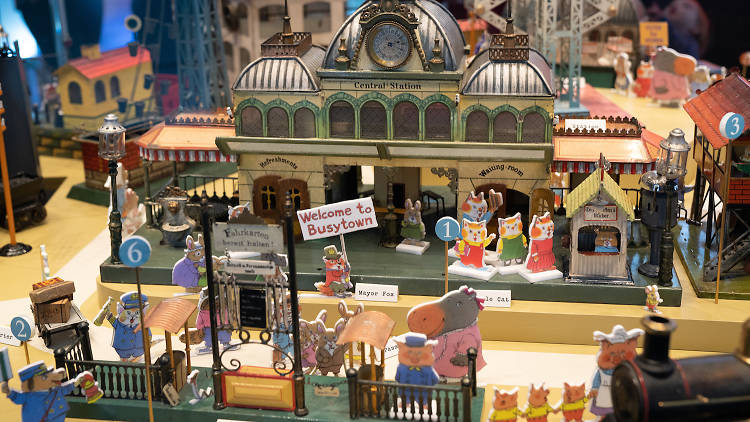
Every December the New-York Historical Society lays out a big model train set to visit, and this year’s design celebrates the centenary of Richard Scarry’s birth by sending the trains through Busytown.

The museum’s webpage doesn’t have any images from the display, but Time Out offered the photo above, showing that Scarry’s characters appear as little flat cutouts direct from his illustrations. (Rather than, say, three-dimensionally modeled adaptations.)

There are also “custom-made Busytown vehicle-themed benches” and larger “Busytown characters” for selfies. Busytown is of course a going commercial concern, licensed from Random House. Given how hard most of its inhabitants work at their jobs, such marketing doesn’t violate the Busytown spirit in the least.

Weekend storytimes will feature Scarry’s books, including The Night Before the Night Before Christmas, and on 14-15 December Scarry’s son and collaborator, Huck Scarry, will get busy sketching characters and talking to visitors.

25 May 2017

The Missing McCloskeys

Tonight I took in the Robert McCloskey exhibit at Boston’s Museum of Fine Arts through 18 June. And I realized I deeply know only half the man’s work—the first half.

In the 1940s McCloskey put out four fine books, including three extraordinary ones: Lentil (1940), Make Way for Ducklings (1941), Homer Price (1943), and Blueberries for Sal (1948). I grew up with copies of all those books in the house, along with Centerburg Tales, the 1951 sequel to Homer Price.

But I didn’t grow up in an intimate relationship with One Morning in Maine (1952), Time of Wonder (1957), or Burt Dow, Deep-water Man (1963). I knew those books from the library, perhaps, but at a much shallower level. Most of the art felt new to me.

All of McCloskey’s books were published before I was born and were thus available to me as a child. But only the first batch were published before my mother’s adolescence. So perhaps she chose those for me because she remembered them fondly from her own childhood.

Notably, this one-room exhibit didn’t include work from any of the books McCloskey illustrated without writing, such as Journey Cake, Ho by his mother-in-law Ruth Sawyer (1953, a Caldecott Honor Book) and the Henry Reed books by Keith Robertson (1958-1970). Both of which I recognize immediately without remembering anything about their contents. In fact, I realize I’ve got the latter series amalgamated with the Henry Huggins books by Beverly Cleary. Much to revisit.

02 December 2015

William Pène du Bois’s Work Before It’s Gone

One of the children’s-book author-illustrators I really liked when I was young was William Pène du Bois. I got deep into his catalogue. The Three Policeman. Those koalas. Emil Bandicoot. Peter Graves before he became a square-jawed movie actor.

I see that this month the Eric Carle Museum is opening an exhibition of his work, titled “A Taste for Adventure”:
This exhibition marks the centenary of William Pène du Bois’s birth (1916-1993). Featured are illustrations from his 1947 Newbery Award-winning book, The Twenty-One Balloons, the fantastic story of Professor William Waterman Sherman’s around-the-world balloon voyage of 1883. Also on view are illustrations of Giant Otto, a large yellow hound who uses his size and strength to perform good deeds. Other endearing Pène du Bois characters come to life in Elizabeth the Cow Ghost, The Horse in the Camel Suit, and Porko von Popbutton. Pène du Bois’s illustrations animate text by such legendary authors as Isaac Bashevis Singer and local professor and two-time Pulitzer Prize winner Richard Wilbur.
I’ll have to get out to Amherst before May Day, when the exhibit closes. I also see that most of Pène du Bois’s books, aside from the Newbery winner (which is unusual, both in his oeuvre and among novels for young readers), are out of print.

01 July 2014

Beyond Their Comprehension

From Tim Grove’s A Grizzly in the Mail and Other Adventures in American History (University of Nebraska Press, 2014):
During my time at the Museum I never tired of observing visitors express delight at seeing a familiar object in person. The iconic ruby slippers from The Wizard of Oz remain one of the most popular items in the collection. Judy Garland used the museum’s pair, one of only four pairs still in existence, for the dance sequences in the film. Their sequins, though showing wear, still glitter and make young girls gasp with delight. Their enduring popularity is a puzzlement to many museum employees, who become quite good at providing directions to the shows through gritted teeth and a fake smile. How visitors can place greater importance on the ruby slippers than the Star-Spangled Banner, say, or the first computer, is beyond their comprehension.
Having worked at the American History Museum, Grove is now chief of learning at another branch of the Smithsonian, the National Air and Space Museum.

29 May 2014

From Spring Heel Jack to Batman

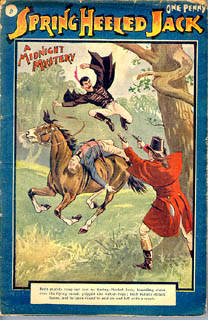
Among the ephemera on display in the “Comics Unmasked: Art and Anarchy in the UK” exhibit at the British Library is a penny-dreadful tale of Spring-Heeled Jack, which the curators suggest was an inspiration for Batman, pointing particularly to his horns.

I thought that was a stretch. Not that Bob Kane and Bill Finger were above borrowing plots, images, and details from other adventure stories of their time, acknowledged and unacknowledged. But how would two guys growing up in post-WW1 America have seen the Spring-Heeled Jack magazine serials from Victorian Britain? And wasn’t Spring-Heeled Jack a monster and/or troublemaker instead of a crimefighter?

At io9, commenter Michael Munro laid out a lineage of pulp fiction leading from London to California to Gotham:
Spring Heeled Jack…transitioned from London urban myth (1830s) to melodrama anti-hero (1870s) to prototype superhero (1880s-early 1900s). As written by "penny dreadful" author Alfred Burrage, SHJ was a wealthy aristocrat who assumed the disguise of a devilish, bat-winged avenger of the night, maintained a secret underground lair and used his athletic and technological skills to battle evil-doers - sounds familiar?
Expounding at more length, Munro wrote:
The several "penny dreadful" iterations of Spring Heeled Jack, many written by Alfred Burrage under the pseudonym "Charlton Lea", portrayed him as a nobleman who had been cheated out of his inheritance and who took up a devilish disguise to punish those responsible. Along the way, Spring Heeled Jack also rescued damsels in distress and generally stood up for the innocent and downtrodden. He wore a distinctive mask and costume and was capable of performing incredible leaps thanks to a special pair of boots, credited in one source to a secret mechanism invented by Indian street magicians.

Anticipating Zorro, Jack was fond of marking both enemies and territory by carving his initial with the point of his rapier. He also maintained a secret underground lair (in a converted crypt) and terrified his adversaries with his ringing laugh and catch-phrase, "The day is yours - leave the night to me!"
As Munro notes, the Batman team acknowledged Zorro, created by Johnston McCully in 1919, as an inspiration. Thus, Spring-Heeled Jack wasn’t a direct influence on Batman, and the horns/ears were a shared trope rather than deliberate borrowing.

03 April 2014

“Book on the Charles” in Belmont through 17 May

The Belmont Galley of Art is featuring an exhibit of work by local children’s-book illustrator for the local children’s-book publisher Charlesbridge.

The Boston Globe reports:
“Books on the Charles – 25 years of Charlesbridge Picture Book Illustrators,” which [Rebecca] Richards cocurated along with Watertown artist Leslie Evans, celebrates 15 New England-based picture book artists who have created art for Charlesbridge Books, a children’s book publisher located in Watertown.

“I’ve always wanted to showcase original works from children’s books in a gallery setting, so people could admire the work for the fine art that it is,” Richards said. “I think this exhibit brings back that sense of fun and wonder we had as children visiting a world of imagination created by picture book illustrators.”
Among the artists featured are Alan Witschonke of Natick and Wayne Geehan of Acton. There will be an artists’ reception and book-signing on the afternoon of 13 April, and the exhibit will be up through 17 May.

15 October 2013

Miss Piggy Goes Shopping for Shoes

From the Smithsonian magazine’s blog:

To welcome Miss Piggy [to the national collection], Smithsonian magazine’s editors treated her to a photo shoot featuring two of the Institution’s most valued treasures—Dorothy’s Ruby Slippers and the Hope Diamond. Pairing the Muppet with the diamond required a secret, predawn escort to the Natural History Museum and an armed guard at the museum's Gems Hall. After staging and art direction by Erickson, she was photographed wearing a necklace bearing the 45.52-carat stone by the award-winning fashion photographer Cade Martin.
And then there was this shot.
Among the other Muppet manifestations now at the Smithsonian is the original Grover, who had dark green fur. If I were a young museum visitor I’d find that very confusing. In fact, I’m a little weirded out by him now.

14 October 2013

SCBWI New England’s New Media Day, 19 Oct.

On Saturday, 19 October, I’ll be at SCBWI New England’s New Media Day, a series of presentations and panels designed for published authors and illustrators of children’s books. This event will take place at the Eric Carle Museum of Picture Book Art from 9:30 to 3:30.

The morning sessions feature technology analyst James McQuivey on “Digital Disruption” in publishing and literary agent Rubin Pfeffer on “Books and Beyond.”

After lunch comes a panel that I’ll moderate, titled “OP to E: Bringing Books Back to Life.” The panelists are three SCBWI members who converted their out-of-print titles into digital books:
Finally, event organizer and nonfiction author Melissa Stewart will interview author-illustrator Ruth Sanderson on “Surviving and Thriving in Children’s Publishing” over thirty years.

The registration date for this event has passed, but I hope to come home with some keen insights into the new world of publishing.

11 October 2013

OIP Derangement Syndrome Not Shut Down

The ongoing House Republican shutdown of the federal government has produced new manifestations of OIP Derangement Syndrome in the form of outlandish accusations about President Barack Obama. Among the choice rumors:

As laughable as those reports are, we must remember that unfounded rumors have been part of the right-wing arsenal for years. I analyzed Presidential rumors at Snopes here and here, finding that there have been many more false reports about Democratic politicians than Republicans, and far more about President Obama than his predecessor.

In fact, just as the shutdown started, some provocateur went onto Healthcare.gov with a highly detailed false claim about trying to sign up for health insurance and being fined thousands of dollars as a result. Outlandish lies are regular part of the American right wing’s approach to politics today.

08 October 2013

Oz at the Farnsworth, Opening 12 Oct.

The Farnsworth Art Museum in Rockland, Maine, is about to open a new exhibit: “The Wonderful World of Oz—Selections from the Willard Carroll/Tom Wilhite Collection”. The exhibit coincides with the 75th anniversary of the MGM Wizard of Oz and opens on Saturday, 14 October. The museum says:
The show, drawn from the world’s most comprehensive collection of Oz materials, which is based in Maine, will run through March 2014 in the museum’s Crosman Gallery. . . .

Included in the Farnsworth exhibition will be the most complete surviving [MGM movie] costume (worn by the green Lollipop Guild Munchkin), one of Dorothy’s pinafores and blouses, examples of the many illustrated versions of [L. Frank] Baum’s books (including the finest known copy of the first edition, first state “green imprint” of Baum’s initial book in the series), rare or one-of-a-kind posters from the various motion picture and stage productions, and a remarkable array of other Oz memorabilia from the Willard Carroll / Tom Wilhite Collection.

Among the major pieces to be displayed is the Hourglass that the Wicked Witch of the West uses in the 1939 film to show Dorothy “how much longer you have to be alive.” Margaret Hamilton, who played the witch, lived during her later years on Cape Island, off Newagen, Maine.
I’m not sure “her later years,” “how much longer you have to be alive,” and “Maine” is really the juxtaposition the museum is looking for in boosting the local angle.

It looks like Willard Carroll’s book I Toto: The Autobiography of Terry, the Dog who was Toto, has been republished in connection with this exhibit and/or anniversary, and Down East is issuing a new edition of John Fricke’s The Wonderful World of Oz: An Illustrated History of the American Classic.

09 October 2012

The Ruby Slippers Go on the Road

The Smithsonian is lending its pair of ruby slippers from MGM’s Wizard of Oz to the Victoria and Albert Museum in London for an exhibit on Hollywood costume. This will be the first time any original pair of the slippers is displayed with one of the blue and white dresses that Judy Garland wore through most of the movie.

The Guardian reported:
The slippers were designed along with all the other costumes for the film by Adrian Greenberg – always just known as Adrian – the chief costume designer at MGM studios, whose favourite childhood book was Frank L Baum's 1900 classic, The Wonderful Wizard of Oz.

In the original screenplay, Dorothy's shoes were silver: scriptwriter Noel Langley is credited with changing this to "ruby slippers", which would give a more striking colour contrast when she is magically transported from black-and-white, storm-torn Kansas to the Technicolor magical world of Oz.

They were made in Los Angeles by a veteran shoemaker, Joe Napoli, from red satin shoes with a one and a half inch heel, covered in red sequins hand-stitched on to fine chiffon, with a centre bow edged with red glass beads and crystals. Visitors to the exhibition may be surprised to see that they are actually a deep winey garnet colour, designed to photograph as scarlet in Technicolor.
These aren’t the only ruby slippers to survive from the movie. The studio had several pairs made, two as prototypes and then perhaps half a dozen in the final design. There were pairs for Garland and for her double. There were shoes for dancing and shoes kept pristine for close-ups. Most of those that remain are in private hands. One belongs to the Academy of Motion Picture Arts and Sciences. And one pair was stolen from the Judy Garland Museum in Grand Rapids, Minnesota, in 2005 and is still missing.

05 June 2012

Oz Museum and Opera in the Works

This Boston Globe interview with illustrator Bob Staake alerted me to work on an opera based on L. Frank Baum’s The Road to Oz. Googling brought me to the website for the National Oz Museum, a project of Oz collector supreme Willard Carroll.

About the opera, the website says:

Together with the prestigious performing-arts organization Bay Chamber Concerts, the Museum is developing a live multi-media musical based on Baum’s book “The Road to Oz.” The production is being written and will be directed by Willard Carroll, with sets and costumes designed by acclaimed author and illustrator Bob Staake. The concept is to create a one-hour, one-act musical work based on L. Frank Baum’s fifth Oz book.

The approach to the music is not envisioned in a conventional operatic or musical-theater/show-tune way, but to find a unique slant from which to tell the story through character and music. Baum’s characters in this book – Shaggy Man, Polychrome, Button Bright the Rainbow’s Daughter [whoops—Button-Bright seems to have gone missing from his proper place in that sentence], etc. – each offer up imaginative starting points for songs to tie together the story; a story about loss, love, reconnection, hope - and joy deferred and joy attained.
Those are indeed some of the themes of The Road to Oz. The book’s main weakness is its story, both thin and cut short. Yet it’s also immensely pleasing, and that simplicity might benefit adaptations into elevated media. A few years back, for instance, I saw Eric Shanower’s adaptation of the basic tale as an amateur ballet, cut down to focus on the Shaggy Man’s transformation, and it worked.

As for the museum, Carroll’s collection seems still to be mostly in boxes after his move across the country, but this spring students at the Rhode Island School of Design worked on designs for the institution.