Showing posts with label ARTIST George Pérez. Show all posts

02 November 2014

“That history will always be in the background”?

In an interview with Comic Book Resources, Grayson co-scripter Tom King spoke of his particular fondness for the character of Dick Grayson:
You’ve said a few places that Dick was always your favorite DC character thanks to his accessibility. With that in mind, what were the big stories that first brought you into his world? Are any of them the kind of thing you’ll look to fold into the background of this book?

I came into DC comics with Tim being Robin and Dick being the ex-Robin, the man who had gone through that uniquely frightening experience and emerged as someone uniquely brave. I remember buying my first trade, A Lonely Place of Dying, and obsessing over the Tim/Dick/Batman interaction. There was this essential question there about how do you leave childhood without losing who you were as a child. I read that thing to pulp. The first time I got to write my own complete script for the series, I titled it “Only a Place for Dying,” as a tribute to that experience.

Some of my other favorite Grayson stories are:

Birds of Prey #8 (the Barbara/Dick date issue), which is where Agent 8 from Grayson #3 gets her name; Batman #156 (“Robin Dies at Dawn”), which will play a role in an upcoming issue; and, probably my favorite Dick Grayson story of all time, Secret Origins Annual #3, which I haven’t yet figured out how to squeeze story out of — but I will! Dick Grayson has a 74-year history, and though Grayson is a book solidly set in the New 52 featuring a very modern take on the hero, that history will always be in the background and will always haunt and elevate our hero.
That’s almost sad. Secret Origins Annual, #3, was a story scripted by George Pérez in 1989 which synthesized the whole history of the Titans up to that point, both pre- and post-Crisis on Infinite Earths. It sought to build coherence and depth from the illogical late-1960s storylines of Bob Haney, revealing a series of villains to be one foe in different guises trying to undermine Dick Grayson.

That story also restored a version of Betty Kane, the first Bat-Girl, who had been abandoned with the “New Look” back in 1964. It reestablished the basics of Titans history as written in the 1960s, 1970s, and early 1980s within DC’s new continuity. And in doing all that, it reflected the importance of Nightwing and his team to the company at that time.

In contrast, the “New 52” reboot of the DC Universe that King and his co-writer Tim Seeley are working within wrote off Dick Grayson’s version of the Titans, and most of the characters and relationships that Pérez’s story stitched together. Grayson has left the character even more alone within the DC Universe. The scripts might contain slight allusions to beloved older stories for long-time fans, but I don’t see how this Dick Grayson can be haunted by a history that he never had.

24 August 2014

Roy Harper, the Anti-Dick Grayson

Just as DC Comics had to separate Green Arrow from Batman, its storytellers had to figure out a way to make Green Arrow’s young sidekick Speedy different from Robin, the Boy Wonder.

For decades the two characters existed in parallel—helping their mentors in fighting crime, providing useful sounding boards, and expressing the emotions of young readers. Dick Grayson was a teen orphan living with Bruce Wayne. Roy Harper was a teen orphan living with Oliver Queen. And their paths never crossed.

In 1964 Robin began working with Aqualad, Kid Flash, and Wonder Girl as the Teen Titans. But Speedy was notably absent. Fans wrote in, asking why the line’s other long-time kid sidekick was being left out.

So Teen Titans, #4 and #11, featured guest appearances by Speedy. And in issue #19 he became an official member of the team—and also managed to score a date with Wonder Girl, thus distinguishing him from all the other teammates who had crushes on her. But not by much.

The real differentiation began in 1971 when Neal Adams and Dennis O’Neil used the character of Roy Harper to explore the issue of drug use—a breakthrough for DC. Green Arrow discovered that his sidekick had become addicted to heroin. Not so badly that he couldn’t kick the habit within two issues, but enough to suggest a new direction for Speedy.

The Teen Titans series, aimed at a younger audience, never mentioned Speedy’s heroin troubles through the 1970s. Its writers tried sought other ways to set him apart from Robin: he and Wonder Girl remained a casual couple, and he was a bit more hot-headed. There was enough space between the characters for the series’ last issue to retroactively establish Speedy as a founding member of the team.

In the early 1980s Marv Wolfman and George Pérez brought Roy Harper back for occasional appearances in the New Teen Titans magazine, this time referencing his troubled past. Now working for a government agency, he joined the Titans in attacks on drug dealers. Those issues also portrayed him as an incorrigible ladies’ man just as Dick Grayson was entering a serious (and sexual) relationship with Koriand’r.

Finally, after Crisis on Infinite Earths Wolfman and Pérez added another layer to Roy Harper’s character. New Teen Titans, vol. 2, #21, revealed that he’d gone undercover [!] and had an affair with an international assassin named Cheshire. They’d even had a child together. Dick (now Nightwing) and Kory were having sex, but Roy was having unprotected sex with a villain!

That provided such a distinction between Dick Grayson and Roy Harper that Wolfman could write a story in Action Comics Weekly of their adventures together looking for Roy’s daughter. Where once Robin and Speedy couldn’t be on the same team, now Nightwing and Speedy could play off each other for several issues on end.

Roy Harper had become DC Comics’s anti-Dick Grayson. Dick was charming, respectful, and monogamous. Roy hit on almost any woman he met, especially when he was on duty. Dick became the one member of the original Titans who never married or had kids. Roy did the kids part first and muddled through as a single dad.

Nightwing was the young hero who did everything more beautifully than anyone else, whom everyone trusted. Roy was the character who managed to screw up most of the time. He bounced among among crime-fighting identities: Speedy to Agent Harper to Arsenal to Red Arrow and back to Arsenal. He owed his co-workers money. He took over the Titans, and the team fell apart. He formed the Outsiders for Dick to lead, and made a stupid fundamental error from the start. Nonetheless, he kept going. The result was a far more compelling character, a favorite for some readers.

While not all of Roy Harper’s background gets transferred into other versions of the DC Universe, his definition as the anti-Dick Grayson does. When the Teen Titans television cartoon introduced Speedy in a later season, producer David Slack explained, “we were looking for someone to mirror Robin.” In the sillier Teen Titans Go, the producers even have actor Scott Menville provide both rival characters’ voices (and of course make in-jokes about that).

DC’s “New 52” universe wiped out the Titans’ past and left little time for Roy Harper to have worked with the new Oliver Queen. Nonetheless, it reintroduced Roy as “the worst former sidekick ever” in Red Hood and the Outlaws. That may not be the best treatment for him, but at least it’s better than the Cry for Justice/Rise of Arsenal miniseries of 2010, which were so poorly received they were quickly written out of continuity. And it does preserve Roy Harper’s distinct role in the DC Universe.

30 March 2014

The New New Teen Titans

DC Comics has started to promote an alternative version of its Teen Titans brand, to debut this fall. Teen Titans: Earth One, is what for the past quarter-century would have been called an “Elseworlds” story, and prior to that an Earth-Two or imaginary tale. It uses the familiar brand names but is outside of the current main continuity, thus allowing more latitude in storytelling. Paradoxically, DC is creating multiple “Earth Ones” for its main brands.

The main creators of this book will be writer Jeff Lemire and artists Terry and Rachel Dodson, and Lemire gave an interview to Comic Book Resources this week. As usual in such promotional interviews, the conversation is all about describing how wonderful the story will be while avoiding as many specifics as possible.

But here are some mildly interesting details:
  • This story is clearly inspired by the Marv Wolfman–George Pérez New Teen Titans series of the 1980s. Lemire told CBR: “Marv Wolfman and George Pérez were the first creators whose work I followed avidly. ‘The New Teen Titans’ from the ’80s was like my Bible as a kid. I read every issue over and over and over again.”
  • However, one of the major themes of that series—inheritance—will be less in evidence because the new team won’t include such protégés of older heroes as Robin/Nightwing, Kid Flash, and Wonder Girl. In the new story’s world, these heroes are the first generation to have superpowers. (Of course, they might still have problematic parents.) That said, Beast Boy/Changeling, created in 1965 as a sort of mascot of the Doom Patrol, will be in this new story; he’ll have his old green coloring but presumably a new backstory.
  • The team includes new versions of several Wolfman/Pérez creations from the ’80s: Cyborg, Raven, Starfire, Terra, Jericho, and Deathstroke. That helps DC maintain the viability of those trademarks. However, Lemire is promising surprises with several characters’ backstories, so readers can’t make assumptions based on past versions.
  • Lemire has “been done [with] this book for over a year.” As a standalone volume rather than an ongoing magazine series, it needed a longer lead time for the art, so DC has kept the project under wraps until now. If the book proves to be a hit, Lemire is obviously up for a sequel—though that could presumably take another year or two.
No versions of the Teen Titans have survived for long without a Robin or Wonder Girl. Will this departure break that pattern?

05 January 2014

Beast Boy in Turnaround

Last month the artist Karl Kerschl shared six pages drawn and colored for the Teen Titans: Year One miniseries (published in 2008 and discussed back here) but yanked from the book. (Thanks to Icon_UK for spreading the word about Kerschl’s posting.)

Garfield Logan, known at different times as Beast Boy and Changeling, was originally a different sort of kid sidekick from the Doom Patrol comic. He made a cameo appearance in one early issue of Teen Titans, returned for a couple more issues when that series resumed in the mid-1970s, and then flowered as the main comic relief in Marv Wolfman and George Pérez’s New Teen Titans of the 1980s. Beast Boy is also one of the five Titans included in the TV cartoons.

As a result, there was fan interest in seeing what he was up to while the Titans formed, but he wasn’t on that first team and part of their first storylines. In fact, his status as a lonely kid eager to join the big kids’ team is key to his characterization in some stories.

Kerschl described what he and scripter Amy Wolfram were aiming for in these discarded pages:
The original concept was to do a two-page Beast Boy sequence at the end of each issue, telling the story of Beast Boy (always depicted as an animal) looking for the Teen Titans he’s heard so much about because he wants to join. He visits the locations from the story but is always too late to catch them. In the end, I guess he would have found them and he’d have been included in Teen Titans: Year Two. Presumably.

Anyway, only the first sequence got printed, but when someone actually noticed that we were doing something fun, we were ordered from on high to remove the Beast Boy story from the issues because “animals in the DC Universe don’t talk.”
This seems all too typical for Gar Logan. He’s always had hard luck, which he hides behind jokes and bonhomie. Gar aches for family and admiration more than anyone, but he’s never become a star—always an ensemble member. (Well, Beast Boy did headline a four-issue miniseries in 2000—but even that had to feature a couple of rescues and cover appearances by Dick Grayson, and it was reprinted inside a Teen Titans collection.)

So Kerschl’s news that Gar Logan was supposed to have a solo spotlight in Teen Titans: Year One, only to be unceremoniously dropped, makes me imagine an episode within DC’s previous continuity:
“Hey, Dick—it’s Gar! How ya doing? . . . Oh, nothing, I just wanted to pick your brain about my movie deal. Haven’t I told you? . . . Anyway, the studio guys and I have been having meetings about the best way to brand it: Changeling or Beast Boy? Or maybe Beast Boy: The Changeling!

“It’s a feature about my origin: I get powers, become a major TV star, then have to choose between that and saving the world. Real life, just a little compressed. Don’t worry—I make the right choice, of course.

“The sequel might have space for the Titans as supporting characters. Nothing against team movies—they’re great for heroes who don’t have the fan bases to finance a feature individually. But, you know, there’s X-Men and then there’s Iron Man, right?

“Since you were in the business, kind of, I thought I’d ask what you thought about the title—Hang on, I’ve got a call coming in from my agent.

“Hey, Ellie! What’s new today? . . . Really? . . . Did they say why? . . . But they knew about the green when they optioned. It’s kind of my thing. . . . New people? Yeah, I know how it is. Any chance of— . . . Oh. Okay. Well, I guess I can take that motion-capture job after all. . . . A different direction? Well, good luck to them getting a real orangutan to hit his marks! . . . Yeah, Ellie. Thanks for telling me.

“Dick, you still there? Well, anyway, these movie deals, they, you know, take a long time. So don’t spend too much energy on that title thing, all right? . . . Say, do you know what the Titans are paying these days?”

03 November 2013

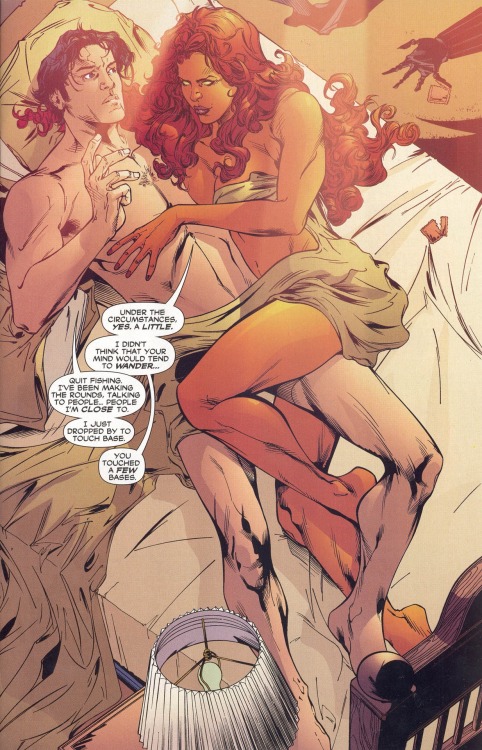
Dick Grayson and Redheads

A few weeks back I had a Twitter conversation about the idea that Dick Grayson is attracted to red-haired women. Where did this idea come from, and who promulgated it?

Dick’s two longest and deepest relationships in the comic books have been with Koriand’r (Starfire) and Barbara Gordon (Batgirl, Oracle). And both those female superheroes are redheads. But otherwise they’re very different characters.

DC Comics introduced Barbara to prepare the way for Batgirl in the Batman television show. She was already at work in a library while Dick was in high school. Later she served in the House of Representatives when he was in college. In the late 1970s the Batman Family magazine raised the possibility of a relationship between them, only to bat it down.

In 1980 Marv Wolfman and George Pérez created Koriand’r in New Teen Titans to become Robin’s love interest. That was obvious from their first storyline. Together Dick and Kory led DC into exploring relationships that involved sex, as I discussed back here. Their pairing was a mainstay of the Titans comics for more than a decade, until the mid-1990s when they broke up.

The first Nightwing miniseries; Nightwing Annual, #1; and the Nightwing-Huntress miniseries showed Dick Grayson exploring the possibilities of other relationships. But it was apparent—especially in the last—that the company was moving him back toward Barbara Gordon. That partnership finally took hold during the No Man’s Land crossover.

In most ways Kory and Barbara were symbolic opposites. The first was an extraterrestrial princess descended from cats who had spent her adolescence in slavery. The second was the daughter (or niece and/or adopted daughter) of Gotham police commissioner James Gordon who had spent her adolescence earning a library science degree. Kory was emotionally open and naïve about life on Earth; Barbara was all about knowledge. Kory was a towering, buxom, barely-dressed supermodel who represented physical power and pleasure. Barbara at that point was paralyzed from the waist down and represented intellectual power and pleasure.

But of course both had red hair. Was that why Dick Grayson was attracted to them? I don’t like to think so, for two reasons. In the first place, that would make Dick rather shallow, driven by one physical trait rather than his deep emotional connections to people. I interpret his character as drawn to strong and strong-willed women who nonetheless seemed to need rescuing, as both Kory and Barbara did at times.

The second reason is all those other women DC’s creators showed Dick attracted to over the years, at least for a while:
  • Mary Wills in Star-Spangled Comics, #103 (1950), redhead.
  • figure skater Vera Lovely (1957), blonde.
  • tennis star and occasional crime-fighter Betty Kane/Bat-Girl (1960-64), blonde.
  • college student Lori Elton (1975), blonde.
  • damsel in distress Miggie Webster (1995), dark hair.
  • murder suspect Emily Washburn (1997), blonde.
  • landlady Bridget Clancy (1997), black straight hair—she being Eurasian.
  • fellow vigilante Helena Bertinelli/Huntress (1998), black hair.
  • fellow Titan Jesse Chambers/Jesse Quick (2000), blonde.
  • first kiss Wily Wendi (2002), black curly hair—since she’s African-American.
  • fellow vigilante Catalina Flores/Tarantula (2003-04), black hair.
In sum, DC Comics didn’t depict Dick Grayson as having a physical “type” at all.

Nevertheless, the idea that Dick likes red hair took hold. The earliest exemplar of that statement I could find is a fanfiction request dated 20 July 2004 which says: “Dick had a definite thing for redheads - Barbara, Wally, Kory, Roy.” That offered two more data points not from the comic books but from slash fanfiction—which DC was still running away from at the time. The Titans comic books don’t really show Dick in love with Wally West (Kid Flash, Flash) and Roy Harper (Speedy, Arsenal, Red Arrow, Arsenal,…); some fans just like that idea.

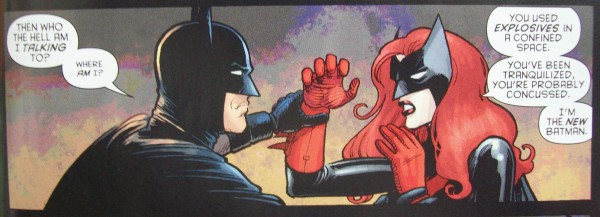
Only after the redhead meme became popular among fans did DC’s writers adopt it, in a way. The collectively written magazine 52, #30 (Nov 2006), showed him saying to Kate Kane/Batwoman, “I’ve got a thing for redheads.” Kate’s type is policewomen, so the creative team knew that wasn’t going to work out—it was just a wink to Nightwing fans.
Since then, however, the comics have shown Dick in a series of other relationships with a variety of women—brunettes, blondes, and, it appears, a somewhat higher fraction of red-haired women. What started as a cheeky fan observation has apparently become part of the mythos.

25 August 2013

Titans vs. X-Men

A Twitter comment from UK artist Randolph Hoyte alerted me to Chris Sims’s Comics Alliance essay on Marv Wolfman and George Pérez’s New Teen Titans. Sims is careful to note that his assessment of that magazine versus its predecessor is a matter of taste and “probably has a lot to do with reading X-Men as a kid and not getting around to The Judas Contract until I was in my 20s.”

As I’ve noted before, Sims was twelve in the 1994, and the comics we read when we’re twelve shape our tastes and memories, for better or worse. I was in my late teens when New Teen Titans was published, and hadn’t read previous versions of the team. The magazine thrilled and pleased me by doing all I’d learned to like in superhero comics and more besides. I can reread those stories and enjoy the nostalgia, but it’s next to impossible to find the same thrill in other superhero stories—and nothing’s more disappointing than picking up a story touted as “classic” and finding that it’s, well, just a superhero comic showing the traits of the time it was written.

It’s fair to compare New Teen Titans to Uncanny X-Men, Marvel’s alternate-superhero team book of the same era, as Sims does. Wolfman, Pérez, and their editor Len Wein probably did pitch their Titans revival as a possible answer to Marvel’s mutant magazine. And the X-Men issues that Chris Claremont, John Byrne, and Dave Cockrum created in the late 1970s and 1980s are top-notch.
But Sims gives more space in this essay recounting favorite moments from X-Men #132 (“Wolverine gets dropped through four floors to the sewer, then comes back at the end ready to literally murder everyone he sees”) than discussing any New Teen Titans story, for better or worse. It’s true that X-Men “feels like a product of the Modern Age,” but that’s because a big part of the “Modern Age” (at its height around, oh, 1994) was Wolverine killing lots of people. A look at The New Teen Titans should highlight its storytelling, perhaps noting some qualities that the “Modern Age” left behind.

Unfortunately, Sims’s aside about when he read “The Judas Contract” is the only time he mentions that best-remembered New Teen Titans storyline. And the only page of Wolfman and Pérez’s work illustrating the essay is one that introduces a supporting character (one whom many readers hate far more than I think is healthy). Those details indicate how glancing this assessment is.

Let’s start instead with the differences between Uncanny X-Men and New Teen Titans to isolate the qualities of each. Wolfman and Pérez worked with a different universe and characters, and they created a different type of superhero saga.

The Uncanny X-Men had the overall theme of being outcast. The Marvel mutants were disliked and hunted by authorities. Their headquarters was a shadowy private school in upstate New York. In contrast, the Titans were celebrities who worked with the government out of a T-shaped skyscraper on an island in the East River.

Even the Titans who felt like outcasts fit in better than almost anyone on the Marvel team. X-Men’s “demonic” character was Nightcrawler, who had a barbed tail, blue skin, and a habit of disappearing in a puff of brimstone. The Titans’ equivalent was Raven, daughter of a horrific giant four-eyed red demon who looked like…a beautiful thin girl with straight dark hair wearing a hooded cape. Cyborg had major body issues, but he was a big, handsome jock. In fact, as Pérez drew them, all the Titans looked like supermodels, and the one who was a supermodel looked like a Playboy fantasy. Being accepted and popular wasn’t their problem. Their challenges grew from their internal lives and their pasts.

The overall theme of the New Teen Titans was inheritance. All four of the established heroes were sidekicks or younger versions of adult heroes, with varied feelings about their mentors and legacies. The three new heroes were all at odds with their parents. (One was sold into slavery by her father, another crippled when his father opened an interdimensional rift, and then there’s that four-eyed giant red demon—the usual issues.) The magazine’s breakout villain, Deathstroke the Terminator, was the epitome of a toxic father. The villainous cult of Brother Blood was a corrupted reflection of the new “family” that the Titans were creating for themselves.

The best and most innovative New Teen Titans stories focus on family: the ground-breaking issue built around Wally West’s letter to his parents, Starfire’s rivalry with her sister, Changeling’s rage at the killers of his adopted mother, Donna Troy’s search for relations, Dick Grayson’s decision to move past being Robin, and even “The Judas Contract.” Those emotional issues reflect the superhero storytelling style of the early 1980s when the big fights were held together with extended melodramas full of thought balloons.

As Sims says, that sort of superhero saga might not be to everyone’s taste. Undoubtedly my own fondness for those stories is rooted in the fact that I was in my late teens when they appeared. But the best of Wolfman and Pérez’s work stands up just as well as Claremont, Byrne, and Cockrum’s, and may hit deeper emotions.

28 October 2012

Dick Grayson as DC Comics’s First Overt Male Sex Symbol

Earlier this month Thoughts About Dick Grayson considered when DC Comics began to present Dick Grayson as sexy:

I’m just spitballing here, but I don’t think DC really presented Dick as sexy until the 1980s in New Teen Titans, and I don’t think he became an icon for sexiness until the 1990s.
I agree with the first part of that conclusion, but I also think Dick Grayson was the company’s primary male sex symbol in the mid-1980s because he was the first hero frankly shown to be having sex.

That was a big change from the early days, of course. For the first thirty years of his existence, as the most prominent minor in a genre with strict rules about sex and everything else, Dick Grayson was kept far away from sexual feelings. In fact, Batman, #1, ended by showing how Robin was immune to the Cat[woman]’s charms even as Batman succumbed.

In 1963’s the “Prisoners of Three Worlds” story ended with Robin and Bat-Girl going off hand in hand while Batman blushed and gulped at Batwoman’s advances, but Dick and Betty would surely do nothing but kiss. In contrast, Alfred’s imaginary stories in the same era presented the clear possibility of Bruce and Kathy having a child.

Similarly, while there was a lot of flirtatious banter with Wonder Girl in the early Teen Titans stories, Robin never really connected with her, Harlequin, Batgirl, or other possible partners. In solo stories Dick’s college girlfriend Lori visited his dorm room, but he stayed dressed in his turtleneck sweater.

But then came New Teen Titans, by Marv Wolfman and George Pérez, in 1980. And that was one sexy comic book, from its very first images of Starfire in her barely-legal and completely impractical armor. Cartoonist R. C. Harvey tried to analyze the runaway popularity of that magazine in The Art of the Comic Book:
Upon first looking into issues of Perez’s New Teen Titans, I was struck by two aspects of his drawing style—how pretty his people looked and how copiously his detail abounded. . . . His people were statuesque hunks and glossy glamour girls, hothouse heroes and heroines cavorting in shapely perfection amid uncluttered and tastefully appointed settings.
The Titans were often working out in skimpy clothing or lounging around pools. Gar Logan’s jokes always drew attention to the beautiful girls, though they also made clear he wasn’t getting any. Even characters who weren’t supposed to be or think of themselves as physically appealing, like Changeling, Cyborg, and Raven, were gorgeous.

Pérez made no bones about designing sex appeal into the magazine in an interview with The Comic Times in 1980:
Starfire…was definitely created for pure sex. The fact is she’s sexy, she enjoys sex, and she makes no bones about it. She attacks Robin in the second issue. You know, really gives him one right across the mouth. The thing is. Starfire is an alien from another planet, but she can learn the language by touch. That’s just the way she chooses to touch. She likes Robin because he’s one of the few guys who's gutsy enough to show his legs. I hate that damn costume of Robin’s. but at least we’re going to have a little fun with it.
In 1983, Pérez repeated to Comics Scene that “Starfire was created as the group’s sex symbol.” Part of the fun of her early aggressiveness came from how Robin was such a straitlaced fellow, both as a character within the story and as a symbol in the larger American culture.

But soon Starfire wasn’t the only Titan to be sexy. In 1983 The Comics Journal’s Dwight R. Decker told Wolfman during an interview: “the Titans aren’t hopping into bed with each other, but there’s still an undercurrent of sexuality.” Wolfman acknowledged that Donna Troy (Wonder Girl) was in a “very healthy sexual relationship” with her boyfriend, Terry Long.

And there was more going on than Wolfman was ready to acknowledge. In New Teen Titans, #28 (dated February 1983), Dick visits Kory’s apartment and on a later page is wearing nothing but his pants while Kory is down to her nightgown. It didn’t take a lot of reading between the panels (or, to put it another way, in the gutters) to figure out what they had been doing. Later Wolfman joked about that scene but at the time he apparently had to be more circumspect.

In 1984, DC Comics launched a new New Teen Titans magazine with better printing and a higher price. This was sold only through comics shops, not newsstands, relieving the creators of worry about what innocent children might stumble across. And in the first issue of that magazine, one panel showed that Dick Grayson and Kory have been sleeping together. (As if we didn’t know.)

In the book Focus on George Pérez, published in 1985, the artist said that panel was his idea:
the simple reason that Dick is 19 years old. I was married at 19. . . . they are both consenting adults, and no matter what—the title says Teen Titans—at 19 years old, those two are legally adult. . . .

And, that one panel, which I did as tastefully as I could, there was no nudity involved, nothing was shown of the act, it’s just the fact that she was in what was established as being his bedroom, because I’d drawn the bedroom before. It’s the bedroom set I have. And, make no question about it, they were in bed together...
The company received “a few letters,” Pérez said then; “about three or four,” he recalled in 1987. But enough that Wolfman as the magazine’s editor felt he should respond on the letters page:
this has become one of the most controversial panels we’ve ever presented. Many readers wrote in saying “Way to go!” and others said “How could you do that in a book about teenagers?” The question cannot be resolved in a letter column. We didn’t mean to use Dick and Kory as role-models. That’s never been our intention anyway, but we realize by their being printed and portrayed as heroes (which they are) the mantle of being a role-model rests on their shoulders.

We acknowledge the problem some of you had with the scene and we apologize if it bothered you. We honestly had no idea there would be any problem. We also acknowledge that premarital sex obviously does exist, end we neither condone nor condemn those who believe or disbelieve in it.
In 1987 Pérez said:
As far as the backlash, it seemed like more only because Marv wanted to deal with the actual question. Even though there were very, very few letters about it, Marv wanted to deal with that and state something about it. I think Marv didn’t go far enough, myself. But again, I have an opinion on that type of thing, or am more vocal in some respects.

Unfortunately, by doing that, it called attention to it, and I think that it probably got more of a backlash of attention brought on by putting it in the letters page than it ever did appearing in the comic, itself.
Indeed, regardless of his denials, Wolfman’s discussion of the characters as “role models” raised the question of what they symbolized. Dick Grayson had been a comic-book role model since his first appearances. He had also symbolized youth, and now the former Boy Wonder was in bed with an alien supermodel. What was America coming to in 1984?! Next we’d be noticing that the President and his wife had gotten married in a secret ceremony eight months before the birth of their first child.

Pérez pointed to preceding examples of comics heroes having sex: Bruce Banner in The Hulk and Charles Xavier in X-Men. But those were:
  • Marvel magazines, not the more traditional DC titles.
  • characters established as adult.
  • not a character America had known as a youth since 1940.
Sex meant more when it involved Dick Grayson. As Wolfman and Pérez had planned, that character’s growth to independence, soon to culminate in taking the new name of Nightwing, was intimately tied up in his leadership of the Titans and his relationship with Kory. And that relationship included sex, even if it wasn’t yet a marriage. As an original reader of those magazines, I can attest that the characters’ behavior didn’t seem scandalous; it seemed natural.

Of course there’s a delightful irony in the fact that the original kid sidekick became the first unmarried male DC hero to have a sex life. I think that made Dick Grayson the company’s primary icon of male sexuality all the way back in 1984.

Within a few years, other DC characters followed. Dick came to represent monogamous values while other heroes of his generation were more freewheeling (providing yet another way for Roy Harper to screw things up for himself). But, just as he was always comics’ first and thus leading kid sidekick, Dick Grayson would always be DC’s first sex symbol.

03 May 2012

Who Would Win in a Debate—Batman or the Avengers?

The hype for the new Avengers movie (especially in the Boston Globe) has gotten so loud that it’s starting to make me forget the Kree-Skrull War. One item stood out: Alyssa Rosenberg’s brief essay at Think Progress:
I’m excited to see an intellectual debate between [The Dark Knight Rises] and The Avengers. Christopher Nolan’s Batman movies have always had an element of monkish sacrifice to them: to be an impactful superhero, Bruce Wayne’s had to surrender his true public image (in the first film, he acts the playboy to disguise his intentions), the love of his life and of the populace, and now, it’s implied, either his life or his physical health. . . .

The Marvel franchise, and The Avengers in particular (without spoiling anything), take the opposite tack. Its superheroes become better individuals more closely drawn to their communities for their experiences as superheroes. . . .

These two movies are going to make serious bank for their studios. But taken together, they’re also a vigorous argument about superheroism.
And the superhero genre is usually, I’d say, an exploration about what it means to be a hero, writ large and acted out while kicking other largely symbolic characters in the face.

The debate that Rosenberg envisions is, we should note, between Marvel’s mightiest team and Batman, not DC’s hero lineup or outlook. One theme of Kurt Busiek and George Pérez’s two-company crossover of the Justice League and the Avengers back in 2003-04 was the Marvel heroes’ surprise and suspicion that the DC team was so comfortable with popular acclaim. In that case the Avengers stood for “monkish sacrifice,” for doing the right thing without expecting praise or popularity. The Justice League was their world’s mightiest law-enforcement organization.

But Batman changes the equation. Since the 1980s the Dark Knight has stood apart from most of his DC Universe colleagues because of his lack of attention to social niceties and preference to work alone (albeit with a large “family” of supporters and protégés). Nolan’s movies give Bruce Wayne two in-the-know father figures (Alfred and Lucius Fox), but no other surviving confidants.

That Batman would fit with several of Marvel’s heroes as Stan Lee, Steve Ditko, Jack Kirby, and colleagues originally conceived of them: the Hulk is an anti-hero, Spider-Man an outsider, and so on. He wouldn’t get the modern Tony Stark, also a billionaire playboy but one who’s told the world that he’s Iron Man.

01 April 2012

The Sensational Character Find of 1965

This being the first of April, it seems appropriate to discuss the Titans’ resident jokester and comic relief: Gar Logan, known alternatively as Beast Boy and Changeling. But mainly how he fits alongside Dick Grayson as Robin/Nightwing. This shows the flexibility (or perhaps the tribulations) inherent in a superhero who’s a supporting character.

Writer Arnold Drake introduced Beast Boy in the Doom Patrol comics of the late 1960s: a green teen (probably inspired by Dean Stockwell’s role in The Boy with Green Hair) who could take the shape of any animal. Beast Boy was a kid sidekick, but not a junior version of any member of the Doom Patrol. At first he wasn’t even a member of the team, but eventually one of those heroes adopted him.

When that magazine was canceled and Drake killed off his creations, young Gar survived as an orphan. After he appeared in some Teen Titans issues of the 1960s and ’70s, Marv Wolfman and George Pérez brought him into their New Teen Titans magazine in 1980 as the team’s gag man. He was one of the five main characters to make the leap to the Teen Titans TV cartoon in 2003.

As a character, Beast Boy has always worked best as part of an ensemble. In 1999 Geoff Johns and Ben Raab wrote a short miniseries with him as the main character, but notably it also featured Dick Grayson and other old teammates. Logan’s most memorable moments in comics have come in the various Titans series, and at the top of that list is “The Judas Contract,” in which Logan fell in love with a cute new Titan named Terra who turned out to be much more trouble than he’d dreamed.

In recent years, DC Comics has moved sharply away from the concept of a single “continuity” or history codifying all forms of its mythology. The Teen Titans of the cartoon aren’t the same as the team in Wolfman and Pérez’s New Teen Titans, or those of their New Teen Titans: Games, or the hybrid team now appearing in the Young Justice cartoon, or the parody versions in Tiny Titans.

The origins, personalities, and powers of DC’s main characters—Superman, Batman and Robin, Green Lantern, etc.—don’t change greatly from one continuity to another, but relationships among them can vary and the histories of secondary characters can change greatly. (The company also treats Wonder Woman as a main character, but her underpinnings do change as creators struggle to figure out what she best represents.)

As a secondary character, Gar Logan is therefore often in flux. New Teen Titans and its offshoots established him as a lovelorn wise guy, a bit younger than his teammates, who submerges his losses and neediness behind jokes.

But in the Young Justice cartoon, Dick Grayson as Robin is the group’s nerdy little wise guy. He’s the youngest of the group and deeply into computers and word games. So what space does that leave for Beast Boy?

In an episode broadcast last month, Young Justice showed us Garfield Logan as an eight-year-old living in Africa with no special powers. He gets a blood transfusion from the hero Miss Martian, a green-skinned shapeshifter. Frankly, that sets up a better explanation of why little Gar might grow up to be a green-skinned shapeshifter than the mysterious disease-and-cure interaction established in Doom Patrol decades ago. But for now that continuity still doesn’t have a Beast Boy.

In Tiny Titans, Robin is the put-upon central figure infatuated with a red-haired girl, and the whole comic is comic relief. So what space does that leave for Beast Boy?

Creators Art Baltazar and Franco re-established his crush on Terra as a more demonstrative one-sided relationship than Robin’s crushes—which is to say that Terra throws rocks at him. Otherwise, however, that comics’ Beast Boy seems more worldly than Robin. And in the magazine’s final issue, he actually comes up a winner.

The Tiny Titans versions of all six of the other New Teen Titans regulars look on happily from the center of this panel.

Finally, where’s Beast Boy in DC Comics’ new main continuity? He’s been changed to a red shapeshifter, more consistent with another animal-based hero. His debut in May will reveal more about that character’s name and history. Rather than part of the revamped Teen Titans, this Beast Boy’s in a related group.

In sum, Beast Boy is going in all directions, as dictated by the storytelling needs of whatever ensemble he’s assigned to.

30 October 2011

Finishing New Teen Titans: Games a Bit Hastily?

The last few weekly Robin installments have celebrated the art of George Pérez in New Teen Titans: Games. There are many more examples to enjoy.

Early in the book a series of panels of Dick Grayson using Central Park as his own steeplechase course for a workout, silhouettes interspersed with full-figure sketches. This visual effect returns as Nightwing and his adversary fight as silhouettes stomping on a scale model of New York.

Pérez and his inking and coloring colleagues drop the solid lines and strong colors of the ordinary settings to depict Azarath, Raven’s hellish home dimension. (See here for an early take on that page by colorist and collector Tom Smith.)

Despite being one of the DC graphic novel division’s premium new books, however, Games shows signs of hasty production. On one page (see above) a misplaced borderless white box cuts off characters’ feet. Presumably it was left over from some design program.

I spotted some panel lines incompletely erased, as in the example below. (Those panels also show how scripter Marv Wolfman, the editor, and the letterer made Nightwing’s speech appear before the villain’s even though it comes out of a later panel.)
The front- and backmatter are illustrated with images of the main characters cut out and enlarged from the pages in between. It’s possible that those images were inked digitally, and they were certainly colored and finished on a computer. That means they were created to be printed at a certain size, with an appropriate dots-per-inch measurement.

Rather than rescan and rework Pérez’s pencils at a higher resolution to make those big portraits look even more magnificent, the production team simply enlarged the images from the pages, resulting in jaggy lines. Beginner PhotoShop classes warn against doing that. Seeing the effect in a premium graphic novel makes the production look slapdash.

24 October 2011

Weekly Robin Extra: More Pérez Panels

Here’s another example of striking design from George Pérez in New Teen Titans: Games. Just before this sequence, the Titans have learned that there’s a bomb about to go off in New York City.

Pérez first creates a series of horizontal panels of Titans racing to the site of that bomb in their different ways: Joe Wilson in his circa-1988 car, Donna Troy gliding, Gar Logan flying as a hawk, Starfire blasting through the sky, and Vic Stone in the Titans jet. Each panel is slightly longer, extending further into the negative space above the jet, suggesting progress—but slow progress. Will they be on time?

At the bottom of the page is a series of six vertical images of the character Raven visiting her mother, an unusually untroubled moment for her. Like a movie director, Pérez pulls back from a close-up of Raven looking happy through a window into the house, and then moves forward into another close-up of her emblem, which also serves as her Titans radio. We realize that Raven, who could teleport instantly to the scene of the bomb, has not gotten the message.

Travis Lanham’s digital lettering of the alarm sound breaks horizontally across the bottom panels, growing bigger and darker. That line of letters reflects the horizontal, left-to-right movement of the Titans above. It’s impossible to resist turning that page to see what comes next.

23 October 2011

Fight at the Guggenheim Museum

Here’s a page from New Teen Titans: Games with visuals I found particularly striking. In this scene, George Pérez shows Joey (Jericho) Wilson fighting villains called Knight and Squire in New York’s Guggenheim Museum. At the top, the Knight knocks Joe over the rail of a balcony.

As Joe falls down the page, the Guggenheim’s tiers define the tiers of the panels, providing strong horizontal lines yet uniting the fall into a single image. The effect reminds me of Maurice Sendak’s In the Night Kitchen, which in turn drew heavily from Winsor McCay’s Little Nemo in Slumberland. Near the bottom, Joe grabs onto the rail of a lower balcony, and thus in a way grabs onto the top border of that panel to hold himself up.

Meanwhile, on the left, Pérez offers framed vignettes of the museum staff reacting to the fight, and at the bottom (within a differently styled frame to signal the difference) the Squire taunting them. The shapes and scale of those panels are reflected in the picture frames that Joe falls past on the right.

In the years when no one expected Games to come out, some of Pérez’s artwork circulated among fans. Titans Tower has posted a scan of the line art of this page, showing the bare design.

The finished page includes the contributions of Hi-Fi, the firm that provided digital coloring for Games. That process added not just colors but Joe’s shadows on the wall, and the images of famous nineteenth-century art in the frames, under glowing lamps.

Of course, that’s not the type of art that gets displayed in the Guggenheim. Modernist works, particularly Pop and Op Art, might even have worked better in this scene, playing off the medievalism of the villains and Jericho’s costume. But those works have more copyright protection. And the choice of Impressionism enhances the surreal contrast between this fight and the dignified placidity of its museum setting.

16 October 2011

Pérez’s Panels in New Teen Titans: Games

One of the great pleasures of New Teen Titans: Games is the chance to revisit George Pérez’s art. He’s known for attention to detail, but he’s also a master of composition and page design.

So many comics artists have a limited repertoire of facial types and expressions. In superhero magazines, “handsome man” and “beautiful woman” get a particular workout. That makes it hard to tell characters apart. Pérez is famous for giving characters not only different faces (as shown above), but different repertoires of expression and different body languages. There’s never any problem distinguishing one of his characters from another.

And the panels! Working on extra-large pages in Games, and before the style of “decompressed” storytelling, Pérez produced a massive quantity of images. The average number of panels on a page is in the double digits. One page has 31 separate images.

The designs become very complex, particularly as the story splits into conflicts between individual Titans and matching villains. On a single page spread the narrative can switch among three or four storylines, or between flashbacks (outlined in red) and the present.

What’s more, one villain is monitoring events on TV screens while standing beside his exact scale-model of New York. The panels can thus shift from a real-life setting to a video image of that setting to a little replica of that setting. Yes, it’s more than occasionally confusing, but that mirrors the layering of the plot itself.

Early in the book Pérez shows team member Joe (Jericho) Wilson, who’s mute, spelling out T I T A N S in American Sign Language. His extra-thin panels convey the speed of Joey’s communication—a novel way to combine words and pictures in comics. Yet even in those thin panels, Pérez doesn’t just copy the same face, but shows Joey’s expression changing.

Pérez created Joey with writer Marv Wolfman with the idea that he would never have thought balloons. Readers would have to pick up what Joey’s thinking entirely through Pérez’s art and the other characters’ interactions. Very few other artists have been able to make the character work.

Pérez mixes up panels with thick borders and thin borders, or no borders. (In some comics, such changes have storytelling significance. Here most seem to be aesthetic choices only.) There are panels defined by darkness around shafts of light. There are panels defined by the single-color silhouette of an explosion around a character, as shown at top. (Can you spot Starfire’s curves?)

One approach was so new to me that at first I thought it was a mistake: in certain small panels without borders and backgrounds, Pérez and his inkers and colorists leave out the lines delineating a character’s white clothing from the paper. The second time I saw it, I realized it was just another way Pérez was stretching his style.

COMING UP: Some favorite pages.

10 October 2011

Weekly Robin Special: The Games Plotters Play

Saturday’s weekly Robin special discussed how Marv Wolfman and George Pérez developed New Teen Titans: Games over more than two decades, and how Wolfman believes (for the purpose of a publicity interview, but no doubt sincerely as well) that that delay benefited the book.

Indeed, at some points in recent years the book could not have been published. Its action involves attacks on New York City buildings, bombs planted in the UN and other landmarks, an attempt to shoot a passenger jet out of the sky, and, at the climax, the tops of skyscrapers crumbling (as shown above).

In late 2001 Pérez responded to a question about whether Games would ever appear by stating, “a major scene in the story took place on the World Trade Center towers. That pretty much ends the speculation for me.” But more years have passed, that scene was changed, and those images, while powerful, are no longer so raw. [Ironically, New Teen Titans, vol. 2, #20, from 1986, shows Donna Troy nearly flying the Titans jet into the World Trade Center. Oops!]

Still, it seems that the long gestation time blurred some details of the Games plan. The way the book was created, Pérez typed up an incomplete plot outline and then went home to draw pages, filling out the action visually for Wolfman to script later. By the time they came back to those pages, Pérez no longer remembered how he expected certain images to fit together. And then the team rewrote their story with a new ending and more character moments.

As a result, some parts of the plot don’t quite fit together. Early on, the Titans spot secret agent King Faraday using all the resources of the federal government to pressure them into helping him on his mission. Yet the book has shown Faraday losing power within the bureaucracy, and the Titans have their own high connections. More important, despite knowing that Faraday is willing to manipulate them, Nightwing and the Titans never question the evidence he shows them.

At one point young Danny Chase is grazed by a bullet; several pages later, he’s shielded from six bullets. Three different times, things blow up in front of him. A character named the Squire suddenly feels his body age or deteriorate, but it’s unclear how that happens, and most of the other secondary villains just explode. And I never got what powers the Squire’s musical instrument is supposed to have.

The villains prove that they can plant bombs and lasers all over New York, unleash giant robots, take over all television broadcasts, and make nasty creatures appear from nothing. Yet the whole nefarious plot requires taking over one building and its power supply. Because without that, the US won’t believe that really bad things can happen. Yeah.

In the end, the plot turns out to involve one crazy person secretly recruiting several more crazy people. (I use the term “crazy” because there’s no realistic depiction of mental illness; the characters’ conditions are excuses for them to behave unreasonably as need be.) Wolfman and Pérez invented villains for this project to reflect various types of video games popular in 1988. By the end of this volume they’re almost all dead, with no great loss to the world—not that that stops comic-book characters from coming back.

The Titans split up to battle those separate foes, then gradually team up to triumph, underscoring this series’ recurring theme of sticking together. Some of those conflicts weren’t compelling for me, but perked up as they intertwined. Pérez and Wolfman make especially good use of Jericho’s power to enter and take over other people’s bodies.

Of course, I never read the New Teen Titans for the villains or the fights. (Remember that fish-god-thing from the museum? I thought not.) I read it for the heroes and their interactions. Games brings back the Titans’ private lives and relationships, even Donna’s relentlessly loving marriage with Terry Long.

I’d have been happy with a few more glimpses of Dick and Kory as a couple, but Pérez made sure to show Nightwing shirtless for the final pages of the fight; some traditions are indispensable. Koriand’r comes through as gorgeous, strong, and passionate, and she also thinks through her opponent’s weaknesses. This is especially welcome in a month when DC introduced a new version of Koriand’r who appears emotionally and mentally vacant, and—hard as this is to believe—even less dressed.

My favorite of the “private” moments on first reading was Dick having to contact all of Joey Wilson’s recent girlfriends on what, way back in 1988, we called “answering machines.” (At another high-tech moment, Donna holds up a CD and calls it “a hard disk.”)

At the end, we see several past Titans joining the current lineup before one of their beloved picnics together. Titans Tower doesn’t look the way it once did, but once again we’ve seen what’s really important: the team stands tall.

COMING UP: Pérez’s panels.

09 October 2011

The New Teen Titans: Games Pocket Universe

As the weekly Robin started to discuss yesterday, Marv Wolfman and George Pérez began mapping out New Teen Titans: Games in 1988. At that time, a young telekinetic named Danny Chase was one of the Titans, Batman’s young crime-fighting partner was Jason Todd, and Nightwing was feeling estranged from his mentor.

Within months, Jason was killed, Nightwing had responded by cutting Danny from the team, and Tim Drake was slipping into the role of Robin—in a story initially written by Wolfman and drawn by Pérez. Those developments meant that Games no longer reflected current Titans continuity. As time passed, its storyline slipped even further behind the DC Universe.

Soon the Games pages that Pérez had drawn belonged in a pocket universe of their own. Rather than toss those aside or rework them, he and Wolfman proceeded with their story. The result is what DC once called an “Elseworlds” story, though less radically redesigned than usual.

This version of DC reality offers starkly different fates for Danny Chase, master spy King Faraday, and Cyborg’s friend Sarah Simms, who works with children who have prosthetics. In this continuity, Tim Drake wears the first, bare-legged Robin uniform, and Dick and Bruce Wayne exchange warm handshakes, as in the pre-Crisis universe.

But otherwise, the Titans are very much like what we fans from the 1980s remember. In fact, in some ways they might be better. After the main action in Games, Pérez shows us that Gar Logan has stopped wearing his green hair in a mullet, which offers hope that Dick will never go down that route.

We can imagine a brighter future for the whole team. Donna might find a less ludicrous costume more quickly and not lose her family. Joey might never go mad. Dick and Kory could live together happily ever after. In sum, Games offers select comics fans the chance to imagine that things will always stay the way they remembered.

The biggest difference lies in the story of Danny, the “Cousin Oliver” of the Titans. When Wolfman invented that character, full of braggadocio and insults, he planned for the young teen to mature, and hoped that eventually people would recognize his good qualities. (Even Pérez didn’t care for Danny.) But readers didn’t come around. Wolfman wrote him off the team, and eventually out of existence.

Games offers an alternative path for Danny, and perhaps his finest moment. Wolfman scripts him realizing he’s reached his limits and then going beyond to protect people, making a big sacrifice in the process. In this continuity, Danny Chase remains a Titan, and becomes a hero.

TOMORROW: Plots within plots.

08 October 2011

Weekly Robin Special: Let the Games Begin

DC published the New Teen Titans: Games graphic novel this season, more than twenty years after scripter Marv Wolfman and penciler George Pérez met to map out their story. Such a big event demands more than a single weekly Robin posting.

I’ll start on a personal note: I had stopped reading the New Teen Titans magazine before DC Comics first announced back in the late 1980s that this book was on its way, so I’m not one of those fans who’ve waited for Games for over two decades.

On the other hand, I have been waiting for two years since DC announced that Pérez had resumed work and that it would soon publish the book. Fortunately, having grown to more than twice the age of the heroes in the magazine, I’d developed enough patience to handle that delay.

In fact, the book has benefited in many ways from the long wait. According to Wolfman’s comments in an interview at Bleeding Cool by new Teen Titans scripter Scott Lobdell:
In 1988, I had come up with the basic storyline, but I was then suffering a terrible writer’s block, the only one in my career, thank God, although it lasted 5 years. George, then-editor Barbara Randall Kesel and I talked over what I’d come up with, and because of my block George went home and typed up the overview, breaking it down and filling it out with ideas, etc. We actually print that plot in the Games hardcover complete with annotations so people can see what had been and what was then changed. He then drew between 60-70 pages before going into a Titans block and stopped. I never dialoged any pages since I was waiting for them all to be finished so I could write them all at once. Also, I was hoping my block would go away as didn’t want to do less than my best on it.

But when we finally came back to the story 23 years later, since we had not really worked out the last 50 plus pages in any depth, and because neither of us could remember what we intended decades before, and the plot, frankly, would have felt dated, we decided to come up with a new story, utilizing and making sense of all the pages George had already drawn, yet written to have an entirely new meaning. I started re-plotting the story, adding in a new villains, plot twists and more, as well as suggesting we change the major villain who was actually behind the whole plot, which was new as well. We also had to come up with all new character-driven scenes to make what was supposed to have been a pure action story into something much more. (As a companion piece to the regular book we were working on, a solid action book would have worked. Twenty-three years later that would not have been satisfying to any of us who had been waiting so long.)

Knowing the new character scenes which George and I worked on together, batting ideas back and forth as we always had, I then was able to dialog the earlier, already drawn pages, in a way that would cleanly set up where we were going to go. When you read it you will assume that was what was intended all along, because the copy and art work perfectly together, but it’s new. George and I would go back and forth and I’d rewrite the ideas and we finally had a story that was much, much stronger than had originally been designed.
That delay also meant that Games has ended up standing outside the standard DC Comics continuity—which might well be a good thing.

TOMORROW: The weekly Robin explores the New Teen Titans: Games pocket universe.

19 June 2011

Glimpses of the Original Conception of Tim Drake

When DC Comics introduced Tim Drake in late 1989, the character was still solidifying. A couple of unclipped loose ends slipped through in that early material to show how he might have been a little different.

The first panel here comes from the collection of world-class Robins fan and occasional Oz and Ends commenter Icon-UK, shared on the Comic Art Fan website. It’s from the pencil of George Pérez and the pen of inker Bob McLeod. Our helpful pal Ike reveals:
Tim’s hair has been altered after the inking stage with an overlay, to what would become his trademark appearance; originally he seemed destined to have the same side-curls as Dick and Jason had had at the start of their Robin careers, but clearly they wanted to give him his own look both in costume and civilian looks.
It’s interesting how in the same stretch of issues show Timmy as a younger boy appears with a side part. As a teenager, did he start trying to imitate how his idol wore his hair the same age?

Those double forehead curls appear in a classic Dick Grayson image to the right. They stopped being standard for Robin with the “New Look” of 1964. For the next quarter-century, various artists instead depicted Dick with his hair combed straight back or a side part. (And then came the dreaded mullet years.)

After the first and then the second Jason Todd came into the picture, that character inherited the classic Robin hairstyle. Until recently he retained those forehead curls in most artists’ depictions, along with a streak of white through his black hair. In Jason’s most recent appearance he has long red hair. And who knows what will be under the red hood after the upcoming reboot?

The panel to the left comes from another issue of the story that introduced Tim Drake, Batman, #441, drawn by Jim Aparo. In this image, Dick addresses Tim as “Jeff.”

Originally DC planned for Batman’s new sidekick to be named Jeff, but plans changed toward the last minute, probably because editors wanted to put more distance between this character and his predecessor Jason, often addressed as “Jay.” The revision process caught most of the old name’s appearances in Marv Wolfman’s script, but not this one. (Many years later Robin, #167, told us that Tim’s middle name is Jackson.)

The first three male Robin names aren’t really that far apart. Despite the characters’ different backgrounds, they’re all WASPy names of the sort American pop literature has given young heroes since the dime-novel days. They all built around percussive consonants (D in particular) and that strong long A. And so far each male Robin has a given name sharing a rhyme or first letter with his predecessor’s last name.

The girls, Carrie Kelley and Stephanie Brown, are of course left out of these patterns.

15 May 2011

Looking Back on Dick Grayson’s Life after 49 Years

When Dennis O’Neil and his editorial colleagues at DC Comics decided to bring on a (by my count) fourth Robin in 1989, they were convinced that they needed to please fans of the first, Dick Grayson.

As I wrote back here, I suspect the second Jason Todd started hemorrhaging fans after he was rude to Dick in Batman, #416. If fans took against Jason’s replacement for the same reason, or any reason, then all the effort of introducing that new character would go to waste.

Part of the company’s strategy appears to have been to reestablish the place of Dick Grayson in the DC Universe. After the Crisis on Infinite Earths miniseries, fans were no longer sure what stories and details were “in continuity.” That same Batman, #416, had drastically changed how Dick had taken on the role of Nightwing. So what else was solid about Dick Grayson in the post-Crisis universe?

An issue of Secret Origins Annual codified Dick’s history with the Titans, going back to his first team-up with Kid Flash and Aqualad in The Brave and the Bold, #54. Scripted by George Pérez and illustrated by a variety of artists, it bundled two decades’ worth of often goofy storylines into a tighter—though only slightly less goofy—knot.

The second stage of the process was a series of four issues in Batman magazine called “Year Three,” scripted by Marv Wolfman and drawn by Pat Broderick, with stunning covers by Pérez. The first, Batman, #436, was cover-dated August 1989, so it appeared in late spring, around the time of Tim Burton’s Batman movie.

While Frank Miller and David Mazzucchelli’s Batman: Year One and Mike W. Barr’s less highly regarded Year Two were set entirely in Bruce Wayne’s early crime-fighting career, “Year Three” wove flashbacks to how Dick Grayson became Robin into a story taking place in the present.

The basic origin myth didn’t change much: thugs working a protection racket killed Dick’s parents during their trapeze act, and Bruce Wayne took him in and trained him as Robin. But while those events took less than a page in 1940, the retelling gave due respect to the bureaucracy of child services. In other words, Dick spent time in an orphanage before coming to Wayne Manor.

In addition, the gangster who ordered the hit on the Flying Graysons, Tony Zucco, changed in significant ways. Originally he was a fat version of Edward G. Robinson’s Little Caesar lording over a town outside Gotham. In the retelling, Zucco is an orphan who worked his way up in the mob, keeping notes on all his Gotham colleagues’ activities. Year Three begins with Zucco about to be released on parole.

The storyline’s most far-reaching development is Bruce Wayne’s reaction to Jason Todd’s death back in Batman, #429. DC’s writers had been keeping away from that subject, at first because they wrote their scripts before knowing the result of the fan poll and then because the team hadn’t decided how to address it.

Wolfman made Bruce’s psychology a major part of his story. Batman has suffered a second trauma, almost equal to his parents’ death. He’s more angry, tight-lipped, and violent than ever. He’s no longer acting ultra-rational (or as much so as a man in a bat costume can be), but taking reckless risks and coming close to violating his ethical code.

This of course all makes Dick look even more admirable and important. His arrival provided Bruce with emotional balance, the story implies. And in the present-day adventure, Dick as Nightwing solves the mystery and wins the final fight with the bad guys. The story also parallels him with Zucco—both spent time in the same orphanage—further underscoring what a moral paragon Dick Grayson has turned out to be. (See Reason for Robin, #10.)

One more little detail: among the flashbacks to young Dick’s circus career, we see him greeting a four-year-old fan named Timmy.

COMING UP: Dick Grayson’s biggest fan.