Showing posts with label AUTHOR Frank Miller. Show all posts

19 October 2014

Loeb’s Untraveled Road

This month John Siuntres’s Word Balloon podcast reran excerpts from some past years’ interviews with Batman story creators. Starting about 54 minutes into the recording, scripter Jeph Loeb described a story of the Dynamic Duo that never got off the ground:
My pitch on the original All-Star Batman and Robin, which is a book that I was writing when I left for Marvel and then got replaced by Frank Miller—and if you've got to get replaced by somebody, that's not a bad choice—…was going to be Jim [Lee’s] and my return to the character. . . .

At the beginning we really didn’t understand what All-Star was. The first time it was pitched, it was, “Take these characters as though it’s 1968, that’s the continuity you’re using.” And I was like, “So, basically, what you’re saying is that Barbara Gordon hasn’t been shot. I mean, is there anything different?” Because I really thought it all should have been Year One, and you should take it from there, and that way you could do whatever you wanted. And then I didn’t know how much you could change stuff around. I never had any idea they were going to change things as much as they were, like, you know, the Black Canary playing such an important role in Batman’s world. . . .

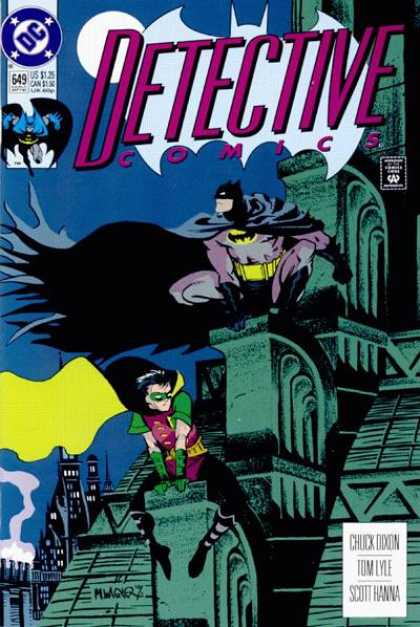
The story that I wanted to tell was that Jason was the first Robin, and that he’d been killed, and that Batman…hid the fact that Jason had died, and then met Dick in the same way that he always met Dick. And decided that there was a way that all the mistakes that he had made with Jason he could rectify with Dick. Which is a little bit more like what he did with Tim Drake, having failed with Jason.

But what I liked about this story was that the only two people who knew what he had done were Gordon and Superman, both of whom came to Bruce and said, “What the hell are you doing? Like you’ve already gotten one child killed, why would you do this again?” And then you really saw Batman’s arrogance about it, that he thought that he could make up for the death of this child by making it right with another child.

But that was not a story that ever got told.
That apparently would have been Loeb’s second take on how Dick Grayson came to be Robin, following Dark Victory. Then again, considering that All-Star Batman and Robin the Boy Wonder fans are still waiting for Lee to finish the issues Miller mapped out years ago, it might be more accurate to say it would have Loeb’s take one-and-a-half.

11 May 2014

Not-So-Secret Origin

Before DC published Secret Origins, #1, with the origin stories of Dick Grayson as Robin as well as Superman and Supergirl, scripter Kyle Higgins said in an interview that his final issue of Nightwing actually “says everything I have to say about the character.”

Unfortunately, he was right. The twelve-page story in Secret Origins goes over old ground. The art, penciled by Doug Mahnke, is pretty, just as in the recent Batman and Robin Annual. The story confirms some things already established in DC’s “New 52” continuity, such as Dick already being in his mid-teens when he meets Bruce Wayne. The title “The Long Year” provides another temporal fact for readers who care deeply about such things.

But the problem is that the first Robin’s origin just isn’t secret anymore. In fact, it’s so well known among superhero fans that storytellers can evoke it with just partial images, such as a Flying Graysons poster or the broken trapeze rope swinging into the frame in the TV cartoon episode “Robin’s Reckoning.”

While the stories of how Jason Todd and Tim Drake became Robin have been significantly reworked, Dick Grayson’s has remained basically the same since 1940. The only changes have been at the margins: whether the authorities sent Dick to an orphanage instead of apparently straight to Wayne Manor, whether Tony Zucco or his family are still around.

The radical changes have been Frank Miller’s story of Bruce kidnapping Dick over several long issues of alternative-continuity All-Star Batman and Robin and Scott Snyder’s decision to make the Haly Circus a training ground for athletic assassins—which plays no role in Higgins’s new story.

So Higgins’s origin story has almost no place original to go. We see the robin bracelet he already established in Robin, #0. We see Tony Zucco threatening the circus. We see the death of Dick’s parents as Bruce Wayne watches, and an orphanage. Dick tries hunting his parents’ killer and has to be rescued by Batman, but we’ve seen that before, too.

Higgins said the one idea he had left to explore was the origin of the Robin name, mostly because DC’s new editors had nixed the idea of inspiration from Robin Hood movies. (Apparently Kevin Costner’s and Russell Crowe’s versions don’t have the cultural resonance of Errol Flynn’s.) So we have a page of Dick thinking about what his crime-fighting identity should be and seeing a robin fly by—the same scene we saw with Bruce Wayne and a bat back in 1939.

The last panel on that page drives home the symbolism with Bruce speaking of the robin as a symbol of “growing up,” which is what Robin/Dick Grayson has meant in the DC mythos since the following year. But we already knew that.

31 March 2013

Is One’s Choice of Best Robin Generational?

Chris Sims of Comics Alliance (and, earlier, the Invincible Super-Blog) posted a very good essay this week on the questions: “Who is or was the best Robin? What is the Best Robin moment in Comic Book History?”

Ultimately Sims decides that what defines Robin is helping Batman, and by that measure he chooses Tim Drake as the best. That approach allows him to praise Dick Grayson for having been Robin and leaving that role to become a major character in the DC Universe. He also finds the best Robin moment when Carrie Kelly fully adopts the role, not through any feat of acrobatics or detection but simply in assuring Batman that he has help.

I see only one major flaw in the essay, and it’s part of Sims’s argument in favor of Tim Drake:

Tim's not in it for himself, and a lot of that comes from the simple fact that he doesn't need to be. When he first appears, he doesn't have a tragedy that defines his past and drives him to seek vengeance. In fact, he has the exact opposite: It's not really exaggerating to say that he's the single most privileged, well-adjusted character in the entire Batman mythos. He's rich enough to live more-or-less next door to Wayne Manor, he has two loving (and living) parents. The one thing that drives him is that he's a kid who loves Batman.
But why does Tim (like Sims) love Batman? A big part of the reason, I think, is that he doesn’t have “two loving (and living) parents” with him anymore. When Tim first connects with Batman and puts on the Robin suit, his parents Jack and Janet have parked him at a boarding school while they travel the world doing business deals and sniping at each other. Tim’s interest in Dick Grayson isn’t fueled just by having met the young circus flyer on a bad night; he also hungers for a family. His interest in Batman isn’t just driven by justice; it’s also a desire for an admirable father in his life.

Soon after Tim starts interning in the bat-cave (though that was before the term “interning” had escaped the confines of the medical field), his mother is killed and his father paralyzed by a criminal in Haiti. DC Comics planned for Jack Drake to die soon as well, making Tim’s trajectory the same as the preceding Robins: orphaned by crime, taken in by Bruce Wayne. But scripter Chuck Dixon kept arguing (and demonstrating) that there was more drama in keeping the man alive.

Instead, for more than a decade Tim juggled life with his father and life with Batman, which set him apart from past Robins. And it’s tough to say which man caused Tim more trouble. Jack Drake fell in love with his physical therapist Dana and married her, moved the family out of Gotham and then back, sent Tim to another boarding school, lost all his money, found out about Tim’s double life, and so on. An underlying theme of the Robin comics then was that Tim was actually the more dependable and responsible of the Drakes, the one who was really looking after other people.

In other words, Tim still needed the strong father figure of Batman in his life, whether he could admit that or not. That’s why I don’t think Tim Drake became Robin just for justice. He also had private psychological needs compelling him to take on that role. (Another underlying theme, stronger in the 2000s, was that Tim was also often more mature than Bruce Wayne.)

I also suspect Chris Sims has a particular perspective on the Robins question based on his age—or more particularly on the age when he was reading superhero comics most avidly. Now I recognize that as a professional comics writer with a specialty in Batman he’s still reading superhero comics avidly, and that he’s consumed and considered the canon published back before he started. Nonetheless, I think that the stories one read as a child and young adolescent exert the strongest emotional tug and establish one’s expectations.

In another essay Sims has stated that he was twelve in 1994 when he started to collect back issues. In other words, he was at that crucial age when:
  • Tim Drake was established as Robin. Furthermore, by then Tim had his father and stepmother at home (hence the “loving parents” understanding).
  • Jason Todd was established as the dead Robin, the possibly homicidal Robin, the Robin that haunted Bruce Wayne. As I’ve written, this characterization didn’t solidify until after 1989.
  • Dick Grayson was established as Nightwing, the former Robin, but the New Titans were past their glory days.
  • Carrie Kelly was a possible future Robin who appeared in one revolutionary volume.
And it’s those figures that dominate Sims’s essay.

The Robin that came before—the first, red-haired Jason Todd—gets less than a sentence. Of the Robins that came later, Stephanie Brown is dismissed with a hand wave (“Stacy?”). Jason Todd’s return from the dead is treated as an unnecessary, unfortunate change that doesn’t affect his symbolic significance. Damian Wayne gets a longer analysis, and a good one, but it still seems clear that Sims’s heart is back in the 1990s.
Another essayist might conclude that Dick Grayson is the best Robin because he established the mold not just for that character but for all kid sidekicks in superhero comics; because he provided the emotion and humor that the first year of Batman stories lacked; because he was popular enough to appear on more DC covers of the 1940s than any other character; because his relationship with Bruce Wayne offered the only ongoing emotional depth in Batman comics for two decades; because he set the standard all subsequent sidekicks aspire to. And that reader probably read the comics of the 1940s and 1950s at a crucial age.

Yet another fan might argue that Dick is the best Robin because Batman could rely on him whether they were fighting gangsters or extraterrestrials; because he symbolized the best of America’s youth but would, both Alfred and Earth-2 agreed, grow up to be a crime-fighter; because he had no powers but was still the Teen Titans’ leader and badass; because as “Teen Wonder” he offered DC Comics a way to gingerly explore youth culture. And that reader probably read the comics of the 1960s and 1970s, and watched the ABC TV show, at a crucial age.

As I’ve written several times, my first prolonged exposure to superhero comics was the Batman: From the ’30s to the ’70s collection, which emphasized the stories between Robin’s arrival in 1940 and the “New Look” of 1964. And the last superhero comics I was reading in my late teens was the New Teen Titans series in which Dick Grayson made the leap to become Nightwing.

So for me that character wasn’t always a former Robin, and the goofy, shallow stories of the 1950s aren’t just quaint embarrassments—though they were juvenile adventures that Dick Grayson’s character helped lead the company away from as he matured in the early 1980s. Sims’s analysis is rooted in DC’s post-Crisis universe; my expectations were established before the Crisis struck.
For other readers, younger than both of us, Stephanie Brown’s brief period as Robin might loom much larger because it came at a crucial time in their own exploration of Batman comics, and Jason Todd might not be the dead Robin but the Robin who returned from the dead and is still not fully part of the family. Some such readers might prefer those other Robins, arguing that they had so few of Tim’s advantages (and so little of his support from the publisher and the fans he was clearly designed to reflect).

Even younger readers might have just had their expectations shaped by the presence of Damian Wayne for the past few years, seeing him as the best Robin (just as he’d want). Readers whose notions are being shaped by the “New 52” universe are also seeing quite a different Tim Drake, with a different family history and different challenges to overcome. So they may well come to a different conclusion about the best Robin.

I’m not saying that everyone of Sims’s comics-reading generation would agree with him while his arguments would fail on everyone else. I just think that his essay and its conclusions reflect the age when comics meant the most of him, and probably resonate most strongly with people of similar experiences.

Because my own experience starts before Dick Grayson was a former Robin, I’m inclined to see more of the essence of Robin in him, and to see Tim Drake as striving always to match that nearly Platonic model (which Dick might be the first to acknowledge he himself didn’t always attain).

But I’ve become very fond of the first Tim as well, and wouldn’t want to give up either character. As I wrote back here, I imagine Tim would agree that Dick was the best Robin and Dick would say Tim was.

Of course, Sims might argue that Tim’s ability to win over a crotchety reader who grew up with Grayson is actually evidence that Tim deserves top honors.

(And the best Robin moment of all time? It’s in The Dark Knight Returns, to be sure. But it’s when Carrie is ready to hold off Superman with an effin’ slingshot.)

24 February 2013

The Evolution of Carrie Kelley

Earlier this month, Brian Cronin’s “Comic Book Legends Revealed” series at CBR discussed how Carrie Kelley, the possible future Robin of The Dark Knight Returns, emerged from the interactions of three highly praised writer-artists of the 1980s.

The history begins in 1982 when Jaime Hernandez drew his character Maggie Chascarrillo as Robin for The Comics Journal. That was only a year after he and his brother self-published their first Love and Rockets issue, but they had been picked up by Fantagraphics, also publisher of The Comics Journal. This art was therefore, I suspect, both promotion and a dig at mainstream comics.


Three years later, Frank Miller was planning what became The Dark Knight Returns when he shared a plane flight with fellow comics star John Byrne. Miller described that conversation in an introduction to his book’s 1996 reissue:
1985. At 30,000 feet. I talk to cartoonist John Byrne about Batman. John talks to me about Robin. “Robin must be a girl,” he says. He mentions a drawing by Love & Rockets artist Jaime Hernandez of a female Robin. To prove his point, John provides me with a pencil sketch of his own.
Byrne called that a “napkin-sketch.” Here’s his tribute to the characters Miller eventually designed from 2008.

At the time, Miller was apparently not even planning to use Robin. “But then,” he wrote, “one day, I pictured a little bundle of bright colors leaping over buildings, dwarfed by a gray-and-black giant…and there she was. Robin.”

Miller tweaked the established Robin design to be even more bright than before. Carrie had the red hair that DC’s licensing department didn’t allow the first Jason Todd to keep, and she wore it swept upwards for more prominence. Instead of a dark domino mask, her eyes were covered by sunglasses with light green lenses.

The contrast in that Dynamic Duo, brightly colored versus dark gray, contributed to some of The Dark Knight Returns’s most iconic pages, such as this splash page priced at more than $100,000 two years ago.

As for Byrne, in 2005 he wrote on his website’s forum:
Some of you may recall that it was on a plane ride home from Altlanta that I suggested to Frank Miller some of the elements that became his female Robin. Those which he didn't use, I used in Radio Girl.
Radio Girl was the Cold War–era sidekick to the Torch of Liberty in a superhero universe that Byrne created in the mid-1990s.

11 April 2012

The Significance of a Pearl Necklace

Frank Miller introduced several icons of the Batman mythos in The Dark Knight Returns, including the Jason Todd trophy case and the phrase “boy hostage.”

Perhaps the most powerful of his visual innovations is the pearl necklace that Martha Wayne wears when she is murdered. The breaking of that necklace, its white pearls spilling loose on the sidewalk, symbolizes how young Bruce’s family was destroyed. It evokes the loss of his parents’ death without showing the violence. If I wanted to get artistic, I could talk about the round, white pearls contrasting with spiky, black batarangs.

The necklace has reappeared in nearly every retelling of and flashback to that event since, including the animated television series and the movie Batman Begins. Often comics creators can simply show a panel of round white pearls falling, knowing their readers (who generally know the mythos already) will read that image to stand for all of Bruce Wayne’s traumatized childhood.

A good demonstration of that iconographic power appears in Noir, an anthology of crime comics published in 2009. The last tale, “The Bad Night” by Brian Azzarello, Fábio Moon, and Gabriel Bá, involves a down-on-his-luck man agreeing to pretend to mug a family and steal a necklace so the owner can collect the insurance.

Nothin’ to worry about,” the narrator says in the last panel—but that panel closes in on the woman’s pearl necklace. And superhero comics readers see that everything can go wrong, and probably will. In fact, the ending makes no sense at all without the symbolic significance that Frank Miller had invested in those pearls two decades before.

That’s all the more striking since Noir wasn’t published by DC Comics, which owns the copyright on Martha Wayne’s pearl necklace, but by Dark Horse. Azzarello has written stories for DC, including the alternative-Batman stories for the “Flashpoint” crossover, which also started with the Waynes’ mugging, but in this case he was building off of that company’s world elsewhere.

20 November 2011

Eleven Nightwings in One Panel

Earlier this month Miguel Rosa at Comics Without Frontiers set himself to “find a panel that shows a character doing multiple actions.”

This was because Devin Grayson had advised novice comics scripters to be sure they ask artists to depict only one action per panel, something she had to learn early on. In that respect, comics panels are not like shots in a movie.

Rosa found two examples of multiple-action panels from Frank Miller’s Daredevil. Yet another appears in this month’s Nightwing, drawn by Eddy Barrows:

There are also plenty of examples in the Flash comics: a speedster moves so fast that he or she appears in several places at once (yet another form of “showing the invisible”). But the relative rarity of such panels supports Devin Grayson’s point, that generally comics scripts need to specify one moment per image.

Artists pull out the technique of showing one person several times in one big panel to portray that character’s exceptional speed (as with the Flashes) or exceptional grace (as with Nightwing and Daredevil). Those images achieve their power because they’re unusual, and break the expected rules.

Furthermore, those panels almost always show only the main character doing multiple actions, and that character has a single goal and mood throughout. It would be much harder for one image to comprehensibly show two characters reacting to each other multiple times, or changing goals or emotions as they move.

Occasionally artists use the technique symbolically, as in the lower example showing how Dick Grayson grew up. This particular image demands that readers already know that history, however.

To make such panels easier to interpret, as Rosa’s examples and the picture above show, colorists usually render most of the figures in lighter shades. Motion lines can also guide our eyes from one figure to another in the proper order.

(The larger point of Rosa’s post is about how motion lines are vanishing from recent American superhero comics, along with other “show the invisible” techniques. He complains that pencilers are acting as “nothing more than glorified illustrators” rather than using the form’s full potential.)

06 February 2011

Jason Todd’s Memorial Trophy Case

There was a time when the Batcave contained no trophy cases devoted to the memory of the late Jason Todd.

Last year the weekly Robin reviewed the history of Jason, by my reckoning the second and third Robins in the Batman mythos, until his death at the hands of the Joker. The Batman comics then had to shift away briefly as DC’s editors and writers worked out the ramifications of fate their readers had chosen for Jason. In early 1989, the team dove into stories about reactions to Jason’s death.

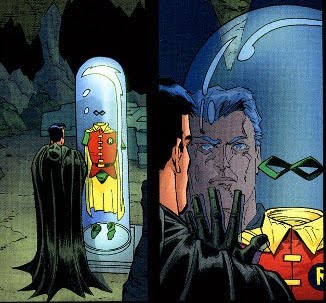
The panel above, from Batman, #436, shows Dick Grayson’s first return to the Batcave after learning of that event. For decades that cave was graphically defined by the Dynamic Duo’s trophies, particularly a robot dinosaur (species variable, but eventually a T. rex), giant penny, and giant joker playing card. As technology burgeoned, the team installed a giant computer as well. There were also many smaller trophies in glass cases, wall-mounted batarangs, and other memorabilia. But, as Dick noticed, Bruce Wayne refused to memorialize any of his work with Jason.

Eventually, Dick, Alfred, and a potential new Robin named Tim Drake helped Bruce through the mourning process. Denial gave way to a new trophy case displaying Jason’s Robin costume, floating in space, mask and all. That costume looked exactly like Dick’s, but its emptiness symbolized loss.

Like so many other parts of the modern Batman mythos, the glass case with the costume actually appeared first in Frank Miller’s The Dark Knight Returns. That story, set in one potential future, also suggested Jason’s death, and introduced the phrase that sometimes appears on the case’s label: “A Good Soldier.”

As I’ve written before, when Jason died, he finally acquired the symbolic definition that the living character had lacked. Indeed, we might say that Jason became that costume in the trophy case, haunting the Batcave. He and it were together a symbol of youth cut short, of Batman’s greatest failure, of the dangers of masked vigilantism.
In the following years, Bruce would brood in front of the case. Tim would gaze up at the costume, seeing both the allure and the danger of being Robin. The trophy case was how Tim’s friends on the Young Justice team learned about his late predecessor. If villains invaded the Batcave, their desecration of that ground became undeniably clear when the fight that followed always smashed Jason’s case.

Eventually that glass case with the costume floating inside supplanted the Batcave’s older landmarks as a visual shorthand for that setting. Its design varied from one artist to another, but it was always immediately recognizable. (Perhaps Bruce had it rebuilt in different styles every time it got smashed.) Comics fans embraced the importance of the case. Matt Cauley at Iron-Cow Productions hand-crafted his own action-figure version. When Stephanie Brown died after being Robin, fans at Project Girl Wonder demanded to know why Batman hadn’t created a trophy case for her costume as well. (She got better.)

Remarkably, the symbolic significance of the trophy case endures when even Jason is not dead. In the DC Animated Universe of the 1990s Batman cartoons, which never had a Jason Todd, Tim Drake gazes at a costume in a glass case, a costume that those cartoons never show Dick Grayson wearing. A sense of promise and danger hovers overhead, even though there’s no explanation for it.

In the comics Jason Todd has returned from the grave (a story for another week), but his costume is still on display, and the trophy case is still sacred ground. In Batman and Son Damian Wayne goes down to the Batcave, breaks into the case, and puts on parts of Jason’s costume; that seems like such defilement that it’s hard to recognize how Damian is seeking acceptance into the Batman family.

That parti-colored costume behind glass thus now carries a symbolic weight separate from the actual loss of a young man. Indeed, in recent years Batman comics have shown future or imagined Batcaves with multiple trophy cases holding multiple Robin costumes, some not previously seen in that DC Universe. The sight of a Robin costume behind glass now has a visual resonance and significance of its own.

02 January 2011

Robin’s Hood, and How It Changes the Universe

I’ve written before about thinking that Grant Morrison’s most immediate inspiration for his long Batman and Robin arc that’s produced a (by my count) sixth Robin was Frank Miller and Jim Lee’s All Star Batman and Robin.

Of course, Morrison had many other inspirations as well, going back to the collection that he (and I) read as a wee lad, Batman: From the 30s to the 70s. But Miller’s vision of a “goddamn Batman” strikes me as the most likely jumping-off point for Morrison to think up Damian Wayne, the goddamn Robin.

In All Star Batman, Dick Grayson (age twelve) creates a crime-fighting costume for himself based on Robin Hood. (That legend was in fact Jerry Robinson’s principal inspiration in designing the character, which is why the original costume has a little medieval styling.) The goddamn Batman doesn’t like the long name “Robin Hood.” And he doesn’t like the hood. So far as I know, there’s no precedent for that moment in previous DC Comics, no previous portrayal of Dick wanting to wear a hood. It supposedly happens only on “Earth 31,” reserved for Miller’s vision of the goddamn Batman.

But in Batman and Robin Morrison scripted a moment (for Philip Tan to illustrate) that’s a direct response to Miller’s. Dick Grayson, now Batman, tries to pass on some of his mentor’s wisdom to Damian—wisdom we’ve never “officially” seen Bruce give. And this hood-wearing goddamn Robin responds in his own special way. (I only wish the word balloons were placed more gracefully.)

05 December 2010

All Star Robin

For whatever reason, I think it’s time for the weekly Robin to assess the highest-profile reexamination of Dick Grayson’s origin in recent years: Frank Miller and Jim Lee’s All Star Batman and Robin the Boy Wonder. Or, to call the series by the catch phrases it sparked off, The Goddamn Batman and Dick Grayson, Age Twelve.

When DC Comics launched this magazine in 2005, the company warned fans of two things. First, its version of Robin’s origin was “out of continuity”—it would not be part of the “official” story of the DC Universe. Second, because of the creators’ other responsibilities, issues would not appear on a regular schedule.

The company said the same about Grant Morrison and Frank Quitely’s All Star Superman. That magazine nevertheless came out on a regular basis. And people love it so much that many want to make it part of the official version.

Over three years, All Star Batman and Robin limped through ten issues, the first nine of which have been collected. As for continuity, Miller stated in interviews that he saw this magazine’s Batman as the same character he’d written in the future-set The Dark Knight Returns and the in-continuity Batman: Year One, as well as more controversially in The Dark Knight Strikes Again. To placate Miller and his fans, DC’s editors have dubbed this version of life “Earth 31.”

As for reader reaction, there was a huge split. All Star Batman and Robin sold extremely well. Some readers adored it, either because they saw it as satire or because they enjoyed how much it annoyed traditionalists. Others complained that Miller had turned Batman from a hero into a crazed, sadistic kidnapper. And then there were the delays, which put fans in the position of complaining that this comic book sucked and they weren’t getting enough of it.

Jim Lee, already an executive at DC (and since promoted), was apparently the source of the delays. And I think he was also a big part of fans’ complaints that this comic book corrupted Batman. That’s because Lee’s pencils are immensely handsome. He’s great at drawing in what critic Douglas Wolk has called “the default style of the superhero mainstream,” though his work also adapts well to modern coloring.

Unlike Miller’s own art in The Dark Knight Returns, Lee’s pages don’t look like an individual’s stylized rendition of the Batman mythos. This is the Dynamic Duo we’re used to seeing, more vivid and rounded than ever. This world looks like what we want Earth 1 to look like. And yet Batman behaves like a crazy asshole. Everything else is over the top, too. Boss Zucco’s men don’t just sabotage the Flying Graysons’ trapeze; a sniper shoots Dick’s parents. (Usually protection rackets are a tad more subtle than that.) The magazine piles on the cheesecake of ace journalist Vicki Vale in her underwear and the Black Canary as an angry Irish barmaid who has sex with Batman on an industrial wharf.

Basic storytelling gets shot down early. The time line is screwed up, as many readers quickly pointed out. Bruce Wayne is clean-shaven at the circus, but Batman shows up shortly afterward with a five-o’clock shadow. The goddamn Batman’s overnight drive to Gotham City with Dick Grayson (age twelve) takes three issues. Even before the duo reaches the batcave, however, Clark Kent has not only seen a report of Dick’s kidnapping in the Daily Planet, but he’s seen Dick’s photo as a missing child on a milk carton.

Nevertheless, the first volume of All-Star Batman and Robin the Boy Wonder succeeds in the criterion that matters for the weekly Robin: it gets Robin right. Dick and Alfred have the character to stand up to Batman like no one else. Pushed to his limits, Dick shows basic moral decency, and thus hope for the future. And in the final collected issue, the sight of what he’s turning Dick Grayson (age twelve) into pulls the goddamn Batman back from the brink. Because even in this insane, semi-satirical retelling of the mythos, Robin isn’t evil.

17 October 2010

The Robins’ Recurring Problem of the Future

The last weekly Robin discussed how the glimpses of the future in Grant Morrison’s Batman scripts show life in Gotham City getting more grim and ruthless, despite Dick Grayson being a relatively friendly Batman.

Of course, that’s only one possible future, but it’s still cause for worry—which is, after all, what superhero comics are designed to make us do in the middle of a story.

But I think the quality of life in the future has particular importance for the character of Robin, especially as embodied by the two longest-tenured Teen Wonders, Dick Grayson and Tim Drake. As Fabian Nicieza, currently scripting Red Robin, has explained:

The concept of Robin defines the nature of the legacy in the DCU and with that, implies hope for the future…
Put another way, if Robin inherits a lousy future, the DC Universe at large has a lot of pain to look forward to as well.

One example of this pattern appeared in the Titans magazines of the early 1990s. In an one-off annual, Marv Wolfman introduced a possible future in which the world will turn evil, and Dick Grayson/Nightwing will be the only familiar hero still fighting. This Nightwing will lack his friends, his lover, his mentor. He’ll be an outlaw against an oppressive state. And because so many comics readers identify with Dick Grayson, that future feels especially bad.

But it can get even worse. How? If Dick Grayson himself will get worse. That’s where Wolfman went next, after DC asked him to expand on that storyline. The second-tier Team Titans magazine showed that future Nightwing turning evil. He will take a new name: Deathwing. And in case that won’t be evil enough, he will also adopt an edged weapon, long straggly hair, and a costume that exposes his nipple rings.

Deathwing comes back to the present and helps to break up the familiar Dick Grayson’s wedding to his longtime girlfriend Koriand’r. Eventually that whole unsuccessful storyline imploded, and that future was mercifully canceled. DC declared that Deathwing wasn’t actually Dick Grayson at all, and shuffled the character off to bureaucratic oblivion. Some people still wonder where he’s gone.

But the short, unhappy career of Deathwing had served its purpose of telling readers how awful that alternate future would be, how glad we should feel that it won’t come to pass. Because if one of the beloved Robins will turn evil, the whole DC Universe is messed up.

Other writers have gone to the same well. Frank Miller’s The Dark Knight Strikes Again (2001-02) was a sequel to his beloved but out-of-continuity The Dark Knight Returns. As far as I can tell, Miller set out to mess up the DC Universe as much as possible. So the sequel tells us that the first story’s new Robin, Carrie Kelley, will give up that identity and go around in a catsuit. Superman and Wonder Woman will have aerial sex. Many other heroes will become dejected or depowered.

At the end, Miller had only one place to go, only one more card to play: make Dick Grayson evil. I suppose that’s a SPOILER, but this whole tale has the sour taste of spoiled milk from the start.

In the early 2000s, Geoff Johns wrote a story about the Teen Titans group that included Tim Drake meeting their possible future selves. Embittered by their losses, those young heroes will become ruthless tyrants, oppressing villains and the western US as a whole.

And the leader of that future team? It will be Tim, taking the mantle of the late Batman—but as a murderous, gun-toting vigilante. Later, Sean McKeever wrote a follow-on to this “Titans Tomorrow” storyline. Both tales gain their power from the notion of a corrupted Robin, and the young Tim has to prevent that future from happening. Because if Robin doesn’t grow up well, there’s no hope for the rest of us.

The most recent example of this pattern is the current Batman Beyond limited series, set in the future and inspired by the past TV cartoon. This story, scripted by Adam Beechen, has just shown that its villain Hush is Dick Grayson, who will—wait for it—become evil! (Or will he? This is a six-part story, and it’s only up to issue #4. There’s no way the series’s big reveal and final twist happens only two-thirds of the way through.) On the plus side, once a DC storyline shows a future Dick Grayson (or Tim Drake) as evil, there’s nowhere further down we can go.

29 August 2010

1989: Year Without a Robin?

As 1989 began, it was the first year since 1940 that DC Comics had no character named Robin appearing (at least occasionally) as Batman’s young assistant. Toward the end of the previous year, fans had voted to let the Joker kill Jason Todd, the latest Robin.

The Batman editorial team was reeling from fans’ criticism of the character of Jason and from wider criticism of the decision to show his death. Interviews and introductions to Batman collections published around that time show how editor Dennis O’Neil was feeling more than a little shell-shocked.

To be sure, the company was still publishing stories about Dick Grayson, the original Robin, in his new guise as Nightwing. Those stories, in The New Titans, were among the company’s top sellers. And DC still owned the Robin trademark, which had been a source of licensing revenue for decades. But there was no Robin in the Batman comic books, and at least a possibility that there would be no replacement.

That year looked like it would be huge for Batman. It was the fiftieth anniversary of when the character debuted (without Robin). Warner Bros. would bring out a major Batman movie by director Tim Burton in the summer (without Robin).

Furthermore, some graphic novels had pushed Batman into more adult territory, including Mike W. Barr and Jerry Bingham’s Son of the Demon (1987), and Alan Moore and Brian Bolland’s The Killing Joke (1988). Neither of those volumes included Robin.

Frank Miller’s future-set The Dark Knight Returns (1986) debuted a new Robin in Carrie Kelley, but also presciently portrayed Jason Todd as dead and Dick Grayson as estranged from his mentor—hinting that there had been no Robin for years.

In fact, some comics readers and creators were insisting that Robin no longer made sense in the Batman mythos. Grant Morrison couldn’t convince Dave McKean to include Jason in their Arkham Asylum: A Serious House on Serious Earth graphic novel, due to be published in 1989. Morrison later wrote:

The original first draft of the script included the character of Robin as Batman’s sidekick. Robin appeared in a few scenes at the beginning then remained at Police Headquarters for the bulk of the book, where he spent his time studying plans and histories of the house, in order to find a way in to help his mentor.

Dave McKean, however, felt that he had already compromised his artistic integrity sufficiently by drawing Batman and refused point blank to bend over for the Boy Wonder—so after one brave but ridiculous attempt to put him in a trench coat, I wisely removed him from the script.
Not entirely, though. The Joker tries to unnerve Batman by alluding to his unseen partner: “How is the Boy Wonder? Started shaving yet? . . . a cute little long-legged boy in swimming trunks?” Those remarks underscored how poorly the character seemed to fit in a more realistic, more dangerous crime-fighting world.

The Batman movie became a huge hit, spawning three sequels. (I didn’t care for it myself.) Arkham Asylum, benefiting from coming out alongside the movie, sold half a million copies. Batman comic-book sales soared. Those developments helped touch off a speculative boom in the comics industry over the next few years. In sum, it didn’t look like Batman needed Robin to be a hit anymore.

But O’Neil and his writers were already planning a replacement for Jason Todd.

COMING UP: Her name was the Huntress.

27 June 2010

The Short, Happy Life of the First Jason Todd

When I posited that Reason for Robin #10 is that “Robin Isn’t Evil,” I promised to discuss the two major counterexamples. Actually, back when I conceived of that series, I had only one counterexample in mind: the second Jason Todd. And to lay the groundwork, I have to address the first Jason.

Back in 1940, Dick Grayson went from meeting Batman to becoming his costumed companion in the course of a few panels on one page. His decision to leave the partnership in the early 1980s took considerably longer, aided by the huge success of the New Teen Titans magazine. Leading DC’s hottest team (in every sense of the word), Dick became an independent young adult.

The pivotal moment arrived when a meeting of writers Gerry Conway and Marv Wolfman, artist George Pérez, and their editors concluded that Dick Grayson should break free from the Batman books and adopt a new identity—eventually Nightwing. Meanwhile, Conway could develop a new character to take his place at Wayne Manor.

This was the first Jason Todd. Conway had a traditional understanding of how Robin functioned in Batman stories, and his Jason was very much like Dick Grayson. To the extent of being a young trapeze artist whose parents are murdered by criminals and goes to live with billionaire Bruce Wayne.

Jason fought crime in a costume and mask in Detective Comics, #526—the 500th appearance of Batman in that magazine, and Conway’s last issue. But it took the rest of 1983, and some black hair dye, before he officially became Robin. One milestone in that period was when Dick Grayson graciously passed on the red, green, and yellow outfit. For merchandising reasons (all those pajamas with Robin’s picture on them), Jason had to look exactly like Dick.

Just like the Robin of the 1940s through 1960s, the first Jason Todd was occasionally impetuous and immature. He made mistakes, and showed more emotional reactions than Batman. He was, after all, still a kid.

In that period, each superhero comic usually had a complete adventure in one issue, but subplots extending over many months. The first Jason Todd became the object of a custody battle between Bruce Wayne and Natalia Knight, the criminal Nocturna; basically, he went undercover as her adoptee. Again, that plot emphasizes how Robin is still a child.

Robin scholar Mary Borsellino quotes a letter from a reader in Detective Comics, #530, calling this Jason a “quiche eater,” an allusion to the 1982 bestseller Real Men Don’t Eat Quiche. But of course a Boy Wonder isn’t supposed to be a Real Man—yet.

In Alan Moore and Dave Gibbons’s terrific Superman story, “For the Man Who Has Everything” (1985), an extraterrestrial conqueror dismisses Jason as “the little yellow one.” Yet who saves the world in the end? That tale is the first Jason Todd’s finest hour.

(In that story, Jason had also grown up enough for Batman to famously remind him, “Think clean thoughts, chum.” But different artists depicted him at different stages of adolescence.)

Then two major events jolted the DC Universe. The first was Wolfman and Pérez’s Crisis on Infinite Earths (1985-86), which opened the door for DC to relaunch and redefine all its major franchises.

The second was Frank Miller’s The Dark Knight Returns (1986), the story of a potential future Batman. Among its innovations was a female Robin. Among its allusions to the standard comics was a brief line about Jason Todd being dead; clearly, this was a rougher Batman in a rougher world. This series was highly stylized, highly violent, and highly successful.

Post-Crisis, DC commissioned Pérez to retell the origin of Wonder Woman, John Byrne to relaunch Superman, and Miller to set a new tone for the regular Batman series. Editors thought that the character’s origin myth still worked, but that readers would appreciate more grit. The audience for superhero comics now consisted of young adults in specialty shops, not kids browsing in drugstores.

In Batman, #404-7 (1987), Miller and David Mazzucchelli showed the start of Bruce Wayne’s career as Batman. Like Miller’s earlier series, Batman: Year One was stylized, stark, and very successful.

The first Jason Todd, cheerful former circus acrobat, had come out of the Crisis of 1986 intact, and appeared in a few more months of stories. But DC’s editors felt that his character didn’t fit the new, grittier Batman’s world. Therefore, in Batman, #408, the Caped Crusader met a new Jason Todd.

COMING UP: Battling for the soul of a new Robin.

02 May 2010

Robin Isn’t Evil, But Batman…?

At last the weekly Robin returns to exploring how the tenet that Robin isn’t evil became an important part of what the character symbolized in the DC Comics mythos. Before the 1980s, all superheroes weren’t evil. Robin’s solo stories had depicted him as struggling to follow Batman’s model. But a new characterization showed him trying to help people with Batman as one inspiration among several.

Concurrently, DC writers were edging toward the possibility that Batman might be evil. In the early ’80s The Comics Journal quoted comics artist and writer John Byrne calling the character a “brooding psychopath.” Not everyone in the business agreed with him, of course, but that possibility became more and more central to Batman stories.

Does Batman operate so close to the edge of human endurance that he might go over at any time? Is he so driven by his mission that he’s willing to sacrifice ordinary human relationships? Is his life as Bruce Wayne such a sham that it’s made him as hollow as he acts? As his ward, Dick Grayson was Bruce Wayne’s natural foil in such stories.

In Detective, #500 (1981), scripted by Alan Brennert, Batman got a chance to enter an alternative universe where Bruce Wayne is still a boy and his parents haven’t been murdered—yet. He jumps at the chance at saving some version of his parents. Robin (already a star of New Teen Titans) races to accompany Batman because he doesn’t trust what Bruce might do when he sees his parents under attack. While Batman gets tunnel vision, Robin worries about disrupting this alternate universe before deciding what his values require. This story ends with a curious twist. Batman does save his parents, but his young alter ego nevertheless starts to dedicate himself to being a crime-fighter. That implies that Bruce wasn’t necessarily motivated by his parents’ murder; rather, their murder may have simply been his rationale for doing what he’d have been naturally driven to do anyway.

DC started to separate Batman from its other heroes with Batman and the Outsiders, #1 (1983). Scripter Mike W. Barr showed him storming out of the Justice League of America to start his own, more aggressive superhero team. A crossover with New Teen Titans a few issues later underscored the new rift and differences between Batman and Robin—the younger man is the better team leader.

Which brings us to Batman’s working methods. Back in 1939, Gardner Fox’s origin story explained that after his parents’ murder he chooses to dress as a bat to scare criminals. He became more cuddly under the Comics Code of the 1950s and early ’60s, then returned to the dark side. And any persona based on vengeance and fear naturally lends itself to questions of evil. In the early 1980s writers began to explore how close Batman came to that evil. Could Bruce Wayne be driven to kill? Does the Batman persona actually attract supervillains like the Joker? Might Batman’s methods end up producing the injustice that he wants to eradicate?

Frank Miller brought those themes to the fore in The Dark Knight Returns (1986). This volume also explored how Superman might become evil, so ready to serve “the American way” that he’s the tool of a repressive US government. Where in that book does the ideal of heroism shine purest? In its new Robin, of course: Carrie Kelley.

Miller’s vision of Batman fed into Alan Moore’s characterization of Batman in A Killing Joke and Grant Morrison’s in Arkham Asylum: A Serious House on Serious Earth, both depicting the Dark Knight as a mirror of his villains. These stories aren’t outliers in the modern Batman mythos; they’re fundamental. Most of the examples I’ve discussed are among the ten greatest Batman stories ever told as recently announced at Comics Should Be Good!

In the last two decades, Batman’s storytellers have maintained his potential for evil—never fully realized, of course—as part of his basic characterization, even in the DC Animated Universe. Meanwhile, the most successful young Robins provide solid examples of sanity and virtue. Some notable storylines:

  • Knightfall: After being injured, Bruce Wayne chooses a replacement Batman who can’t stand the pressure, goes crazy, and starts killing criminals. Meanwhile, Robin isn’t evil.
  • JLA: Tower of Babel: After suffering hideously effective attacks, members of the Justice League discover that Batman has assembled information on how to beat each of them, and a villain has obtained those files. The League members wonder if they can trust Batman, and their young counterparts in Young Justice wonder the same. But Robin isn’t evil.
  • In one of DC’s many lead-ups to its Infinite Crisis event, Batman has created a satellite called Brother Eye to keep watch over everyone on Earth with superpowers or criminal tendencies. Naturally, this gets out of his control and threatens everyone on Earth. Meanwhile, Robin and Nightwing aren’t evil.
We can see those themes in today’s magazines and movies: Batman being driven to kill in Final Crisis, the Joker’s soliloquies in The Dark Knight, Tim Drake putting on a dark cowl in Red Robin and then having to pull himself out of a dark place, and of course the “goddamn Batman” of Miller’s All-Star Batman and Robin.

COMING UP: But what about the second Jason Todd—wasn’t that Robin evil?

04 October 2009

A Return to Carrie Kelley

Last month the weekly Robin examined a couple of times in the early 1980s and ’90s when Batman creators considered making Robin a black teenaged boy. In that same period, writer-artist Frank Miller did what many fans found even more radical: he made Robin a girl.

Of course, readers didn’t have to accept that portrayal as real. Miller’s The Dark Knight Returns miniseries depicted one possible future for Bruce Wayne, after he and his fellow superheroes have been driven underground or coopted by an authoritarian US government.

Gotham remains crime-ridden, and an acrobatic, hero-seeking teenaged girl named Carrie Kelley spends two weeks of lunch money to make herself a Robin costume, then finds herself rescuing the aging caped crusader and becoming his sidekick.

An Oz and Ends reader named Raius spontaneously sent me an essay on Carrie Kelley, perhaps not realizing how hungry a daily blogger is for material. So I asked if he’d share those thoughts with the world, and here they are.


The first time I read Dark Knight Returns, Carrie Kelley was one of my least favorite elements. I didn’t like Robin being a girl, I didn’t like her lack of really obvious talents or skills, and I didn’t like the way she talked.

I was a lot younger then. I recently re-read the book. All I could think as I read it was, “This is exactly what Batman’s dynamic with Robin should be like.” I loved all the little nuances of how he sees her, why he lets her join, and why he likes having her around despite Alfred’s protests and the cries of child endangerment from virtually everyone else.

To Bruce, kids are serious business. He took himself seriously as an eight-year-old with murdered parents, and he sees himself in all children. He likes having a kid around because it keeps that part of him alive. He likes their hope, their naïveté, their sincerity, their openness to teaching, their recklessness, their devotion, and their simplistic view of right and wrong, so close to his own.

With Carrie, we see all of this. Batman revels in mentorship. When she complains about waiting on ledges, he enjoys teaching her about patience, something he probably wishes he’d been able to learn earlier. He likes her pluckiness, the way she just states she’s Robin, and he accepts the assertion. He enjoys her ingenuity, when she changes the controls on the helicopter to help him out, even in defiance of his orders. He admires her bravery as she starts to fall to what could easily be her death and notes that she doesn’t make a sound. As a much older man at this point, he envies her youth and potential, as he watches her learn to ride and grow. He empathizes with her loss of innocence as she sees a man who was trying to kill her fall to his death, even as he relies on her resilience in dealing with such things and her continuing support of him and his war, contending with threats that are really years beyond her.

She embodies everything that gives him hope, that makes the mission about more than his own demons. Last but not least, he just seems to enjoy having someone out there with him, someone to share the night with.

Also, all of these things are implied about his earlier relationships with Dick and Jason, to one degree or another. He remembers Dick as his “little monkey wrench”—that little x-factor that skewed bad situations in his favor.

In some ways, I feel like he even sort of preferred Jason because the age difference between them was greater, he was more of a fixer-upper, and possibly even more of a son to Bruce. Dick was almost more like a little brother, who’d already had his own strong parental figures, and eventually becomes his own man, with his own views and such (not quite so positively in the Millerverse, but I tend to ignore The Dark Knight Strikes Again). I always loved that line about Jason. “I will NEVER forget Jason. He was a Good Soldier. He HONORED me. But the WAR goes on.” Just got me right here, ya know? He had so much to teach Jason, who had so much life left to learn it in, and then he died a hero’s death. No wonder Batman retired in Miller’s ’verse. His hope died with Jason.

So anyway, I came away with a much more charitable view of Carrie Kelley, if only because she works as such a wonderful foil for Bruce, someone to bounce things off of that we wouldn’t see otherwise, which is of course one of the original “Reasons for Robin.” She’s still not my favorite, but I think portrayals of other Robins could maybe learn something from her dynamic with Batman.


Thanks, Raius!

All the pictures in this posting come from The Dark Knight Returns, which offered the darkest portrayal of Batman until then. As you can see, Carrie Kelley with her light red hair, her green sunglasses instead of a mask, and her traditional Robin costume with turned-up toes is the lightest, most colorful Robin to date. The Dynamic Duo’s visual contrast thus became even more striking.

The Dark Knight Returns remains only one potential future for Batman, and Carrie thus remains only a potential Robin. But of course symbolically any Robin is all about potential.

24 May 2009

Competing Portrayals of Batman and Robin

In September 2005, DC Comics launched a magazine called All-Star Batman and Robin the Boy Wonder, written by Frank Miller and drawn by Jim Lee--two of the very biggest names in American comics. Its first story arc retold the origin of the Batman and Robin team: vengeance-driven billionaire Bruce Wayne takes suddenly orphaned young acrobat Dick Grayson under his webbed wing.

Two months later, the companion magazine All-Star Superman took off, featuring words by Grant Morrison and art by Frank Quitely. The first six issues were collected in a book in 2007, the next six earlier this year. They're just a whole lot of fun.

Meanwhile, Miller and Lee's All-Star Batman and Robin trundled on in fits and starts. It became notorious for production delays; after three years, there were just enough issues to fill one book. And Miller's script became even more notorious for its portrayal of Batman as a borderline psychopath.
Both All-Star titles sold big, but All-Star Superman got universally good reviews while All-Star Batman and Robin has been lambasted. Some people love it, to be sure, but part of what they enjoy is how much it ticks so many other people off. DC assured readers that these stories weren't in "regular continuity"--i.e., readers could treat them as imaginary. (As opposed to other Batman and Superman stories, which are real.)

For weekly Robin purposes, all that matters is that at the center of All-Star Batman and Robin is the relationship between the Boy Wonder and the Caped Crusader. At the end of the first story arc, "the goddamn Batman" finally realizes that he's pushed Robin too far toward his own madness.

This year, DC Comics will launch a new magazine called Batman and Robin, by Morrison and Quitely. (Last week we learned about a variant cover by J. G. Jones.) This story is "in continuity" as a follow-up to the "Batman RIP" arc in which Bruce Wayne died, sort of. To the surprise of few, the Batman in these stories will be Dick Grayson, grown up. (He took on that role in 1994 as well.) And the Robin of this magazine will be Damian Wayne.

Who? Back in 2006--i.e., soon after Miller's All-Star Batman and Robin started--Morrison introduced this character into issues of Batman magazine that have been collected as Batman and Son. Damian was supposedly Bruce Wayne's child by Talia al Ghul, an old nemesis. He fights well above his weight, having been raised in the League of Assassins, but has no moral sense and a big chip on his little shoulder.

A new interview at IGN confirms implicitly that Morrison was planning to make Damian Wayne a new Robin ever since he invented the character. And from that start, Damian has insisted that he--not Tim Drake--was Bruce Wayne's rightful partner and heir.

Morrison has said he was inspired by the Son of the Demon graphic novel, written by 1987 in Mike W. Barr. Bruce and Talia's child in that story has a different fate, but it was always "out of continuity."

I wonder if an unacknowledged source of inspiration for Morrison was Miller's concurrent take on the Batman and Robin team. This new Batman and Robin magazine seems to reverse the All-Star premise. Instead of a humorless, violent "goddamn Batman" finding Robin as his inspiration to remain sane, we'll see a more solidly grounded Batman trying to rein in and teach "the goddamn Robin."

This wouldn't the first time that Morrison drew inspiration from Miller, and perhaps tried to outdo him. Back in early 1986, Miller published The Dark Knight Returns, arguably the most important Batman story since 1940. Months later, Morrison pitched DC the idea that in 1989 became Arkham Asylum: A Serious House on Serious Earth. It took the notion that Batman was as crazy as his enemies about as far as it could go. In a reissue of that book Morrison wrote:

The repressed, armoured, uncertain and sexually frozen man in ARKHAM ASYLUM was intended as a critique of the '80s interpretation of Batman as violent, driven and borderline psychotic.
What "’80s interpretation of Batman as violent, driven and borderline psychotic" could that be? None other than Miller's depiction in The Dark Knight Returns, of course.

How will the response to Morrison's Batman and Robin compare to the response to Miller's? Fans will hate Damian as Robin, at least for a while, because Robin's supposed to be the good cop. (That's coming up in my "Reasons for Robin" series.) DC tried to shake up the Dynamic Duo's dynamic the same way in the late 1980s, and it ended with the reader-voted death of the second Jason Todd. Whose costume, I can't help but note, Damian Wayne put on in Batman and Son.

(This analogy between the Miller and Morrison Batman and Robin magazines has been discussed elsewhere, such as The Big Smoke and the new scans_daily, but not to my knowledge at this verbose length. Batman and Son must not be confused with the delightful parody webcomic "Batman and Sons.")