Showing posts with label AUTHOR Mike W. Barr. Show all posts

01 December 2013

More Retrospective Than Retroactive

A while back I looked at DC Comics’s Legacies miniseries, a summary of its 1986-2011 superhero universe’s history. Just after Legacies the company announced a line called DC Retroactive, pitched as exercises in nostalgia.

Editor Ben Abernathy told Newsarama that “the opportunity to revisit that era, with the creators who made it great, is a welcome change from everything else going on in the industry these days.” It was almost an explicit admission that DC’s audience had become middle-aged folks chasing memories of their early teens.

That announcement ran in mid-April 2011. At the end of May, Newsarama was running breathless stories about DC’s “New 52,” which replaced the latest continuity with a new one. That news took up all the attention of comics fandom and critics, leaving little for the DC Retroactive magazines when they came out. I don’t know if this fact is at all pertinent, but Abernathy is no longer with DC Comics.

The idea behind DC Retroactive was to publish stories in the style of the ’70s, ’80s, and ’90s from creators who had worked on the properties then. There were triads devoted to Superman, Batman, Wonder Woman, the Flash, Green Lantern, and the Justice League. (There was no Teen Titans equivalent, but Marv Wolfman and George Pérez’s finally-completed Games would push similar buttons.)

The only DC Retroactive book to feature a Robin was the 1980s Batman issue. It was created by Mike W. Barr and Jerry Bingham, collaborators on the Batman: Son of the Demon graphic novel from 1987. But Barr’s story has more connections with Detective Comics stories he created with Alan Davis featuring a young Jason Todd.

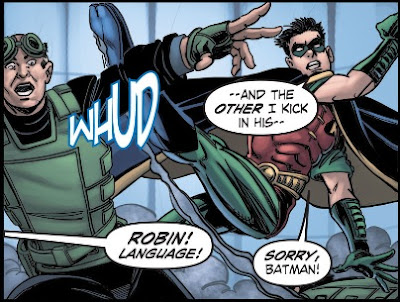
Thus, as in Barr’s issues of the digital Legends of the Dark Knight, we see a Batman who calls Robin “chum” and shouts to him not to look at one of the villains kills another. The bat-cave’s criminal files are actually file cabinets.

Robin adds puns to a fight scene and needs to sit on a Gotham phone book to drive the Batmobile. It would have been nice to see Davis‘s small, spindly Robin in these scenes instead of Bingham’s bigger, tougher-looking version.

Barr’s DC Retroactive story is also a sequel to his Year Two series from 1987, set before any Robin. (A previous sequel, Batman: Full Circle from 1991, had brought Dick Grayson into the story.) All these stories featured a murderous vigilante named the Reaper, a role taken on by a series of people.

Year Two has been controversial for many Batman fans because it shows Bruce Wayne thinking about using a gun in his war on crime—and not just any gun but the gun that killed his parents. The fact that the story ends with him deciding against that method doesn’t stop many readers from declaring that action completely out of character.

At the end of its 1994-95 Zero Hour crossover, DC apparently repudiated the Year Two story. Yet here the Reaper is back. The DC Retroactive: Batman—The ’80s comic book even reprints the story that ends with Bruce holding up the old gun. This magazine was thus an exercise in reclamation not just for old readers but for an old writer.

(As I composed this posting, I discovered that weekly Robin essays comprise this website’s discussion of Jason Todd. Needless to say, I agree with most of the insights there, but I disagree on reprinting them without permission, credit, quotation marks, or links.)

22 September 2013

The Good Old Days with Mike W. Barr

Comics Alliance has run a wide-ranging conversation between columnist Chris Sims and Mike W. Barr, who scripted many Batman and Robin stories in the 1980s and recently returned to those characters with a story for DC’s digital-first, out-of-continuity Legends of the Dark Knight series.

As I discussed back here, that story reads like a throwback to the pre-Crisis Batman, perhaps even to the 1960s television Batman. Indeed, Barr says he was aiming for a retro feel, even inventing a new villain who seems to be a very old one. As for Robin:

I’d written the first episode with basically the Jason Todd Robin, and [artist] Tom [Lyle] obviously feels more comfortable with the Tim Drake Robin, which is fine, because he co-created the character. I said “Sure, I have no problem with that whatsoever, whatever Tom is comfortable with,” so we used Tim Drake for the rest of the story. And it worked out fine. As [editor] Hank [Kanalz] pointed out, there are some differences between the personalities of the characters, which we were able to use in the second chapter. Tim is a different character than Jason, and that’s reflected in the story.
But that’s also why the Robin in the first of the three installment reads like smart-mouthed Jason, and why the verbal clues indicating he’s Tim don’t show up until the later installments.

Another striking aspect of the interview is how much freedom Dennis O’Neil allowed his writers and artists when he was editing DC’s Batman line from 1986 to 2000. Early in that period Max Allan Collins and Jim Starlin were making Jason Todd an angrier character with a grittier background, but Barr continued to write Jason as a happy young sidekick facing off against old Batman villains. “Denny O’Neil was always open to those kinds of stories, as long as you set up what was going on,” says Barr.

Furthermore, when it came to Son of the Demon, Barr’s graphic novel with Jerry Bingham:
MWB: The graphic novel took a fair amount of time to come about, because it was such a long story. Denny O’Neil was actually not involved in that as the editor. Dick Giordano was the editor, and it was in the pipe by the time Denny and I were doing Detective, I believe. I always told Denny, “You should look into this because I guarantee you’re going to want to know what’s happening in this story,” but I don’t think he ever did until someone pretty much handed him a Xeroxed copy of the finished book and what was in there.

CA: What was his reaction?

MWB: I don’t know, because he never told me. I have heard stories, and this is hearsay, I’ll admit, but I’ve heard it from a number of sources, that Denny very much disapproved of what I’d done with Batman and Talia. Not only getting them married, which was done as a sequel to one of his stories, but also having a child, which he had absolutely forbidden.
Evidently O’Neil kept himself from criticizing Barr’s story (and his mentor Giordano’s work as editor) even when he “very much disapproved” of how it had used Talia, a character he had co-created. O’Neil would have had the company on his side; according to Barr, “Warner executives” disliked Batman having a child with one of his villains so much that:
[DC publisher] Jenette Kahn herself called me and told me that if that child ever appeared again in a story, she would be fired. I don’t know how much of that I believe, even to this day, but basically we were told to never use that child ever again, he does not exist in continuity anymore.
(Almost two decades later, Barr’s story was the inspiration for Grant Morrison’s saga of Damian Wayne.)

Even today, it appears, Denny O’Neil still hasn’t told Barr that he shouldn’t have told the story he wanted to tell. As an editor, his philosophy was to give his creators room to create, and the results include some of the most popular modern Batman sagas, such as Knightfall and No Man’s Land. Given all the stories coming out of DC Comics today about the in-house staff vetoing storylines in the works, O’Neil’s editorial example seems even more striking.

01 September 2013

Elements of a Digital Dynamic Duo Story

“Elements of Crime,” the story in Legends of the Dark Knight, digital issues #63-65, features a version of the Dynamic Duo never seen before.

The story comes principally from two comics creators with significant experience portraying Batman and Robin. Mike W. Barr scripted many issues of Detective Comics in the 1980s and the Son of a Demon graphic novel that inspired Grant Morrison to create Damian Wayne. Tom Lyle penciled the three Robin miniseries in the early 1990s, establishing the look (well, the now-embarrassing haircut) of Tim Drake.

Lyle’s visual depictions of Batman and Robin in this Legends of the Dark Knight digital-first tale basically match those from the 1990s. Tim is back in his original uniform. Batman doesn’t have the yellow oval around his bat symbol but otherwise looks quite familiar.

But Barr’s dialogue is well out of time. This Batman takes polite leave of Commissioner Gordon and chides Robin for using the mildest of racy language, like “get to first base.” In sum, this is the Batman of the 1960s television show. As for Tim as Robin, he’s hard-working and gets the computer jobs, but he’s also uncharacteristically hot-headed and loud-mouthed.
What’s more, the Batmobile in this story is the version seen in Gotham City before the “New Look” of 1964, with a big bat face on the front and a big fin sticking out the back. Far from acting in the shadows, this Batman is welcome at the Pentagon. And the story itself is a throwback, with the villain deliberately sending Gordon clues about upcoming crimes.

Thus, the story is not just not part of the “New52” universe—it doesn’t quite fit into any of DC’s many continuities over the years. That reflects how the company’s digital-first wing is free of the burden of consistency. Batman: Li’l Gotham likewise serves fans all the happiest bits of the pre-New52 universe, and other digital titles take off of TV shows instead of the current comics.
I wish I could say that “Elements of Crime” was an unalloyed delight because of those old-fashioned touches, but I struggled with the story. Despite several readings I still can’t tell you how Batman escaped the Element Queen’s death trap the first time. Robin does nothing but play Boy Hostage. The art in the last installment sometimes seems unaccountably awkward.

I noticed an interesting lettering technique, though. When characters are speaking on the other side of glass from readers, Saida Temofonte’s balloon tales end in little arrows on the glass surface, as shown in the first two pictures above.

11 July 2010

The Two Paths of Jason Todd

As the last weekly Robin described, in 1987 Max Allan Collins turned Jason Todd into a new kind of Robin, offering new storytelling possibilities. He explored Jason’s criminal background, rashness, and anger for a handful of issues, and then left the Batman magazine.

Meanwhile, at Detective Comics Mike W. Barr was writing a very traditional and fun set of Batman and Robin adventures. Alan Davis drew many of those stories, depicting Jason as a cute, spindly-legged kid in his early teens. (Greg Burgas has profiled the Barr/Davis run of Detective for Comic Book Resources.)

This run of issues straddles the period when Collins introduced Jason’s new origin, but Detective made almost no reference to the boy’s now-troubled past. Instead, Barr’s Robin acts very much like Dick Grayson from the 1940s through the 1960s, fulfilling the usual reasons for the character:

Barr’s scripts did edge into the darker universe that DC was trying to create in the late 1980s. Detective, #571, ends with an image of Jason’s tombstone, albeit an imaginary one. In issues #573-4 Jason gets shot, forcing Bruce Wayne to examine the danger he exposes his sidekicks to. Those stories show the dark side of Batman himself. In #570, he almost beats up a helpless Joker, but Jason holds him back—because Barr’s characterization also fulfilled Reason for Robin, #10: Robin Isn’t Evil.

Barr’s last story gave Jason another encounter with Two-Face, who killed his father. To his surprise, Jason discovers he can pity the villain. Those two issues, illustrated by Jim Baikie, depict Jason in his late teens, and in addition to growing up physically he’s clearly grown up emotionally.

However, over at the Batman magazine new scripter Jim Starlin moved in the opposite direction, going deeper into the dark side of Jason Todd that Collins had established. Starlin worked mainly with artist Jim Aparo, who had already illustrated many Batman stories in The Brave and the Bold and Batman and the Outsiders.
In a 2001 interview, Starlin declared that the character of Robin simply didn’t make sense: “The idea of taking a kid along to fight crime is ludicrous.” Barr had probed that very topic, but for Starlin the remedy was more drastic: “I wanted to kill off Robin as soon as I started writing Batman.” At least that’s what he said over a decade after that fact.

Back in late 1987 Starlin’s built stories around conflicts between Jason and established characters. In issue #416, he brought Dick Grayson back to Gotham to meet the new Robin, and to confront Bruce Wayne over their break-up. The result was an emotion-packed issue, worthy of reprinting. In the end Dick praises Jason’s potential. But for a lot of readers that tale probably turned them against Jason Todd.

Because it’s one thing to show Jason sassing Batman, acting cocky, or roughing up criminals. It’s quite another to show Jason disrespecting Nightwing—the leader of DC Comics’s most popular team, the character readers had grown up alongside, the one hero who’s most assuredly not evil. Jason was in serious trouble.
This recent panel from The Black Cat captures the character of Jason Todd by late 1987, tugged between competing portrayals.

COMING UP: Jason goes to the dark side?

29 March 2009

Mike W. Barr on Robin

Mike W. Barr was one of the leading Batman writers of the 1980s, scripting Detective Comics and creating the magazine Batman and the Outsiders. In those Batman stories, he wrote stories about two Robins: Dick Grayson, leaving the nest, and Jason Todd, just starting out.

In this interview at Jeffery Klaehn's Pop blog, which also appears in Inside the World of Comic Books, Barr spoke of Robin as one of the elements "vital to a Batman story":

JK: In a perfect world, should Batman stories be infused with sense of adventure and heavy doses of periodic lightness? This seems to have been what Bill Finger and Jerry Robinson hoped to achieve by introducing the character of Robin in Detective Comics #38 (April 1940). Your handling of Robin seemed very much in keeping with what I imagine their original intent was. How did you view Robin, in relation to Batman?

Barr: I'm convinced Robin is a major reason why the Batman strip has had such longevity. Batman is by no means psychotic, but I do think he's emotionally crippled in some respects, and he knows it. He sees with Robin a chance to bring the lad through his emotionally fragile adolescence by giving him an outlet for his rage that Batman didn't have when he was a boy. They're at once father and son, big brother and little brother, and anyone who thinks there's anything untoward in their relationship can go to hell . . .
Given that opinion, it's ironic that some of Barr's highest-profile Batman work came in 1987 in two stories with no Robin in sight: the "Year Two" series and the graphic novel Batman: Son of the Demon. The latter showed Bruce Wayne having a child with longtime antagonist Talia al Ghul. That took place in an alternative universe, but in Batman and Son (2006) Grant Morrison brought such a child into the standard DC continuity under the ominous name of Damian. Now he appears to be the latest Robin.
