Showing posts with label AUTHOR Chuck Dixon. Show all posts

24 November 2019

Tom Lyle and the Robin Miniseries

In 1986 Tom Lyle, an aspiring comic-book artist in his thirties, went to a comics convention in Philadelphia. There he met Chuck Dixon, a young writer who was scripting Air Boy for Eclipse. Based on Lyle’s samples, Dixon got him the job of penciler on a related title, Sky Wolf. In a chat with Comics Interview magazine, Lyle credited that as “the event that triggered my career” in comics.

Lyle was recruited by DC Comics to draw Starman in 1988. After a couple of years, as he was wrapping up that assignment, Lyle asked Batman group editor Dennis O’Neil if he had any openings. O’Neil was planning a miniseries focusing the newly created Robin, Tim Drake.

“I’ve never been real thrilled with the Robins,” Lyle told his interviewer. “Dick Grayson, the original Robin, I couldn’t have given a flip about when I was a kid; it was like, ‘Get out of the way, kid, I want to see Batman.” But a job was a job.

O’Neil’s team wanted to make Robin into a martial-arts expert, so they needed a writer who understood the martial arts. Lyle suggested Dixon. He got the assignment and went on to be DC’s most productive writer of the decade. (On the occasion of his 40,000th comics page in 2017, Bleeding Cool noted Dixon wrote 106 issues of Robin, 89 issues of Detective Comics, 77 issues of Nightwing, 46 issues of Birds Of Prey, and 22 issues of Catwoman, to name a few.)

Dixon and Lyle’s first issue of the first Robin series carried a cover date of January 1991. The character of Tim Drake had been created by Marv Wolfman in issues drawn by George Pérez, Jim Aparo, and Norm Breyfogle, and his costume was designed by Neal Adams. But Dixon and Lyle’s portrayal fleshed him out by showing him on his own. Lyle was especially good at portraying Tim as a thirteen-year-old, lithe but not a powerhouse, the littlest guy in the fight who needed to think harder than anyone else to stay alive.

In the gritty, pouched, and overpumped 1990s, Robin was the equivalent of counterprogramming on broadcast television—standing out by doing something different. And it worked. According to Lyle, DC expected to sell about 200,000 copies of the first issue of the Robin miniseries. Instead, it sold three times that number.

DC asked the Dixon-Lyle team for a second miniseries about Tim Drake going up against the Joker, issued at the end of 1991. Then came a third, featuring the character the Huntress for an interesting contrast. That was the height of the speculative boom, and those magazines are festooned with holograms and other gimmicks.

Dixon and Lyle also collaborated on issues of Batman and Detective Comics showing Batman and Robin together. One of those magazines introduced Stephanie Brown as the Spoiler, who went on to become Tim Drake’s love interest, a fan favorite, and eventually Robin and Batgirl herself for limited periods. Lyle was also the artist for the first Robin Annual and the 1992 public service ad in which Tim decides to learn the facts about AIDS.

During that time, Lyle also plotted and penciled the early issues of The Comet for DC’s Impact imprint. In 1993 he started working for Marvel Comics on Spider-Man stories. That same year, DC launched the Robin monthly series with Dixon as regular scripter.

After another ten years or so, Lyle left monthly comics to become an art teacher at the Savannah College of Art and Design. Earlier this year he suffered an aneurysm, and last week he died, aged 66. Friends and fans have set up a Go Fund Me page for his family.

08 November 2015

“Some outstanding work” in Dick Grayson, Boy Wonder

Here are nice quotes from reviews of Dick Grayson, Boy Wonder, edited by Kristen L. Geaman and published this year by McFarland.

John DeNardo, Kirkus Reviews:

“Dick Grayson, aka. Robin, Batman’s young sidekick, [has] been around nearly as long as the caped crusader but rarely sees any media attention. That is, until now, with this collection of scholarly essays. Dick Grayson, Boy Wonder: Scholars and Creators on 75 Years of Robin, Nightwing and Batman is an interesting collection that features critical analyses and essays about the most overshadowed sidekick in comics. Also included are interviews with the Boy Wonder’s past and current creators Chuck Dixon, Devin Grayson and Marv Wolfman. Collectively, these essays examine Robin’s place in comics and his evolution across the decades—all within various contexts like trauma, friendship, feminism and masculinity.”
Nick Smith, ICv2 (4 Stars out of 5):
“Some outstanding work . . . for anyone who wants insights into the detailed history of Dick Grayson, as Robin and as Nightwing, and into the creative processes that have guided the character over such a long time, this is a valuable work, well worth reading. It should also be of interest to anyone interested in writing any company-owned character, because the history and interviews may prevent career-threatening pitfalls. Its price may keep it out of the hands of some fans, but it belongs in most libraries, at the least.”
As I wrote last week, the preview function on Barnes and Noble and Amazon websites offers an overview of the book and a good chunk of the first essay, by me.

18 May 2014

Adam Beechen on Taking on Tim Drake

Several weeks back, the Nerdist Writers podcast had a discussion about the challenge in comic-book scripting of taking over an ongoing magazine. One of the regulars, Adam Beechen, spoke about his two experiences with that challenge, which both happen to have involved Tim Drake as Robin.

One was Robin itself at the “One Year Later” break after DC’s Infinite Crisis, issues #148-166. As Beechen says, he wasn’t picking up right after the previous scripter; the company had established an excuse for changing things, dropping threads, reworking the situation.

The second magazine was Teen Titans a short time later, with a transitional period of co-scripting with that volume’s founding writer Geoff Johns, issues #44-49. (Beechen briefly mentions his work launching a Batman Beyond comic and doesn’t mention his Batgirl miniseries.)

Along the way, Beechen, who came from the field of television animation, made a few notable observations:
  • DC’s only editorial mandate for Robin was that the first villain had to be Cassandra Cain, then Batgirl. That remains a very unpopular decision with her fans, for which Beechen is sometimes blamed. (I discussed the possible thinking behind DC’s mandate here.)
  • Beechen studied his predecessor Bill Willingham’s issues of Robin and tried unsuccessfully to contact him, and he read Chuck Dixon’s earliest issues, available in paperback. But he apparently didn’t check the bulk of Dixon’s run (nor the intervening stretch by Pete Wood).
  • Beechen didn’t study Batgirl. His comments implicitly acknowledge one result, the fan criticism of how he handled the question of Cassandra Cain’s difficulties with language.
  • Beechen came away with the idea that no one had explored Tim’s life as a teenager. Actually, that was the focus of most of Dixon’s issues. One result, it seems to me, is that after the initial storyline Beechen’s issues don’t really stand out. The small moments that are memorable, however, involve Tim’s relationship with Bruce Wayne.
As for Teen Titans, Beechen voices the usual complaints of a comics writer without the clout of Johns or Grant Morrison: sudden editorial changes, company-wide crossovers, having to cut a plotline short.

06 April 2014

Kyle Higgins’s Two Dick Graysons

In this recent interview with Newsrama, Kyle Higgins discussed the challenge of writing the character of Dick Grayson in two storylines.

One was the “in continuity” Nightwing title (about to be concluded, with a new magazine called Grayson coming this fall). The other was the possible-future, non-continuity, digital-first Batman Beyond, which grew out of DC’s 1990s TV cartoons.

Higgins replied:
But I differentiate between the two Dick Graysons. You know, the whole DC animated universe is a favorite of mine, and when I write Dick Grayson in Batman Beyond, I hear Loren Lester’s voice. But when I write him in the regular DC continuity, I don’t.
Lester was the voice actor who performed the role of Dick Grayson in Batman: The Animated Series (1992-1995) and The New Batman Adventures (1997-1999).

That intrigued me, so I went looking and found that last year Higgins expanded on that topic to Comicosity as he started to write Batman Beyond:
They are completely separate people to me. The reason why is that the animated series version of Dick Grayson was always very different than the comic version of Nightwing. Chuck Dixon and Scott McDaniel’s stuff that I grew up on was definitely a bit lighter and quippier than the animated series version was. The animated series’ interpretation was a lot more brooding, a lot more “Batman.” That worked really well because you were transitioning from a light, jovial Robin to a few years later where Dick Grayson is a bit hardened. Loren Lester played the character a lot more even keel and darker — almost evolving into Batman. The comics went the other way with that.

Whenever I write Nightwing in the New 52, I’m writing him in a lot of ways closer to Loren’s portrayal of Robin in the animated series. Whereas in writing Dick Grayson in the Beyond book, I’m deliberately writing him more in line with Loren’s portrayal of Nightwing, if that makes sense. I try not to think about it too much, but when I write the New 52 Nightwing, I don’t always hear Loren’s voice for the character. When I write Dick Grayson for Batman Beyond, however, not a line goes on that page that Loren’s voice hasn’t influenced.
In Higgins’s Batman Beyond story, a middle-aged Dick Grayson takes over the role of mentor for Terry McGinnis, the latest teen-aged protégé to have friction with Bruce Wayne. Higgins said:
One of the things I find so interesting about Dick Grayson in this era and at this age is that Dick has already gone through a lot of the experiences that Terry is now going through—having a fallout with Bruce, working to get out from under Bruce’s shadow. The thing that is often very interesting to me is that while Bruce could always give crime-fighting advice to Terry, he couldn’t give Terry the advice of what it’s like working with Bruce. So now someone like Dick can actually empathize with Terry as to what he’s gone through.

And from a personality standpoint, even though Dick Grayson is a little more hardened over the years now, he still is a character who enjoyed what he did. His persona lends itself toward being a little more lighthearted, with a few more quips. He’s a bit looser than someone like Bruce is. That is very similar to how Terry operates. Terry has gotten more serious as the show and the book progressed, but at his core, he’s still a late teenager.
Batman Beyond, digital #16, is Higgins’s single-issue (or half-issue in print) story about Dick and Barbara Gordon talking out their relationship in that future. In the main DC universes, their on-and-off relationship has been fraught, but that’s nothing compared to the DC Animated Universe. In that continuity Barbara once had a romantic relationship with Bruce before marrying Sam Young, eventually Gotham’s District Attorney. Meanwhile, this Dick Grayson doesn’t seem to have any equivalent of Koriand‘r (Starfire) or his other girlfriends to distract him from pining over Barbara.

16 September 2013

Tim Drake’s “happy personal life”?

As part of a sometimes heated internet discussion on DC Comics’s decision not to approve a storyline about Batwoman getting married, Gavin Jasper quoted the company’s co-publisher this way:
As it turns out, this is what Dan Didio had to say at Baltimore Comic-Con the other day. “Heroes shouldn’t have happy personal lives. They are committed to being that person and committed to defending others at the sacrifice of their own personal interests. That’s very important and something we reinforced. People in the Bat family, their personal lives basically suck. . . . It’s wonderful that they try to establish personal lives, but it’s equally important that they set them aside. That is our mandate, that is our edict and that is our stand.”
In response, Jasper wrote that “Tim Drake was able to make ‘having a family’ work for fifteen years.” And I suspect that Jasper became a fan during that period, perhaps while he was twelve. Not that there’s anything wrong with that, but we do tend to like the superhero stories we grew up with.

J. Caleb Mozzocco picked up on the same point:
…it is interesting to look back to the character’s creation and realize that various editors and writers decided not to make him an orphan right off the bat (sorry; that really was unintentional), but used the ways his life and background varied from Bruce Wayne’s (and Robins I and II) not only to differentiate the character from those others, but as a source of drama (Trying to be a 15-year-old crime-fighting vigilante while keeping it secret from your dad and step-mom, for example).
To be exact, writer Chuck Dixon has said that he argued long and hard against the company’s initial plan and kept Tim’s father alive through the 1990s. He took as his model the Amazing Spider-Man of the 1960s, with Peter Parker as a teenager hiding his arachnid activities from Aunt May.

Dixon’s approach worked and, as Jasper and Mozzocco note, made Tim Drake different from the other characters around him. But it’s also important to note that Tim didn’t have a happy personal life as a result. He had a reasonably happy family that caused him no end of low-level trouble—especially from his clueless, distant, yet often overbearing dad. Tim also had girl trouble, friend trouble, school trouble, and so on.
That provided the right level of drama for the stories Dixon wrote about Tim because it matched the audience, or at least the sensibility, those stories were aimed at. They symbolically explored American adolescence, with Tim feeling capable of acting like an adult and yet held back by his father—just as many teens feel. After years of stasis in that situation, DC moved Tim to a higher level of independence, which involved killing his father and breaking ties with his stepmother.

Batwoman offers a different story. Its hero, Kate Kane, was drummed out of the US military for being gay and took up costumed vigilanteism as a way to make use of her skills. The book is suffused with an apocalyptic Gothic vibe, playing to its artists’ strengths. That means the stakes of its stories have to be higher than Tim’s 1990s worries about his high-school friends.

What would happen if Kate Kane and Maggie Sawyer got married? There would be a big wedding issue. And then there would be trouble. As DiDio said (and Leo Tolstoy hinted before him), there’s not a lot of drama in a happy household. Most likely, Maggie would be put in danger and/or killed so Kate would have a big reason to react—and of course the internet would have a big reason to react, too. That’s the way modern superhero stories work.

TOMORROW: And who bears responsibility for that approach?

11 November 2012

The Exaggerations of Dick Grayson’s Love Life

A couple of weeks ago, the weekly Robin discussed how in 1984 Dick Grayson was the first hero DC Comics clearly showed having a sex life—and outside of marriage yet! However, his relationship with fellow Titan Koriand’r was always presented as a long-term commitment.

Indeed, for the rest of the 1980s that relationship was one of the tent poles of the Titans franchise—which meant Marv Wolfman and his artists were constantly shaking it to make readers worry. Kory contracted a political marriage for the sake of her home planet, and Dick couldn’t handle it. Teammate Raven had sexual fantasies about Dick, and Kory could handle it. A freedom fighter from an alternate future disguised herself as Kory to have sex with Dick.

The relationship endured until New Titans, #100, when Dick and Kory tried to get married and everything went horribly, horribly wrong. Dick and Kory broke up, and that Titans team itself went separate ways—which just shows how much of a tent pole it was.

That left Dick Grayson unattached for the first time in years. He kept busy being Batman for a while, but then DC’s writers happily seized the chance to use “Dick has a new girlfriend” as the starting-point for stories.

Meanwhile, the internet enabled fanfiction to spread, and that area of writing has never been bound by what official continuities say about heroes’ love lives. As a result, Dick Grayson became a “fandom bicycle” on which everyone got a ride. TV Tropes lists him as DC’s top “Launcher of a Thousand ’Ships,” saying: “It's a running gag in the DC Universe that virtually every female that comes in contact with Nightwing falls in love with him.” In fanfiction, that group expands to include every male.

Despite Dick being a symbol of sexual appeal, however, his romantic/sexual activity within the comics was exaggerated. Here’s a conversation on the topic between Dick and Tim Drake, his successor as Robin, in Nightwing, #25 (dated October 1998, script by Chuck Dixon, art by Scott McDaniel). The boys are, naturally, standing on the back of a freight train while blindfolded—Dick’s told Tim this is good training. Tim manages to say the only thing that can throw Dick off balance.
Dick asks Tim if perhaps he could choose a girlfriend who’s not an “Afterschool Special,” knowing that won’t happen. Tim responds by showing off how much of a Dick Grayson fan he is.
Tim lists six women whom Dick has had a relationship with since Crisis on Infinite Earths. But in fact that list is exaggerated, even more than Dick’s response in the following panel lets on.

His relationship with Koriand’r was more than “a need…for affection”—it was a multi-year, live-in relationship that came close to marriage. It was precisely the opposite of casual.

As Dick reminds Tim, he and Donna Troy never “really dated.” They never dated at all. Wolfman did propose to “have very slowly had Dick and Donna get together,” “if only for them to see that they were too similar to be together.” But that never happened.

Miggie Webster appeared in the Nightwing miniseries by Dennis O’Neil and Greg Land. Dick was apparently depressed at the time—or maybe just weighed down by his hair. In any event, he became briefly infatuated with Miggie because he thought she represented a normal, happy family life—only to see her kill her abusive father. And as far as I can tell, they never even went on a date.

Emily Washburn married Dick in Nightwing Annual, #1 (cover shown above). That was part of a 1997 DC tribute to pulp fiction, and the story was a James M. Cain-style take on a murderous marriage. Dick married Emily as part of his investigation. After he identified the killer, he offered to remain her husband and help raise her son—again with the monogamous values!—but she declined. It’s unclear whether the marriage was consummated, but given scripter Devin Grayson’s take on Dick as a very physical and open person, it probably was.

Meanwhile, in 1996 DC launched the Nightwing series written by Dixon. Among its subplots was Dick’s friendship—or would it be something more?—with the superintendent of his apartment building in Blüdhaven, Bridget Clancy. Dixon was a master at playing out conflicts over many issues, but this relationship never reached the level of dating.

Instead, at the time of this train-top conversation, Dixon was gradually moving Dick toward a second serious, multi-year relationship: with Barbara Gordon, daughter of the Gotham police commissioner, former Batgirl, and at that time Oracle. Dick had shown interest in her in the 1970s, but fans then pointed out that she was several years older than he. At the time of this issue, Nightwing, #25, it was still unclear whether they would become an item.

Thus, of the six women Tim reeled off, Dick had actually had serious and/or sexual relationships with only two, and in one of those (Emily Washburn) he was working on a case. That exchange thus leaves a misleading impression.
Of course, I have to acknowledge a seventh relationship that Tim, despite his snooping, doesn’t know about until Dick reveals it. Dick is just coming off the 1998 Nightwing/Huntress miniseries, once again scripted by Devin Grayson and drawn by Land. That shows his brief affair with Helena Bertinelli, the Huntress. It’s clearly sexual. (“Tunnel”!)

But in that miniseries Dick is looking for something long-lasting. (He’s evidently drawn to strong women who need rescuing.) The story ends with Helena seeing the chemistry between him and Barbara and chuckling that they don’t notice it themselves. In other words, even this example of Dick having a sexual fling points to him as a man seeking a committed love.

From the No Man’s Land crossover (1999) through Infinite Crisis (2006), Dick and Barbara were usually a couple. Since then, each new regular Nightwing scripter came up with a new love interest: a fashion designer, a criminal who lured a teen-aged Dick away from Wayne Manor, a librarian. Judd Winick has put him back in bed with Kory a couple of times. But only the unfortunate Nightwing Annual, #2, portrayed him as anything other than a one-woman man.

20 July 2012

OIP Derangement Syndrome: The Dark Knight Rises Edition

In 1993, Dennis O’Neil and the Batman team at DC Comics envisioned a long story of the Dark Knight meeting his match and having to retire from crime-fighting for a while. This story got the overall title of Knightfall.

What villain would be worthy of breaking Batman’s back? As with the concurrent “Death of Superman” storyline, the company thought that job called for a completely new character. Writer Chuck Dixon and artist Graham Nolan came up with Bane. He wore the full-face mask of a Mexican luchador wrestler and pumped himself up with a steroid-like drug called “venom” (thus making his victory over Batman a cheat). The name Bane reflects the character’s function within Knightfall: he was the bane of Batman’s existence and his name an abridgement of “Bruce Wayne.”

Knightfall led to a character named Azrael taking over as Batman and going crazy with great power and responsibility, to the Robin solo series, and eventually to Dick Grayson wearing the cape and cowl for a while in Batman: Prodigal. It remains one of the most popular Batman sagas, recently reprinted.

Bane has also remained a formidable villain. He’s smart as well as muscular, and knows Bruce Wayne’s secret. His upbringing, as a poor boy in a horrible prison, is the mirror image of Wayne’s privilege and creates natural sympathy. In subsequent stories, Bane teamed up with the Batman family. After Batman appeared to die, he even toyed with the possibility of taking the Caped Crusader’s place.

The character of Bane has also appeared in other media, including nearly all the DC television cartoons, several videogames, and the 1997 Batman and Robin movie. A few years ago, writer-director Christopher Nolan decided to make Bane, as played by Tom Hardy, one of the main villains of his highly-anticipated The Dark Knight Rises, opening today.

Earlier this week right-wing commentators began to speculate about what that character’s visibility might mean to the presidential candidacy of Mitt Romney, until 2002 the chief executive and sole stockholder of Bain Capital.

Dixon, a vocal political conservative, wrote on his website that any connection was “Ridiculous…Tho’ I got a cold feeling in the pit of my stomach that Rush may pick up on this.” (Dixon gave similar comments to Comicbook.com.)

And indeed Rush Limbaugh felt the need to comment on Bane. One might think that he’d feel some affinity for a drug-dependent character, or notice that the story of a heroic multimillionaire might make moviegoers more willing to admire Romney.

Instead, Limbaugh let his paranoia flow. “Do you think that it is accidental that the name of the really vicious fire breathing four eyed whatever it is villain in this movie is named Bane?” he asked, according to his own transcript. He declared that “a lot of brain-dead people, entertainment, the pop culture crowd” would indeed connect Bane and Bain when they voted. “You may think it's ridiculous, I’m just telling you this is the kind of stuff the Obama team is lining up.”

Of course, this conspiracy theory has no historical or logical basis. Limbaugh could have easily dismissed it. But he couldn’t resist any chance to say bad things about President Barack Obama. As has been clear for years now, the racist blowhard suffers from OIP Derangement Syndrome.

10 June 2012

Stephanie Brown: The Final Fight

The last weekly Robin closed with a hint that it was actually good that the Robin storyline titled The Final Fight, scripted by Chuck Dixon, was never produced.

That’s not because Fabian Nicieza’s Search for a Hero was stellar. (I thought Nicieza was kept from exercising his fine understanding of the character of Tim Drake because of difficult scheduling.) And it’s certainly not because that canceled volume would have impeded Tony Daniel’s Battle for the Cowl.

Rather, the key to that sentiment rests in how DC Comics’s description of that volume concluded: “Robin also has his hands full with a not-so-happy family reunion between his lady love [Spoiler] and her father, Cluemaster!”

Dixon created Stephanie Brown, the Spoiler, as an antagonist for the Cluemaster, a second-rate Riddler introduced in 1966. When fans wanted to see more of her, Dixon wrote stories of Stephanie as Tim’s other woman, then his main girlfriend. But since Tim was the protagonist of those stories, Stephanie mainly posed problems for him: a crush on her when he was seeing someone else, her pregnancy, her father moving back in, her replacing him as Robin, her temporary death, and so on. Stephanie was, as TV Tropes said, a walking Afterschool Special of teen woes.

The Final Fight description promises further adventures in that mode. It describes Robin with “his hands full” once again because of Spoiler and Cluemaster. And as the protagonist in his own magazine, Tim Drake would have once again helped to fix Stephanie’s troubles for her.

But being the child of a minor supervillain was Stephanie’s problem, not Tim’s. So the cancellation of this Robin storyline meant that problem was available to Bryan Q. Miller to address in his Batgirl series, collected in three volumes: Batgirl Rising, The Flood, and The Lesson.

And those volumes are really good. Miller wrote funny dialogue. He created a solid supporting character in a young homicide detective who becomes Stephanie’s special contact on the police force (every hero seems to need her own) and possible love interest (ditto). He had the advantage of a clear narrative arc as Stephanie took over the role of Batgirl with the help of predecessor Barbara Gordon.

As Miller was telling his stories, Christopher Yost and Nicieza were showing Tim Drake fighting crime overseas and in cyberspace. That left Stephanie with the challenges that Dixon used to give Tim in Robin: trying to keep up the life of a normal Gotham City student while also fighting powerful criminals. So Stephanie has to deal with midterms, campus crime, a teenage witch-boy, and a suspicious mom.

It’s clear that Miller had to shape his storytelling around some editorial mandates. Barbara Gordon gets yanked out of the action when DC needed her to appear in another series. Another supporting character, Wendy from Teen Titans, is just settling in when she suddenly disappears. One issue in the last volume was written to set up an issue of Batman Incorporated that wasn’t even published until months later. But the series’ overall narrative arc stands up to all that.

Like Nicieza in his second opportunity with Tim Drake, Miller had to finish his run much faster than he planned to make room for DC’s reboot. I thought Nicieza’s climactic storyline suffered from being crammed into one issue, but Miller was able to overcome that problem. In a terrific last issue, he simultaneously showed Stephanie confronting her oldest problem—her dad, of course—and looking ahead to possible glorious futures. And she achieves those triumphs for herself.

It would still have been possible for Tim and Stephanie to confront the Cluemaster in Dixon’s Final Fight and for her later to confront him again in her own magazine. Parental issues never go away, after all. But for Stephanie Brown to come of age, she had to be more than support for another title character. Tim makes some appearances in Batgirl, but the much more significant crossovers of this period are when Stephanie appears in Red Robin, showing him how she can stand on her own.

In DC’s rebooted universe, Stephanie Brown’s role—and even existence—is uncertain. She was never a Robin, even briefly. It’s unclear whether she was ever Batgirl. Her larger story for all practical purposes appears to be over.

COMING UP: But that may not be a bad thing.

03 June 2012

The Lost Robin Storyline of 2008-09

Collected Editions alerted me to this curiosity from 2008: the announcement of a collection of Robin issues to be scripted by Chuck Dixon and drawn (at least initially) by Chris Batista, the team behind most of the Violent Tendencies volume. In June 2008, Dixon and DC Comics parted ways, and that book was canceled before its scheduled publication in early 2009.

DC Comics’s description of the forecast Robin: The Final Fight, still visible at Powell’s and elsewhere, said:
All of Robin’s training and crime-fighting by Batman’s side comes to a head in this spectacular volume as Batman goes missing and the Boy Wonder becomes the new Dark Knight.

Tying into the events of “Batman R.I.P.” continues here as Robin and the Bat family search for their leader while engaging in all-out battle with Gotham City's underworld. And with his once-dead girlfriend Spoiler now back among the living, Robin also has his hands full with a not-so-happy family reunion between his lady love and her father, Cluemaster!
This copy makes clear that Dixon didn’t break with DC because he disagreed with that “Batman RIP” storyline, as some observers posited at the time. As I wrote back here, Dixon’s a pro who knows how the business works. Rather, the difficulty was that it wasn’t working that way. His comments at the time showed that he disliked how the company changed its plans.

Clearly the storyline described above had DC’s approval—otherwise, the company wouldn’t have announced this volume. It was a direct continuation of the events Dixon had scripted in Violent Tendencies, which in turn grew from some of his earliest work with the Tim Drake character.

Then the top editors suddenly decided to go in a different direction, one which ultimately led to Tony Daniel’s Battle for the Cowl. We know that was a late decision, after Judd Winick had scripted some of the same transition for Dick Grayson. We know that the timing of that shift caused plotting trouble for Fabian Nicieza when he suddenly took over Robin after Dixon and for Peter J. Tomasi when he scripted Nightwing.

Dixon has a reputation in the industry for working well ahead of deadline, and interview with the Examiner in March 2009, shortly before this volume was to appear:
I [had] written about eight more scripts. There was a storyline with Steph’s dad and the return of some Robin villains in a new way and the introduction of several new bad guys. Much of this is hazy in my mind already. Lots of changes were made as I was writing and the direction of the book was being altered even as I was in the middle of a story arc.
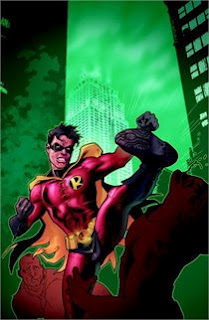
Some covers were already prepared and released when Nicieza took over from Dixon. Others were altered. The Final Fight cover shows Robin kicking someone in the face; was that character deliberately obscured to hide his identity?

Despite the breathless marketing copy quoted above, I doubt Tim Drake was to become “the new Dark Knight” permanently. I noted back here that Grant Morrison had pitched the idea of Dick Grayson taking over as Batman back in 2005 when he first talked with Tomasi, then an editor, about the assignment. I suspect Dixon wrote Tim trying to be Batman in a pinch, as in Battle for the Cowl, and deciding (once again) that’s not what he wants to do.

COMING UP: Why it was good this Robin storyline was canceled.

06 November 2011

Robin Around the Web This Week

At Comics Should Be Good!, Brian Cronin asked for reader suggestions of the Greatest Tim Drake Stories Ever. That evolved into the Greatest Robin/Red Robin Stories Ever.

Some patterns stood out:
  • Six of the top ten were written by Chuck Dixon.
  • Only two of those ten appeared in the last ten years. Most date from the early and mid-1990s.
  • Many crucial events in Tim Drake’s career (his mother’s death, meeting Spoiler, joining Young Justice, joining the Teen Titans, his father’s death, shift to Red Robin, deducing that Bruce Wayne was lost in time) don’t appear in any of these stories. 
Cronin doesn’t include vote counts, and I may be projecting here, but the level of commentary on those posts makes me suspect fans had a hard time coming up with top ten lists. Yet the same website had another fan poll that placed Tim Drake as DC’s eighth best character this year. (Dick Grayson, coming off a year in the batsuit, came in a solid #3.)

The character of Tim Drake, as a symbol and as a member of the shifting casts of people around Batman and/or of DC’s young heroes, may well be better and more beloved than individual stories about him.

Elsewhere, the artists at Comic Twart focused on Damian Wayne; the panel above comes from Evan Shaner. It looks like some contributors knew much more about the character going in than others. (“Gerads told me this is all that kid says.” “So apparently Damian Wayne is 10.”) The resulting exercise might therefore be less successful than it could have been.

The group’s tribute to Bucky Barnes seems more sure-footed. I especially like Tom Fowler’s mash-up of the finale of Dr. Strangelove with Baron Zemo’s rocket.

07 August 2011

Stephanie Brown’s “intrinsic importance to the Bat-verse”

Back when I discussed the second Jason Todd, I posited that death was the best thing that had ever happened to that character. Dying removed Jason from current Batman stories for fifteen years, but it solidified what he symbolized within the DC Comics mythos. It resolved the conflicting roles and personas that different writers had depicted in the preceding years.

Did the apparent death of the fourth Robin, Stephanie Brown, have the same effect? I don’t think so. Instead, it amplified the symbolic meaning she already had, which DC’s editors and many of its writers hadn’t recognized.

The development of the Stephanie Brown character began in 1966, when Batman writers created the Cluemaster as a stand-in for the Riddler when they wanted to tell a Riddler-type story (villain unaccountably leaves clues about his upcoming crimes for Batman to figure out). The Cluemaster was so generic that his last name was Brown.

In Detective Comics, #647, writer Chuck Dixon brought the Cluemaster out of character limbo, having cured himself of his compulsion to leave self-defeating clues. But someone else was revealing all his plans: a young woman calling herself the Spoiler! Tim Drake, rookie Robin, discovered that the Spoiler was a teen-aged blonde. Finally, Batman stopped the Cluemaster at a crucial moment by revealing that the Spoiler was the man’s own daughter, Stephanie.

In a 2008 interview with Comic Book Resources, Dixon said:
“Frankly, Spoiler began as a pure plot device and evolved, because of fan interest, into a romantic foil for Robin. I’m not really certain of her intrinsic importance to the Bat-verse other than the fact that she’s become a beloved supporting character.

“It’s also kind of cool that Robin has someone around his own age to run rooftops with,” laughed Dixon. “It’s sort of a male fantasy to find a girl who shares your hobby.”
Dixon and his editors thus used Stephanie as a supporting character in the Robin series—rooftop companion, romantic complication (Tim already had a girlfriend from his second miniseries), and source of valuable lessons about life.

For example, immediately after Robin and Spoiler officially became an item, in Robin, #58, Stephanie discovered she was pregnant by her previous boyfriend. That being a magazine about Robin, the subsequent action hinged on the question, What would Tim do? Because he’s mature for his age, and a natural hero, he found a way to help Stephanie through labor. Tim’s solution involved a skeevy alternate identity and help from the Flash getting back to Gotham, but he was there for her.
Then Stephanie put the baby up for adoption, and almost nothing more was said about it. (Except in fanfiction.)

Almost all of Stephanie’s subsequent storylines in Robin involved her dealing with another Horrible Burden: “My dad is a supervillain who brings his friends home with him!” “My mom is addicted to pills!” “I was sexually abused as a young girl!” Some readers complained that she was nothing more than a magnet for Afterschool Specials. Indeed, the PFS Bookclub even defines such a fictional archetype this way:
The Afterschool Special represents a character that is maimed, killed, or otherwise emotionally devastated for the purpose of another character learning a valuable lesson in life. The name comes from the television trope of the 80’s afterschool specials, which were designed to teach children life lessons. An example is Stephanie Brown, who was killed in battle to teach Robin that he bears a responsibility to protect the people.
Stephanie’s death in Batman: War Games thus simply extended an existing pattern.

That said, Stephanie played other roles in other DC magazines. When she interacted with Batman, she was mostly not-Tim-Drake: someone Bruce Wayne used to manipulate Tim while the Dynamic Duo was on the outs. When she interacted with Cassandra Cain as Batgirl, a preternaturally gifted martial artist unfamiliar with normal life, Stephanie was regular-girl.

What was common across all those appearances, and key to her character, was that things never came easy for Stephanie Brown. She wasn’t close to being as good an acrobat as Dick Grayson, a detective as Tim, or a fighter as Cassandra. In fact, by their high standards, she was close to incompetent—but only because she aimed so high from where she started.

Stephanie was from a working-class family; she didn’t have Bruce Wayne’s billions or Helena Bertinelli’s millions or Barbara Gordon’s technology. She sewed her own costumes and, most of the time apparently, secured her own equipment. She didn’t even have the independence of being an orphan; she was still hiding her crime-fighting life from her mother, and her occasionally returning father.

But Stephanie never gave up. In the context of Tim Drake’s story, and Bruce Wayne’s, that made her a complication to deal with. Her perseverance could get her in trouble (or, occasionally, get them out). In the context of her own story, that spunky quality made Stephanie Brown a hero. After all, no superheroes give up.

Stephanie’s death by torture in War Games fit right into the line of Horrible Burdens the character was saddled with. So did the apparent disrespect from Batman not installing a trophy case in her honor. And—this is where it gets interesting—so did the apparent disrespect of DC Comics, first using her as a sacrificial supporting character and then declaring “she was never really a Robin.”

Both within the fictional DC Universe and within the fan culture around that universe, Stephanie Brown came to symbolize someone who wasn’t getting any breaks.

And yet she, and her fans, never gave up. Stephanie came back from the dead—perhaps a little ahead of schedule. Even then, as the quotation from Dixon above shows, DC’s creative team still had trouble understanding her unique symbolism within the Batman mythos. But unwittingly they had created one for her.

In 2009 Stephanie Brown took over the role of Batgirl, for the first time becoming the title character of a magazine. A magazine which will soon be canceled because of sliding (though not disastrous) sales and the overall DC reboot. I’ve read some fun issues in that run, and look forward to reading the rest as collected. But I wonder if enjoying advantages at last—Barbara Gordon as committed mentor, advanced equipment, better training, official status within the Bat-family—washes out some of what’s made Stephanie Brown interesting and unique.

05 June 2011

Reborn Robin Reflects Readers

As the last weekly Robin discussed, when DC Comics introduced Tim Drake as a new Robin in late 1989, it was careful not to offend fans of the original by letting him appear to supplant Dick Grayson.

He was, unlike the first Jason Todd, not simply a younger version of Dick. More important, unlike the second Jason, he was passionately respectful of Dick’s legacy.

The character made the arguments that had been appearing in the Batman letter columns about what Robin meant to Batman, and why he needed a teen sidekick.

But those weren’t the only aspects of Tim Drake’s character that produced a hit. As Marv Wolfman conceived of and scripted the story, there was a certain grouping of his personal qualities that readers might have found familiar.
  • Tim knows all about Batman, Robin, and Nightwing. “I’ve followed them both....I know them so well.” “Mostly, I read about you two.”
  • He collects stories about them (“Since I was able to read, I clipped every article I could”) and pictures (the first thing we see him doing is taking photographs of Batman).
  • He knows their secret identities. He knows where they live. Indeed, his analysis of Batman’s psychology shows that he knows more about them than they do: “Batman needs a Robin. No matter what he thinks he wants.”
  • He’s emotionally invested in the Dynamic Duo. “I care about them, Alfred. I really do.” “You’ve both been so important to me in so many ways.”
  • They’re part of his imaginative life. “Heck, I used to fantasize what it would be like to be Robin.”
In subsequent stories, writers Alan Grant and Chuck Dixon added these details:
  • Tim is a whiz at computers.
  • He hangs out with his school’s nerds.
  • He plays role-playing games.
Finally, even though Tim’s only thirteen, he insists that Batman and Robin should be the way they were when he was twelve. “I want him to be the Batman I remember.” “I was only thinking of the team...of what Batman and Robin meant! You can’t let a legend die like that, Dick...”

In short, Tim Drake was the embodiment of a comic-book fanboy. Of course, the company’s writers never gave him the habit of reading comics (unlike his future young teammates Impulse and Kid Devil), avoiding the risk that readers might think they were being parodied. Fanboys were free to identify with Tim’s smarts and ideals.

Back in 1940, when Detective Comics introduced Dick Grayson, comic books were published through newsstands for a mass audience. Dick was everything all boys might want to be—athletic and smart and funny. (So much so that he turned off some readers, like Jules Feiffer, even as he caught the attention of others.)

Nearly fifty years later, the comic-book market was defined by specialty shops. Readers were older, more dedicated, and more critical. And for those readers, the new Robin could reflect of the best parts of their youthful selves.
I started making notes for this posting in 2007, and in early 2011 Brian Cronin at Comics Should Be Good made similar points. But the idea goes back a long time. Reviewers like Tom Bondurant and D. K. Latta saw similarities between Tim and fanfiction Mary Sues [well, Latta wrote “Mary Janes”], which are projections of a writer’s wishful self. That’s not really the same as a character designed for fans to identify with. Nonetheless, Tim definitely reflected the fans.

06 March 2011

A Month of Robin-Related Interviews

The past fortnight brought four notable web articles featuring scripters’ comments on past and present Robins. These being publicity interviews, all the writers are enthusiastic about us buying the next product, but amidst the marketing they make some interesting points. In particular, all talk about how mainstream superhero comics are a collaborative creation stretching back decades, so they have to work with other people’s ideas, sometimes on the fly.

Newarama had an essay examining the enduring appeal of Tim Drake. The article jumps straight from the company’s somewhat desperate introduction of the character in 1989-1991 to Tim’s dark period, starting with Identity Crisis and War Games in 2004.

But weren’t the intervening years part of building the character’s lasting appeal? There are no quotes, furthermore, from Chuck Dixon, the writer who scripted the Robin miniseries of the early 1990s and the first hundred issues of the comic book that followed—perhaps because he’s not working for DC Comics today.

DC’s own blog put the spotlight on Tim’s relationship with his successor as Robin, Damian, following their resentful team-up in Teen Titans. Scripter J. T. Krul spells it out:

Red Robin wants to show that he can treat Robin just like any other member of the team - bringing the tactical leadership and detachment that Batman seems to master so easily. But more importantly, or rather more personally, Tim wants to show (and perhaps even convince himself) that he doesn’t feel threatened by Damian - that he doesn’t fear being replaced in the eyes of the titans. As for Robin, he wants Tim to see that he can do just as good of a job as he ever did - that he can be a team player when needed. In other words, he wants to show his big brother that he’s no child.

On the surface, both Tim and Damian are seeking to convey the same notion - that they don’t care what the other one thinks about them - When the opposite is actually closer to the truth.

Ah, sibling rivalry.
That dynamic informs the page from Teen Titans, #92, shown with the essay. note how Krul and artist Georges Jeanty make the bottom panels into mirror images, visually conveying that these Robins are more alike than they’d care to admit. Krul’s essay seems unusual in spelling out his character motivations, but it comes at the end of a story arc, and thus isn’t giving any part of that story away, just reinforcing what’s already on paper. Did Krul or the company feel that we fans needed some extra explanation? Or do they hope that understanding the two characters in this way will make us more interested in following their relationship over the next few years?

Comic Book Resources ran a publicity interview with Judd Winick in advance of his issues of Batman and Robin, which bring Jason Todd back after his odd appearance in Grant Morrison’s issues of the same magazine. And by “odd appearance,” I mean that he literally appeared odd.

The first Jason Todd had red hair, which he eventually dyed black to please Bruce Wayne and DC’s licensees. The second Jason Todd had black hair, even when he was living rough on the street, walking the world half-dead, and living undercover. On coming back to Gotham, he also had a streak of white to symbolize his trauma.

Yet Morrison presented the character a redhead once again, talking about dyeing his hair—yet there was still that streak of white. Jason’s his new Red Hood costume was based on the original Red Hood in Detective, #168; I think that when even the Joker has abandoned a costume as too flamboyant, it’s time to move on. Normally I enjoy Morrison’s continuity syncretism, but I hope Winick can fix those details.

Since this interview comes at the start of a story arc, however, Winick says very little about future developments. He does, however, state:
Jason is a bad guy. I do Jason as a villain—a villain with very, very close ties to the home set which makes him way more difficult, and also heartbreaking.
I think of Jason as a troubled antagonist, rather than a villain, but of course in the superhero genre the people whom heroes fight must be either villains or very special guest stars.

In the Teen Titans page noted above, Damian uses the word “motif,” which I can’t imagine any ten-year-old doing. Winick echoes that point, saying:
Damian is not like any 10-year-old kid who ever lived! Damian is very much like a little adult, and I think Grant set the tone; it’s just a matter of following in Grant’s footsteps. He really has a terrific voice.
Finally, Comic Book Resources had a publicity interview with Art Baltazar and Franco about their assignment writing a Young Justice comic book alongside the Cartoon Network series. That series has an overarching narrative about the team’s dynamics, membership, and leadership, and the individual teens’ development. The comic book stories have to fit into that same narrative without giving too much away; it’s the tail, not the dog. Baltazar explains:
The first issue we have kind of takes place between scenes of the episodes on TV. Our comic almost fills in the blanks of what you don’t see on the show. . . . We’re writing really closely to the episodes, and we’re anxious, too, because when we write an issue, we'll know it fits between episode four and five or whatever.
Franco and Baltazar run ideas for using versions of other DC characters past the TV producers, and get approval, guidance, or veto based on plans for the cartoon.
I really like the Super Friends villains—you know, the Legion of Doom. So, so far we’ve been throwing Solomon Grundy and Bizarro at them for every issue. And they know that by the time it’s time for us to write the next issue, and they go, “Who do you want for villains?” we’ll go, “Solomon Grundy and Bizarro.” And they're like, “It’s the same thing we told you last time.”
So it doesn’t sound like we’ll see Bizarro soon in the Young Justice comic. (I suspect the explanation may lie in the series’ exploration of Superboy as a clone, and the current similarity between Bizarro and Match.) And I imagine Baltazar and Franco’s assignment will become even tougher when DC rolls out Young Justice on Ice! in arenas everywhere.

20 June 2010

Robin Tweets for the Week

I’m busy at a conference this weekend, so this weekly Robin consists of some links, most already shared on that Twitter feed.

First, in the thumbnail at left, artist Carly Monardo shares her vision of Robin as he’d look if designed and drawn by Edward Gorey. Her Batman may be even more Gorey than that. Each entry in Monardo’s blog is an attempt to draw an iconic character in an unfamiliar artistic style.

Comics Should Be Good! rightly featured Chuck Dixon and Jason Armstrong’s 1995 retelling of how Dick Grayson became Robin in Robin Annual, #4.

Comics Make No Sense demonstrates the dangers of fighting crime in the vicinity of a giant sewing machine, especially if you fall down a lot.

The Speed Force highlighted the moment in Young Justice, written by Peter David and drawn by Todd Nauck, when some of Tim Drake’s teammates realize just how much they resent him.

Finally, here’s an image of Robin as a member of The Breakfast Club, created by artist Cliff Chiang. (Despite being a “child of the ’80s” I’ve never watched more than five minutes of that movie or felt any desire to. So I can’t say if Robin makes sense in the Ally Sheedy position.)

26 April 2009

Chuck Dixon on Robin—and Spider-Man

From Joshua Lapin-Bertone's Batman Examiner, here's an interview with Chuck Dixon, the comics writer most closely associated with the character of Robin--at least in his modern forms. Dixon scripted the first Robin miniseries in 1991, the first hundred issues of the Robin magazine starting in 1993, and most issues of the Nightwing magazine starting in 1996.

As part of the Batman writing team, Dixon wrote other magazines as well and contributed to a number of landmark crossover events under editor Denny O'Neil. He also co-scripted the fine Robin: Year One miniseries with Scott Beatty. Dixon was excellent at keeping storylines strung out issue to issue--though, looking back, the drama wasn't always worth the suspense.

I've rearranged Lapin-Bertone's questions to make Dixon's comments more chronological.

Tim [Drake] was unique among the other Bat-characters in that he wasn't a total orphan at the time. Was there ever any pressure to kill off Jack Drake [Tim's father]?

All the time! I kept Jack alive for years past the point my editors wanted him dead. Their reasoning was always that Tim having a parent with all the limitations of that provided too many complications to Robin’s story. They saw that as a negative. I saw it as a positive.

I’ve never made a secret of the fact that I used the first fifty issues of The Amazing Spider-Man as a dramatic template for Robin. Those stories got much of their suspense from the dangers Peter Parker faced if his identity were revealed.

For Tim Drake, the stakes were even higher. The reveal of his identity would have affected his family and also unraveled the secrets of the entire Bat organization. You don’t throw away solid gold like that.
And indeed, in a letter column early in the magazine's run, the editors acknowledged that they'd originally planned to kill off Tim's father, but kept finding it more interesting to keep around.
Any stories that you weren't able to tell (Batman, Nightwing, Birds [of Prey] or Robin) that you can reveal? Any stories that originally had a different ending but it went in another direction?
Nothing I can think of right now except that my plans leading to Robin 100 and beyond were pretty cool and I regret not being able to do that story. My plan was to have Tim quit as Robin and become the new Blue Beetle under Ted Kord’s [i.e., the old Blue Beetle's] guidance. Batman would pick Steph to take on Robin’s role. Tim would then be featured in a six-issue mini as Blue Beetle until events in the Batbooks would bring him back to the fold.

The idea coming out of this would be a BB ongoing in which Ted gets the idea to create what amounts to a Blue Beetle franchise. He creates what amounts to Blue Beetle Inc and has a representative in every DCU city. I was shot down on this one over and over. As soon as I left the title they did a kind of pale version of the story I had been proposing for more than a year.
Dixon might be referring to Robin, #101, which featured Stephanie Brown as Robin, but no Blue Beetle. That was an alternate universe, part of a crossover from Peter David's wackier Young Justice series. Years later, Bill Willingham proposed making Stephanie into Robin for real, since the editors had decided to kill her off anyway.

Which brings me to 2008, when DC rehired Dixon to write Robin, with part of his mandate to bring Stephanie back from the dead. Those issues are now collected in Robin: Violent Tendencies.

But then Dixon and the company had a sudden and dramatic parting of the ways. DC found a new writer for the magazine, even reworked some cover art to reflect the new stories. The company dove into the "Batman RIP" and "Battle for the Cowl" storylines being played out in comic shops now.
Had you stayed on the title, what were your plans for the book?

Well, I written about eight more scripts. There was a storyline with Steph’s dad and the return of some Robin villains in a new way and the introduction of several new bad guys. Much of this is hazy in my mind already. Lots of changes were made as I was writing and the direction of the book was being altered even as I was in the middle of a story arc.
I've seen a lot of speculation, even from former comics editor Valerie D'Orazio, that Dixon became upset because of DC's plans for Tim Drake--i.e., that the honchos were insisting the character go in a direction Dixon didn't like. Those theories never convinced me. Furthermore, in this interview Dixon doesn't speak of quitting in protest; he says that he was "let go."

Dixon strikes me as a superhero-book veteran, well aware he was hired to enhance a large corporation's intellectual property. All of his own comments about the break indicated that he was getting sick of working with a particular executive who made what he considered late, wishy-washy, and poorly communicated decisions. In most jobs, the biggest pain isn't the work but the people you work with.

As I noted above, Dixon had worked on many crossovers for DC; had he been brought into discussions on these latest, he could surely have contributed rather than writing eight scripts that turned out to be unusable.
In the final issue of Robin, Tim finally confronted the Obeah Man, killer of his mother [back in 1990]. I understand you had your own take on the story during your first run on the title but never got to tell it. What was it and why?

I never intended to have a story in which Tim resolved the Obeah Man story. I felt that would be the end of Tim’s story. Apparently, I was right.
The Robin magazine is in abeyance, and we last saw Tim Drake with a batarang impaled in his chest. But I suspect his story will continue.

06 July 2008

Robin’s “Storytelling Engine”

As I wrote yesterday, at Fraggmented John Seavey writes an ongoing series of posts called "Storytelling Engines," which analyze the situations that drive different superhero comics. These are the dilemmas, paradoxes, and never-resolved desires and questions that keep successful comic-book serials rolling year after year.

Last Monday, Seavey discussed Robin, both the original (Dick Grayson) and current (Tim Drake) incarnations. I suspect that two recent developments influenced how Seavey analyzed the Boy Wonder:

  • Fans are working themselves into a fever about the upcoming second Batman movie from Christopher Nolan, many debating whether the expected third movie could or should include the character of Robin.
  • Chuck Dixon, who scripted the first several years of the Robin comic (1993-) and the first few years of the Nightwing comic (1996-), recently returned to Robin, only to suddenly part ways with DC Comics.
Seavey's essay discusses what having a young sidekick has brought to Batman's stories since 1940:
The Boy Wonder is an essential element of Batman's storytelling engine, and has been for generations. He's a handy audience identification figure for younger readers who want to imagine themselves adventuring side by side with their hero, he's a handy means of providing exposition (so that Batman doesn't have to talk to himself quite so much), and as a crimefighter slightly less competent than the Darknight Detective, he's a useful source of plot complications if the writer needs to extend the story. (And he's also a source of comic relief, if your source of humor trends towards terrible puns...)
In the last twenty years, DC Comics writers have emphasized a couple of other ways that Robin adds to Batman's stories. He represents the innocence that Bruce Wayne lost when his parents were murdered, and he can talk back to the Caped Crusader when almost everyone else is afraid to. But those are relatively recent developments; they don't explain why Robin was immediately popular in 1940, and I agree with Seavey's explanations.

Off and on, DC published solo Robin adventures. The first batch appeared in Star-Spangled Comics in late 1940s and has been collected in the Archive volume shown at top. Another set appeared starting in the late 1960s, when Robin was the "Teen Wonder"; some are reprinted in the cheaper Showcase volume at right. However, neither set was really compelling.

Dick Grayson became a widespread favorite in his own right in the early 1980s when he was the leader of the New Teen Titans. DC had him take on a new identity as Nightwing. Eventually the company created Tim Drake as Batman's new young partner, giving this Robin some miniseries and then (when Bruce Wayne was temporarily replaced as Batman) his own magazine. Seavey writes:
So now, instead of one Robin who doesn't work as a solo hero, we have two that do (three, if anyone here actually cares about the resurrected Jason Todd. Anyone? Anyone? No, didn't really think so.) What made the difference? Arguably, Chuck Dixon. As a writer who's always been concerned with the nuts and bolts of good storytelling, he made sure to surround his characters with the elements that made their storytelling engines work. He made sure the characters had easy access to story ideas, if for no other reason than it made his job easier, and it made those characters work in a way they hadn't before...and in a way they haven't since. . . . A hero without a good supporting cast, a good setting, and a good antagonist is really just a sidekick.
Unfortunately, I don't think Seavey's essay ever gets to the question of what has made Robin's and Nightwing's solo stories successful enough to sell year after year. It's all very well to praise Dixon for creating good supporting casts and sticking with them, but the heroes themselves need to have interesting conflicts and challenges that arc from issue to issue. So here are my thoughts on those two characters' storytelling engines.

Nightwing's solo series began after he left the Titans in the early 1990s. (He's returned to that group at least twice since, but no matter.) Within the Titans, Dick had a role and even a family. Without them, he feels adrift and unaccomplished. He has to find a place in the superhero world outside of Batman's shadow and in the civilian world outside of Wayne Manor. Above all, he has to live up to the impossible standards he's inherited from his mentor.

As for Tim Drake, he was the first and most successful of several teen-aged heroes that DC launched in the 1990s. One ongoing theme of his magazine is what a young man has to do to grow up as a hero, but that theme also appears in the stories of the second Superboy and the speedster Impulse.

What's made Tim Drake's adventures last longer than those others is how clearly he sees the dark side of being a costumed hero. He admires Batman, but from the beginning he sees the harm that Batman can do to himself and others. Tim wants to learn, but he also wants to figure out how to avoid his teacher's mistakes.

For most of Robin's run, Tim also sought his father's respect, yet had to hide his nocturnal crime-fighting. More recently, his father and several friends have been murdered, and that's made Tim closer to and more worried about sliding into a dark, Batman-like adulthood.

Those challenges and paradoxes have run from issue to issue, evolving but never resolved. They were often more interesting than the villain of the month. They comprised this Robin's storytelling engine.

There's more commentary on Seavey's Robin essay at Comics Should Be Good.