Showing posts with label AUTHOR Allan W. Eckert. Show all posts

11 July 2020

Interpreting Incident at Hawk’s Hill through the Autism Lens
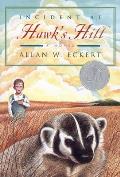
How are we to make sense of the 1971 novel Incident at Hawk’s Hill and the actual 1873 event at its root?

In 2004, Prof. Kenneth Kidd wrote about Allan W. Eckert’s novel for the children’s literature journal The Looking Glass. In that paper, titled “Leave It to Badger,” Kidd reported that he’d found no corroboration of Eckert’s claim that he had based the book on a real incident.

At the time, digital book and newspaper archives were in their infancy, so it wasn’t as easy to find the period sources I quoted back here, or the intervening secondary sources I analyzed here. Not only did Eckert have reason to believe he was working off a report of a real incident, but it’s clear that a lost little boy was indeed found in a badger hole in 1873 Manitoba. Would that knowledge have changed Kidd’s analysis?

Kidd made sense of the novel by applying the thinking in his book Making American Boys: Boyology and the Feral Tale. He discussed the story through the lens of folklore. Many cultures have stories about children being raised by animals, including such famous western examples as Romulus and Remus, Mowgli, and Tarzan. Viewed entirely as fiction, Eckert’s novel fits into that paradigm. Kidd saw an Oedipal dimension to such stories in general and Eckert’s novel in particular.

Of course, when the event at the core of Incident at Hawk’s Hill—a little boy lost on the prairie who survives by finding shelter in a badger’s hole—is real, then the ways people tell that story aren’t new examples of old folklore but attempts to understand what really happened. (Or, in the case of Eckert’s acknowledged fiction, to present what might have happened.)

Bruno Bettelheim’s paper “Feral Children and Autistic Children,” published in the American Journal of Sociology in 1959, was an attempt to explain similar events. Bettelheim posited that the root of many of those stories of children raised by animals is autism, a psychological condition he was groping to understand. Throughout history, he wrote, people had seen “severe cases of infantile autism with seemingly animal-like traits and habits” and explained that behavior by believing the children had been raised by animals.

Bettelheim’s own theory of autism was deeply flawed. In that same paper he posited that it was largely or entirely due to “extreme emotional isolation combined with experiences which they interpreted as threatening them with utter destruction.” As for the source of the emotional isolation, Bettelheim mostly blamed mothers (of course), saying they were the real “feral” ones.
While Bettelheim’s theories about autism and how to respond to it have fallen by the wayside, his suggestion that autism explains many examples of “feral children” has caught on. Uta Frith analyzed some historic cases of "feral children” in Autism: Explaining the Enigma (1989) and elsewhere. She suggested, “an unduly high proportion of feral children suffered from autism before they were abandoned. Indeed autism, with its often severe conduct problems, may be the cause for the abandonment in the first place.”

Frith’s book and others have helped to make our culture much more aware of autism since Incident at Hawk’s Hill appeared in 1971. We now recognize a spectrum of related conditions under the autism label. Not only do we better distinguish autism from other cognitive conditions, but we acknowledge autistic ways of thinking and viewing the world in high-functioning individuals.

That knowledge allows us a new perspective on how authors from earlier generations discussed the story of the little boy lost on the Manitoba prairie. The initial reports said almost nothing about the boy himself, only that he was scared when men came by. It’s not clear how much detail in the oral traditions is based on fact and how much was added by people seeking to comprehend the mystery. Nonetheless, the more detailed recounting by Ernest Seton Thompson and the fictionalized story of Allan W. Eckert lend themselves to interpretation through the lens of autism.

Seton was quite clear about little Harry Service not being normal:
He was a strange child, very small for his age, and shy without being cowardly. He had an odd habit of following dogs, chickens, pigs, and birds, imitating their voices and actions, with an exactness that onlookers sometimes declared to be uncanny.
For Seton, this affinity with animals was a strength. He linked kindness to animals with general goodness, and equated cruelty to animals with cruelty to people. Seton’s tale contained an explanation for how this boy survived in the badger’s hole—because the badger, having lost her own young, showed maternal kindness to this unusual newcomer. And he concluded with an optimistic suggestion that Harry’s experience with the wild badger cured him of his most obvious strangeness.

In Incident at Hawk’s Hill Eckert picked up on those details and made a major subplot of the boy’s parents wrestling with what we’d now call their youngest son’s special needs. Early in the novel, Bill MacDonald tells his wife:
“Oh, what’s the use of trying to fool ourselves? He isn’t normal, Esther, and we both know it, whether or not you’re willing to admit it. He not only isn’t normal physically, he’s not normal mentally, either. Look how he acts toward animals.”
When Eckert finally shifts his narration into the little boy’s own perspective, it states:
Ben had no idea why he was so afraid of people. He was not, as his father seemed to think, retarded in his mental processes. He was, in his way, quite intelligent. He could think things through very well for his age and he retained a surprising percentage of what was taught him by his mother and the others. It was just that he kept what he learned to himself. He didn’t like to talk to people.
Was this Eckert’s attempt to depict an autistic child? Someone he knew, something he felt? Or was he picking up imaginatively on the hints in Seton’s story? I have no idea. In the end, Eckert followed Seton’s line and portrayed the experience out on the prairie as making Ben open up more than ever, especially to his father.

Reflecting the greater awareness of autism today, many recent readers of Incident at Hawk’s Hill interpret Ben forthrightly as on the autism spectrum. Monado at Book Crossing describes him as “a boy, whom these days we’d describe as autistic,” while Lori Steinbach at enotes says he probably has “a condition something like autism.” The Home School Book Review said, “Ben would probably be considered somewhat autistic today.” At Goodreads, the Shayne-Train wrote, “now that I [re]read it with adult eyes, it may be the first novel I’d ever read that had an autistic protagonist.” And the study guide for the novel at Bookrags includes a whole section on autism.

Such a diagnosis is of course only a partial explanation for the character, or the history deep behind it. Did the little Service boy who got lost on the Manitoba prairie have some form of autism? How did that affect his lost time, or his family’s and neighbors’ interpretations of it? What experiences with autism, a condition not yet isolated and named in the early 1900s, did Seton have? What about Eckert, writing in 1971? Is it just coincidence that this modern example of a “feral child” story fits so easily with an autism reading, or are we still seeking an explanation with the partial knowledge we have?

10 July 2020

How a Real Story Became Incident at Hawk’s Hill

In 1873, a young boy went missing from his family’s farm in Manitoba. After more than a week, a man of Native and European ancestry found him hiding in a badger hole. That much we can read in nineteenth-century sources from Winnipeg.

In the early 1900s the nature writer Ernest Thompson Seton picked up that story from some Manitobans. He published a version that went into much more detail about how the little boy had actually shared that hole for days with a mother badger that had recently lost its young. Seton or his informants turned the mysterious event into a morality tale, which he published in at least three books.

This 1960 article from the Manitoba Historical Society’s Manitoba Pageant magazine mentions some other local recountings: by Archbishop Samuel Matheson in 1936, in Country Guide in 1951 by Margaret Arnett MacLeod, by the Manitoba Free Press in 1953. I haven’t seen those versions, so I don’t know what new details they provide and what evidence they were based on.

At some point the American writer Allan W. Eckert (1931-2011) came across Seton’s version of the story. Eckert had made himself a specialist in ecological writing, penning most of the scripts for Mutual of Omaha’s Wild Kingdom. He also found a niche writing on Native Americans, including outdoor dramas about Tecumseh and Blue Jacket. (That pairing of nature and Native Americans probably reflects a bias within our culture.)

Eckert’s nonfiction tended toward the imaginative. One of his early magazine sales was an article for the American Legion magazine in 1962 about the disappearance of the US Navy air training mission Flight 19 off the coast of Florida. Eckert appears to have added details not in the documentary record, and that event later became a keystone of the “Bermuda Triangle” legend.

Likewise, Kirkus said of Eckert’s 1992 biography of Tecumseh, A Sorrow in Our Heart, “in its interpretative zeal it strays from, or at least embellishes, the historical record to the point of being suspect.” Even Kirkus’s good review of That Dark and Bloody River noted Eckert’s method of “'reconstituting' credible dialogue among people in briefly reported events.”

On the other hand, Eckert’s fiction was often based closely on historical fact. His first novel was about the extinction of the great auk. Another was based on an event in the life of Daniel Boone. In the late 1960s Eckert started a series of historical sagas about the “Winning of America.”

Eckert saw the skeleton of a novel in Seton’s tale of the lost boy and the badger. The tale offered a chance to write about both the frontier past and the natural world. And it came with the gloss of nonfiction. When Eckert published his novel Incident at Hawk’s Hill in 1971, he stated up front in a short author’s note, “The story which follows is a slightly fictionalized version of an incident which actually occurred at the time and place noted.” Toward the end of the book, Eckert introduced characters who shared the names of two of Seton’s informants.

Eckert changed some details of the story, starting with calling the little boy not Harry (or Willie) Service but Benjy MacDonald. Seton had written that the event took place near “Bird’s Hill,” and Eckert turned that into “Hawk’s Hill,” named after a hawk the MacDonalds see. (The original Manitoba landmark was named after a settler named Bird, not an actual bird.)

Many other details and the plot of Eckert’s story came directly from Seton’s narrative. From the outset, the little boy shows more affinity for animals than for people. Seton’s villain—a nasty neighbor named Grogan—appears under the name of George Burton. He’s not a “half-breed,” however; in fact, he’s cruel to Natives as well as animals. As in Seton’s story, Benjy wanders away after a prairie chicken and needs to take shelter from a storm. A mother badger has been injured in the villain’s trap and lost her babies, leaving her with unfulfilled maternal instincts.

The real boy was lost for about ten days, but Incident at Hawk’s Hill draws that time out to two months. Eventually, Benjy is rescued by a relative rather than (as with the real boy) a stranger; where Seton wrote that that relative was a cousin, Eckert found more drama in making the rescuer a brother.

When Benjy returns, he initially behaves like a badger, but eventually returns to human behavior, stronger for his experience in the wild. Finally, just as in Seton’s telling, the villain shoots the badger, not realizing it has become a family companion, and the family unites to drive him away. The experience brings the MacDonalds closer, particularly father and son. But the family has also decided, with a visiting archbishop’s help, to keep the full story secret so as not to make Benjy appear stranger than people already think of him.

Eckert didn’t write Incident at Hawk’s Hill for children. The point of view skips around among many characters—adults, children, badger, and omniscient narrator. Though six-year-old Benjy is a central character, for many pages Eckert describes him entirely from the outside, and not in appealing terms—he’s small for his age, developmentally odd. It takes several chapters before readers are privy to Benjy’s thoughts, and then only when he’s the only human in the scene. Much of the book follows the drama of the MacDonald family searching for him or reacting to his return.

The early reviews treated Incident at Hawk’s Hill as an adult novel. Critics focused on Eckert’s reputation as a nature writer, with the New York Times calling the book a “folk fable” written “without recourse to undue anthropomorphism.” Kirkus’s reviewer, who could barely stand the story, concluded, “Were it not for Mr. Eckert’s natural history credentials one might think he had been sniffing too much meadow grass.”

Soon, however, people began to view Incident at Hawk’s Hill as a book for children. It was, after all, about a young boy and an animal making friends. It was on the short side, well under 200 pages. And it had pictures. Little, Brown commissioned scratchboard art from John Schoenherr, who had illustrated Sterling North’s Rascal (1963) and Walt Morey’s Gentle Ben (1965)—two novels about boys and animals written for children. (Schoenherr had an earlier career as a science-fiction illustrator. He would go on to win the Caldecott Medal for Owl Moon.)

The Bulletin of the Center for Children’s Books deemed Incident at Hawk’s Hill “An adult novel that should appeal to many young readers.” And in 1972 the novel was named a Newbery Honor Book. That year the judging committee appears to have been unusually generous, naming five Honor Books, more than in any other year in the 1960s and 1970s. From then on, Eckert’s novel was treated as a children’s book.

Disney adapted Incident at Hawk’s Hill into a 1975 television movie called The Boy Who Talked to Badgers. This treatment made Benjy, played by ten-year-old Christian Juttner, more of a likable hero. It switched some episodes around, but the basics of Seton’s and Eckert’s story remained. One notable addition was Denver Pyle as narrator, revealed at the end to be Benjy grown up.

Almost two decades later, in 1998, Eckert published Return to Hawk’s Hill, starting at the end of the first novel and then going over much the same ground. Benjy, a little older, wanders off again. Even the villain returns, despite having been run off before. But the new story had one major difference. This time, instead of a badger Benjy falls in with a community of mixed Cree and French descent who look after him, and his father learns to apologize for his prejudice against these Métis.

Return to Hawk’s Hill thus restored the helpful role of Métis in the real story of the lost boy in Manitoba. As specified in the nineteenth-century sources, a man of Cree and European ancestry rescued the boy from the badger hole. Seton’s early-1900s version had not only erased that rescuer from the story but made the villain a “half-breed.”

I have no idea whether Eckert had learned of those original sources by the time he wrote Return to Hawk’s Hill and set out to fill a deficit in his earlier novel. He may simply have wanted to create a sequel to one of his most successful books and looked to his interest in indigenous North Americans for inspiration. Either way, he added yet more significance in the mysterious story of a lost boy in the badger hole.

TOMORROW: Further meaning for 21st-century readers.