Showing posts with label SERIES Homer Price. Show all posts

25 May 2017

The Missing McCloskeys

Tonight I took in the Robert McCloskey exhibit at Boston’s Museum of Fine Arts through 18 June. And I realized I deeply know only half the man’s work—the first half.

In the 1940s McCloskey put out four fine books, including three extraordinary ones: Lentil (1940), Make Way for Ducklings (1941), Homer Price (1943), and Blueberries for Sal (1948). I grew up with copies of all those books in the house, along with Centerburg Tales, the 1951 sequel to Homer Price.

But I didn’t grow up in an intimate relationship with One Morning in Maine (1952), Time of Wonder (1957), or Burt Dow, Deep-water Man (1963). I knew those books from the library, perhaps, but at a much shallower level. Most of the art felt new to me.

All of McCloskey’s books were published before I was born and were thus available to me as a child. But only the first batch were published before my mother’s adolescence. So perhaps she chose those for me because she remembered them fondly from her own childhood.

Notably, this one-room exhibit didn’t include work from any of the books McCloskey illustrated without writing, such as Journey Cake, Ho by his mother-in-law Ruth Sawyer (1953, a Caldecott Honor Book) and the Henry Reed books by Keith Robertson (1958-1970). Both of which I recognize immediately without remembering anything about their contents. In fact, I realize I’ve got the latter series amalgamated with the Henry Huggins books by Beverly Cleary. Much to revisit.

15 September 2014

Another Childhood Illusion Shattered

Tonight I attended Leonard Marcus’s talk about Robert McCloskey on the centenary of the author-illustrator’s birth. (It turns out he was born in Hamilton, Ohio, now home of this sculpture. But I digress.)

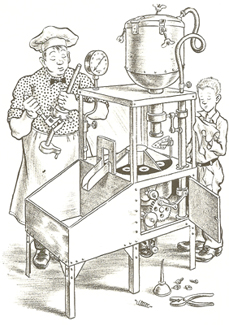
Marcus showed a photo of the doughnut-making machine from Homer Price and remarked how there are only two places to see such a machine now.

“Well, it’s good that someone preserved that model of doughnut-maker,” I thought. “I’m surprised there are so few left—maybe it really didn’t work well, so most of the machines were pulled apart.”

But that wasn’t what Marcus was saying. If I understood him correctly, only two examples of that machine were ever made. One was for the Walden Wood film studio when it adapted Homer Price as a short film in 1963. McCloskey was a friend of the studio owner and spent a lot of time there in later life; as a lifelong tinkerer, he might well have helped to build that machine.

The other was a replica built and displayed in the Municipal Building back in Hamilton, amid McCloskey’s architectural decorations. It’s not clear whether that one was made to work or just to look like the picture in the book.

All along I’d thought that was a standard type of doughnut-maker from the 1940s. After all, I’d seen it in action in that movie, operated by a boy who looks just like Homer Price (and couldn’t act for beans).

But it sounds like McCloskey made it up, based on real, less compact doughnut-making machinery. I feel like Freddy and Louis discovering that the Super Duper can’t lift his car out of the ditch.

04 November 2010

Homer Price in Capes?

Last week and month I had an intriguing online exchange with author Gail Gauthier about the notion of “Homer Price in space.”

Was it possible, I questioned, to replicate the tone of Robert McCloskey’s books in an environment that wasn’t familiar to the point of quaintness. Homer’s adventures depend on ordinary things—ragweed, balls of twine, visting movie stars, tunes that get in your head—being just a little bit off. But if we readers don’t have a deep sense of where the “on” setting should be, how can we be sure what’s off? To repeat the analogy I used in Gail’s comments section, maybe all donut machines work that way in zero gravity.

After signing off, I realized that I’d just read a book that contained a lot of what I enjoy about the Homer Price novels, yet set in a rather wild supernatural environment. That book was G-Man: Cape Crisis, by Chris Giarrusso. It’s in comics form, and stars several young superheroes with a somewhat addled wizard mentor. The kids are generally eager and well-meaning, and the adults generally too bothered to get a clue or do useful work.

That story gets its grounding, I think, in the clichés and givens of superhero tales. Mikey’s magic cape lets him fly, be super-strong, and super-tough. (Not invulnerable, as other kids point out at the start.) Those powers make sense because we’re used to seeing superheroes with them. Mikey’s circle of young heroes contains three who can fly and blast things in different ways, one who’s superfast, and one who can turn different colors—easily portrayed on the brightly tinted pages.

But Giarrusso doesn’t try to incorporate rarer, less easy to understand powers, such as controlling one’s body density (the Vision), tactile telekinesis (the second Superboy), or shape-changing within certain rather arbitrary parameters (Beast Boy). Depicting those powers might raise more questions about what’s ordinary in this world, and what’s off.

Lots of the humor (and there is a lot of it, in forms that made me laugh out loud) grows from our expectations: the boys questioning the science behind holding a buttercup under your chin, the fact that broomsticks can fly but clearly aren’t designed to be ridden, the hope that if you foil a bank robbery you’ll get some of the money as a reward. Some of those expectations reflect everyday life, but others simply reflect experience with fantasy adventures.

So a “Homer Price in space” could work, I guess, as long as it’s grounded in our received understandings of what space is like, and doesn’t drift too far into novelty or scientific exactitude. Maybe it’s even worked already; I haven’t read the Danny Dunn books in decades.

19 October 2010

Homer Price: “a universal and delightful brat”?!

Eric Gugler began a short essay in the November 1943 Horn Book like this:

When I thumb through this decidedly provocative bunch of illustrations made by Bob McCloskey for his new book, Homer Price (Viking), hundreds of tangent thoughts pop up.
Evidently not among them was “I should read this book.” Because it quickly becomes apparent that Gugler hadn’t read Homer Price.

“What a universal and delightful brat, this Homer Price,” Gugler proclaimed two sentences later, leading into a rhapsodic ode to mischievous boys:
They rings bells at front doors; when maids answer they snitch ice cream and cakes from the kitchen door and run away with bubbling glee; and they know they are never going to amount to much in the future unless they sell newspapers.
At no point in Homer Price or its 1951 sequel, Centerburg Tales, does Homer play any pranks like that. Instead, most of the time we see him working: in his mother’s hotel, in his uncle’s lunch room, at the greenhouse, at the library, in the town pageant.

For fun, Homer builds a crystal radio and goes to a movie, but he passes up fishing because of a job. Neither he nor his young friends makes trouble. Instead, it’s the adults of Centerburg who avoid work, put things over on each other, and tell outlandish tales. Level-headed, hard-working Homer helps to keep the town together.

Gugler was obviously less interested in reading McCloskey’s stories than in sharing “reminiscences of other boys I knew very well indeed.” Maybe he was busy, on deadline, and anxious to say nice things about “Bob’s” new book. He provided a lively disquisition on the “lovable bad boy” type established by Twain, Aldrich, Tarkington, Shute, and Peck. But Gugler didn’t know young Homer Price at all.

What was Gugler’s connection to children’s literature? How did he come to The Horn Book? He was an architect who helped design the West Wing of the White House. Among Gugler’s other work was the office of his good friend May Massee at Viking Press—editor of Homer Price. So this little essay looks like those excited but empty five-star Amazon reviews you can’t help suspecting were written by the author’s friends and relations.

The same issue of The Horn Book contained a better appraisal of Homer Price by James Daugherty, Newbery winner in 1940. He focused on its gentle satire of “the daily life of the Mid-Western small town” and McCloskey’s “solemn and devastating humor.” Daugherty noted how “Homer and his friends cope with, and master, such surprising emergencies as radio robbers, Superman, musical mousetraps, ferocious doughnut machines, housing problems, and mass production.” He didn’t neglect the delight and craft of McCloskey’s pictures, but it’s clear that Daugherty had read the text as well.

02 March 2009

The Pitfalls of Picking an Official State Children’s Book

The Columbus Dispatch is reporting on an Ohio legislator's proposal to make Robert McCloskey's Lentil the official children's book of Ohio. McCloskey was a native of Hamilton, Ohio, and Lentil's fictional setting of Alto, Ohio, rather resembles that town. Which, not by coincidence, is the area that the act's sponsor represents. The town already has a Lentil statue, as I reported back here.

Curiously, this proposal wasn't initiated by a set of schoolkids cajoled into proposing a state symbol as part of a unit on government, the way the "third grade class at the Dean S. Luce Elementary School in Canton" made McCloskey's Make Way for Ducklings into Massachusetts's official state children's book. According to StateSymbolsUSA.org, Massachusetts is the only state to have designated an official book of any kind.

Aside from lack of such grass-roots support, the major problem for the Lentil proposal is that Ohio, being a large state, has produced other important children's authors and illustrators: Natalie Babbitt, Virginia Hamilton, Lois Lenski, R. L. Stine. Here in Massachusetts we've addressed that problem by dubbing Dr. Seuss our official state children's author-illustrator so his partisans don't feel left out.

Another problem is that, with all due deference to Lentil, McCloskey's greatest Ohioana are the Homer Price books. Nothing else can compare.

(Thanks to Publishers Weekly for the pointer.)

15 May 2006

Homer Price, small-town hero

One of the models I keep coming back to for some of my stories are two collections of tall tales by Robert McCloskey: Homer Price (1943) and Centerburg Tales (1951).

A big part of their appeal is the old-fashioned, small-town setting. I'm not sure that can be nostalgia on my part since I've never lived in such a town. But the books were nostalgic from the get-go, showing how Centerburg modernizes slightly with each fast-talking businessman who comes through. We can see that theme in the machines slipping into the lunch counter, the development displacing the old Victorian homestead, and even (on a thematic level) the way most of Grandpa Hercules's stories are about little changes gradually adding up.

But the biggest change from the first book to the second, I realized on a recent rereading, is in Homer himself. Most of the first book's stories start with him doing kid stuff: playing with radios, reading comics, visiting relatives. Homer helps his Uncle Ulysses at the lunch counter, but that's more a family chore than a job. In Homer Price the boy proves himself so capable that in Centerburg Tales he has at least three regular jobs. In fact, he often seems to be the only local doing any work.

That shift is most clear in the story called "Experiment 13." Not only does Homer seek out a summer job, but that job involves standing on the roof of a greenhouse smashing panes of glass with a hammer—does his mother know? Later, the town leaders frighten themselves with the Cold War potential of ragweed seeds, planning to send a delegation to Washington, D.C.—and then entrust those dangerous items to Homer and his pal Freddy.

The narrative reflects that shift in how the "Experiment 13" point of view sticks with the adult characters, not Homer. He goes across the street to the bank; we readers wait with the grown-up men to find out what he's learned. Homer recognizes the giant plants, and McCloskey ends the scene; we find out what he's realized along with Uncle Ulysses and the sheriff. We're not in the room as Homer and Freddy decide what to do with those seeds; we're once again outside with the grown-ups. This is opposite from how most stories from kids are written, but then everything has been gently turned upside-down in Centerburg.