Showing posts with label COMIC X-Men. Show all posts

25 August 2013

Titans vs. X-Men

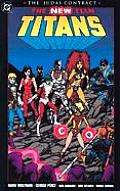
A Twitter comment from UK artist Randolph Hoyte alerted me to Chris Sims’s Comics Alliance essay on Marv Wolfman and George Pérez’s New Teen Titans. Sims is careful to note that his assessment of that magazine versus its predecessor is a matter of taste and “probably has a lot to do with reading X-Men as a kid and not getting around to The Judas Contract until I was in my 20s.”

As I’ve noted before, Sims was twelve in the 1994, and the comics we read when we’re twelve shape our tastes and memories, for better or worse. I was in my late teens when New Teen Titans was published, and hadn’t read previous versions of the team. The magazine thrilled and pleased me by doing all I’d learned to like in superhero comics and more besides. I can reread those stories and enjoy the nostalgia, but it’s next to impossible to find the same thrill in other superhero stories—and nothing’s more disappointing than picking up a story touted as “classic” and finding that it’s, well, just a superhero comic showing the traits of the time it was written.

It’s fair to compare New Teen Titans to Uncanny X-Men, Marvel’s alternate-superhero team book of the same era, as Sims does. Wolfman, Pérez, and their editor Len Wein probably did pitch their Titans revival as a possible answer to Marvel’s mutant magazine. And the X-Men issues that Chris Claremont, John Byrne, and Dave Cockrum created in the late 1970s and 1980s are top-notch.

But Sims gives more space in this essay recounting favorite moments from X-Men #132 (“Wolverine gets dropped through four floors to the sewer, then comes back at the end ready to literally murder everyone he sees”) than discussing any New Teen Titans story, for better or worse. It’s true that X-Men “feels like a product of the Modern Age,” but that’s because a big part of the “Modern Age” (at its height around, oh, 1994) was Wolverine killing lots of people. A look at The New Teen Titans should highlight its storytelling, perhaps noting some qualities that the “Modern Age” left behind.

Unfortunately, Sims’s aside about when he read “The Judas Contract” is the only time he mentions that best-remembered New Teen Titans storyline. And the only page of Wolfman and Pérez’s work illustrating the essay is one that introduces a supporting character (one whom many readers hate far more than I think is healthy). Those details indicate how glancing this assessment is.

Let’s start instead with the differences between Uncanny X-Men and New Teen Titans to isolate the qualities of each. Wolfman and Pérez worked with a different universe and characters, and they created a different type of superhero saga.

The Uncanny X-Men had the overall theme of being outcast. The Marvel mutants were disliked and hunted by authorities. Their headquarters was a shadowy private school in upstate New York. In contrast, the Titans were celebrities who worked with the government out of a T-shaped skyscraper on an island in the East River.

Even the Titans who felt like outcasts fit in better than almost anyone on the Marvel team. X-Men’s “demonic” character was Nightcrawler, who had a barbed tail, blue skin, and a habit of disappearing in a puff of brimstone. The Titans’ equivalent was Raven, daughter of a horrific giant four-eyed red demon who looked like…a beautiful thin girl with straight dark hair wearing a hooded cape. Cyborg had major body issues, but he was a big, handsome jock. In fact, as Pérez drew them, all the Titans looked like supermodels, and the one who was a supermodel looked like a Playboy fantasy. Being accepted and popular wasn’t their problem. Their challenges grew from their internal lives and their pasts.

The overall theme of the New Teen Titans was inheritance. All four of the established heroes were sidekicks or younger versions of adult heroes, with varied feelings about their mentors and legacies. The three new heroes were all at odds with their parents. (One was sold into slavery by her father, another crippled when his father opened an interdimensional rift, and then there’s that four-eyed giant red demon—the usual issues.) The magazine’s breakout villain, Deathstroke the Terminator, was the epitome of a toxic father. The villainous cult of Brother Blood was a corrupted reflection of the new “family” that the Titans were creating for themselves.

The best and most innovative New Teen Titans stories focus on family: the ground-breaking issue built around Wally West’s letter to his parents, Starfire’s rivalry with her sister, Changeling’s rage at the killers of his adopted mother, Donna Troy’s search for relations, Dick Grayson’s decision to move past being Robin, and even “The Judas Contract.” Those emotional issues reflect the superhero storytelling style of the early 1980s when the big fights were held together with extended melodramas full of thought balloons.

As Sims says, that sort of superhero saga might not be to everyone’s taste. Undoubtedly my own fondness for those stories is rooted in the fact that I was in my late teens when they appeared. But the best of Wolfman and Pérez’s work stands up just as well as Claremont, Byrne, and Cockrum’s, and may hit deeper emotions.

30 June 2013

But Who Would Be More Insulted by “Blind as a Bat”?

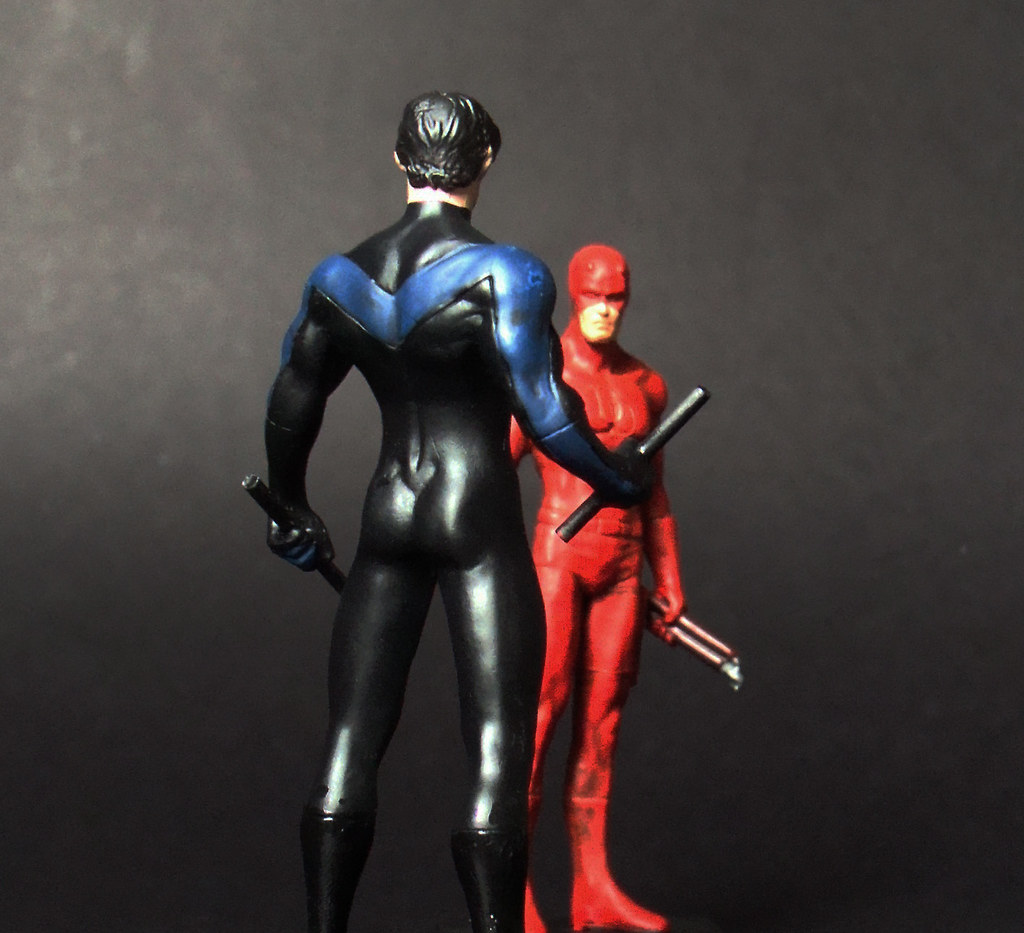
At Comic Vine, Gregg Katzman summarized last month’s discussion on the all-important question: Who would win in a fight, Nightwing or Daredevil?

Even current Nightwing scripter Kyle Higgins weighed in:
In my opinion, it all depends on how quick (if at all) Nightwing can figure out that Daredevil relies on heightened senses/radar. If he can deduce that, he’s a few gadgets away from screwing with DD’s navigation system enough to make it a fight. Of course, there’s also the variable of “what kind of mood is Mark Waid in while he’s writing this” (come on, is there ANYONE else you’d rather see write this fight?!?). I’m pretty sure he could come up with sixteen clever ways to take down either character without the other breaking a sweat.
Higgins’s comment acknowledges the dirty little secret of superhero battles: the fix is always in. The outcome of the fight depends on what’s necessary for a compelling, satisfying narrative. Early in a story, we’ve seen the Condiment King take down Robin and Black Canary together. But at the end of a rousing tale, and given the right circumstances, Jason Todd can conquer Mongul.

Adding fan popularity to the question further complicates the issue. In 1996 DC and Marvel collaborated on a miniseries that pitted a number of their brands against each other. The outcome of the major battles was determined in advance by readers’ votes. That resulted in the extremely popular Wolverine and Spider-Man beating the extremely powerful Lobo and Superboy.

That miniseries didn’t include Nightwing or Daredevil, but it did feature Tim Drake as Robin. He was set against Jubilee, a young mutant in the X-Men who could generate fireworks. Despite having no powers, Tim sneakily managed to pin Jubilee down without hitting her (he has trouble hitting girls), and they ended up making out, thus satisfying nearly all readers. Simpler times.

(Photo at top by Osvaldo Eaf 2, via Flickr.)

16 May 2009

Wolverine Meets Wimpy Kid—Who Would Win?

A while back, Graphic Novel Reporter ran a preview of Wolverine: Worst Day Ever, written by Barry Lyga and illustrated by various Marvel Comics artists.

The website called the book a “graphic novel,” which prompted a visitor [okay, it was me] to comment:

I'm glad to see Barry Lyga getting work. But why is Wolverine: Worst Day Ever being described as a “a YA graphic novel”? It's an illustrated story which uses very little of the comics format. And are the illustrations original to this project or repurposed?
When GNR went back to review the book, it answered those questions:
Wolverine: Worst Day Ever is close to being a prose work itself. It uses the blog format to advance its story, combined with archive images of Wolverine that have appeared in comics throughout the years. So while not technically a graphic novel per se, it has several of the elements (not least of which is one of the most popular characters to ever appear in comics).
And the book was scheduled, I suspect, to appear alongside this spring's Wolverine movie.

Lyga, former employee of the Diamond comics distribution monopoly and award-winning YA novelist, seems like a good choice to bridge the worlds of superheroes and YA prose fiction. And he understands that Wolverine: Worst Day Ever isn't a graphic novel. In an interview at Comic Book Resources Lyga discussed how his text interacts with the artwork:
In the Wimpy Kid books [by Jeff Kinney], the artwork is sort of seamlessly integrated into the text as an essential part of the story. You can't remove the art and have a coherent story, really. In that sense, they are sort of prototype graphic novels, in a way, with the art conveying story points.

With Worst Day Ever, my original thought was that the artwork would stand alone, on separate pages, like a traditional illustrated novel. But a couple of things happened. First of all, some of the art just SCREAMED for snarky captions in [the narrator] Eric's voice, and I got carried away. Next thing you knew, I was writing captions for every piece of art, not just a few.

And then, secondly, Marvel's designer made the artwork blend with the text in a very natural way, not on separate pages, but actually with the text, so that the art sort of comments on the text. Which actually makes sense--the book is supposed to be a blog, and on blogs, art co-exists with text. So it's a very organic and sensible decision. Her name is Spring [Hoteling], and she's done a great job designing the book.

That said, unlike in Wimpy Kid, if you removed the art, you would still have a complete story. It might not be quite as funny, but it would still be a complete story. I'm not 100% sure that's the case with Wimpy Kid--I think you'd lose more than mood or atmosphere if you yanked the art.
I wasn't so sure; Wimpy Kid was first written with much less art. But at least everyone agrees that just because a book contains lots of pictures--even cartoons or drawings of superheroes--that doesn't make it a "graphic novel."