Showing posts with label my first and last post about videogames. Show all posts

19 November 2015

When Nate Wright Met Greg Heffley

Yesterday’s post left aspiring comic-strip artist Jeff Kinney working at an online “edutainment” company while corresponding with full-time comic-strip artist Lincoln Peirce.

As I described back here, Kinney’s employer saw some potential in a middle-grade novel in diary form that he was working on. At his boss’s suggestion, he added more illustrations and shared the novel day by day on the company’s website.

That story found a young online audience quickly, a book deal only after a couple of years. That was the start of the huge Diary of a Wimpy Kid phenomenon, now stronger than ever.

Kinney continued to work at that company until relatively recently, overseeing the launch of Poptropica. That online videogame platform is built around “islands,” each having its own game and style. Kinney asked his friend Peirce if he was interested in licensing the Big Nate comic strip to the site.

In 2010 the Washington Post reported what happened:
On Valentine's Day last year, Poptropica launched "Big Nate Island," the interactive world of sixth-grader Nate Wright and his adventures as a "self-described genius" and "all-time record-holder for detentions in school history."

Kids went wild. "All I remember is that Jeff called me after the first 48 hours and said: 'You crashed the server,' " Peirce recalls. "It was their biggest launch by 20 percent."

The sudden online popularity of "Big Nate" led to Peirce's long-sought major book deal, with no less than HarperCollins. "Big Nate: In a Class by Himself" just spent 11 straight weeks on the New York Times bestseller list.
That first Big Nate book series is one of many modeled on Diary of a Wimpy Kid: prose with lots of line art, paper-over-board covers, humorous slice-of-life stories, and so on. Its success prompted the comic strip’s syndicate to finally issue Big Nate comics collections. Meaning that after years of having no books and a daily deadline, Lincoln Peirce had two fast-selling book series and an audience beyond newsprint.

And all because he’d been nice enough to write back to an aspiring young college artist. It’s almost as if this publishing story has a moral.

28 April 2014

Going Online to Act Out Stereotypes?

From Jesse Singal’s interview with Ubisoft research engineer Nick Yee in the Boston Globe:
We start off by asking players what they thought men and women stereotypically prefer to do in these games, and...people, both men and women, strongly stereotype female players as preferring supportive roles in the game, that female players prefer to heal [rather than fight]....

We actually had access to “World of Warcraft”’s server data....We had thousands of players fill out surveys. We knew what their gender was in real life. We went and grabbed their data in “World of Warcraft,” and we found that that stereotype was false, that men and women actually heal about the same amount in “World of Warcraft.”

Where there was a finding was in the avatar gender. Female avatars heal more than male avatars, and the effect was entirely driven by gender-bending [playing a character of the opposite gender]. When men gender-bend, they play a female character, they heal more, and when women gender-bend, when they play a male character, they heal less. So, again, we have this notion of virtual worlds allowing us to transcend kind of our social categories and social norms in the real world. But what’s happening is that there’s a stereotype. It turns out to be false, but via play, we create this virtual world where women do appear to prefer to heal, where via play, this false stereotype becomes true.
Yee’s new book about videogames and virtual worlds is The Proteus Paradox.

29 December 2013

Young Justice Time

Last month the Nerdy Show podcast interviewed the creators of the Young Justice TV show, Greg Weisman and Brandon Vietti, on the release of a videogame tied to the show.

That game is set between the TV show’s two seasons, which take place five years apart—one of the striking ways this cartoon used narrative time. In addition, each episode and each sequence have precise stamps of time and place (which Weisman and Vietti said proved to be a real headache), and the companion comic book had to fit into the same timeline.

In the interview Weisman explained how showing the passage of time was integral to the show’s main themes and narrative:
We felt that we were doing a show about growing up, gaining responsibility, gaining powers, gaining experience. . . . The first season takes place over six cohesive months, from July 4 to January 1, and our second season, and this was always the plan, takes places from Jan 1 to July 4, so it’s six months cohesive as well. . . . So in one sense we were always doing “a year in the life,” it’s just that half the year took place five years ago.

In order to tell a story about growing up…and the life of a teenager in particular, you just can't show that in six months or even in one year. And so if you’re going to show how Robin has evolved, or rather what I should say is Dick Grayson has evolved, then we want to see him as Robin in season one and Nightwing in season two. [We want to see him] advance from being an incredibly competent but still relatively immature thirteen-year-old kid to being a leader. You’re not to going to see that over the period of six months. . . . You needed to see him become Nightwing, you needed to see him become a true sort of heir to Batman, whether he wanted to or not, and that meant jumping. So it made the time jump somewhat inevitable. And I don’t just mean Dick Grayson, it was true of Wally West and Artemis and everyone who was a lead in season one—we really wanted to see…how they grew.

And so the time jump, I’m not saying it was planned from moment one, but it was something that we talked about from really early on in the development of the show, and certainly by the time we were in…preproduction of season one we knew we were going to do the time jump for season two—assuming we got a season two.
The show never got a season three, so we don’t know what Weisman and Vietti might have had planned for that season’s timeframe.

Both Weisman and Vietti are working on new projects. For Weisman, one is a new series of novels about a teen-aged girl in the Caribbean, starting with Rain of the Ghosts.

28 December 2013

What “Young Justice: Legacy” Says About Dick Grayson

In the new Young Justice: Legacy videogame, both Dick Grayson as Nightwing and Tim Drake as Robin are playable characters. The game’s story is set in year three of this continuity’s timeline, meaning Dick must have become Nightwing relatively soon after the events of the TV show’s first season. However, it doesn’t look like we see that transition.

In this compilation of scenes linking game play, Nightwing is uncharacteristically quiet. I suspect that voice actor Jesse McCartney was unavailable to record lines for the game.

Instead, the character at the center of the story appears to be Artemis, and the main antagonist is her sister. Thus, even though seven of the twelve playable heroes are male, the central characters are female. That would be refreshing except for what it hints about which voice actors were underemployed.

I should acknowledge that these remarks aren’t based on, like, playing the game. Anyone who has actual experience in that arena is welcome to add better comments.

23 November 2013

Grayson: Haly Origins Trailer

On his latest “Fatman on Batman” podcast, Kevin Smith led Paul Dini into rapture over the preview for the Batman: Arkham Origins videogame. In a short series of animated scenes, the “trailer” traces the early life of Bruce Wayne from happy spoiled kid to Dark Knight.

That got me wondering what the equivalent might be for Dick Grayson. Right away I decided that a wordless video about Dick would require more movement. And this is the series of shots I came up with.

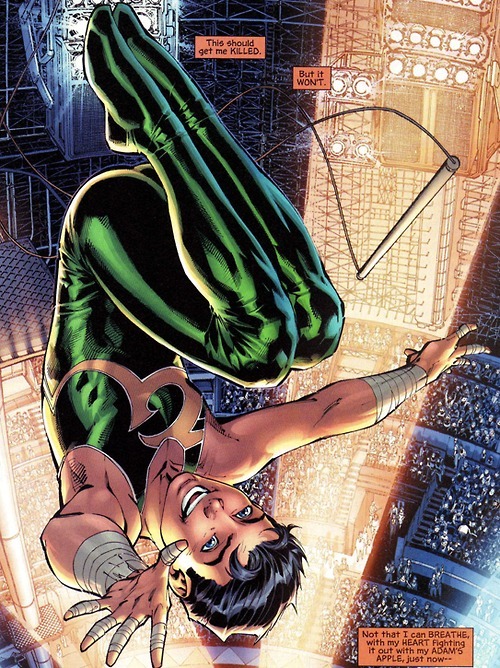
1) A fanfare from a pipe organ. Bright lights illuminate the back of a preteen boy’s head and shoulders: black hair combed and sprayed into barely acceptable neatness. The boy leaps up and forward, then plunges down and straight away from us viewers on a trapeze, swinging in an arc up and out of sight in the distance.

2) As the boy is off screen for two or three second, the pumping music is drowned out by oohs and ahhs and applause. The boy comes swinging back toward us, face front and grinning infectiously, and comes to a halt in the foreground where he began.

3) The boy moves out of the frame to the left, and a woman’s back appears from the right. She, too, swings down and then up and out of sight on the trapeze.

4) The music suddenly cuts off and the crowd gasps. The trapeze swings back into the foreground, empty with one rope broken. The bright lights fade as the broken trapeze swings away again. There is one second too long of emptiness.

5) From the distance the Batman swings down on his rope and up into the foreground. He comes to rest and moves out of the frame to the right.

6) The boy’s head appears again, his hair not so tamed and his shoulders now draped in yellow. Batman and Robin swing away into the distance on twin ropes.

7) Batman and Robin swing back into the foreground in parallel arcs. Batman now has a yellow oval around his chest emblem. Dick is a year older and smiling as before.

That’s enough for an origin. But in the interest of completeness and loyalty to the pre-New52 universe:

8) Batman and Robin swing into the distance. Robin is another few inches taller. Swinging slightly behind Batman, he takes advantage of the privacy to curl upside-down on his rope.

9) Batman and Robin swing back into the foreground on their ropes. Batman is serious. Robin, now in his mid-teens, looks grumpy.

10) The teenaged Robin swings away, alone.

11) Robin the Teen Wonder swings back, once again smiling, flanked by Wonder Girl and Starfire in flight.

12) Dressed in a high-collar outfit with light blue highlights, Dick as Nightwing kisses Starfire as she carries him into the distance.

13) Encouraging a new, pants-wearing, and not quite as graceful Robin swinging forward on the rope, Nightwing glides in from the distance, using the aerodynamics of a new outfit with yellow highlights and wings and an unfortunate haircut.

14) Nightwing swings away to the distance, now handsomely coiffed and in a sheer black outfit with blue highlights all the way down his arms. Another second passes.

15) Batman swings in from the distance, coming to rest in the foreground as in shot #5. At the last instant, Batman cracks the same smile as the preteen boy in shot #2.

12 June 2013

What’s New in DC’s New Digital Formats?

Wired reports on two digital storytelling techniques that DC Comics is touting this month. First up:
“DC2, which will feature “dynamic artwork” that unfolds as the reader taps on the screen. . . . Rather than flipping through pages, readers will “tap on the screen to bring the next element of the story to life, whether it’s a whole panel, or a word balloon or a sound effect,” DC Entertainment Co-Publisher Jim Lee told Wired. “What’s cool is that you really get to challenge the rules of traditional storytelling. You aren’t beholden to a strict left to right western culture narrative. You can have elements that leap back and forth.”
“Dynamic artwork” is making its debut in a comics adaptation of the 1960s Batman TV show. So I expect it will let readers make sound effects that say “POW!” and “BAM!” pop up over the art, amplifying the campiness those comics are probably seeking to replicate. But that wouldn’t really “challenge the rules of traditional storytelling.” Will it do anything else?

Already Mark Waid, John Rogers, and colleagues at Thrillbent.com have been exploring how to employ the technique of changes within a panel in a digital comic. Their storytelling remains sequential, but tapping to bring up new elements can move the story forward at a deliberate pace or draw our attention to particular details. It’s not a gimmick like the the picture-book apps where the young reader can poke around for an element on each page that moves or makes sounds.

DC’s other proclaimed innovation is “DC2 Multiverse, a choose-your-own-path format that will allow users to make decisions at key points that will unlock different storylines.” That seems like an actual challenge to traditional storytelling since it might affect character choices and endings—an author’s basic prerogatives. It’s no surprise that the tryout title for that format is a videogame tie-in, an entertainment medium that’s all about branching storylines.

15 January 2013

Become a Munchkinland Mogul

Last fall Spooky Cool Labs released a Warner Bros.–licensed Wizard of Oz game on Facebook. I, of course, haven’t played it. And even though several of my Facebook friends come from the world of Oz scholarship, I haven’t seen a lot of notifications about “Jenny has killed two Kalidahs!” or the like. Maybe I finally figured out how to work my settings correctly.

I therefore turned to Peter Davison’s review at Inside Social Games for more information. The game uses images, sounds, and footage from the 1939 movie, and the sight of Munchkinland above suggests it also owes something to McDonaldland (and thus to Sid & Marty Krofft).

Davison explains the gameplay this way:
Dorothy…meets Glinda the Good Witch of the North and discovers her quest to follow the Yellow Brick Road and make her way to Emerald City. Thus, most players would probably expect some sort of adventure/role-playing game experience, with players taking control of Dorothy (and later her companions) as they attempt to make the perilous but colorful journey.

Instead what we get is a title that is rather similar to CityVille at first glance. A very well-presented CityVille-alike, yes, and one with a few surprises up its sleeve, but a CityVille-alike nonetheless.

The player’s time in The Wizard of Oz is spent primarily rebuilding Munchkinland by constructing houses and resource-gathering buildings. More houses mean a higher population of Munchkins, who can subsequently be assigned to the production buildings in order to generate the resources required to continue building.
That doesn’t seem much in the spirit of either the movie or L. Frank Baum’s books. The latter eventually proclaimed that Oz was a moneyless economy with everything owned by Princess Ozma and distributed free on the basis of need—a system that no doubt works better in a land where bread and shoes grow on trees.

But social-media games have to make money in this world. Not only is the key to success in this Oz harnessing the work of little people, but players can use real money to buy emeralds that work as Ozian currency and speed up the process.

06 October 2012

SideScrolling Through Life

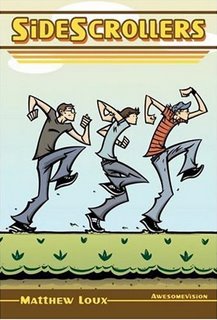
When I first read that Matthew Loux’s SideScrollers had been challenged as a title on a high school’s summer reading list for incoming freshmen, my response was:

Who in the world put SideScrollers on a summer reading list?! Bwahahahahaha!

As Loux just told the National Coalition Against Censorship:
SideScrollers was inspired by my own slackerish social life when I was a teen, hanging out with friends during the summers after high school and college. In retrospect it was a great time of very little responsibility or expectations allowing the freedom to work at a crappy job and use the money earned on snacks, toys, and video games.
In sum, SideScrollers is the absolute antithesis of the summer reading list.

This is a story about lazing around and doing nothing productive. By dint of great effort, followed by mortal necessity, the heroes manage to save a girl from date rape and stand up to bullies. But most of the time their level of motivation is half a step above the self-preservation instinct of sea slugs.

Evidently one Enfield, Connecticut, parent objected to the book’s blue language. And yes, one parent shouldn’t be able to dictate an educator’s choice of reading possibilities for an entire class, especially when the list offered plenty of other books to choose from. But I have a hard time believing that educator had actually read SideScrollers before assigning it. (Loux has become better known for his Salt Water Taffy series for younger readers.)

Assigning SideScrollers as summer reading goes against its very nature. It’s the sort of book that should be recommended with a sly sidelong whisper: “Hey, kid, are you that bored? You want some mindless fun?” And then the young folk might learn something.

Fortunately, the local TV station reported:
The book has become very popular among young readers and there is a wait at the library and local bookstores to purchase or borrow it.

However, SideScrollers will not be on next year's summer reading list, [school superintendent] Schumann said.

16 August 2012

My First and Last Radio Interview about Videogames

This week WBUR, a leading public radio station here in Boston, invited me on the air to talk about a videogame.

Given my vast ignorance of that entertainment form, I must explain that the game was the upcoming Assassin’s Creed III, and the station asked me how accurately it depicted pre-Revolutionary Boston.

You can listen to the well-edited conversation here while enjoying the preview video from UbiSoft that we refer to.

27 December 2011

Oz on the iPad

One of my gifts this holiday/birthday season was an iPad, and one of my first apps purchased for that iPad was Oz, created by Boluga.

The text is an abridgment of L. Frank Baum’s Wonderful Wizard of Oz, and the aesthetic is derived from W. W. Denslow’s illustrations. Not as they originally appeared, though, since the “pages” have also been digitally aged and dusted with grime for a “classic” look. In addition, key phrases are enlarged and laid diagonally on many screens, especially those with no art. As I noted before, Denslow’s thick-line cartooning adapts well to this format.

Kirkus found that shortening the text removed a lot of Baum’s charm. Knowing the story already, I didn’t pay much attention to that, but I agree that a lot of Baum’s strength as a storyteller—his ability to create a verisimilitudinous fairyland through respect for individual characters and quotidian detail—appears in passages unnecessary for the plot and therefore likely to be the first to go.

Some of the screens have interactive elements, but I found them inconsistent. From one page to the next, the art can:
  • do nothing but look pretty. It’s possible to spot these by the lack of a circular icon in the upper right corner. 
  • come with animation, music, or other sounds, but (aside from rerunning the screen by hitting that icon) there’s nothing for readers to do. This is how the Wicked Witches die, for example.
  • let readers play with visual elements, though to no clear purpose. I don’t know why one is supposed to knock down the Soldier with the Green Whiskers’s gun. One can fill the poppy field with poppies drifting snowglobe-style from the sky, which is kind of pretty, but it doesn’t seem to grow from the story. 
  • allow readers to be part of the story by, say, taking the Scarecrow off his pole or putting the heart in the Tin Woodman. These screens are, of course, the most fun. But Kirkus complains that such games and puzzles require too much fine-motor control for the app’s intended audience. I must admit I still haven’t got the Guardian of the Gates’s key into the lock—I’d actually decided it didn’t belong there.
Not being able to distinguish one type of interaction from another was also a little frustrating. For example, after Mr. Joker, the clown in the China Country, shatters into dozens of pieces, I kept trying to reassemble him. But I think he’s a lost cause.

Perhaps a version 2.0 will fix those frustrations. But honestly, for 99¢, Oz was a fine way to learn some of the tricks of my iPad while revisiting some familiar faces and places. I was more than satisfied.

Incidentally, I noticed only one sign of the MGM movie’s influence on this version: when the Tin Woodman’s heart goes into his chest, it starts to tick. All the other details are from the book.

17 August 2010

Had to Find Other Ways to Waste My Time

Despite my birthdate, I’ve never gotten into video games. At least, not since I enjoyed a simple Star Trek game that worked like Battleship with photon torpedos. That was in the late 1970s, I believe; my mom was bringing home an early Apple with a shoebox modem to work on her second bachelor’s.

Once that fun was over, however, I never spent an afternoon loading quarters into an arcade machine. I never owned any home system. I helped a friend get through one challenge in Myst, and then lost interest. I like sudoku and solitaire on my handheld, but those are simply paperless versions of the original.

Last month Godson showed me a version of Lego Batman on a handheld device. The particular challenge engrossing him at that moment involved running around Wayne Manor hitting things so they turned into checkers pieces. (I suppose those are Lego coins.) Robin tagged along, every so often hopping back out of Batman’s way. I silently lamented the lack of character development.

Given all that, I might seem like a poor candidate to enjoy Bryan Lee O’Malley’s Scott Pilgrim series and the new movie adaptation. Those stories reflect the outlook of a young man whose view has been colored by videogame pixels, so he thinks of life in character ratings (“awesome”), challenge levels, fights, and prizes.

But the details of Scott’s worldview aren’t hard to figure out. And its fundamentals are similar what we see in the story of Walter Mitty, Catherine Morland, or Don Quixote. All those characters try to view their worlds through the screen of some shiny, scary new storytelling form. And their basic narrative journeys all involve discovering what’s real about life, and what’s real about themselves. The rest is detail.

29 May 2010

Can Publishers Think This Sneakily?

Yesterday I contemplated how series publishers are finally formalizing the distribution of small snatches of fiction in digital form as appetizers for longer series. But, I noted, the fear of book piracy remains strong. Angelophile reported thusly on the Bristol International Comics Expo’s panel discussion of digital comics, and the challenge of pirated copies:

Kieron Gillen [of Phonogram] then talked about piracy again and mentioned one developer in the games industry, who, recognizing in advance that their game was likely to be pirated, deliberately leaked a version onto torrent sites.

However, they'd built into the version that it used a certain server for all online peer-to-peer multiplayer games. So every now and again, they'd simply turn off that server, frustrating the users enough that they'd then go out and buy the legal version of the game, then after a while, [the company would] turn on P2P play again.
Because by that time, of course, many of those underground users had been hooked.

Can we imagine an equivalent for electronic publishing? For instance, every digital edition of a book (especially in a series) could contain a link to a dedicated discussion site with extras from the author, but the versions secretly released to torrent sites all feed through a balky server. Hmmm.

26 April 2010

Seeking Clues to the Future of Storytelling

Earlier this month, Publishers Weekly reported on the ashbound London Book Fair’s panel discussion on digital books for children, and I was particularly interested in the comments of author Naomi Alderman:

Alderman suggested that the industry really needs new nomenclature for this digital medium. Neither “book” nor “game” is quite apt to describe something like Alderman’s The Winter House, an online short story, with visuals by Jey Biddulph, that is both linear and interactive. Trying to pigeonhole evolving technological developments doesn’t do justice to the work or honor the medium it is being lumped in with, Alderman reasoned.

For Alderman, new media is exciting, not something that compromises traditional and beloved forms of storytelling. “I hear a lot of fear from writers and publishers, but there are a lot of amazing things you can do onscreen that you can’t do on the page,” she said. Digitized books create new roles between writers, designers, illustrators, and publishers—all of these parties want to tell stories, and with this shared desire at the heart, their collaboration can have compelling results thanks to the fusion of different skills, she added.

Alderman feels that the best use of these new methodologies is “something native to the format,” saying that to attempt a transposition of what already exists won’t do it justice outside of the way it was conceived. Adapting traditional imagery is not always possible onscreen, she said, or even necessarily desirable. Digital books are still in an interim period where creativity can be stretched, but a balance between what is commercially viable with what experimental methods could bring has yet to be established.
I visited The Winter House, and three things struck me:
  • Though the story has undeniable graphic and sonic dimensions, words are the crucial, driving element.
  • The tale has quite a feminist underpinning.
  • I had to restart twice because the animation got stuck at different places, and could find no way to jump in at a particular spot (though I could avoid unnecessary loops in the algorithm).
For the “Divided by a Common Language” category, I note that the “About” section of the website suggests students can try to create their “own Cluedo-inspired board game.” In North America, we call that game Clue.

(The picture above shows a ”modernised” Cluedo layout by the DKPM design firm.)

16 November 2009

“It’s Really About Language.”

Last week I read a short news item in a great metropolitan daily that puzzled me so much I went to the original report in the Salem (Massachusetts) News for more detail.

I found it, but the story only deepened the mystery:

Danvers High parents recently got an automated call from the principal warning them that if students say or display the word “meep” at school, they could face suspension. . . .

Murray did not elaborate on how the students were acting out. But he did say the phone call home was an attempt to head off a disruption being planned on the social networking Web site Facebook.

The disruption never happened, and Murray credited students for heeding his warning.

Murray said the school must react when online activity crosses paths with the school day. To that end, some students — Murray did not say how many — were suspended, but there were additional factors involved in their suspension unrelated to simply saying “meep.” . . .

Murray said students were not using the term to harass another student or a teacher.

“It’s really about language and conduct,” Murray said. “For me, it boils down to respectful conduct.”

It’s unclear what meaning “meep” has, other than it is a popular thing for kids to say when they are at a loss for something to say, according to various Web sites.

A group on Facebook called Meep has 370 members, for instance, and lists three Danvers High students as members. . . . Entries for the word “meep” in the online Urban Dictionary include “ouch,” “uh-oh,” a substitution for a swear word, a greeting, an exclamation or ”a random expression of happiness used to fill gaps in conversation.”

Some Danvers High students said yesterday they were not sure what “meep” means. . . . One student said nearly all the students think the whole thing is ridiculous.

Murray said the matter should be a wake-up call to parents about how kids are using social networking sites.
That’s so much clearer, isn’t it? And obviously we should blame Facebook because…it’s new relatively technology that we don’t understand so well.

This must have been a curious article for reporter Ethan Forman to write. He obviously asked the principal what the trouble was (“Were kids using this word to tease someone?”), and got no useful answer. He talked to high school students, and none of them could offer much. He looked up the word online, and found nothing. You know a journalism job isn’t going well when you’re reduced to scrounging in Urban Dictionary.

The principal declined to talk to National Public Radio later in the week, but the network was able to track down a student in the thick of things who explained the meaning (none) and derivation (videogames) of “meep.” Meanwhile, that Facebook group grew to over 1,000 members by Saturday.

29 September 2009

The Psychological Distance of Noninteractive Media

Seth Schiesel sat down to review a slam-bang-punch-’em-out videogame for the New York Times. He ended up having to consider the differences in how stories differ from interactive entertainment in the psychological distance they offer consumers.

Schiesel’s review lays out the premise of the game Marvel: Ultimate Alliance 2:

In a panic, Congress passes and the president signs the Superhero Registration Act, requiring all heroes to submit to government oversight and monitoring. The fearful public approves.

And so the heroes are split between the pro-registration loyalists led by Iron Man, who believe that submitting to the government will increase security, and the anti-registration rebels led by Captain America, who believe that the act is fundamentally, uh, un-American.

You, the player, must choose a side. . . .

This story arc, known as Civil War, was first explored in a series of print Marvel comic books written by Mark Millar a few years ago. I’m not a comic-book expert, but after playing Ultimate Alliance 2 I read the main Civil War books. What I found was a nuanced, probing examination of the interplay between freedom and security that has always defined Americans’ discussion of civil liberties. . . .

Noninteractive media like books and movies allow the viewer some psychological distance from the characters. That sense of remove is a big part of how linear media can explore complex topics of morality: by depicting characters you are not expected to agree with, but merely understand. Great tragedies, after all, are propelled by characters who believe they are doing the right thing, not those trying to be villains.

For instance, a depiction of the psychological struggle of a Nazi soldier as he tries to reconcile his genuine patriotism with a realization that he is serving an evil regime could make a great novel. Books and films are filled with poignant characters who believe they have to do the wrong thing for the right reason. In a civil liberties plot like Marvel’s Civil War, the noninteractivity of print may allow readers to empathize more easily with the motivations of a character they disagree with.

But a game forces the player to occupy a character. That psychological distance is eliminated. And so the other side must be reduced merely to the Enemy. The story of that Nazi soldier would make a culturally uncomfortable, and politically impossible, video game because the player would probably have not merely to witness but also to act out the killing of Allied soldiers and possibly civilians.
One of the benefits of reading fiction, critics have long said, is that it allows us to experience other people’s lives for a time, increasing our understanding and empathy. But can there be too much empathy? Is that effect overwhelming when we’re not simply reading about someone, even reading that someone’s thoughts, but actually making decisions for him?

01 August 2009

Tweets

Last month, under gentle pressure from colleagues in children's books, I signed up for Twitter.

I still haven't figured out the nuances of "tweeting." TweetDeck appeared to slow down my computer, which is, I understand, the exact opposite of what that program's supposed to do. And I have a habit of following someone's link and then losing it to "RT/retweet" with credit. But I'm feeling a little more comfortable.

Here are most of my recent tweets pertinent to Oz and Ends, edited for format and clarity:

Background: I'd heard that both girls liked Twilight. So I hunted for other recent fantasies told from a first-person female point of view--with more female empowerment. Result: carsickness from reading too avidly. Score!
Result:
  • Least necessary apology: young British actor Jamie Waylett to "all HARRY POTTER fans". As if kids were seeking moral guidance from Crabbe.
  • "Folsom Pwison Bwues"? Five-year-old does Johnny Cash. Not well, but at all. [Original tip from Vast Public Indifference.]
  • Large but watery tom yum soup for lunch, followed by a blood donation. So I figure my fluid level is back to where I started.
  • Planned videogame of O'Malley's SCOTT PILGRIM comic makes sense: Fighting Ramona's 7 levels of ex-boyfriends is the only part of his life Scott can grasp.
  • "What kind of story are you looking for?" Editor Nielsen Hayden's real answer: "one I didn't know I was looking for."
  • Chuckled at bookseller Josie Leavitt on how kids handle cash.
More on that last topic way back here.

12 May 2009

Voices from the “World Voices” Festival

Last week Publishers Weekly ran several reports from the PEN "World Voices" literary festival in New York. I've gleaned bits that struck me, starting with a remark from a a session on “Visual Storytelling”:

The use of comics illustration, [Israeli artist David] Polonsky explained, to depict the narrative was apt because the “ability to show things that don’t have any material existence” corresponds to the volatility of memories.
Or, as I've been calling it, "showing the invisible."

And in another panel, on the future of children's books:
[Francine] Prose also recounted a story of speaking before a group of New York University students who questioned the need for reading when there are so many good interactive video games that let you “become the character.” In response, Prose said she told them, “The whole point of literature is reading about people who are not you, to get into someone else’s head.”
Indeed, while videogames let players experience many unusual situations, no matter where you go--there you are.

Finally, in a discussion of growing up, Shaun Tan recalled one influential book from his childhood:
Shaun Tan, who was raised in an Australian community that he fondly described as “idyllic yet boring,” explained how his mother, who wanted her two sons who receive a better education than she did, read Animal Farm aloud to Shaun and his brother, thinking that it was a children’s book. Tan said that he and his brother loved the story, as “it related to everything that went on at the playground every day”...

07 April 2009

I Think This One Would Be Named Thwack

Apparently another bunch of collegiate drunks have stolen another of the Make Way for Ducklings statues from Boston Common.

If events proceed according to pattern, there will be a minor public uproar, followed by a new casting from artist Nancy Schön, a restoration of the missing duckling, and quite possibly a sheepish anonymous return of a now-superfluous piece of bronze. (One time this happened, thieves returned the duckling they had stolen the time before.)

Meanwhile, Irvine, California, gets public art like this, from the campus of the Blizzard videogame company. I bet no frat boys lever this thing off the ground.

(Thanks to Acephalous.)

UPDATE: Pack is back.

13 February 2009

Just Enough Adventure

I own thousands of books. However, I'm close to 100% certain that Hsu and Chan: Too Much Adventure is the only one with this blurb on the front cover: "from the pages of Electronic Gaming Monthly." (I'd have to dig out that copy of Turgenev's Fathers and Children to be completely sure.)

Norm Scott's comic is about two brothers from eastern Ohio who produce shoddy videogames. When, that is, they aren't fighting off ancient demons, the Russian mafia, or rival game lords.

I don't play videogames, shoddy or not; they've never held much interest for me. As I understand it, the short Hsu and Chan comics that appear in Electronic Gaming Monthly have much more videogame content than this volume.

On the other hand, I haven't fought demons or Russians, peddled movie merchandise, or liberated carnival freaks, either. So I shouldn't relate to these adventures any more than the videogames. But this book had me quaking with laughter.

I first got a taste of Hsu and Chan in a "best graphic novels of the year (okay, the last eighteen months--so sue us)" volume from the library. Then I spent a couple of months asking comic-shop owners if they carried Hsu and Chan, which meant a couple of months of spelling out "Hsu." Finally I used the internets.

And I'm delighted I did. I won't claim that Norm Scott's sense of humor is a match for everyone, but it sure hit a chord with me. The only problem is that his lettering is small. Like, smaller than Laika.

There's a five-page preview of Hsu and Chan's next comical adventure here. A smaller-scale story here. A Hsu and Chan adventure from "2003, 2004-ish" here. Turgenev's Fathers and Children here.

17 November 2008

“The Cardinal Rule of Writing for Young Adults”

Last week Publishers Weekly ran a guest column by thirteen-year-old Max Leone on what teen-aged boys want to read. Young Mr. Leone actually has less experience as a teenager than Sarah Palin has as a governor, but he confidently tells us:

  • “To all writers of books aimed at teenage boys, I beg you: please use only modern language, no matter what time period or universe your book takes place in.”
  • Avoid “whatever urge compels writers to clumsily smash morals about fairness or honor or other cornball crap onto otherwise fine stories.”
  • “The vampire...as a menacing badass. That is the kind of book teenage boys want to read. Also good: books with videogame-style plots involving zombie attacks, alien attacks, robot attacks or any excuse to shoot something.”
  • “Finally, here is what I consider the cardinal rule of writing for young adults: Do Not Underestimate Your Audience.”
Except, it appears, if you’re asking that audience to read period or futuristic language, or plots much different from videogames. Got it.

Yeah, I'm being snarky. It's actually an interesting essay written with energy and fervor. And adolescence is large. It contains multitudes. Does it contradict itself? Very well then it contradicts itself.

(The picture above, from the New York Times, shows the young reader/gamer discussed here.)