Showing posts with label Mombi. Show all posts

05 December 2012

Glinda as a "respectable sorceress”

As I wrote yesterday, in The Marvelous Land of Oz (1904) L. Frank Baum started describing Glinda the Good as a “Sorceress” instead of a “Good Witch.” In later books he referred to her as “the Royal Sorceress” or “the Good Sorceress.” But Glinda wasn’t his first sorceress.

The first in Baum’s oeuvre was Maetta, a Glinda-like character in A New Wonderland, completed in the mid-1890s and finally published in early 1900. Three years later that book was republished as The Magical Monarch of Mo. The second sorceress was Gayelette, who created the Golden Cap that enslaved the Winged Monkeys at some unspecified time before the Wizard’s arrival in Oz.

The Wonderful Wizard of Oz mentions sorceresses elsewhere as well. The Good Witch of the North says, “In the civilized countries I believe there are no witches left, nor wizards, nor sorceresses, nor magicians.” The Munchkins keep calling Dorothy a sorceress because she’s killed the Witch of the East and taken her shoes, and because she wears white: “only witches and sorceresses wear white.”

Those statements suggest that “witch” and “sorceress” are similar, overlapping categories. But then there’s this remark early in The Marvelous Land of Oz:
Mombi was not exactly a Witch, because the Good Witch who ruled that part of the Land of Oz had forbidden any other Witch to exist in her dominions. So [she], however much she might aspire to working magic, realized it was unlawful to be more than a Sorceress, or at most a Wizardess.
That implies that a Wizardess was somehow superior to a Sorceress, and both inferior to a Witch.

However, later in that same book Glinda herself suggests that a major difference between a Sorceress and a Witch involves the type of magic each does:
“Really,” said the Sorceress, “that is beyond my magic. I never deal in transformations, for they are not honest, and no respectable sorceress likes to make things appear to be what they are not. Only unscrupulous witches use the art…”
That said, in Rinkitink in Oz (1916), Glinda disenchants a character without discussing such scruples. So it’s not that she can’t do transformations as a sorceress; with Mombi available to reverse her own spell, Glinda chooses not to.

Baum often has characters discuss different types of magic, as in Ozma’s remark to Dorothy in his last book, Glinda of Oz (published 1920):
“I am a more powerful fairy than any other inhabitant of Oz, I am not as powerful as Glinda the Sorceress, who has studied many arts of magic that I know nothing of. Even the little Wizard of Oz can do some things I am unable to accomplish, while I can accomplish things unknown to the Wizard. This is to explain that I’m not all-powerful, by any means. My magic is simply fairy magic, and not sorcery or wizardry.”
That novel also introduces a “krumbic witch,” who esoteric spells baffle even Glinda, and offers our second view of a “yookoohoo,” a magician who specializes in transformations.

Baum was not a consistent writer, and he never laid out all his different forms of magic and which type of magician was more powerful than another. If he had done so, he might well have contradicted that system a few books later when he had a better idea.

But one thing Baum was consistent about was that Glinda is the most powerful magician in Oz. That might imply that a Sorceress is more powerful than a Witch, but perhaps that particular Sorceress is simply more powerful than any Witch. In any event, if Glinda wants to call herself a Sorceress, not many people would dare to object.

30 May 2012

Reconciling with the Wizard of Oz

Yesterday I described a review of a latter-day Oz book by Hugh Pendexter III. Among Oz fans he’s best known for his short book Oz and the Three Witches, published in 1977. It was inspired by two contradictory passages that L. Frank Baum left us about the Wizard of Oz, the evil witch Mombi, and the baby princess Ozma.

First, near the end of The Marvelous Land of Oz (1904), Baum narrated Glinda the Good’s interrogation of Mombi this way:
“I will ask my first question: Why did the Wizard pay you three visits?”

“Because I would not come to him,” answered Mombi.

“That is no answer,” said Glinda, sternly. “Tell me the truth.” . . .

Mombi now saw how useless it was to try to deceive the Sorceress; so she said, meanwhile scowling at her defeat:

“The Wizard brought to me the girl Ozma, who was then no more than a baby, and begged me to conceal the child.”

“That is what I thought,” declared Glinda, calmly. ”What did he give you for thus serving him?”

“He taught me all the magical tricks he knew. Some were good tricks, and some were only frauds; but I have remained faithful to my promise [to hide] the Princess Ozma—the child brought to me by the Wizard who stole her father’s throne.“
Baum wrote that book because of the popularity of the 1902 stage extravaganza adapted from The Wonderful Wizard of Oz. That show used the Wizard as an antagonist, a charlatan and mountebank who had stolen the rightful king’s throne, and the book reflected that characterization.

But in Dorothy and the Wizard in Oz (1908), Baum brought the Wizard back as a capable and reliable protector for Dorothy. What happened when they reached the Emerald City and the Wizard met up with its new ruler, Princess Ozma? She asks him about his first arrival in Oz.
“At that time,” continued the Wizard, busily eating his soup while talking, “there were four separate countries in this Land, each one of the four being ruled by a Witch. But the people thought my power was greater than that of the Witches; and perhaps the Witches thought so too, for they never dared oppose me. I ordered the Emerald City to be built just where the four countries cornered together, and when it was completed I announced myself the Ruler of the Land of Oz. . . .”

“That is quite a history,” said Ozma; “but there is a little more history about the Land of Oz that you do not seem to understand—”
Aha—the J’accuse moment when Ozma confronts the Wizard with his misdeeds: “Do you remember the child you handed over to an evil crone? I, sir, was that little baby you sold into slavery!”

But no. She continues:
“Many years before you came here this Land was united under one Ruler, as it is now, and the Ruler’s name was always ‘Oz,’ which means in our language ‘Great and Good’; or, if the Ruler happened to be a woman, her name was always ‘Ozma.’ But once upon a time four Witches leagued together to depose the king and rule the four parts of the kingdom themselves; so when the Ruler, my grandfather, was hunting one day, one Wicked Witch named Mombi stole him and carried him away, keeping him a close prisoner. Then the Witches divided up the kingdom, and ruled the four parts of it until you came here. That was why the people were so glad to see you, and why they thought from your initials that you were their rightful ruler.”

“But, at that time,” said the Wizard, thoughtfully, “there were two Good Witches and two Wicked Witches ruling in the land.”

“Yes,” replied Ozma, “because a good Witch had conquered Mombi in the North and Glinda the Good had conquered the evil Witch in the South. But Mombi was still my grandfather’s jailor, and afterward my father’s jailor. When I was born she transformed me into a boy, hoping that no one would ever recognize me and know that I was the rightful Princess of the Land of Oz. But I escaped from her and am now the Ruler of my people.”

“I am very glad of that,” said the Wizard, “and hope you will consider me one of your most faithful and devoted subjects.”
And nothing more is said of kidnapping and baby-selling and other disagreeable subjects.

Ruth Plumly Thompson explored the history of Ozma’s father and Mombi in The Lost King of Oz (1925), but many gaps and inconsistencies remained. (Indeed, we haven’t even touched Baum’s later statement that Ozma was really a fairy left by a fairy queen in the far distant past.)

Pendexter’s Oz and the Three Witches picks up after the second conversation above as Glinda comes to the Emerald City to quiz the Wizard about the whole Ozma matter. The result is a lively little tale of the Wizard trying to fend off the Wicked Witches of East and West through his humbug illusions while navigating the tricky politics of pre-Dorothean Oz. He doesn’t realize who Mombi is, and he’s very, very sorry. All in all, it’s about as good a reconciliation of Baum’s contradictory statements as possible.

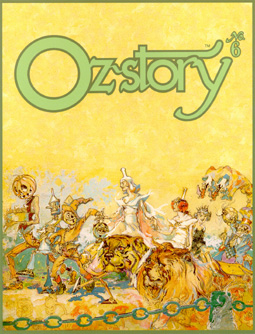
First published in 1977, Oz and the Three Witches was reprinted in its entirety with Patricia Ambrose’s quite competent illustrations in Oz-Story, #6.
