Showing posts with label ARTIST Tom Lyle. Show all posts

24 November 2019

Tom Lyle and the Robin Miniseries

In 1986 Tom Lyle, an aspiring comic-book artist in his thirties, went to a comics convention in Philadelphia. There he met Chuck Dixon, a young writer who was scripting Air Boy for Eclipse. Based on Lyle’s samples, Dixon got him the job of penciler on a related title, Sky Wolf. In a chat with Comics Interview magazine, Lyle credited that as “the event that triggered my career” in comics.

Lyle was recruited by DC Comics to draw Starman in 1988. After a couple of years, as he was wrapping up that assignment, Lyle asked Batman group editor Dennis O’Neil if he had any openings. O’Neil was planning a miniseries focusing the newly created Robin, Tim Drake.

“I’ve never been real thrilled with the Robins,” Lyle told his interviewer. “Dick Grayson, the original Robin, I couldn’t have given a flip about when I was a kid; it was like, ‘Get out of the way, kid, I want to see Batman.” But a job was a job.

O’Neil’s team wanted to make Robin into a martial-arts expert, so they needed a writer who understood the martial arts. Lyle suggested Dixon. He got the assignment and went on to be DC’s most productive writer of the decade. (On the occasion of his 40,000th comics page in 2017, Bleeding Cool noted Dixon wrote 106 issues of Robin, 89 issues of Detective Comics, 77 issues of Nightwing, 46 issues of Birds Of Prey, and 22 issues of Catwoman, to name a few.)

Dixon and Lyle’s first issue of the first Robin series carried a cover date of January 1991. The character of Tim Drake had been created by Marv Wolfman in issues drawn by George Pérez, Jim Aparo, and Norm Breyfogle, and his costume was designed by Neal Adams. But Dixon and Lyle’s portrayal fleshed him out by showing him on his own. Lyle was especially good at portraying Tim as a thirteen-year-old, lithe but not a powerhouse, the littlest guy in the fight who needed to think harder than anyone else to stay alive.

In the gritty, pouched, and overpumped 1990s, Robin was the equivalent of counterprogramming on broadcast television—standing out by doing something different. And it worked. According to Lyle, DC expected to sell about 200,000 copies of the first issue of the Robin miniseries. Instead, it sold three times that number.

DC asked the Dixon-Lyle team for a second miniseries about Tim Drake going up against the Joker, issued at the end of 1991. Then came a third, featuring the character the Huntress for an interesting contrast. That was the height of the speculative boom, and those magazines are festooned with holograms and other gimmicks.

Dixon and Lyle also collaborated on issues of Batman and Detective Comics showing Batman and Robin together. One of those magazines introduced Stephanie Brown as the Spoiler, who went on to become Tim Drake’s love interest, a fan favorite, and eventually Robin and Batgirl herself for limited periods. Lyle was also the artist for the first Robin Annual and the 1992 public service ad in which Tim decides to learn the facts about AIDS.

During that time, Lyle also plotted and penciled the early issues of The Comet for DC’s Impact imprint. In 1993 he started working for Marvel Comics on Spider-Man stories. That same year, DC launched the Robin monthly series with Dixon as regular scripter.

After another ten years or so, Lyle left monthly comics to become an art teacher at the Savannah College of Art and Design. Earlier this year he suffered an aneurysm, and last week he died, aged 66. Friends and fans have set up a Go Fund Me page for his family.

22 September 2013

The Good Old Days with Mike W. Barr

Comics Alliance has run a wide-ranging conversation between columnist Chris Sims and Mike W. Barr, who scripted many Batman and Robin stories in the 1980s and recently returned to those characters with a story for DC’s digital-first, out-of-continuity Legends of the Dark Knight series.

As I discussed back here, that story reads like a throwback to the pre-Crisis Batman, perhaps even to the 1960s television Batman. Indeed, Barr says he was aiming for a retro feel, even inventing a new villain who seems to be a very old one. As for Robin:

I’d written the first episode with basically the Jason Todd Robin, and [artist] Tom [Lyle] obviously feels more comfortable with the Tim Drake Robin, which is fine, because he co-created the character. I said “Sure, I have no problem with that whatsoever, whatever Tom is comfortable with,” so we used Tim Drake for the rest of the story. And it worked out fine. As [editor] Hank [Kanalz] pointed out, there are some differences between the personalities of the characters, which we were able to use in the second chapter. Tim is a different character than Jason, and that’s reflected in the story.
But that’s also why the Robin in the first of the three installment reads like smart-mouthed Jason, and why the verbal clues indicating he’s Tim don’t show up until the later installments.

Another striking aspect of the interview is how much freedom Dennis O’Neil allowed his writers and artists when he was editing DC’s Batman line from 1986 to 2000. Early in that period Max Allan Collins and Jim Starlin were making Jason Todd an angrier character with a grittier background, but Barr continued to write Jason as a happy young sidekick facing off against old Batman villains. “Denny O’Neil was always open to those kinds of stories, as long as you set up what was going on,” says Barr.

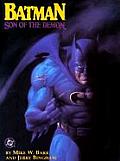
Furthermore, when it came to Son of the Demon, Barr’s graphic novel with Jerry Bingham:
MWB: The graphic novel took a fair amount of time to come about, because it was such a long story. Denny O’Neil was actually not involved in that as the editor. Dick Giordano was the editor, and it was in the pipe by the time Denny and I were doing Detective, I believe. I always told Denny, “You should look into this because I guarantee you’re going to want to know what’s happening in this story,” but I don’t think he ever did until someone pretty much handed him a Xeroxed copy of the finished book and what was in there.

CA: What was his reaction?

MWB: I don’t know, because he never told me. I have heard stories, and this is hearsay, I’ll admit, but I’ve heard it from a number of sources, that Denny very much disapproved of what I’d done with Batman and Talia. Not only getting them married, which was done as a sequel to one of his stories, but also having a child, which he had absolutely forbidden.
Evidently O’Neil kept himself from criticizing Barr’s story (and his mentor Giordano’s work as editor) even when he “very much disapproved” of how it had used Talia, a character he had co-created. O’Neil would have had the company on his side; according to Barr, “Warner executives” disliked Batman having a child with one of his villains so much that:
[DC publisher] Jenette Kahn herself called me and told me that if that child ever appeared again in a story, she would be fired. I don’t know how much of that I believe, even to this day, but basically we were told to never use that child ever again, he does not exist in continuity anymore.
(Almost two decades later, Barr’s story was the inspiration for Grant Morrison’s saga of Damian Wayne.)

Even today, it appears, Denny O’Neil still hasn’t told Barr that he shouldn’t have told the story he wanted to tell. As an editor, his philosophy was to give his creators room to create, and the results include some of the most popular modern Batman sagas, such as Knightfall and No Man’s Land. Given all the stories coming out of DC Comics today about the in-house staff vetoing storylines in the works, O’Neil’s editorial example seems even more striking.

01 September 2013

Elements of a Digital Dynamic Duo Story

“Elements of Crime,” the story in Legends of the Dark Knight, digital issues #63-65, features a version of the Dynamic Duo never seen before.

The story comes principally from two comics creators with significant experience portraying Batman and Robin. Mike W. Barr scripted many issues of Detective Comics in the 1980s and the Son of a Demon graphic novel that inspired Grant Morrison to create Damian Wayne. Tom Lyle penciled the three Robin miniseries in the early 1990s, establishing the look (well, the now-embarrassing haircut) of Tim Drake.

Lyle’s visual depictions of Batman and Robin in this Legends of the Dark Knight digital-first tale basically match those from the 1990s. Tim is back in his original uniform. Batman doesn’t have the yellow oval around his bat symbol but otherwise looks quite familiar.

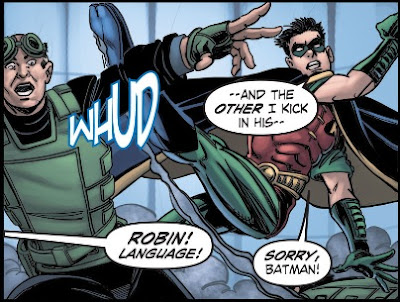
But Barr’s dialogue is well out of time. This Batman takes polite leave of Commissioner Gordon and chides Robin for using the mildest of racy language, like “get to first base.” In sum, this is the Batman of the 1960s television show. As for Tim as Robin, he’s hard-working and gets the computer jobs, but he’s also uncharacteristically hot-headed and loud-mouthed.
What’s more, the Batmobile in this story is the version seen in Gotham City before the “New Look” of 1964, with a big bat face on the front and a big fin sticking out the back. Far from acting in the shadows, this Batman is welcome at the Pentagon. And the story itself is a throwback, with the villain deliberately sending Gordon clues about upcoming crimes.

Thus, the story is not just not part of the “New52” universe—it doesn’t quite fit into any of DC’s many continuities over the years. That reflects how the company’s digital-first wing is free of the burden of consistency. Batman: Li’l Gotham likewise serves fans all the happiest bits of the pre-New52 universe, and other digital titles take off of TV shows instead of the current comics.
I wish I could say that “Elements of Crime” was an unalloyed delight because of those old-fashioned touches, but I struggled with the story. Despite several readings I still can’t tell you how Batman escaped the Element Queen’s death trap the first time. Robin does nothing but play Boy Hostage. The art in the last installment sometimes seems unaccountably awkward.

I noticed an interesting lettering technique, though. When characters are speaking on the other side of glass from readers, Saida Temofonte’s balloon tales end in little arrows on the glass surface, as shown in the first two pictures above.