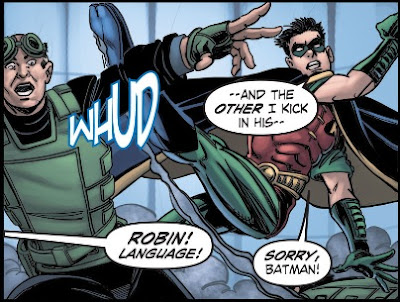
Comics Alliance has run a wide-ranging conversation between columnist Chris Sims and Mike W. Barr, who scripted many Batman and Robin stories in the 1980s and recently returned to those characters with a story for DC’s digital-first, out-of-continuity Legends of the Dark Knight series.
 As I discussed back here, that story reads like a throwback to the pre-Crisis Batman, perhaps even to the 1960s television Batman. Indeed, Barr says he was aiming for a retro feel, even inventing a new villain who seems to be a very old one. As for Robin:
I’d written the first episode with basically the Jason Todd Robin, and [artist] Tom [Lyle] obviously feels more comfortable with the Tim Drake Robin, which is fine, because he co-created the character. I said “Sure, I have no problem with that whatsoever, whatever Tom is comfortable with,” so we used Tim Drake for the rest of the story. And it worked out fine. As [editor] Hank [Kanalz] pointed out, there are some differences between the personalities of the characters, which we were able to use in the second chapter. Tim is a different character than Jason, and that’s reflected in the story.
But that’s also why the Robin in the first of the three installment reads like smart-mouthed Jason, and why the verbal clues indicating he’s Tim don’t show up until the later installments.
Another striking aspect of the interview is how much freedom
Dennis O’Neil allowed his writers and artists when he was editing DC’s Batman line from 1986 to 2000. Early in that period
Max Allan Collins and
Jim Starlin were making Jason Todd an angrier character with a grittier background, but Barr continued to write Jason as a happy young sidekick facing off against old Batman villains. “Denny O’Neil was always open to those kinds of stories, as long as you set up what was going on,” says Barr.
Furthermore, when it came to
Son of the Demon, Barr’s graphic novel with
Jerry Bingham:
MWB: The graphic novel took a fair amount of time to come about, because it was such a long story. Denny O’Neil was actually not involved in that as the editor. Dick Giordano was the editor, and it was in the pipe by the time Denny and I were doing Detective, I believe. I always told Denny, “You should look into this because I guarantee you’re going to want to know what’s happening in this story,” but I don’t think he ever did until someone pretty much handed him a Xeroxed copy of the finished book and what was in there.
CA: What was his reaction?
MWB: I don’t know, because he never told me. I have heard stories, and this is hearsay, I’ll admit, but I’ve heard it from a number of sources, that Denny very much disapproved of what I’d done with Batman and Talia. Not only getting them married, which was done as a sequel to one of his stories, but also having a child, which he had absolutely forbidden.
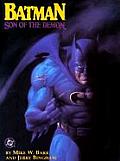
Evidently O’Neil kept himself from criticizing Barr’s story (and his mentor Giordano’s work as editor) even when he “very much disapproved” of how it had used Talia, a character he had co-created. O’Neil would have had the company on his side; according to Barr, “Warner executives” disliked Batman having a child with one of his villains so much that:
[DC publisher] Jenette Kahn herself called me and told me that if that child ever appeared again in a story, she would be fired. I don’t know how much of that I believe, even to this day, but basically we were told to never use that child ever again, he does not exist in continuity anymore.
(Almost two decades later, Barr’s story was the inspiration for
Grant Morrison’s saga of Damian Wayne.)
Even today, it appears, Denny O’Neil still hasn’t told Barr that he shouldn’t have told the story he wanted to tell. As an editor, his philosophy was to give his creators room to create, and the results include some of the most popular modern Batman sagas, such as
Knightfall and
No Man’s Land. Given all the stories coming out of DC Comics today about the in-house staff vetoing storylines in the works, O’Neil’s editorial example seems even more striking.