Showing posts with label AUTHOR Max Allan Collins. Show all posts

10 April 2013

A Mystery with Not-So-Secret Identities
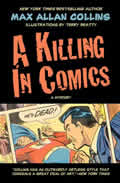
A while back, I had the idea for a mystery story set in the world of mid-1900s American comics publishing. I’m still working on that, but in the meantime I sampled Max Allan Collins’s A Killing in Comics, the first in a series of mystery novels set, well, in the world of mid-1900s American comics publishing.

I should have expected Collins to have worked out this idea already. He’s written many comics himself, including the Dick Tracy newspaper strip for many years, the Ms. Tree private-eye stories, and The Road to Perdition. Collins was the Batman scripter who gave the second Jason Todd his past as a runaway with criminal parents.

Collins is also a prolific writer of prose mysteries, including his award-winning Nathan Heller books, another series built around major modern disasters, and numerous novelizations. So basically he’s already worked out every idea for a mystery story.

A Killing in Comics is clearly inspired by Gerard Jones’s Men of Tomorrow, which has become the authoritative history of the start of the American comic-book industry. It’s a roman à clef about the first generation of DC Comics, or more particularly about the men who worked on its most famous creations, Superman and Batman. But in this book those trademarks are cleverly disguised as Wonder Guy and Batwing.

Thus, instead of Jerry Siegel and Joe Shuster, the book gives us Harry Spiegel and Moe Shulman—but they’re almost exactly as Jones characterized the Superman creators. On the Batman side, Bob Kane becomes Rod Krane, Bill Finger becomes Will Hander, and Jerry Robinson becomes…nothing, because unlike the other creators there’s no clear moral conflict in his career. Editor Mort Weisinger is on the scene at Sy Mortimer but as of 1948 hasn’t reached his full potential as a villain.

The detective, Jack Starr, is the troubleshooting vice president of a newspaper syndication service. Though he refers to his father as “the major,” reminiscent of Maj. Malcolm Wheeler-Nicholson, this business is actually successful. It’s also run by a version of Gypsy Rose Lee, a retired stripper of an intellectual kind. That’s the most fictional part of the book.

As with Oz the Great and Powerful, the story is a little less interesting than watching it play out just on the edge of its source material without stepping over the line onto that territory. In this case, the mystery depends on all those comics pros being capable of killing the equivalent of the president of DC Comics. So of course “any resemblance to actual persons…is entirely coincidental,” as the copyright page says.

Further volumes in Collins’s Jack Starr series appear to be inspired by the Li’l Abner Broadway show of 1956 and its roots in newspaper comics, and by Dr. Fredric Wertham’s anti-comics crusade.

07 October 2012

Another Kid in Crime Alley

For years I’ve owned copies of Batman, #408, in which Max Allan Collins introduced the second Jason Todd stealing tires off the Batmobile in Crime Alley, and Batman, #410, in which Jason makes his debut as Robin.

Curiously, it was harder for me to find the intervening issue, which should theoretically be less prized. Last month I came across an unbagged, 25-year-old copy in the dollar bin at Bedrock Comics in Framingham.

“Just Another Kid in Crime Alley” is an odd little story, penciled by Ross Andru and inked by Dick Giordano. Having found Jason living alone in an abandoned building with nothing but his cigarettes, his vest, and his elaborate stereo system, Batman decides he needs a better home. So he drops the boy at an orphanage.

This orphanage has a reputation for “unorthodox” teaching methods, Bruce Wayne knows it’s had “difficulties with the board of education and various social agencies.” The woman in charge is named Fay Gunn. But somehow Batman’s keen detective instincts don’t clue him in that she’s training the orphans to be a criminal gang.

After several violent incidents Jason decides Ma Gunn is “batty” and runs away. Meanwhile, Batman revisits Crime Alley and meets a fedora-wearing man (it’s a very old-fashioned neighborhood), who discovers that his tires are missing. Now Batman’s deductive power kicks in. He decides that in Gotham City only one person could have committed that crime: the boy he left at the orphanage.

So Batman tracks down this nefarious criminal in…the same abandoned building.
Jason defiantly tells Batman the truth about Ma Gunn’s orphanage. Batman watches Jason reattach the tires (apparently Alfred handles that task at home). And they discuss the serious issues of crime.
And that’s when Batman realizes he’s found a new little friend.

18 July 2010

Jason Todd: Capable of Killing?

The last two weekly Robins have discussed how the personality and narrative function of the second Jason Todd varied greatly depending on who wrote the stories. Those differences arose from the approach of the new editor on DC’s Batman books, Dennis O’Neil. He had helped to usher in the modern Batman after 1969, then worked as an editor at Marvel, and finally returned to DC.

O’Neil recently described his ideal approach to editing:

During my first stint as a card-carrying, full-time comic book editor entitled to health benefits, personal days and my own invitation to the office Christmas party, I screwed up. I thought that the bossfolk had hired me because they thought I could write and therefore all I had to do was make the work of the writers I hired indistinguishable from my own. Which was dunderheaded. . . .

the editorial task was simply to get the best possible stuff from the creative people, given whatever limitations and restrictions were established. To cram another’s prose into the procrustean bed of my own productions was to get, at best, third rate O’Neil when what we should have wanted was first rate (fill in the name of some poor freelancer whose labor was massacred by the younger and dumber me).
Artist Norm Breyfogle confirmed what it was like to work for O’Neil at DC in an interview with Graphic Novel Reporter: “He allowed his creative teams great freedom while providing basic visionary parameters.”

What did that mean for Jason Todd? It meant O’Neil okayed the ideas that his writers thought would produce the best stories. As quoted at Titans Tower, O’Neil described this genesis for Jason’s reinvention:
In 1986, Max Allan Collins inherited the Batman writing assignment and told his editor he had an idea for an improved Jason Todd. Make him a street kid, Collins said. Make his parents criminals. Have him and Batman on opposite sides at first.

Sounded fine to the editor and, since DC was in the middle of a vast, company-wide overhaul of storylines anyway, Collins was told to go ahead. I was the editor; I did the telling. And I’d do it again, today. Collins’s Robin was dramatic, did have story potential.

But readers didn’t take to him. I don’t know now, and will probably never know why. Jason was accepted as long as he was a Dick Grayson clone, but when he acquired a distinct and, Collins and I still believe, more interesting back story, their affection cooled.
O’Neil’s hands-off approach allowed Collins’s Jason to differ from Mike W. Barr’s, which in turn differed drastically from Jim Starlin’s. O’Neil let each writer play to his strength rather than dictate a single approach. With troubling consequences.One of Starlin’s storylines in 1988 involved Batman and Robin tracking down a serial rapist, only to learn that he has diplomatic immunity because of his father. Jason, hot-headed and angry, wants to go after the guy. Bruce, eyes on the law, tells Jason to hold back.

It’s easy to see why O’Neil approved this plotline: it has good storytelling potential (as well as being gritty, the way the new DC wanted). Starlin laid out an interesting conflict between Batman and Robin, letting them act out important debates:
  • What do you do when justice appears to be in conflict with the law?
  • How do you balance the good of an individual against the good of a principle?
  • Can a crimefighter lose his sense of justice by becoming too emotionally involved, or sacrifice it by not being emotional enough?
  • What are the downsides of Batman’s principle not to kill?
In Batman, #424, Jason finds one of the rapist’s victims has hung herself, fearing he’ll come after her again. He swings over to confront the man on his balcony. In the next panel we see the man plunging to the street. Batman arrives.
Jason says the man slipped and refuses to answer any questions. What happened on that balcony remains ambiguous twenty years later. In some stories, that sort of ambiguity can be powerful. But for Jason Todd it was fatal.

Because Robin isn’t evil.

COMING UP: The decision point.

04 July 2010

Jason Todd Remade: ”Promises to Be a Real Thriller”

In late 1986, two new writers took over the Batman stories from Doug Moench: Mike W. Barr on Detective Comics and Max Allan Collins on Batman. Around the same time, Dennis O’Neil returned to DC Comics as editor of the Batman magazines.

Early in 1987, four issues of Batman were turned over to Frank Miller and David Mazzucchelli’s telling of Bruce Wayne’s first year fighting crime in Gotham City, which set a new, grittier tone for the series. Then Collins returned and tackled the challenge of Jason Todd, the current Robin.

At the time Collins was also scripting the daily Dick Tracy comic strip and the Ms. Tree comics with Terry Beatty, featuring a hard-boiled female detective. He would go on to write Road to Perdition, a bloody crime drama. He proposed a way to make Jason Todd part of Batman’s new, rougher milieu.

In Batman, #408, subtitled “The New Adventures,” Collins zipped readers into a new “continuity” for the Dynamic Duo. Dick Grayson’s departure to become Nightwing was no longer a drawn-out but peaceful story of a young man discovering his adult role. Jason Todd was no longer a second boy trapeze artist with murdered parents who found a new home in Wayne Manor.

Instead, the Joker shoots Dick, Bruce Wayne “fires” Dick as Robin out of poorly expressed concern for his safety, and Dick leaves to become Nightwing with the Titans. (New Teen Titans was still one of DC’s bestselling titles, so that last part was a given.) This sort of retroactive rewriting of characters’ history is known among fans as a “retcon.”

As for Jason, he now enters the scene by stealing the tires off the Batmobile in Crime Alley, the same place where Bruce’s parents were killed. When the Caped Crusader tracks down the young thief, he turns out to be living on his own in an abandoned tenement. This scene raises a number of logical questions. How can a young teen boost four tires from a supercar with a state-of-the-art security system? What abandoned tenement still has electricity, and how does Jason keep that stereo from being stolen? Where did he get those red jeans, and why does he wear a vest (aside from his clothes offering visual links to the Robin costume)?

But hey—it’s a superhero comic. Logic matters less than what the new character symbolized. Criminal activity, black vest, hard rock, even (gasp!) smoking—those markers showed us that this Jason Todd was bad!

In the following Batman issues, as Jason takes over the Robin role, Collins revealed that his father was a criminal. Jason learns that his father was murdered by the villain Two-Face, and for a time is devoured by rage, only to learn a valuable lesson about life.

From a storytelling perspective, Collins’s idea was very good. The new Jason was distinct. As reader Anne Guerra said in a letter four issues later:

[Jason’s] first origin was much too similar to Dick Grayson’s and, let’s face it guys, it wasn’t very original. This latest explanation shows imagination and promises to be a real thriller. . . . A gifted writer like Max Allen [sic] Collins could have a field day with a potential storyline like this.
Readers noted how Jason’s new past and personality reshaped the dynamic of the Dynamic Duo, opening the door for never-before-told stories. In that same letters column Adam Schultz wrote:
I hope Jason will remain belligerent for awhile, even after he becomes Batman’s partner. It will be an interesting change from the idol-worshipping that we can usually expect from Robin.
Dick sometimes took impulsive gambles because he was too eager to help. Jason could take the same aggressive risks, even knowingly disobeying Batman’s orders, out of anger at the criminal world. This Robin’s coming-of-age story could thus explore choosing values as well as learning skills.

But there was a problem with a Robin who has a criminal past, who’s driven by questionable motives, who habitually disobeys. DC’s creative team didn’t realize the importance of one thing the character represents:

COMING UP: The two paths of the second Jason Todd.
