Showing posts with label COMIC Amelia Rules. Show all posts

15 January 2014

Writing for “the Saddest Little Girl in the World”

Here’s Jimmy Gownley, author of the Amelia Rules! series, on the Comic Book Diner podcast a couple of years back, talking about his response to criticism that his comic for kids shouldn’t tackle tough emotional topics:
The trick, and this is the hokiest thing in the world and is completely corny and you guys will be like rolling your eyes, but I always picture like writing Amelia for one person: the saddest little girl in the world. Okay? . . .

You don’t know if she has any friends, you don’t know if she has any family or any money, but she’s, like, in a library, right? And she’s just miserable. And she has this book.

And so what am I going to say to her? Well, I want to say something that’s funny, hopefully. I want to say something that’s uplifting, ultimately. But I also want to say something that’s true, because false hope isn’t hope. It’s just a lie.

So that’s what I try to do. And the truth of the matter is that sometimes childhood is not “suitable for children.”
These remarks appear at about 42 minutes into podcast episode 50. I can’t find a link to that episode on the Comic Book Diner website, but cohost John Gallagher has a link here.

09 February 2012

Amelia's Path to Publishing Success

Publishers Weekly featured Brigid Alverson’s profile of Jimmy Gownley, writer, artist, and for a time publisher of the Amelia Rules comics series.

Gownley started out self-publishing in magazine form, improvised a paperback collection (his printing partner “shaved the staples of the single issues and bound them together”), worked with packager Byron Preiss, and went back to self-publishing after Preiss’s sudden death. Some efforts were surprisingly successful, some failures. And that was just the first five years.

Then came the biggest challenge yet—the fruits of unusual success. Alverson reports:
Getting Amelia into the Scholastic book fairs, which was nearly unheard of for a self-published book, was another important step; the best-of anthology that Gownley produced for Scholastic sold 83,000 copies. But with bigger sales came bigger headaches. Big book orders can completely paralyze small publishers who may not have the man power to deliver the order on time. "Six months or so after the Scholastic deal, when we could sell that book ourselves, we got an order for 4,000 copies," Gownley said. "My father helped [get the order fulfilled], and he was really sweating, and I said, 'Can you imagine how strong J. K. Rowling must be?'"
Finally in 2008 Gownley signed an eight-book deal with Simon & Schuster. That arrangement meant Gownley could focus on content rather than production and distribution. Another benefit, as I noted back here, was more support with proofreading, which I can’t help but think meant that the books got into more school libraries.

With the end of his S&S contract, the article reveals, Gownley is moving on to new projects. It’s too bad that there won’t be more Amelia, but she has been growing up, little by little.

29 November 2010

Two Ways of Building a Balanced Audience

In yesterday’s posting about the Young Justice TV cartoon, I quoted from an interview with the producers. Among the non-Robin-centric things they said was this, which speaks to one way modern mass entertainment is created:

[Greg Weisman:] I think, from an economic standpoint, we have to hit boys 6 – 14 for Cartoon Network to sell their ad space or whatever, so if you think of it as a bull’s eye with concentric circles, that’s the bull’s eye we have to hit – but I’m not satisfied with that and I don’t think Brandon [Vietti] is either.

A, we want boys and girls, so there’s a lot of great relationship stuff in this, there’s humor in this show – I mean, it’s a serious show, but there’s a lot of humor in it, there’s a lot of eye candy for little kids. I think little kids could enjoy this show, and some stuff will go over their heads, but they won’t know it’s going over their heads.
The network’s need to “hit boys 6 - 14” might explain why this show not only features a team made up of twice as many boys as girls (four to two), but also why the pilot doesn’t show one of those girls until the very last moments, and the other not at all.

There’s a female trainer for the group, but in the pilot she doesn’t speak. Wonder Woman flies in the background, a female scientist walks around with a clipboard, and that’s about it for that half of humanity. (Now that I think of it, the female teammates might not even reflect humanity: one is an alien from Mars, and the other is Artemis, potentially a goddess. But maybe that’s how the target audience of boys six to fourteen view girls.)

This made me think of how Jacques d’Amboise introduced his celebrated dance classes into New York schools. As People magazine reported in 1982, “d'Amboise first invites only boys (‘otherwise all girls would sign up’) and girls later.“ The Young Justice pilot might be tilted toward the masculine more than subsequent episodes in order to assure sponsors it will attract young male viewers, and to assure those viewers it’s safe to start watching.

Contrast the development of that show to how Jimmy Gownley decided to center his comic for kids on a little girl, from a new interview with R. J. Carter for the Trades:
Somewhere along the way, you decided to make a run with a female protagonist. What caused this shift?

I was working on [a comic book called] Shades of Gray, and I loved doing it, but it was always going to be this sort of thing I did on the side. At this point I'd graduated college and was working as a graphic designer. I was publishing Shades of Gray, and it was doing okay, but it was never going to be a career for me.

I just took the page that I was drawing — I was drawing a page of Shades of Gray, what ended up being the last issue. I just flipped it over, and without any thought of what I was doing, I just started doodling. And I drew this little girl — Amelia, exactly how she appears in the first issue. I kind of liked the way she looked, and I held it up to the person who was sitting with me — at the time it was my long-suffering girlfriend, now my long-suffering wife, Karen — and I said, "Hey, what do you think of her?" And she said, "She's really cute," and I said, "Maybe I should do something with her. What should we name her?" We both thought about it, and then at the exact same second we both said, "Amelia." So I took that as my cosmic sign that I was supposed to write a comic book about this little girl.
The result was Amelia Rules, now published by Simon & Schuster. Gownley enjoyed the freedom of self-financed publishing, and of working in a medium that requires a lot less money than an animated TV show. Perhaps many other author-illustrators have tried to launch comics for kids with female protagonists, and Amelia Rules is the rare success. But the fact that it’s found an audience of both girls and boys might suggest that creating good stories matters more than marketing dicta.
28 July 2009

Spelling Rules!: The Whole Edition’s Crazy

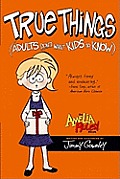
When I sat down to read Amelia Rules!: The Whole World’s Crazy!, I didn't have the 2006 reprint from Renaissance Press, nor the new edition from Atheneum (shown here).

No, I looked at the first edition, which cartoonist Jimmy Gownley issued himself through ibooks.net. (That Byron Preiss start-up was distributed by Simon & Schuster, owner of Atheneum; so the corporation eventually bought rights to something that was once in its catalogue.) And here are my thoughts during that reading.

On the Amelia Rules! website, Gownley describes his wish not to make his heroine a perpetual kid.

Amelia would not be about childhood; it would be about growing up. To me, this gave the strip a dynamic tension that was not present in other kid comics. The friction between the adult and kid worlds provided many story ideas and made Amelia unique. Amelia Rules! is not about being something; it’s about becoming something, which is really the heart of all great storytelling.
This seems to translate into valuable lessons about life that she shares with readers, but those don't come along so thumpingly as to be annoying.

[comma! comma!]

The characters are broadly drawn, but not one-dimensional. Amelia herself is the most rounded, likable but flawed, open to temptation but kind at heart. After her parents' separation, she has moved with her mom to a small town and needs new friends. Among the lessons she learns is that her new life isn't that bad.

[“viciously” has only one s]

Amelia's buddy Reggie is enamored of superheroes, one of many ways Amelia Rules! nods to the American comics tradition it grows from. He insists that he has a secret identity as Captain Amazing, which requires him to wear his boxers over his pants. And he's the most appealing boy around, at least in this volume.

[comma!]

Of course, Amelia's female playmate Rhonda Bleenie is equally caricatured as her "arch nemesis." Why they're always hanging out together isn't clear, but it has something to do with Reggie. And comic tension.

[that’s “you’re,” not “your”]

Her divorcing parents are weak reeds, at least in this volume, but they're doing their best; the most reliable adult guidance comes from her aunt Tanner. The teachers are standard adult antagonists. The cast doesn't really expand until later volumes.

[actually, that spot doesn't need a comma]

Gownley uses some interesting comics techniques, such as the changing icons on the wordless character Pajamaman's chest to indicate his emotions. The requisite bullies have special lettering. But I was most taken with Gownley's frames within panel frames, which he uses to highlight action, show time passing, or emphasize distance between characters. Those deserve more study; see an example at the bottom of this page.

[“nickel” is not spelled like “pickle”]

Finally, I'm pleased to report that the punctuation and spelling errors of the first, self-published edition don't appear in the latest reprint. There are some advantages to working with other people.