Showing posts with label AUTHOR Arnold Drake. Show all posts

10 September 2014

Where Do You Get Your Ideas?

From Marc Tyler Nobleman’s interview with comics scripter Arnold Drake:

when Bill [Finger] was looking for an idea for Batman, one of the tricks that he used was to open up the Yellow Pages in the phone book and just kind of ripple through it. Where his fingers stopped he’d say, “Piano tuner…I wonder if there’s a story in a piano tuner?”
And then, of course, Finger would imagine the piano to be giant-sized.

17 September 2012

Dark Horse Stumbles?

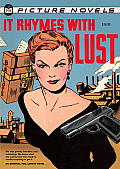
There’s only one reason that Dark House Books reprinted It Rhymes with Lust, script credited to Drake Waller and art to Matt Baker and Ray Osrin: it’s one of the first American attempts to publish a novel-length story in comics form. In other words, it’s a candidate for being the earliest graphic novel.

But you couldn’t tell that from the reprint. Nowhere on or inside the book is the date of its original publication in 1950; instead, the date on the copyright page in 2007, when Arnold Drake wrote the afterword. Nowhere does the book state that its author is a pseudonym for Drake and Leslie Waller. Indeed, Drake’s afterword doesn’t even make clear that what it calls “that first story” is the same volume one is holding.

Nowhere on or inside the book is a statement—even a single sell line—about the book’s significance in comics history. Instead, Dark Horse has carefully recreated the front and back covers of the original, with all the breathless, melodramatic text. In combination with a 2007 copyright date, the result looks like a parody or a nostalgic attempt to recreate comic noir.

Given that the market for stories about family dysfunction and corruption in post-WW2 mining towns is probably small, I think Dark Horse missed a bet in how they packaged this book. They found space on the copyright page for a list of publishing personnel (something one rarely sees from mainstream American publishers), yet nowhere said, “This book is a piece of comics history, and here’s why…”

I guess the company thought its target readers would find the book in comics shops and recognize its significance from Wikipedia. And some people might say those assumptions reflect a larger problem with the American comics industry.

01 April 2012

The Sensational Character Find of 1965

This being the first of April, it seems appropriate to discuss the Titans’ resident jokester and comic relief: Gar Logan, known alternatively as Beast Boy and Changeling. But mainly how he fits alongside Dick Grayson as Robin/Nightwing. This shows the flexibility (or perhaps the tribulations) inherent in a superhero who’s a supporting character.

Writer Arnold Drake introduced Beast Boy in the Doom Patrol comics of the late 1960s: a green teen (probably inspired by Dean Stockwell’s role in The Boy with Green Hair) who could take the shape of any animal. Beast Boy was a kid sidekick, but not a junior version of any member of the Doom Patrol. At first he wasn’t even a member of the team, but eventually one of those heroes adopted him.

When that magazine was canceled and Drake killed off his creations, young Gar survived as an orphan. After he appeared in some Teen Titans issues of the 1960s and ’70s, Marv Wolfman and George Pérez brought him into their New Teen Titans magazine in 1980 as the team’s gag man. He was one of the five main characters to make the leap to the Teen Titans TV cartoon in 2003.

As a character, Beast Boy has always worked best as part of an ensemble. In 1999 Geoff Johns and Ben Raab wrote a short miniseries with him as the main character, but notably it also featured Dick Grayson and other old teammates. Logan’s most memorable moments in comics have come in the various Titans series, and at the top of that list is “The Judas Contract,” in which Logan fell in love with a cute new Titan named Terra who turned out to be much more trouble than he’d dreamed.

In recent years, DC Comics has moved sharply away from the concept of a single “continuity” or history codifying all forms of its mythology. The Teen Titans of the cartoon aren’t the same as the team in Wolfman and Pérez’s New Teen Titans, or those of their New Teen Titans: Games, or the hybrid team now appearing in the Young Justice cartoon, or the parody versions in Tiny Titans.

The origins, personalities, and powers of DC’s main characters—Superman, Batman and Robin, Green Lantern, etc.—don’t change greatly from one continuity to another, but relationships among them can vary and the histories of secondary characters can change greatly. (The company also treats Wonder Woman as a main character, but her underpinnings do change as creators struggle to figure out what she best represents.)

As a secondary character, Gar Logan is therefore often in flux. New Teen Titans and its offshoots established him as a lovelorn wise guy, a bit younger than his teammates, who submerges his losses and neediness behind jokes.

But in the Young Justice cartoon, Dick Grayson as Robin is the group’s nerdy little wise guy. He’s the youngest of the group and deeply into computers and word games. So what space does that leave for Beast Boy?

In an episode broadcast last month, Young Justice showed us Garfield Logan as an eight-year-old living in Africa with no special powers. He gets a blood transfusion from the hero Miss Martian, a green-skinned shapeshifter. Frankly, that sets up a better explanation of why little Gar might grow up to be a green-skinned shapeshifter than the mysterious disease-and-cure interaction established in Doom Patrol decades ago. But for now that continuity still doesn’t have a Beast Boy.

In Tiny Titans, Robin is the put-upon central figure infatuated with a red-haired girl, and the whole comic is comic relief. So what space does that leave for Beast Boy?

Creators Art Baltazar and Franco re-established his crush on Terra as a more demonstrative one-sided relationship than Robin’s crushes—which is to say that Terra throws rocks at him. Otherwise, however, that comics’ Beast Boy seems more worldly than Robin. And in the magazine’s final issue, he actually comes up a winner.

The Tiny Titans versions of all six of the other New Teen Titans regulars look on happily from the center of this panel.

Finally, where’s Beast Boy in DC Comics’ new main continuity? He’s been changed to a red shapeshifter, more consistent with another animal-based hero. His debut in May will reveal more about that character’s name and history. Rather than part of the revamped Teen Titans, this Beast Boy’s in a related group.

In sum, Beast Boy is going in all directions, as dictated by the storytelling needs of whatever ensemble he’s assigned to.