Showing posts with label ARTIST Ty Templeton. Show all posts

21 August 2014

How Syncretism Made DC Stretch

In 1960 the DC Comics editor Julius Schwartz wanted to add a new superhero to his line of comics, a supporting character in the Flash magazine. Schwartz was four years into his project of reviving DC’s old trademarks, starting with the Flash himself and then moving on to Green Lantern, Hawkman, the Atom, and so on.

The company’s new character had to be distinct from those other heroes, to have some roots in science fiction, and to fit into crime-fighting stories but provide some comic relief.

Working with writer John Broome and artist Carmine Infantino, Schwartz came up with Ralph Dibny, the Elongated Man. His power was that he could stretch his body in superhuman ways, making himself tall, thin, bouncy, table-shaped, and so on.

That was also the power of Quality Comics’s leading superhero of the 1940s, Plastic Man, created and usually drawn by Jack Cole. Schwartz hadn’t realized that since 1956 DC had owned Quality’s comics trademarks, including Plastic Man. He later told colleagues that if he’d known that, he would simply have revived the Plastic Man name.

But it was too late: DC now owned two crime-fighting superheroes with stretching powers, both on the funny side. From the start, knowledgeable comics fans saw the similarities. When Schwartz took over the Batman line in 1964, he made the Elongated Man a backup feature in Detective Comics, raising his profile further. And two years later DC launched a new Plastic Man magazine. So what could make the two stretchy guys distinct?

Such overlaps were a drawback to how DC Comics grew through syncretism, as I described yesterday. Different companies created the same types of heroes to star in the same types of stories, but once those heroes were put into the same universe they lost their special qualities.

Fortunately, that need to distinguish characters opened the door for more creative storytelling. In the case of the Elongated Man, he ended up doing things that went against the typical superhero tropes. He married his girlfriend, Sue. He dropped the mask and secret identity. He announced himself as a professional detective for hire. Though he never had his own series, Ralph Dibny became a unique character in the DC Universe with his own following.

As for Plastic Man, DC’s creative teams recognized that Jack Cole had written his crime stories mostly for laughs, so they went further in that direction. Plas became the most wackadoodle hero of the whole line. He could be in the Justice League with Batman, and writers could play off their contrasts for laughs. Creators also made clear that Plastic Man was more topologically powerful and invulnerable than the Elongated Man.

None of that would have happened if Julius Schwartz had simply revived the Plastic Man trademark to create a supporting character for the Flash. Having two similar characters in the same universe forced him and his colleagues to think in new directions.

COMING UP: Syncretism and the Batman.

12 August 2013

“You do Batman stuff all the time.”

As long as I was talking about Ty Templeton’s Batman work, it seemed like a good time to share his autobiographical “Bun Toons” webcomic about being a father of teenagers.

Click through to see what impresses Templeton’s kids even more than dinner with the Governor-General of Canada.

11 August 2013

The R Stands for Hope

While I was disappointed that the second episode of Batman 66 doesn’t use any digital storytelling tricks, the story by Jeff Parker is fine. Robin plays a crucial role, rightly embodying the “idealism of youth” and receiving praise from Batman at the end.

Ty Templeton drew the Boy Wonder with a classic design, green gloves and bare legs, even while climbing on an iceberg. In contrast, Jonathan Case’s pictures in the first issue showed pale tights and darker, almost black gloves, as Burt Ward often wore on the television show.

09 December 2012

The Handsome Young Man on the Flying Trapeze

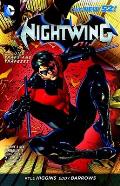
Nightwing: Traps and Trapezes is the first collected volume of Nightwing comics since the launch of DC Comics’s “New 52” universe. Written by Kyle Higgins and penciled mainly by Eddy Barrows, these installments of the ongoing series reestablished Dick Grayson’s character by showing his return to the Haly Circus—evidently his first significant visit since his parents’ deaths.

That, of course, wipes out the visits we’ve seen in previous universes. Indeed, returning to the circus where he grew up is a staple of stories since Dick Grayson became a man. It was while on the flying trapeze that he expressed his independence in Detective Comics in the early 1980s. Dick was buying the circus when he befriended Tim Drake in New Teen Titans. In the first season of the Young Justice TV universe, teen-aged Dick returned to the Haly Circus as a masked teenager, fooling no one.

All those stories portray the Haly Circus as a welcoming home. The elephants remembered Dick well, of course, and so did the regular performers. While the traveling tent show was often in dire economic straits and/or threatened by mysterious crime that only an acrobatic young detective could solve, it was a refuge for Dick from troubles at Wayne Manor, Titans Tower, or elsewhere. At the end of those tales he always realizes he can’t stay; he has responsibilities elsewhere. But Dick can feel happy that the circus will always be there.

(The one exception is Dick’s visit in Batman and Robin Adventures, #15, spun off the animated cartoons of the 1990s. There the circus owner is named Haley, perhaps writer Ty Templeton’s tip-off that this is a different reality but more likely just normal inconsistency.)

Traps and Trapezes rewrites Dick Grayson’s origin, and not just by saying he was with the circus until he was about sixteen, or five years before the present. As part of the “Court of Owls” storyline that Scott Snyder was directing from the Batman magazine, it reveals the Haly Circus to be a breeding-ground for young assassins.

We might ask why gangster Tony Zucco would try to shake down an enterprise connected to the Court of Owls. Nonetheless, he did, and he killed two-thirds of the Flying Graysons (as in every iteration of the Batman universe since 1940), causing Dick to leave the show and start living in Wayne Manor. That’s the only thing, it turns out, which preserved Dick from becoming just another assassin. Everything was already set up, including the dental plan.

The two magazines’ combined storyline thus plays on fans’ visceral dismay at any violation of Reason for Robin, #10: “Robin isn’t evil.” In addition to the overarching narrative, the first issue of the new Batman ends with Alfred finding Dick’s DNA under the fingernails of a murder victim. This Traps and Trapezes volume ends with one of our hero’s escrima sticks showing up at another crime scene. But in all cases the dénouements assure us, after the requisite worry in the middle acts, that Nightwing isn’t evil.

The other thing that this volume reassures us hasn’t changed in the new universe is that Dick Grayson is the pretty one. We see that even in the flashbacks that show him with other circus kids. The boy named Zane has a big, unexplained scar down one side of his face. Another boy, Raymond, starts out basically indistinguishable from young Dick, except perhaps not smiling as much, but he returns with terrible scarring around his eyes. (A detail apparently not yet settled when the first issue showed him taking off his sunglasses.)

And Dick? Despite spending five years in a business that involves being kicked in the face, he remains unblemished and oh-so-handsome. Barrows supplies many pinnable pictures of Nightwing swinging through the urban skies, muscles flexed and hair flowing. The new Nightwing uniform, while not as sleek and distinctive as the blue “fingerstripes” package, is skintight and shiny. Barrows also designs a lot of those panels that show a series of Nightwings bouncing across the rooftops.

Will the surviving traits be enough to keep Dick Grayson as a distinctive character with his own following? The new universe has replaced his long history as Robin with a couple of years at most. It’s wiped out his ascendancy with the Titans. There’s no hint of his years in Blüdhaven or his team-ups with many other heroes. But he does look pretty.

31 March 2012

First Glimpse of Barsoom

Edgar Rice Burroughs’s Barsoom books and I have never had a close encounter. But they were clearly significant to artist Ty Templeton, which he’s been exploring in his Bun Toons series and commentary. In 1975, at the age of twelve, young Templeton came across a John Carter comic book and quickly discovered its appeal.