Showing posts with label ARTIST Braden Lamb. Show all posts

27 February 2014

Will Eisner Week in Metro Boston

The Million Year Picnic comics shop, Stephen Weiner of the Maynard Public Library, the Cambridge Public Library, and folks from the Boston Comics Roundtable are collaborating on a local celebration of Will Eisner Week.

On Thursday, 6 March, the Cambridge library will host a conversation between two comics creators about Eisner’s art and legacy:
  • Paul Hornschemeier, creator of Mother, Come Home; The Three Paradoxes; and the New York Times best seller Life with Mr. Dangerous, among other titles.
  • Denis Kitchen, “underground comix” cartoonist, founder of Kitchen Sink Press and the Comic Book Legal Defense Fund, and Eisner’s literary executor.
That event is said to be scheduled from 6:00 to 8:00 PM at the library. This will be followed by a signing at the Million Year Picnic in Harvard Square, which has a weeklong sale of Eisner books. (I just bought one using another discount.)

On Saturday, 8 March, several local comics creators will lead comics workshops for kids (and interested adults who bring kids along) at the Cambridge library. Those creators are Jef Czekaj, Josh Dahl, Bob Flynn, Dan Mazur, Dan Moynihan, Braden Lamb, and Shelli Paroline. Those workshops start at 12:30 PM and run for two hours. Afterwards, there will be another signing at the Million Year Picnic from 3:00 to 5:00 PM.

28 October 2013

Greatest “Between Good and Awesome”

Back in April, Brian Gardes at the Stumptown Literary Review provided a very nice review of The Greatest of All Time Comics Anthology:
As with most anthologies there were some stories which were more successful than others. However, under the careful eye of editors Dan Mazur and Jesse Lonergan, these variations in quality fluctuate between good and awesome. . . .

While it is often a risk to purchase an anthology, I cannot recommend The Greatest of All Time Comics Anthology enough. It has a solid creative line up, great production values (twenty color pages in a small press book?!?!), and an enjoyable read from cover to cover!
Braden Lamb and I collaborated on one story in that collection, “The Greatest Spy of All Time.” Braden and his wife, Shelli Paroline, won Eisner Awards this summer for their work on Adventure Time, so I can’t argue that this publication was the highlight of the past twelve months for him, but I certainly enjoyed it.

Ninth Art Press’s next comics anthology will be about subcultures; here’s the call for submissions.

24 January 2013

“Strong inky lines” and “swift composition”

The Poopsheet Foundation, which reviews indy and small-press comics, has nice things to say about The Greatest of All Times Comics Anthology, and in specific about my contribution:
J.L. Bell & Braden Lamb deliver the greatest spy of all time, and I’d love to see something feature length from these strong inky lines and the swift composition of the storytelling on display.
There are also fine words for many other contributors, especially Line Olsson (“I’d kill for a piece of her original art”).

Braden also featured a page from our story on his Tumblr site. Doesn’t that make you want to obtain a copy from Ninth Art Press?

15 December 2012

I Am [in] “The Greatest”!

A story I wrote makes its debut today in a new anthology from Ninth Art Press: The Greatest of All Time Comics Anthology, edited by Dan Mazur and Jesse Lonergan.

Opinion is divided as to whether this should claim to be the greatest comics anthology of all time, but it definitely collects twenty stories in 124 pages clustered around the theme of “The Greatest.” Topics include the greatest rock band of all time, the greatest conspiracy theory ever, and one creator’s argument for the greatest bruise. Most of the book is in black and white, but two stories are printed in full color.

I was very fortunate to have as a collaborator Braden Lamb, currently sharing the art chores on the Adventure Time comic book with his wife, Shelli Paroline. (I’m also impressed that Braden got to do some colors on Teen Boat!)

Our story is titled: “The Greatest Spy of All Time.”

14 July 2012

How Teen Boat! Was Launched

Adolescence is a period of change, but in our culture we paradoxically view it as a period of change into what you really are the whole time. Almost all popular-media stories about teens consciously trying to change themselves end with some level of failure for not being honest about their true selves. Instead, our modern stories emphasize self-acceptance, recognizing the value of what you are all along. Whether that’s a purely Good Thing is another matter.

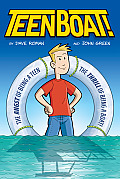
Which, by a roundabout course, brings me to Teen Boat!, a new collection of comics adventures by writer Dave Roman and artist John Green. Little Willow’s interview with Roman at Bildungsroman dredges up the start of this tale:
…the inspiration came to us while we were on a bus. Long trips can often lead to loopy thoughts, especially for comic creators. One minute John Green and I are discussing ’80s cartoons and the spectrum of cool vs. less-cool transformation powers, then we’re talking about imaginary boardroom meetings gone wrong, and before long we were pitching tag lines like “The ANGST of being a teen, the THRILL of being a boat.”

It easily could have stayed a joke amongst ourselves, but we felt compelled to share our idea of a teenager who transforms into a yacht with all our cartoonists friends. The more they laughed, the more John and I were motivated to turn the silly premise into something real. And one of the many beautiful things about comics is there's very little stopping you from making that happen.

Our first Teen Boat! books were printed on a black and white photocopier, hand stapled, and hand sold for 50 cents each at indie comic shows. Ten years later, it’s a full-color hardcover book sold in bookstores everywhere and endorsed by the Junior Library Guild!
Specifically, Teen Boat! appears to have been inspired by Turbo Teen, a 1984 animated cartoon about a boy who makes temperature-sensitive shifts to and from being a car. Hard to imagine why that show lasted only twelve episodes.

Teen Boat! began as a series of black-and-white minicomics parodying such adventures through a adolescent hero who can change into a small yacht. It grew into a substantial (though unfinished) collection of stories from Clarion, now fully colored (by a team that included Braden Lamb).

Mercifully, the collection doesn’t include an origin story. We have no idea how Teen Boat came to be both a boy and a boat. (In one flashback panel he has a mom.) Nor does he have a secret identity—his name is Teen Boat. But we don’t need those elements of the classic superhero narrative. All that matters for these stories is that our hero is stuck/blessed with being both a boat and a teenager.

Beyond that premise, Teen Boat! floats on an ocean of North American teen-comedy-adventure stories from cartoons, sitcoms, and comics. We see the rich and jockish bully, the pretty exchange student, the inveterate rule-breaker, and other familiar high-school types. Teen Boat’s best friend climbs in through his bedroom window as on Clarissa Explains It All or Doogie Howser, M.D. Stories revolve around the class trip, the big dance, the school election, the driving test, the mystery that only a teen-aged amateur sleuth can solve, and other common rites of passage.

Yet Teen Boat! goes deeper than parody. As other have noted, including the AV Club and Hal Johnson at Paste Magazine, these stories has real heart. Just because the situations that teenagers find themselves in can easily be parodied doesn’t mean the underlying emotions aren’t real.

Teen Boat’s everyboat quality makes him an appealing hero. While young readers may laugh at the parodic touches, they may also recognize their own concerns in him. And when they see that even Teen Boat worries about skin blemishes or how to buy “nautical accessories,” might that offer a little more perspective on their own angst?

13 May 2012

Doing Justice to Young Justice

One of the most interesting aspects of the Young Justice television cartoon is how its creators have played off of, and played havoc with, all the continuities that DC had previously established. There’s a Justice League of America headed by Superman, Batman, Wonder Woman, and the other household names, and a set of eager sidekicks organized into a somewhat rebellious junior team. Beyond that, we viewers can’t assume anything.

Supporting characters have familiar names (Mal Duncan! Rita Farr!), but it’s not clear they’ll follow the same paths as in the comics. Hero names (i.e., valuable corporate trademarks) like Artemis are assigned to characters with completely new backstories. The cartoon’s Beast Boy receives his powers as a green shapeshifter from another green shapeshifter, Miss Martian—a character invented about forty years after Beast Boy’s first appearance.

In some cases these changes are improvements. Last week Braden Lamb, one of the artists on the Adventure Time comic, pointed out to me that the cartoon’s Adam Strange has a much more logical background for a space adventurer than the comic-book version. In other cases, the changes allow new stories. Peter David wrote an episode using two characters he’d developed in the original Young Justice comic books, Secret and Harm, but aside from their relationship as sister and murderous brother nothing was the same.

Over the course of the season, it also became clear that Young Justice’s producers were playing the long game: setting up tensions, mysteries, and relationships to pay off a dozen episodes or more down the line.

Probably the most obvious example of that was the character of Miss Martian, the first girl to join the team. Fans complained that Miss Martian was a perky sitcom caricature, baking cookies for the boys and repeating the phrase “Hello, Megan!” whenever she did something the least bit dumb. They showed their displeasure by compiling videos of that catch phrase repeated for ten minutes or Hitler reacting angrily to it. And eventually it turned out those complaints were right. Miss Martian was acting like a sitcom caricature, and the producers had been planning that revelation all along.

In fact, the first season of Young Justice was basically all about adolescents desperate to hide embarrassing secrets: their pasts and identities, their weaknesses and habits. And over the last few episodes, the teens repeatedly learned that the people they were trying to fool (a) already knew, and/or (b) didn’t care. Even Dick Grayson, who was mostly in the already-knew camp (of course), had to learn that lesson when he went back to the Haly Circus “undercover” and expected no one to recognize him.
The second season of Young Justice has started fast with a five-year jump from where the first season ended. Nerdy little wise guy Dick has grown up into hunky Nightwing, and some version of Tim Drake has taken over the Robin role to show how nerdiness is done. Beast Boy is old enough to join the team. Superboy has mellowed, Miss Martian turned harsher, and new teens are on board.

And fans are complaining about the new mysteries. Where are the characters from season one who haven’t appeared yet? What’s the status of the romances from that year? What happened to the other Speedy? And so on.

Viewers seem to forget what made the first season compelling: the gradual development of the storylines, the nagging mysteries, the big reveals. Those turns in the overall plot have the power to entertain us only if the producers keep some secrets up their sleeves.