31 March 2013

Is One’s Choice of Best Robin Generational?

Chris Sims of Comics Alliance (and, earlier, the Invincible Super-Blog) posted a very good essay this week on the questions: “Who is or was the best Robin? What is the Best Robin moment in Comic Book History?”

Ultimately Sims decides that what defines Robin is helping Batman, and by that measure he chooses Tim Drake as the best. That approach allows him to praise Dick Grayson for having been Robin and leaving that role to become a major character in the DC Universe. He also finds the best Robin moment when Carrie Kelly fully adopts the role, not through any feat of acrobatics or detection but simply in assuring Batman that he has help.

I see only one major flaw in the essay, and it’s part of Sims’s argument in favor of Tim Drake:

Tim's not in it for himself, and a lot of that comes from the simple fact that he doesn't need to be. When he first appears, he doesn't have a tragedy that defines his past and drives him to seek vengeance. In fact, he has the exact opposite: It's not really exaggerating to say that he's the single most privileged, well-adjusted character in the entire Batman mythos. He's rich enough to live more-or-less next door to Wayne Manor, he has two loving (and living) parents. The one thing that drives him is that he's a kid who loves Batman.
But why does Tim (like Sims) love Batman? A big part of the reason, I think, is that he doesn’t have “two loving (and living) parents” with him anymore. When Tim first connects with Batman and puts on the Robin suit, his parents Jack and Janet have parked him at a boarding school while they travel the world doing business deals and sniping at each other. Tim’s interest in Dick Grayson isn’t fueled just by having met the young circus flyer on a bad night; he also hungers for a family. His interest in Batman isn’t just driven by justice; it’s also a desire for an admirable father in his life.

Soon after Tim starts interning in the bat-cave (though that was before the term “interning” had escaped the confines of the medical field), his mother is killed and his father paralyzed by a criminal in Haiti. DC Comics planned for Jack Drake to die soon as well, making Tim’s trajectory the same as the preceding Robins: orphaned by crime, taken in by Bruce Wayne. But scripter Chuck Dixon kept arguing (and demonstrating) that there was more drama in keeping the man alive.
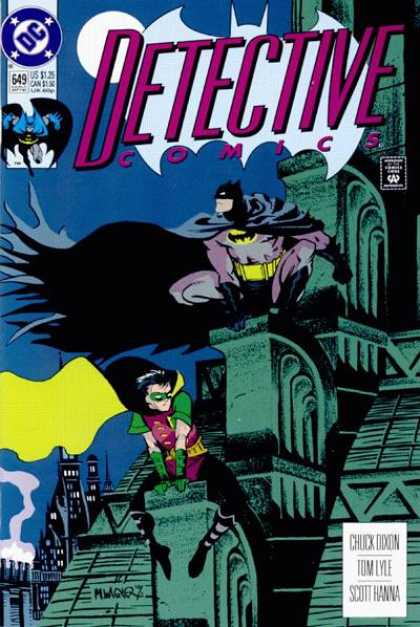
Instead, for more than a decade Tim juggled life with his father and life with Batman, which set him apart from past Robins. And it’s tough to say which man caused Tim more trouble. Jack Drake fell in love with his physical therapist Dana and married her, moved the family out of Gotham and then back, sent Tim to another boarding school, lost all his money, found out about Tim’s double life, and so on. An underlying theme of the Robin comics then was that Tim was actually the more dependable and responsible of the Drakes, the one who was really looking after other people.

In other words, Tim still needed the strong father figure of Batman in his life, whether he could admit that or not. That’s why I don’t think Tim Drake became Robin just for justice. He also had private psychological needs compelling him to take on that role. (Another underlying theme, stronger in the 2000s, was that Tim was also often more mature than Bruce Wayne.)

I also suspect Chris Sims has a particular perspective on the Robins question based on his age—or more particularly on the age when he was reading superhero comics most avidly. Now I recognize that as a professional comics writer with a specialty in Batman he’s still reading superhero comics avidly, and that he’s consumed and considered the canon published back before he started. Nonetheless, I think that the stories one read as a child and young adolescent exert the strongest emotional tug and establish one’s expectations.

In another essay Sims has stated that he was twelve in 1994 when he started to collect back issues. In other words, he was at that crucial age when:
  • Tim Drake was established as Robin. Furthermore, by then Tim had his father and stepmother at home (hence the “loving parents” understanding).
  • Jason Todd was established as the dead Robin, the possibly homicidal Robin, the Robin that haunted Bruce Wayne. As I’ve written, this characterization didn’t solidify until after 1989.
  • Dick Grayson was established as Nightwing, the former Robin, but the New Titans were past their glory days.
  • Carrie Kelly was a possible future Robin who appeared in one revolutionary volume.
And it’s those figures that dominate Sims’s essay.

The Robin that came before—the first, red-haired Jason Todd—gets less than a sentence. Of the Robins that came later, Stephanie Brown is dismissed with a hand wave (“Stacy?”). Jason Todd’s return from the dead is treated as an unnecessary, unfortunate change that doesn’t affect his symbolic significance. Damian Wayne gets a longer analysis, and a good one, but it still seems clear that Sims’s heart is back in the 1990s.
Another essayist might conclude that Dick Grayson is the best Robin because he established the mold not just for that character but for all kid sidekicks in superhero comics; because he provided the emotion and humor that the first year of Batman stories lacked; because he was popular enough to appear on more DC covers of the 1940s than any other character; because his relationship with Bruce Wayne offered the only ongoing emotional depth in Batman comics for two decades; because he set the standard all subsequent sidekicks aspire to. And that reader probably read the comics of the 1940s and 1950s at a crucial age.

Yet another fan might argue that Dick is the best Robin because Batman could rely on him whether they were fighting gangsters or extraterrestrials; because he symbolized the best of America’s youth but would, both Alfred and Earth-2 agreed, grow up to be a crime-fighter; because he had no powers but was still the Teen Titans’ leader and badass; because as “Teen Wonder” he offered DC Comics a way to gingerly explore youth culture. And that reader probably read the comics of the 1960s and 1970s, and watched the ABC TV show, at a crucial age.

As I’ve written several times, my first prolonged exposure to superhero comics was the Batman: From the ’30s to the ’70s collection, which emphasized the stories between Robin’s arrival in 1940 and the “New Look” of 1964. And the last superhero comics I was reading in my late teens was the New Teen Titans series in which Dick Grayson made the leap to become Nightwing.

So for me that character wasn’t always a former Robin, and the goofy, shallow stories of the 1950s aren’t just quaint embarrassments—though they were juvenile adventures that Dick Grayson’s character helped lead the company away from as he matured in the early 1980s. Sims’s analysis is rooted in DC’s post-Crisis universe; my expectations were established before the Crisis struck.
For other readers, younger than both of us, Stephanie Brown’s brief period as Robin might loom much larger because it came at a crucial time in their own exploration of Batman comics, and Jason Todd might not be the dead Robin but the Robin who returned from the dead and is still not fully part of the family. Some such readers might prefer those other Robins, arguing that they had so few of Tim’s advantages (and so little of his support from the publisher and the fans he was clearly designed to reflect).

Even younger readers might have just had their expectations shaped by the presence of Damian Wayne for the past few years, seeing him as the best Robin (just as he’d want). Readers whose notions are being shaped by the “New 52” universe are also seeing quite a different Tim Drake, with a different family history and different challenges to overcome. So they may well come to a different conclusion about the best Robin.

I’m not saying that everyone of Sims’s comics-reading generation would agree with him while his arguments would fail on everyone else. I just think that his essay and its conclusions reflect the age when comics meant the most of him, and probably resonate most strongly with people of similar experiences.

Because my own experience starts before Dick Grayson was a former Robin, I’m inclined to see more of the essence of Robin in him, and to see Tim Drake as striving always to match that nearly Platonic model (which Dick might be the first to acknowledge he himself didn’t always attain).

But I’ve become very fond of the first Tim as well, and wouldn’t want to give up either character. As I wrote back here, I imagine Tim would agree that Dick was the best Robin and Dick would say Tim was.

Of course, Sims might argue that Tim’s ability to win over a crotchety reader who grew up with Grayson is actually evidence that Tim deserves top honors.

(And the best Robin moment of all time? It’s in The Dark Knight Returns, to be sure. But it’s when Carrie is ready to hold off Superman with an effin’ slingshot.)

29 March 2013

The Chief Justice and His Convictions

There was strong competition for this week’s example of OIP Derangement Syndrome, but I decided to give the prize to Chief Justice John Roberts as an example of how the problem can affect even people who pride themselves on being intelligent, fair-minded, and scrupulous.

This issue was why President Barack Obama instructed his administration to continue enforcing the Defense of Marriage Act even as he decided that law is unconstitutional and indefensible in the courts.

As the New York Times reported:
Chief Justice John G. Roberts Jr. accused Mr. Obama from the bench on Wednesday of not having “the courage of his convictions” for continuing to enforce the marriage law even after concluding that it violated constitutional equal protection guarantees. The chief justice’s needling touched a raw nerve at the White House. “Continuing to enforce was a difficult political decision,” said an aide who asked not to be identified discussing internal deliberations, “but the president felt like it was the right legal choice.”

Other presidents have enforced laws that they no longer defended in court, including the first George Bush, whose acting solicitor general, a man named John Roberts, once asked the Supreme Court to overturn an affirmative action program at the Federal Communications Commission.
Thus, a little over twenty years ago Roberts was himself involved in a similar decision about a law the administration disagreed with. The President he was working for came to the same conclusion as the current President, to have his appointees adhere to the law while also having Roberts argue against it. But for some reason this President lacks “the courage of his convictions.”

It’s not too hard to imagine how Republicans in Congress, many of them already showing the signs of OIP Derangement Syndrome, would have responded if President Obama had declared his administration would set aside DOMA without judicial or legislative approval. As the Times reported, in the White House people had argued that action “would provoke a furor in the Republican House and theoretically even risk articles of impeachment.”

By one measure, to be sure, Roberts was consistent. Back in the Bush administration he argued against a progressive policy designed to open opportunities to people who’ve traditionally been kept out. From the bench he’s arguing the same thing.

28 March 2013

The Wonderful Wizard of Oz and the Bechdel Test

Critics of Oz the Great and Powerful have been lauding L. Frank Baum’s The Wonderful Wizard of Oz as a first-wave feminist fable, but I started to wonder: Does it pass the Bechdel Test? It certainly has more than two female characters, and they certainly do talk to each other. But do they talk about something other than a man? That last question looks a bit iffy for a while.

Dorothy and Aunt Em don’t actually have a conversation in the first chapter. Aunt Em just calls out, “Quick, Dorothy! Run for the cellar!”

The first woman (or character) Dorothy has a long conversation with is the Good Witch of the North, and that conversation eventually focuses on a man: the Wizard.

In her journey to the Emerald City, Dorothy talks with two more female characters: the Queen of the Field Mice and a housewife outside the city. But they both talk about the scary Cowardly Lion.

In the city itself, Dorothy chats with a young maid in the palace; later Baum named this character Jellia Jamb. They discuss clothes and the Wizard.

Dorothy then sets off to kill the Wicked Witch of the West. The Witch captures the little girl with the help of her winged monkeys, and at last there’s an extended exchange of words that’s not about the Wizard or the Lion. So in chapter 12 The Wonderful Wizard of Oz does indeed pass the Bechdel Test. Of course, the conversation between those two female characters is all about shoes. (Way to undermine the stereotype!) And it doesn’t end well for both parties.
In the rest of the book, Dorothy converses again with the Queen of the Field Mice about the Golden Cap. On her journey to the south she talks with the Princess of the China Country. And finally she meets Glinda and has a really substantive conversation about her adventure, who should rule parts of Oz, and how to get home.

By that point in the book, the Wizard is no longer a factor; both his humbug magic and his shaky ballooning skills have come up short. Dorothy has learned to stop relying on that man.

That’s when The Wonderful Wizard of Oz gives up the pretense of revolving about its title character and focuses on its real center: the change Dorothy unleashes everywhere that she and her companions go. That’s one reason I think the book’s final act, which can seem like an anticlimax, are in fact crucial to its tale.

27 March 2013

Oh, Little China Girl

One of the new characters in Oz the Great and Powerful is the China Girl, an inhabitant of a village of china people who appear to have been genocidally destroyed by the Wicked Witch’s Flying Baboons. (She’s also the fairyland avatar of a disabled girl whom the carnival wizard can’t help back in Kansas.)

The china village is obviously inspired by a chapter L. Frank Baum interpolated into The Wonderful Wizard of Oz, in which Dorothy and her companions visit a China Country on their way south to Glinda’s palace. In that chapter, Dorothy wants to take a China Princess home to her aunt but is dissuaded. In the movie, China Girl demands that Oz take her along on his adventure.

There are various ways to read the character’s behavior in that scene. On the one hand, China Girl is insistent on her right to go on an adventure. On the other hand, she casts herself as a fragile little creature who shouldn’t be left on the Yellow Brick Road alone. Of course, she is a fragile little creature; we just saw her legs broken, and she’s less than a foot tall. China Girl clings weepily to Oz’s leg, but as soon as he agrees to take her she trots off happily. I think it’s clear that China Girl’s behavior is a ploy to manipulate Oz, the master manipulator. But in that effort she invokes gender stereotypes.

During the movie’s climax, China Girl plays an important role, bravely bringing Glinda her wand. (The fact that China Girl doesn’t use the wand herself implies the magic of this Oz differs from that in Baum’s Oz, where most magical tools can be wielded by anyone who holds them.) She’s also one of the two characters who asks anything specific of Oz beyond regime change, and ends the movie as his informally adopted daughter.

Illustrator Ben Wood noted a resemblance between the design of China Girl and how John R. Neill drew Dorothy in later Oz books, as he showed in the image above. He wrote, “It was a smart way to add her in without really adding her.” I’m not sure that’s what the moviemakers had in mind, but China Girl does provide more interest and, ironically, someone to identify with.

26 March 2013

Gender Politics in the Latest Oz

I’ve noted a couple of feminist critiques of Oz the Great and Powerful, one from Aisha Harris based on early previews and another from Elisabeth Rappe based on seeing the whole movie. I thought those critics made good points about the irony of taking L. Frank Baum’s fairyland, where little girls overthrow humbug rulers and the most powerful person is a sorceress, and pulling out a story all about a man.

But I wasn’t convinced that the main female characters in the new movie—the three witches Theodora, Evanora, and Glinda—really went gaga over the humbug Oz. And did even Glinda lack all “agency,” or independent thought and action? Having now seen Oz the Great and Powerful, I think those critiques were a little overblown. But in the main they’re sound analyses of how the Hollywood moviemakers adapted Baum’s mythos to mainstream storytelling expectations.

From the start, much of this project’s attraction for producer Joe Roth was the man at its center, as he told Jim Hill: “During the years that I spent running Walt Disney Studios, I learned about how hard it was to find a fairy tale with a good strong male protagonist. You’ve got your Sleeping Beauties, your Cinderellas and your Alices. But a fairy tale with a male protagonist is very hard to come by.”

In fact, as the recent Jack and the Beanstalk movie shows, there are many fairy tales about young men, and adapting those for the big screen is no guarantee of box-office success. Still, Hollywood producers believe, and with some reason, that the key to an international blockbuster that can pay for a production budget of well over $100 million is to bring in lots of male moviegoers, and for that it helps to have a male protagonist.

Once the moviemakers put the man called Oz at the center of their tale, his desires and character development defined their plot, according to the tight storytelling approach that Hollywood usually uses. Other characters, male and female, work around him, talk about him, and react to his actions and desires. In that respect Oz the Great and Powerful is no different from Lincoln.

Within the fiction of Oz the Great and Powerful, the inhabitants of Oz are in the grips of a religious belief. Their king with magical powers has been killed, and they eagerly await his return or the arrival of his successor, also with magical powers, to put everything right. Folks who grew up in western civilization shouldn’t have a hard time recognizing the durability of this way of thinking. That milieu explains why, as Rappe says, “the witches Glinda, Theodora, and Evanora now clasp their hands at [Oz’s] arrival, thrilled the prophesied hero has arrived.”

But of the three witches, only Theodora turns out to really believe in Oz’s magic and his amorous hints. Evanora pretends to share her sister’s faith, but views it and Oz as threats to her own power. Glinda is also happy to harness the popular belief in Oz to her own, more beneficent ends. So it’s inaccurate to say that all three witches, or even most of them, fall for Oz’s appeal. Two of the three quickly recognize him as a humbug.

I wasn’t surprised to find that Glinda sees through Oz but recognizes his potential to benefit the oppressed people. I was surprised, however, by the very late scene in the movie of Oz and Glinda sharing an amorous kiss. There’s no precedent for that in Baum’s novels or in the new movie’s real source material, the 1939 MGM film. It doesn’t seem to fit Glinda’s character even in this movie up until that point.

But evidently the moviemakers felt that a romantic pairing was necessary for a happy ending. Perhaps that’s because Oz’s seductions were an important element of the preceding plot, so that thread needed to be knotted off. But was it thought impossible for Glinda to have led on the foolish man, turn him aside, and yet remain Good? I’d have preferred Oz to realize that  Glinda had pushed him into growing as a man but he still had a way to go before he could win her, if ever.

TOMORROW: A strong female character?

25 March 2013

Never Saw It, But I Read the MAD Parody

At Film Comment, Grady Hendrix traces the rise and fall of MAD Magazine’s film parodies:

…the arrival of Mort Drucker in 1957 changed everything. Initially no one saw Drucker’s talent. Then in 1959 he drew the television parody The Night Perry Masonite Lost a Case and the basic movie parody format for the next 44 years was born.

Opening with a splash panel that took up two-thirds of the page, it was all cartooning, used square word balloons, and the dialogue was copy cast. Playing to Drucker’s strengths, The Night Perry Masonite Lost a Case opted for an extremely tame design, mandated by art directors John Putnam and Leonard Brenner, who gave Drucker his panel layouts. The panels were mostly two-shots and medium shots, usually showing the characters from the waist up.

The comedy came from Drucker’s uncanny ability to capture the likeness of an actor and then blow it up to the point where it started to deform but didn’t quite tip over into caricature. The cartoonist’s equivalent of an actor’s director, Drucker was a master of drawing hands, faces, and body language, and his approach (he wound up creating 238 movie satires) became the house style.
I was one of the young readers Hendrix writes about, being introduced to movies I couldn’t see and in many cases hadn’t heard of through their MAD parodies. Years before I saw The Godfather movies, for example, I knew the plot of the first and how the second one jumped back and forth in time.

Sometimes the MAD writers parodied movies as musicals, and that provided a double education: not just the movies but the songs the writers felt were in the American canon. Even now I remember lines from a song for James Bond set to “The Surrey with the Fringe on Top” more surely than I remember the plots of any early Bond film or Oklahoma!

24 March 2013

“Gotham’s weird, but come on.”

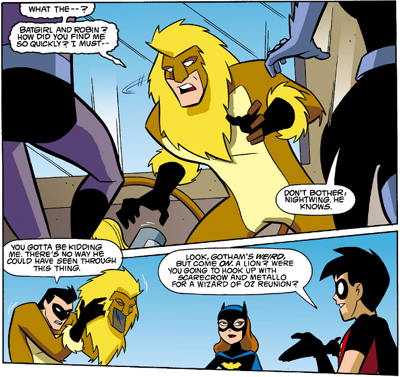
Since Oz and Ends has been talking a lot about Oz lately, I figured the weekly Robin could get into the game.

These panels are from Batman: Gotham Adventures, #19, set in the DC Animated Universe of the 1990s. That continuity’s Tim Drake has been feeling morose because his work as Robin doesn’t seem to have a lasting effect. (This is an odd sentiment for a teenager, but then Tim was always mature for his age.)

Batgirl and Nightwing try to give Robin reasons to go on by dressing up as easily defeated costumed criminals like…Lionman!


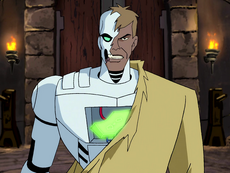
Below are images of the Scarecrow and Metallo from the DCAU, looking much scarier than they should be for this light-hearted Bat-family tale by Scott Peterson, Tim Levins, and Terry Beatty.

23 March 2013

Less Than Noble Nobel Considerations

Earlier this year, the Guardian reported on disclosures from the Swedish Academy about the discussion behind the awarding of the Nobel Prize for Literature in 1962. They show how many considerations there were besides literary quality.

For example, Karen Blixen (Isak Dinesen) might well have had the inside track as a Scandinavian—but then she died, and the prize can’t be awarded posthumously. (A person can die between the announcement and the awards ceremony.)

The academy was evidently waiting for Ezra Pound to die as well. Its members considered him the greatest poet then working in English, but also politically unacceptable. That meant they wouldn’t give him the prize, but equally they wouldn’t give it to another English-language poet until he died—and that scotched the chances of Robert Graves (shown here).

So eventually the academy awarded that year’s prize to…John Steinbeck. Even at the time, he was considered not up to the standard of other literature laureates. But Steinbeck’s stature has obviously been raised by the Nobel. I wonder whether, if those other considerations hadn’t intervened, he would have had been such a presence on my junior-high reading list?

22 March 2013

Amy Kremer’s OIP Derangement Syndrome

As Talking Points Memo highlights, in September 2012 Amy Kremer, chairwoman of the Tea Party Express, told CNN, “I just don’t believe that [President Barack Obama] loves America the way that we do.” That was a follow-up to a tweet the preceding month, also claiming that the President didn’t love America.

When asked to explain her thinking, Kremer said things like: “I think he is more about a global, being a, oh, what’s the word? Being more one-world, global, with, you know, other countries, and it’s not about the shining city on the hill, the greatness that has always been America, that our founding fathers were about.” She preferred the candidate with the Cayman Island tax shelters.

However, this week Kremer looked back on how the Bush-Cheney administration invaded Iraq and said, “The American people, I don't think, have any alternative but to believe our president. That’s why he’s been elected. . . . We have to trust our leaders.”

Unless, of course, the elected leader (the choice of the American people, unlike his predecessor in 2003) is Barack Obama. In that case, Kremer voices unfounded accusations and erects doubled standards. Back in 2009 she even supported a colleague who promulgated caricatures of the President as a witch doctor. This “founder” of the Tea Party movement in that year provides a clear case of OIP Derangement Syndrome.

21 March 2013

The Real Sources of Oz the Great and Powerful

Yesterday I noted how Oz the Great and Powerful credits “the Works of L. Frank Baum” as its source but doesn’t actually draw much from that source—and what it does draw is almost entirely filtered through MGM’s Wizard of Oz from 1939.

That beloved movie is of course the main source for the new one. Oz the Great and Powerful is quite obviously an attempt to create a prequel. Yet the new movie’s makers didn’t have the rights to do so, so they played an odd game of tiptoeing to the edge of fair use and stopping just an inch away from infringement.

Thus, MGM’s Wicked Witch of the West is green with a black gown, hat, and broomstick. (W. W. Denslow’s Wicked Witch is tan with an eyepatch, jacket and patterned skirt, and umbrella.) Sam Raimi and his team couldn’t exactly copy the previous movie, so they made the witch a different shade of green.

The New York Times reported on how Disney’s lawyers advised the moviemakers to alter one Munchkin’s whiskers to be less like those in the 1939 movie. But they’re still the same singing, dancing, particolored little people of that movie, not the dignified farmers all in blue of Baum’s book.

Similarly, the end of the yellow brick road goes in circles, but not in a spiral. There are brightly colored horses grazing outside the Emerald City, but they’re several colors at once instead of in succession. Glinda’s bubbles work a little differently. The green Wicked Witch says “my pretty one” instead of “my pretty.” Oz produces the illusion of a giant heading speaking from a cloud of smoke, but it’s a different giant head. And there are no ruby slippers or silver shoes.

At times, finding a way to evoke the MGM movie without directly copying some detail still under copyright produced new creativity. The winged baboons are even more frightening than MGM’s flying monkeys. The Emerald City’s towers are reminiscent of those from the older movie, but more angled. The landscape of Oz has a verticality that was hard to portray on 1939 sound stages, much easier with CGI.

At other time, the strain of aping the MGM movie is too great. There’s a scene at the end of the Wizard conferring gifts on his companions, but his remarks aren’t nearly as interesting as the dialogue Yip Harburg wrote for Frank Morgan in the equivalent scene, and most of those characters never asked him for stuff, so the scene has no greater meaning than triggering audience nostalgia.

Plotwise, the result doesn’t hang together. Like the 1939 film, the new movie’s screenplay provides for people whom Oz knows in Kansas to reappear as other characters in Oz. Yet there’s no hint that Oz is dreaming, as Judy Garland’s character was. Nor does Oz recognize the resemblance between his Kansas girlfriend and his Oz girlfriend.

And that girlfriend points to the second big influence: Wicked. (The hit stage show, not Gregory Maguire’s novel.) Again, the moviemakers didn’t have the rights to make Wicked, and they had a very different conception of the Wizard. But the screenplay is designed to set off the same nostalgic neurons that produce applause during the stage play, whenever the story foretells some detail from the movie: a cowardly lion, a scarecrow, and so on. And of course the Wicked Witch of the West starts out as sympathetic.

One of the biggest changes in Wicked’s journey from book to stage was the inclusion of a happy ending for Elphaba, with a boyfriend. Oz the Great and Powerful likewise ends with Oz and Glinda paired off. There’s no hint of that in the MGM movie, even less than none in Baum’s books, but apparently Hollywood demands a romantic ending. (To be fair, Baum inserted such pairings in most of his stage and screen adaptations of his books, and imported them back into books he based on his scripts.)

A third, smaller influence is Disney’s theme park and merchandising divisions. When the Wizard arrives in Oz, his balloon lands in a raging river, and we’re then treated to a water slide in 3-D. The climax involves fireworks bursting over the turreted city. I was pleased that Mari Ness also noted the similarity between that action and Disney’s nightly fireworks display. And the corporation already has a ton of collectibles on sale.

Indeed, the main takeaway from Oz the Great and Powerful isn’t a great screenplay or powerful acting (hard to do without a great screenplay), but spectacle and nostalgia. On that level it succeeds—quite well enough to make hundreds of millions of dollars. But I doubt it will have the real emotional impact as any of its predecessors and influences.