31 July 2008

Where I Went on My Summer Vacation, part 2


The Falkirk Wheel is a rotating boat lift that connects the Union and Forth & Clyde Canals in southern Scotland, which are separated by a vertical distance of 35 meters. Until the 1930s, moving from one canal to the other meant going through eleven locks, taking more than a day for each to fill and empty. Then that connection was broken altogether as the canals lost their industrial viability.

The wheel, opened in 2002, takes only a few minutes to raise or lower canal boats most of that vertical distance (there's another, traditional lock in the foreground of these pictures). Because each side of the wheel holds the equivalent of a lock's worth of water, it's so well balanced that it needs only 1.5 kilowatts of power to operate.

Photographs by Jerry Bell.

30 July 2008

The Evolution of Pop Culture Icons

I missed this back in March, but I want to link to Greg Hatcher's image-rich essay on the twists and turns of latterday sequels to The Wonderful Wizard of Oz at Comics Should Be Good! He traces how sequels, adaptations into other media, and revivals eventually gave way to deconstructions, reimaginings for adults, and deliberately dark versions.

Along the way, Hatcher sums up my general feeling about "dark Oz" adaptations after seeing one or two:

what started as a one-off novelty is now its own genre, almost. Once a startlingly novel approach, it’s rapidly becoming a cliche. Even the good stuff can’t help but look a little tired just because it’s one more in a long line. How many times and how many ways can you do a clever adult re-imagining of the same juvenile property?
Especially if the cleverness consists mainly in imagining the popular details turned 180 degrees. It's easy to find the exact opposite of something, so such "dark" versions become predictable fast.
Eventually, you come full circle. It reaches the point where a new juvenile version, told in modern idiom without any attempt to trade on nostalgia, is actually the novelty.
Hatcher then goes on to suggest that same pattern holds for a different sort of American mythos: the superhero universe.
...when you apply it [this pop-culture model] to Marvel and DC, you posit that things like the animated cartoons and DVDs are the new juvenile version, and the regular line of print comics that we see every Wednesday are the last gasp of the adult re-imagining of characters like Superman or Spider-Man.

Anyway. I can’t quite decide how I feel about it, if it’s good or bad or what.
One way to explore this idea further might be to go back earlier in popular culture than Oz, and see what happened to other fictional universes. For instance, Uncle Tom's Cabin started as a greatly affecting, hot political book, and soon became a staple of theater, then a music-house cliché and narrative for children. It inspired counter-narratives like The Klansmen and Gone with the Wind. Now it's read mainly by academics, and popular culture uses the title character's name as a pejorative.

29 July 2008

Wrong Answer in Spiderwick Movie

While traveling last month, I saw the film adaptation of The Spiderwick Chronicles on an airplane. Not the best place to see any movie, to be sure, but in this case I didn't feel I'd missed too much. The movie had far too little griffin, and the story felt small compared to the books. Of course, when most of the speaking roles are handled through computer graphics and the two main roles are played by the same actor, the cast is bound to seem small.

However, what really bothered me about the movie adaptation was the ending. Did that happen in the books? I wondered. This week I found an essay on Nick Owchar's Jacket Copy blog for the Los Angeles Times that expressed my feelings very well [***SPOILERS*** and all]:

In both cases -- books and movie -- the villainous ogre, named Mulgarath, is confronted by the children. And in both cases, the wily shapechanger tries to fool the children by taking the form of their father. It doesn’t work. In the books, Jared suspects that "Dad" is a phony and tells him so, causing the ogre to give up his ruse and resume his monstrous shape, tree-limbs and all. A showdown ensues in the ogre's shabby palace.

In the movie? Quite a different climax.

Here, we get a heavy undercurrent of family unhappiness, of marital collapse; the mother is a wreck and the father’s absence is painfully felt. When the father (played by Andrew McCarthy) finally does appear at the movie’s end, he gets asked a question by Jared as he walks through the mansion’s front door. Jared’s question is extremely general: He wants to know what message his father promised to give him when he arrived at the estate for a visit. Of course, it’s a test to confirm his father’s identity.

With a puzzled look on his face, Mr. Pretty in Pink says plainly: “I love you.”

There is no menace, no sarcasm nor any irony, nothing to cue us that lurking behind his aging boyish face might be a yellow-eyed creature of nightmares. He sounds like any beleaguered parent facing a child unhappy that his parents have split up.

What is Jared’s response?

“Wrong answer!” he declares, and then -- the horror of it -- he stabs his father in the chest with a kitchen knife. The father gasps in disbelief, and then, he hunches over and begins a transformation that makes his skin bubble and stretch as the true villain is revealed.

What’s going on here?

Why turn Jared's defiant challenge into a stabbing? Kids are savvy, I agree, but why force such an ugly scene on them?

Irony rules the day in Hollywood. I’m sure that Jared’s stabbing of “his father” was explained in some concept meeting as being a powerful expression of how much pain he feels because of his father’s desertion.

On the screen, though, it only makes Jared seem vicious, especially because it comes in response to being told he is loved. Jared’s brilliant ability to detect elfin fakery is never established, and Mulgarath’s shapechanging early in the movie is so minimal that it’s easy to forget. This change to the story loses sight of the bright tones and adventurous spirit in the series. The filmmakers evidently forgot something important: This is a story for children, not adults. Save the parricides for your R movies. Oedipus doesn’t play well with kids, ok?
And right after the stabbing, Andrew McCarthy reverts back into Nick Nolte--which is even more scary.

28 July 2008

Lucius Fox: In the Know

Yesterday I discussed how The Dark Knight uses the character of Alfred Pennyworth differently from how he first appeared in the Batman comics, back in 1943. Today I'll talk about the movie's approach to another supporting character, but this one goes back only to 1979.

Lucius Fox was introduced into the comics that year as a talented corporate executive who ran Bruce Wayne's corporation and foundation for him so he could sleep off his late nights chasing criminals as a vapid playboy. Fox is African-American, and his arrival expanded the "Batman family" beyond White Anglo-Saxon Protestants.

In the comics, Fox's acumen lies in managing corporations and managing money. He even built Dick Grayson's small inheritance from his parents into enough money that the young man could live apart from Wayne Manor and buy the circus where he grew up.

Batman Begins, the first of the new Batman movies directed by Christopher Nolan, gave Fox a new role: chief inventor of Batman's stuff. He's an engineer at Wayne Enterprises, unfairly shunted aside by a usurping CEO. Fox slips Bruce some of the technology that helps him become Batman, and eventually Bruce makes him the new head of the company.

The comic-book Lucius Fox has yet to tumble to his boss's secrets (or at least he has yet to let on that he has). Once Hollywood cast Morgan Freeman in that role, however, audiences wouldn't believe that he'd remain that ignorant. After all, he's the industry's current choice to play God. (A very long way from holding cue cards as Marcello on The Electric Company.)

Therefore, The Dark Knight shows Lucius Fox as fully cognizant of Bruce Wayne's activities. In essence, he's a second Alfred. Which brings me to this New York Post interview with Freeman:

What's the secret to making a superhero movie?

You gotta make the superhero believable. Batman is not super. He has extensive training in order to be able to do what he's doing. What made "Batman Begins" work is that you saw how he begins. He's not bitten by a spider or bathed in atomic rays or anything. The guy was trained in a certain art. That's very believable.

Part of that believability is also that Batman is disturbed.

He is. This is one of the things the new movie brings out. He sees his path, and he knows the price he pays for it. His mentors, the people watching over him, are saying, "You're getting into dangerous territory here."

27 July 2008

Alfred Pennyworth: Replacing Robin since 1986

I find myself in the midst of a little series of Dark Knight postings, yet it's time for the weekly Robin. Oh, what to do? I'll discuss how the Batman mythos we see in the new movies, as well as the previous movie series that started in 1989, manage to get along fine without a Robin.

Bruce Wayne's original supporting cast in the Batman comics consisted of Police Commissioner James Gordon, introduced in the very first story, and Julie Madison, Bruce's fiancée. Neither of those characters knew his secret identity as the Batman (or "the Bat-Man," as it was originally written). Julie eventually disappeared.

When the creative team introduced Dick Grayson in 1940, they didn't simply lower the average age of the cast. They also added a character who knew about Bruce Wayne's nocturnal activities and helped him. In the late 1960s, Batman co-creator Bill Finger described his thinking to comics artist and historian Jim Steranko:

Robin was an outgrowth of a conversation I had with Bob [Kane, the artist]. As I said, Batman was a combination of [Douglas] Fairbanks and Sherlock Holmes. Holmes had his Watson. The thing that bothered me was that Batman didn't have anyone to talk to, and it got a little tiresome always having him thinking. I found that as I went along Batman needed a Watson to talk to. That's how Robin came to be.
(Eventually I'll analyze this some more in a subseries I'll call "reasons for Robin.")

In 1943, the Batman team added another supporter to the Batman team: Alfred Pennyworth, Bruce Wayne's butler. As originally written, Alfred looked like a portly Arthur Treacher, but that same year a Hollywood serial portrayed the character as thin and mustachioed, so the comic-book butler went off to a spa and returned with less weight and more facial hair. (Cover at left courtesy of the Grand Comics Database.)

Alfred was originally comic relief, with a broad ethnic dialect. His shtick was wishing to be a great detective but achieving results--such as discovering his employer's secret identity--only through dumb luck. Later writers portrayed Alfred as actually smart and capable, with a background in British intelligence and the theater which had left him with very useful disguise skills.

And thus things remained (with a odd break in the 1960s that I've decided not to acknowledge) until DC Comics's Crisis in 1986. The company rewrote the origins of some of its major characters. For Batman, the big change involved Alfred. Now, the comic books told us, he had been a servant in the Wayne household when Bruce was a boy. He (and a local physician, Leslie Thompkins, introduced into the mythos in 1976) had cared for young Bruce after his parents were shot.
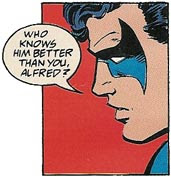
In other words, Alfred--not Dick Grayson--was Batman's oldest friend and assistant. He still had a theatrical and intelligence background, and he turned out to have another skill necessary in those darker times: combat surgeon. With Dick off with the Titans as Nightwing and the Robin situation in flux, Alfred became Bruce Wayne's most constant aide and confidant--in short, his Watson.

In all Batman stories since 1986, Alfred knows Bruce's secrets, perhaps better than the master himself. He offers snarky comments about Bruce's Batman habit, but in the end is what the recovery movement would label an enabler. He has helped to raise the orphan boys Bruce keeps bringing home, and assisted them on their own adventures. At a few points, Alfred even left Wayne Manor to reconnect with family in Britain or to look after Tim Drake at boarding school.
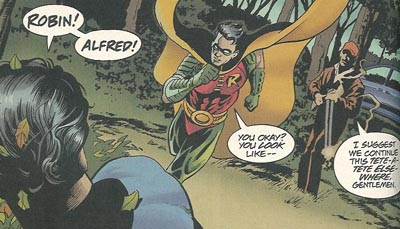
The 1989 Batman movie directed by Tim Burton and the 2005 Batman Begins directed by Christopher Nolan both adopted DC's "post-Crisis" history of Alfred. Even more than comic books, which at least had the option of thought balloons, moviemakers need sounding-boards for their heroes to talk to. And as long as Alfred is there for those conversations--particularly as depicted by a movie legend like Michael Caine--Robin doesn't have to be.

26 July 2008

Renee Montoya and Anna Ramirez

There's a character in the Batman mythos named Renee Montoya. She was created as a Gotham City police officer for the animated cartoon of the early 1990s, and quickly slipped into the comic books to tie the two media together. Montoya served several roles in those early stories, from providing Batman with a regular contact on the cops to offering a non-stereotypical role for a female and Hispanic.

Soon Commissioner Jim Gordon promoted Montoya to detective and assigned her to the Major Crimes Unit. Over the years her partners were Harvey Bullock and Crispus Allen, two other established DC supporting characters. Two-Face developed a crush on her in the No Man's Land arc.

Montoya was a major character in the Gotham Central series, which revealed more of her personal life: she had a girlfriend, and parents who disapproved of that relationship. Some fans disliked this revelation, seeing it as changing the character they'd imagined rather than filling her out. For others, Montoya became even more interesting and admirable.

In a series that DC published in 2006, Montoya took up the role of the Question, a superhero Steve Ditko had created for Charlton in 1967 as a mouthpiece for his Ayn Rand philosophy. (The Question became part of the DC stable when Charlton sold its superhero properties.) I've written about how this development exemplifies the dominance of costumed-hero adventures in American comic books.

I mention all this because early on in the new Batman movie, The Dark Knight, we see a young Latina detective working closely with Jim Gordon. She's played by Monique Curnen. More than a few Batman fans assumed that she was Montoya, as I did. Only late in the film do we learn that her name is Ramirez.

Earlier this month, Joanne at Comic Genius wrote about why the character of Det. Anna Ramirez was appearing not only in The Dark Knight but also in an animated film just released to DVD, Batman: Gotham Knight. Where was Montoya? she demanded.

The answer becomes clear once one sees The Dark Knight. [And now we get into ***SPOILER*** territory for people who haven't.] The screenwriters, Jonathan and Christopher Nolan, undoubtedly used the sight of a Latina detective to lure fans into thinking that character was Montoya, and would behave as Montoya has behaved in numerous Batman stories since 1991. But Ramirez acts differently, providing a surprise for the cocky fanboys who think they can predict everything the Joker will do. The filmmakers could pull off that trick only because they were working within an established universe with a big fan base.

At the same time, having built Renee Montoya into a heroine and even a costumed heroine, DC and Warner Bros. got to preserve that character free of whatever fate Anna Ramirez might face.

Bagram Source of False Obama Rumor

A while back, I noted how Snopes.com's rumors collected on the internet about the Democratic Presidential candidates far exceeded those about this year's Republican candidate, and how the statements about Democrats were false far more often than true, and false far more often than the equivalent statements about the Republican.

The pattern continues. As of today, there are three rumors about John McCain listed on the Snopes website, none of them false. There are twenty-seven rumors about Barack Obama, seventeen of them false and only two of them clearly accurate.

The latest lie was drafted by an army captain in Afghanistan named Jeffrey S. Porter and spread around the internet this week. The New York Daily News identified Porter as a “Utah Army National Guard intelligence officer in a linguist unit at Bagram Airfield,” which is a major major detention and interrogation site. FactCheck.org preserves how the paper added:

Now the Bagram captain is dialing back, having signed the viral e-mail with his name, rank and unit - a possible violation of military regulations barring political statements. . . .

An Army officer familiar with the incident told The Mouth today that the writer is “devastated that the letter was made public. It was never his intention that it go beyond members of his family.”
It seems curious for Porter to have signed the email with his rank, unit, assignment, and the phrases "American Soldier" and "(married and father of 6 children)" if he were writing only to his family. You'd think they'd know all that stuff already.

25 July 2008

Poetry Friday: The Original Dark Knights

Marc Tyler Nobleman, author of the recent Boys of Steel, wrote about his disappointment that the new movie The Dark Knight didn’t credit Bill Finger with having first applied that title phrase to the Batman in Detective Comics, #40. Finger had created the character with artist Bob Kane a few months before, and wrote many Batman scripts from the 1930s through the 1960s, almost always uncredited.

Marc’s posting made me curious about where the phrase “dark knight” originally came from. Finger was obviously trying to evoke our cultural memories of the Middle Ages, just as one of the supposed inspirations for Robin was Robin Hood. A little searching for “dark knight” in Google Books’s “Full Texts” database led me to the British literary scene of the early 1800s, a time of medieval revivalism. So for Poetry Friday here are the two earliest examples of the “dark knight” that I could find.

The Anglo-Irish writer Charles Maturin (1782-1824) used the phrase in his play Bertram; or The Castle of St. Aldobrand (1816). A prior describes an off-stage character this way:

The dark knight of the forest,
So from his armour named and sable helm,
Whose unbarred vizor mortal never saw.
He dwells alone; no earthly thing lives near him,
Save the hoarse raven croaking o’er his towers,
And the dank weeds muffling his stagnant moat.
It turns out this dark knight is a personification of the devil, who corrupts Bertram. Walter Scott, Byron, and other top writers of the day admired Maturin's play. (In fact, it’s easier to find Scott’s review quoting this scene than to find a copy of the play itself.) Maturin knew that he had a good thing because he also used the phrase “dark knight” in his 1824 novel The Albigenses.

Maturin was never able to match the quality of Bertram, however. He overspent his income, got into quarrels with critics, and died (possibly a suicide) after a literary career of less than a decade.

Later, a Scottish poet named Henry Glassford Bell (1803-1874) wrote a ballad named “The Dark Knight” in pseudo-medieval style. It was first published in 1830 in The Edinburgh Literary Review, which Bell happened to edit. The poem is more easily read here in Bell’s collection Summer and Winter Hours.

Here’s the story in a nutshell:
There came a dark knight from a far countrie,
And no one ever saw his face, for he
Wore his black vizor down continuallie.

He came to a gay bridal, where the bride
Stood, in rich robes, her destined lord beside,
Who gazed upon her with a joyful pride.
...
Yet ever and anon her look would fall
On the dark knight who stood apart from all,
Dark as his shadow, moveless on the wall.
...
The hour grows late, and one by one depart
The guests, with bounding step and merry heart,--
Methought I saw that new wed ladie start.

None in her father’s hall are left but she
And her young bridegroom, who, as none may see,
Hath twined his arm around her lovinglie.

Yes, there is still a third,--the vizor’d knight,--
...
A shriek was heard at midnight, such as broke
On every ear, like the first pealing stroke
Of the alarm bell, and the sleepers woke!

In the old hall, where fitful moonlight shone,
There lay the bridegroom and the bride alone,
Pale, dead, and cold as monumental stone,--
A vizor’d helm was near, but the dark knight was gone.
Obviously, both Maturin’s and Bell’s dark knights are villains. Finger and Kane created the Batman as either a hero or an anti-hero, depending on the editorial direction. Nonetheless, Bell’s poem provides interesting commentary on the new movie’s love triangle among Bruce Wayne, his childhood friend Rachel Dawes (who has no equivalent in the comics), and district attorney Harvey Dent.

(The thumbnail above shows the determined Black Knight from Monty Python and the Holy Grail, as rendered in “plush with removeable limbs,” courtesy of Geek Venue's Monty Python Toys collection.)

24 July 2008

Why So Serious?

In today's Boston Globe, Ty Burr writes:

On Sunday I went to a memorial service in Mount Auburn Cemetery for the sister of a family friend. Afterward, as the group milled around drinking iced tea and eating finger food under a small tent next to the chapel, word got out among the teenagers and college kids that there was a movie critic present. One by one, they came up to me and asked the same question, with almost the same wording.

Is "The Dark Knight" the best movie of all time?
Burr goes on, but at that point my own responses were:
  • No. It's a very good superhero movie. But compared to The Bicycle Thief or From Here to Eternity or The General (to name just a few), it's an amplified thrill ride featuring two-dimensional characters.
  • At a memorial service? I hope the deceased was either a movie fan or a Batman fan. Otherwise, entertainment about a mass-murdering crazy man seems like the wrong topic for the occasion.
Burr has some interesting points on the rare combination of factors that--for some people--imbue this superhero movie with more emotional resonance than any other. Or, seemingly, than any other event of recent memory.
Go ahead and scoff at the analogy, boomers, but one of the kids at the memorial service likened the opening of "Dark Knight" to the JFK assassination and the Challenger disaster as quintessential where-were-you defining moments of his generation.
Good to know the kids are getting over that little "destruction of the World Trade Center" thing.

23 July 2008

Blogger Tags Can’t Exceed 200 Characters?

Some of my tags are on the long side (a habit I picked up from Fuse #8 and Read Roger). And some of my postings have a lot of tags that are pertinent--or impertinent, as the case may be. Every so often, when I try to save one of those postings, Blogger will tell me that the totality of the tags can't exceed 200 characters. So I've had to make the hard choice to cut a few.

Lately I discovered, however, that Blogger counts the spaces after the tags in its 200-character maximum. So I can simply delete those spaces, and Blogger will save the posting. It may also be possible to add tags over the 200-character limit to an existing posting from the "Edit Posts" page.

It's my ambition to one day write a posting that touches on so much so succinctly that the tags are longer than the posting itself. This ain't it.
