30 March 2014

The New New Teen Titans

DC Comics has started to promote an alternative version of its Teen Titans brand, to debut this fall. Teen Titans: Earth One, is what for the past quarter-century would have been called an “Elseworlds” story, and prior to that an Earth-Two or imaginary tale. It uses the familiar brand names but is outside of the current main continuity, thus allowing more latitude in storytelling. Paradoxically, DC is creating multiple “Earth Ones” for its main brands.

The main creators of this book will be writer Jeff Lemire and artists Terry and Rachel Dodson, and Lemire gave an interview to Comic Book Resources this week. As usual in such promotional interviews, the conversation is all about describing how wonderful the story will be while avoiding as many specifics as possible.

But here are some mildly interesting details:
  • This story is clearly inspired by the Marv Wolfman–George Pérez New Teen Titans series of the 1980s. Lemire told CBR: “Marv Wolfman and George Pérez were the first creators whose work I followed avidly. ‘The New Teen Titans’ from the ’80s was like my Bible as a kid. I read every issue over and over and over again.”
  • However, one of the major themes of that series—inheritance—will be less in evidence because the new team won’t include such protégés of older heroes as Robin/Nightwing, Kid Flash, and Wonder Girl. In the new story’s world, these heroes are the first generation to have superpowers. (Of course, they might still have problematic parents.) That said, Beast Boy/Changeling, created in 1965 as a sort of mascot of the Doom Patrol, will be in this new story; he’ll have his old green coloring but presumably a new backstory.
  • The team includes new versions of several Wolfman/Pérez creations from the ’80s: Cyborg, Raven, Starfire, Terra, Jericho, and Deathstroke. That helps DC maintain the viability of those trademarks. However, Lemire is promising surprises with several characters’ backstories, so readers can’t make assumptions based on past versions.
  • Lemire has “been done [with] this book for over a year.” As a standalone volume rather than an ongoing magazine series, it needed a longer lead time for the art, so DC has kept the project under wraps until now. If the book proves to be a hit, Lemire is obviously up for a sequel—though that could presumably take another year or two.
No versions of the Teen Titans have survived for long without a Robin or Wonder Girl. Will this departure break that pattern?

28 March 2014

The Deep Roots of Inflation Fears

Back in 2006, the historian Michael O’Malley wrote an article for Common-place about links between fear of economic inflation (money losing value in the real world) and racial fears. Specifically, he looked at the debate in the late 1800s between maintaining a gold standard for US currency and adding a silver standard:
Arguments for gold aimed at the working class often linked gold to both a high standard of living and the intrinsic superiority of the Anglo-Saxon race. “Take a look at the company before you sit down at the feast,” an anti-silver tract warned workingmen. Who had silverites invited? “Half civilized, half clad peoples, who are weak and ignorant, who have little or no commerce; where bullfights abound and schools do not; where human labor is in sharp competition with the meek and lowly jackass; where the breech-clout is preferred to a full suit.”
In his 2013 book Face Value: The Entwined Histories of Money and Race in America, O’Malley extended that exploration, going back to the early republic and up to the present. This month he discussed some aspects of that history in this episode of Back Story, the radio show/podcast.

O’Malley’s chapter 3 analyzes reactions to paper currency that the US federal government issued during the Civil War at the same time it was enlisting African-American soldiers for the first time in decades. Opposition rhetoric claimed that paper money had less value than specie and those black soldiers had less value than white. Of course, both helped the Union to win the war.

Toward the end of his book, O’Malley notes parallels between such fears and some people’s anxieties today. The election of President Barack Obama in 2008, coinciding with the Bush-Cheney recesssion, prompted sudden new interest in gold. In turn, gold dealers became the leading sponsors of several political commentators on the right.

O’Malley notes a pattern in those advertisers and pundits warning about about “Zimbabwe-style” inflation. Why is that their chosen metaphor, he asks, rather than the better known and more significant inflation in post-WW1 Germany? Perhaps because of the underlying racial component.

More disquieting, because it’s more influential, is how so many economists and politicians have focused on inflation in recent years even though it’s hardly appeared. While international banks warn about deficit spending, most industrial nations that followed austerity programs have recovered more slowly or suffered double-dip recessions compared to those that responded with economic stimulus. Meanwhile, unemployment remains a major problem, one that central banks are supposed to address.

26 March 2014

The Ruby Slipper Gang

From the DNAInfo website (via Blair Frodelius’s Daily Ozmapolitan) comes the story behind the recent theft of replica ruby slippers from a hotel on Staten Island.
The three, including a former Washington DC lobbyist, took the $2,500 replica shoes from the lobby of the Hilton Garden Inn on South Avenue earlier this month, police said.

Julie Walker-Merkle, 39, and Joseph Cipoletti, 58, turned themselves in March 21, police said. Ronald Geraghty, 57, was arrested March 24.

Walker-Merkle and Cipoletti lifted the display case the slippers were in while Geraghty kept lookout on March 2, court documents said.

Walker-Merkle, a former lobbyist for American Public Power Association and congressional aide, was caught on surveillance video wearing the slippers in the hotel and later left with them on, hotel owner Richard Nicotra previously told DNAinfo New York.

Nicotra reported the theft on March 6 and, a day later, Walker-Merkle's father dropped them off inside a bag at the hotel's front desk of the hotel, the source said.
The New York Daily News added that the bow was broken off one of the shoes when it was returned. Again, these were replicas the hotel used to promote its services, with no direct connection to the MGM movie.

24 March 2014

A Thoroughly Modern Debate

The theater program at my old high school has been making news—indeed, prominent news in the Boston Globe—with a production of Thoroughly Modern Millie.

As the show was in preparation and then nearing its premiere, Asian-American parents and teachers complained that it would present old-fashioned stereotypes of Chinese immigrants into the U.S.

Which it does. When I saw this musical at the Kennedy Center in Washington a few years back, I was surprised by how much the story relied on hoary ideas of the threat of “white slavery” and Chinese laundries.

Of course, Thoroughly Modern Millie was always a deliberately old-fashioned tale, its title ironic from the start. It began as a 1967 movie spoofing the 1920s. The 2002 stage adaptation was an even broader spoof on the 1920s—including the racial attitudes of that time.

The show was developed in years when much of American pop culture was supposed to be ingested ironically. The team adapting the movie into a 21st-century stage show seems to have tried to make clear that they were portraying those bigoted notions of the 1920s only to laugh at them. Or at least audiences could come away telling themselves that.

One of the second act’s laughs comes from the audience’s recognition that “Muqin,” a song the Chinese laundry workers are singing about their mother, has the same tune as “My Mammy.” (My grandmother loved that moment because she finally recognized something.) Does that moment convey the realization that all people are the same at heart? Or that it’s funny to hear Chinese syllables in place of English? The show seemed to both ride on ethnic humor and assure us that we all know better now.

Some of the stage show creators’ thoroughly modern tweaks can’t be discussed without giving away details of their ending. Most notably, ***SPOILER*** one of the laundry workers ends up rescuing the second female lead and thus becoming the second male lead—a significant figure in the American musical comedy form. That was a change from the 1963 movie, not to mention from 1920s America. (New York never had “anti-miscegenation” laws, but many people there would still have frowned on such an “interracial” relationship, and the young woman could have lost her US citizenship.)

Presenting a stereotypical characterization for a extended stretch, only to reveal hidden depths, is a risky dramatic ploy. Back here I described how the producers of the Young Justice TV show did it with the character of Miss Martian, prompting internet rants about her silly female behavior before the show revealed just why she was conforming to that stereotype. It was impossible for the producers to respond to those complaints without giving away an important moment of the story they’d crafted and thus an important comment on adolescent behavior. Such examples raise the question of just how much of a work of art we have to take in before passing judgment on it.

In this case, I did see the modern Thoroughly Modern Millie without knowing what to expect, and I did find it problematic. Despite its many roles for dancing girls (always a plus in youth theater), it’s surprising to see the show getting so many school productions.

23 March 2014

Who Controls Superheroes’ Family Lives?

Back in September 2013 I cogitated on whether DC Comics’s heroes could have happy family lives without that interfering with the sort of melodrama that modern superhero stories are built on. I promised a follow-up, and never completed it. So here it is.

That discussion had been set off by a comment from Dan DiDio, co-publisher of DC Comics, about why he hadn’t approved a storyline about Batwoman marrying her girlfriend: “It’s wonderful that they [superheroes] try to establish personal lives, but it’s equally important that they set them aside. That is our mandate, that is our edict and that is our stand.” That’s partly a matter of heroics—heroes are expected to sacrifice for a greater good—and partly, I think a matter of economics.

Gavin Jasper summed up DiDio’s comment as: “DC Comics appears to simply hate marriage, whether it be straight or gay.” Which is typical of internet comics fandom, expressing corporate policy as personal antipathy.

DC Entertainment doesn’t hate anything except declining sales and profits. If superhero marriage could make sales go up, then we’d see more marriages. Indeed, over many years wedding issues did make sales go up, and they were often reserved for landmark issues. But family life? That’s another story.

In 2005-06, DiDio was DC’s Executive Editor when it entered a period of trying out parenthood for several leading characters. Clark Kent and Lois Lane adopted a young Kryptonian refugee with superpowers they named Christopher Kent (shown above). Wally and Linda West had twins, who quickly grew out of the infant stage; for a while Iris and Jae were running in costume alongside their dad, the Flash. Bruce Wayne discovered he’d fathered a boy named Damian. Even Selina Kyle, Catwoman, had a child.

Was that a reaction to Identity Crisis, a 2004 crossover story that had destroyed DC’s oldest superhero marriage (Ralph and Due Dibney), plumbed the deep dark side of another (Ray Palmer and Jean Loring), and killed the first Tim Drake’s father?

Or was it an attempt to appeal to older comics readers who were becoming parents themselves, and might identify with those new challenges for Superman, the Flash, and Batman? I certainly see story potential in Wally West as the Flash trying to find reliable babysitters or rushing to keep up with his kids’ after-school activities. Caring for a kid did take the Clark Kent/Lois Lane relationship in a new direction.

But not enough comics readers evidently wanted to follow those storylines. DC’s sales continued a slow decline during that period. Within a couple of years Chris Kent had been quickly aged to be an independent teenager. Wally West was supplanted by the original, childless Flash. Catwoman’s daughter disappeared into adoption, never mentioned again.

The only child who stuck around was Damian Wayne, and he was the least conventional of those children. (Which says a lot about Damian, given how most of the others had superpowers.)

The market had spoken. Indeed, we might say it had given DC’s leaders a “mandate.” The only DC superhero to have a spouse and kids would remain Animal Man, a third-tier hero whom Grant Morrison had established as fodder for wild experiments years before. (The latest Animal Man series is just ending, critically acclaimed but earning only mediocre sales.)

A couple of years later, another crossover story ended with the death of Lian Harper, daughter of Roy Harper (Speedy/Arsenal/Red Arrow/Arsenal), who had come on the scene as a baby in the late 1980s, as shown above. That might have been a step too far in the other direction; few people praised that series, and it was followed rather quickly by a total reboot of the DC Universe.

But it seems significant that in the “New 52” none of DC’s top-tier heroes restarted with a spouse or child (once again with the exception of Damian Wayne, now dead). That’s not because DC hates marriages and family life; it’s because most superhero-comics readers today have shown themselves to be uninterested in reading about those topics.

22 March 2014

Dummy Type

Book designers, especially those packaging books that haven’t been written yet, often use “dummy type” to show how words will look on the page. Back when I was in publishing, American designers tended to use English text, but British designers used a passage that began:

Lorem ipsum dolor sit amet, consectetur adipiscing elit. Nam hendrerit nisi sed sollicitudin pellentesque. Nunc posuere purus rhoncus pulvinar aliquam. Ut aliquet tristique nisl vitae volutpat. Nulla aliquet porttitor venenatis.
I remember my first department head saying how when she’d started in the business she’d always been impressed by design samples from Britain because they looked so classy.

But it turns out that this isn’t real Latin—it’s a jumble of Latin-like words and phrases reminiscent of Cicero and established in the 1600s. The London Review of Books just published a Cambridge graduate student’s translation of the whole paragraph, designed to recreate the feeling of reading the original as if it were meaningful. It begins:
Rrow itself, let it be sorrow; let him love it; let him pursue it, ishing for its acquisitiendum. Because he will ab hold, uniess but through concer, and also of those who resist. Now a pure snore disturbeded sum dust. He ejjnoyes, in order that somewon, also with a severe one, unless of life. May a cusstums offficer somewon nothing of a poison-filled.
Equally enjoyable, the British scholar who produced that prose is named Jaspreet Singh Boparai, showing how bad Latin and bad English both became worldwide languages.

21 March 2014

Rience Priebus Speaks to His Party’s Reality

The job of the Republican National Committee chairman, Reince Priebus, is to speak up his party, which can’t be easy when a significant portion of that constituency is no longer tethered to reality. This week Priebus played to that crowd by claiming that the GOP had really won the 2012 Presidential campaign:

"I mean, the fact of the matter is Mitt Romney won on the message," Priebus said. "He won on jobs, he won on the economy, he won on the question of, 'Who do you actually think would make a better president?' But where he lost was on the question of, 'Who cares about you?'"
That seems to be yet another attempt to delegitimize Barack Obama as President.

Talking Points Memo analyzed Priebus’s comments.
Exit poll data throws doubt on those claims. Voters were pretty much evenly divided on the question of who would handle the economy better, with Romney edging President Obama by 1 percent [which would be within margins of error].

But it's unclear from the exit polling what led Priebus to believe that Romney "won on jobs" and even more inexplicable why the chairman believes that voters said Romney "would make a better president."

Priebus was right about one thing though: Obama claimed a massive advantage over Romney on the empathy question.
The true facts of the matter are that President Obama was reelected with a clear majority of the popular vote; that Mitt Romney convinced only 47% of American voters that he’d be the better President; and that Priebus’s attempt to claim otherwise is simply a play to OIP Derangement Syndrome.

20 March 2014

Crisis on Multiple Podcasts

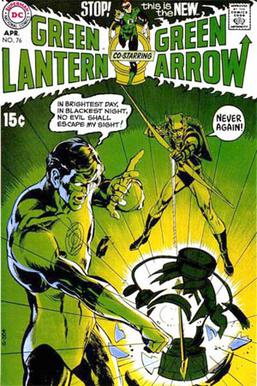
This week comic-book writer and editor Dennis O’Neil showed up on two of my podcasts.

I’d expected to hear his voice on Fat Man on Batman because Kevin Smith had promised a multi-part interview about O’Neil’s career in comics, particularly as writer and editor of the Batman magazines.

But I was surprised to also hear O’Neil pop up on Back Story, the best radio show/podcast about American history. The St. Patrick’s Day theme was “green,” and producer Andrew Parsons interviewed O’Neil about the Green Lantern/Green Arrow series starting in 1970.

That series was also a big part of Smith’s interview, which is longer and more detailed. It’s a milestone in “relevant” superhero comics, marred only by the fact that it didn’t win over enough readers at the time to keep the Green Lantern magazine from being canceled within two years.

19 March 2014

Kick-star-ter for Tik-Tok

This week I pledged in a Kickstarter campaign for a production of The Tik-Tok Man of Oz, first shown in 1913-14, at this summer’s Winkie Convention in San Diego.

I’m attending that convention (in fact, I’m helping with the daytime programming), so I’m already going to reap the benefit of this production. But I admired producer Eric Shanower’s theatricality in a bare-bones ballet adaptation of The Road to Oz a few years back, so I thought this show would be worth a real ticket price.

As a celebrated artist, Eric had the ability to offer a very rare incentive for a large pledge: a “20"x24" original painting by Eric Shanower of 30 major Oz characters.” Having just one person sign up for that reward would have brought the campaign two-thirds of the way to its goal. I assumed that was the sort of pie-in-the-sky level that Kickstarter campaigns offer people in order to make the next level down seem less expensive.

Instead, two people have signed up for that grand reward, putting the campaign over the top and producing an unusual pattern in the pledges. Recent Kickstarter campaigns for a documentary film titled “Who Stole the Ruby Slippers?” (still ongoing) and a “Shadow of Oz” tarot deck (which just made its goal) seem to have a more common distribution, with most people pledging in the low and middle tiers and nobody offering four-figure sums.

The demand indicated by this pledge pattern for Tik-Tok Man would make me seriously think about doing nothing but original paintings of 30 major Oz characters.

18 March 2014

Oz and the Riverside Orchestra

On 13 April, the University of California at Riverside Orchestra will offer a program titled “American Fairy Tales,” celebrating the life and work of L. Frank Baum.

The orchestra’s description says:
We celebrate The Wizard of Oz and its creator, L. Frank Baum: the world premiere of Tim Labor’s A Royal Pair, musically telling two tales by Baum, and concert suites from The Wizard of Oz and its two offspring Wicked and Oz the Great and Powerful. The brilliant Johanna McKay returns as narrator.
Ruth Charloff (shown here) will conduct.

On Facebook, Jane Albright reports that A Royal Pair is based on Baum’s “The Queen of Quok” from American Fairy Tales—and perhaps a second tale? Composer Tim Labor is on the UCR music faculty; on Facebook he mentioned only one tale, so perhaps plans changed.

I mention this not because I know any of the folks involved or expect to attend a concert on the other side of the country. Rather, it’s because I attended symphony concerts in Riverside while still in the womb, and my mother introduced me to the Oz books.