28 February 2014

Diagnosis: Fear of Obamacare

News stories and political commercials have spotlighted some Americans complaining about changes in their health insurance under the Affordable Care Act. In nearly every case that’s been critically examined, however, those people have actually been suffering from fear of Obamacare.

Maggie Mahar at HealthInsurance.org looked into an article in the Fort Worth Star-Telegram about four people who said they were worse off under the new law. Three of those people turned out to be active in the Tea Party. Their claims of not being able to find affordable insurance didn’t add up. Mahar concluded, “The paper describes them as among Obamacare’s ‘losers,’ but the truth is that they didn’t want to be winners. Two hadn’t even attempted to check prices in the exchanges.”

The same behavior showed up many other places. NBC and FOX News both featured Deborah Cavallaro and Richard Helgren complaining about their experiences with the new law. At the American Prospect, Paul Waldman checked Cavallero’s story and found that she (and the reporters who spoke to her) must not have tried her state exchange since it offered quite affordable insurance for someone in her situation.

As for Richard Helgren, buried inside the NBC report was this important fact: “Ultimately, though Helgren opted not to shop through the ACA exchanges, he was able to apply for a good plan with a slightly lower premium through an insurance agent.” Helgren probably had a very good insurance agent because he was in the insurance business, having retired as CFO of Michigan Hospital Association Insurance, which made its money selling medical malpractice insurance to hospitals and doctors.

NBC News also featured Greg Collett, who said he’d refuse to go along with the provisions of health insurance reform as a protest against government involvement in health care—while his ten children continue to receive care through Medicaid.

How many people suffer from fear of Obamacare? A recent poll in Arkansas offers some numbers for that state. A plurality of 48% of Arkansans supported the state’s “private option” for expanding Medicaid. However, only 35% of respondents supported the same plan when they were told it’s linked to the Affordable Care Act. That suggests that at least 13% of the population of Arkansas lives under the influence of fear of Obamacare.

Fear of Obamacare is so strong that it’s blocked a significant number of Americans from accepting options that would be more beneficial to them. It’s made them go on television to complain about problems they’ve chosen to perpetuate. It’s another form of OIP Derangement Syndrome.

27 February 2014

Will Eisner Week in Metro Boston

The Million Year Picnic comics shop, Stephen Weiner of the Maynard Public Library, the Cambridge Public Library, and folks from the Boston Comics Roundtable are collaborating on a local celebration of Will Eisner Week.

On Thursday, 6 March, the Cambridge library will host a conversation between two comics creators about Eisner’s art and legacy:
  • Paul Hornschemeier, creator of Mother, Come Home; The Three Paradoxes; and the New York Times best seller Life with Mr. Dangerous, among other titles.
  • Denis Kitchen, “underground comix” cartoonist, founder of Kitchen Sink Press and the Comic Book Legal Defense Fund, and Eisner’s literary executor.
That event is said to be scheduled from 6:00 to 8:00 PM at the library. This will be followed by a signing at the Million Year Picnic in Harvard Square, which has a weeklong sale of Eisner books. (I just bought one using another discount.)

On Saturday, 8 March, several local comics creators will lead comics workshops for kids (and interested adults who bring kids along) at the Cambridge library. Those creators are Jef Czekaj, Josh Dahl, Bob Flynn, Dan Mazur, Dan Moynihan, Braden Lamb, and Shelli Paroline. Those workshops start at 12:30 PM and run for two hours. Afterwards, there will be another signing at the Million Year Picnic from 3:00 to 5:00 PM.

25 February 2014

Off to Australia

Elizabeth Gilbert, author of Eat, Pray, Love, provided the Sydney Morning Herald with a list of “Books that changed me.” The first on the list:
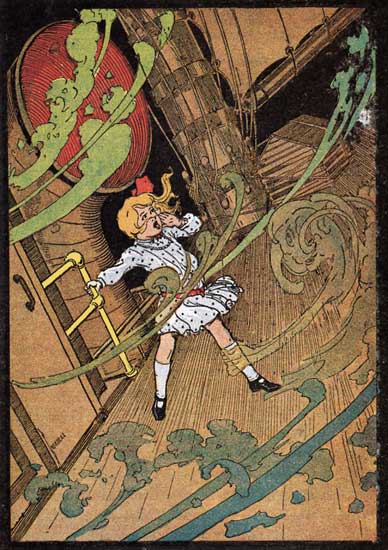
The Wizard of Oz series - L. Frank Baum

This is my origin story. I grew up with well-worn copies of these books - books that had been handed down through my family for several generations, complete with the stunning art deco illustrations. The Oz stories were tales of a farm girl (which I was) who went on otherworldly adventures (which I wanted to do) and who was incredibly brave (which I still want to be). I always credit these books with making me into a traveller and a writer. If you have an especially dreamy little girl in your house, forget about Disney videos - get her a box set of these babies.
Dorothy herself visits Australia in the series’s second book, Ozma of Oz. Of course, first she gets castaway at sea, bests the Wheelers and the Nome King, befriends Ozma, and visits Oz for the second time.

Two years ago, Gilbert similarly praised the series in the New York Times Book Review.

(Hat tip to Blair Frodelius’s Daily Ozmapolitan.)

24 February 2014

Dense Thoughts

Water has the very unusual physical property of expanding as it turns from liquid to solid. Most substances take up less volume as solids than as liquids, meaning they become denser when freezing. Frozen water, in contrast, is less dense and thus floats on liquid water.

If water behaved like most other chemicals in the universe, water that froze at Earth’s poles would sink to the bottom of the ocean, made up of the water that remained liquid. And most of that ice would remain frozen, out of reach of the Sun’s rays. Gradually more and more of the planet’s water would turn solid, building up on the ocean’s bottom and interfering with the processes of life. In other words, if water weren’t so weird, we wouldn’t exist.

I try to keep this thought in mind as I navigate around another result of water expanding as it freezes: potholes.

23 February 2014

Neal Adams on Robinson’s Robin

In the third part of Kevin Smith’s podcast interview with artist Neal Adams, Smith asks whom Adams sees as the creator of Batman. Earlier in the conversation Adams mentioned both Bob Kane and Bill Finger, and he didn’t evince a lot of respect for either man. Rather, he says, he sees Batman as a collective creation, not any one person’s character.

But Adams goes on to say:
I think of Robin as Jerry Robinson’s, for sure. That bouncy…Robin that I put in Batman: Odyssey. Like, I have Man-Bat right at the beginning of the story. . . . Man-Bat comes into the cave and just grabs Robin and starts flipping him up into the rafters. And so they fight up in the rafters, but while they’re fighting Robin is talking to Batman, and Batman is talking to Robin.

And for Robin, that’s great. First of all, he’s hearing from his mentor,…and yet he’s flying around in the top of the cave…with Man-Bat, and they’re spinning on stuff and doing all this shit. That’s Jerry Robinson’s Robin to me. He doesn’t stand there and have a conversation, boy, if he can be up in the rafters and spinning around. That’s Robin. And I love that Robin.
That said, Adams dressed the Dick Grayson in Batman: Odyssey in the costume he’d designed for Tim Drake back in 1989 or so, rather than in Robinson’s costume. There are limits, after all. Or maybe royalties.

Adams and Robinson were both crusaders during the 1970s fight for creators’ rights. In the middle third of Smith’s interview Adams described how they teamed up to win recognition and pensions for Superman creators Jerry Siegel and Joe Shuster, as shown above. (Robinson is on the right, pre-toupée. Adams is the young man.) So I suspect Adams saw Robinson as standing out from the collective a bit.

22 February 2014

Introducing (One Version of) Dr. Megalo

A couple of weeks back, I linked to the Boston Comics Roundtable’s “Working Method” experiment, which this month is focused on a script I wrote called “Owl and Pussycat.” Different artists are sharing their character designs, layouts, and even finished pages.

As part of the exercise, I avoided specific details about the characters because I wanted to give the artists the widest latitude. And because the way I pictured those characters wasn’t original at all. When one of the artists, Mike Tomasulo, asked me what I had in mind for the villain Dr. Megalo, I had to admit I was imagining Sivana from the Captain Marvel comics.

But Mike’s question prompted me to push myself a little, and I gave him some more options for Dr. Megalo:

For instance, Dr. Neil deGrasse Tyson in an ugly plaid blazer. An attractive blonde woman whose face has been scarred in a lab accident. A spoiled young prodigy in an oversized lab coat. A Silicon Valley billionaire who hasn't worn a tie since his bar mitzvah.
And the next day I had another idea: basing the design of Dr. Megalo on Edward Lear, author of “The Owl and the Pussycat.” At the Thursday B.C.R. meeting I sketched out that idea. Dan Mazur inked it (while fixing some proportions) with a brush. And finally I added type while trying out Manga Studio.

20 February 2014

Adding to the Fantastic Four Mythos?

The core mythos of the Fantastic Four comics, launched in 1961 by Stan Lee and Jack Kirby, is that a family goes into space, gets turned into monsters by cosmic radiation, and decide to make themselves into a new sort of superheroes. They don’t have secret identities (at first they didn’t even have special costumes, but fans insisted); in fact, they’re celebrities. And they take on the biggest threats to Earth.

Family was key to the mythos: an arrogant scientist, his best friend, his fiancée, and her kid brother. As the crew of a space mission, an extended family made no sense. As a team stuck together and sticking together through one galactic crisis after another, it had deep meaning.

Earlier this year an alleged synopsis of the movie leaked and was then denied:
“The Fantastic Four” will tell the story of two very young friends, Reed Richards and Ben Grimm. After an event transforms the boys, they find themselves empowered with bizarre new abilities. Reed becomes a scientific genius who can stretch, twist and re-shape his body to inhuman proportions. Ben becomes a monstrous, craggy humanoid with orange, rock-like skin and super strength. However, the two end up being owned by the government and used as weapons. But after they mature, two others with powers come into the picture – Sue Storm “The Invisible Girl” and Johnny Storm “The Human Torch.”
In other words, the four principals weren’t a family first and superheroes second. That would be a big change. But instead of talking about that, a significant number of fans got upset only about the concurrent casting news: that the actor expected to play the Human Torch was Michael B. Jordan, a young black man.

That talk continued today as the studio confirmed Jordan’s casting and revealed more information, including Kate Mara as Sue Storm. Jamie Bell, who became a star in Billy Elliot, has been tapped for Ben Grimm, the Thing. I can’t really see that, and it’s impossible to imagine someone better for that role (as Kirby originally designed the Thing) than Michael Chiklis in the last two movies. But Bell can produce Grimm’s working-class, Yancy Street outlook, and we probably won’t see his body anyway—we’ll see a CGI, motion-captured overlay.

But again, a significant slice of people complained about Jordan being black. Some of those folks tried to justify themselves by saying that Johnny and Sue are supposed to be siblings, yet Jordan is black and Mara white. As artist Cameron Stewart responded on Twitter, “Interracial siblings are apparently much much harder to explain and accept than stretchy limbs, invisibility, burning skin and a rock man”. Other complainers simply repeated their gripe that today’s moviemakers were changing a detail of the story they liked when they were twelve simply to be nice to people of color.

I can see one argument that Johnny Storm’s character has to be white as Kirby originally drew him. In the early comics Lee wrote Johnny as a hothead with a big ego and dangerous powers. Only a good-looking blond kid could get away with that behavior in 1961 and become a celebrity. Even now, young black men are subject to dangerous stereotyping. So that argument for casting Johnny as white, male, and handsome rests on a racist society.

But to see Johnny Storm’s character or story requiring him to be black in this age depends on seeing his skin color and ethnic background as inherent to his character—more than being a young and handsome hothead, more than his relations with other team members. Furthermore, most of the criticism has focused on that casting instead of on the much bigger changes to the larger mythos. It’s hard to see it as not just resting on but perpetuating a racist society.

18 February 2014

Illustrating Picture Books versus Drawing Comics

Toward the end of his conversation with Skottie Young on the Stuff Said podcast, artist Gregg Schigiel asks about Young’s experience illustrating his first picture book, Fortunately, the Milk by Neil Gaiman. (A lot of Schigiel’s interviews seem to be digging for career counseling, but that’s another story.)

Young sounds almost amazed as he reports how much easier illustrating a picture book was compared to drawing a comic. Jef Czekaj said the same thing on a panel I moderated a while back. I wouldn’t be surprised if other artists who’ve worked in both fields feel the same way. That’s not to say picture-book illustration is easy; but relatively it seems to be a more pleasant experience.

For one thing, picture books don’t require so many pictures. A 32-page picture book might require 20 separate images, which could fill as few as four pages of standard comics. True, those images have to be bigger and more detailed so that they reward multiple readings. On the other hand, they don’t have to be so tightly squeezed together on a page with captions and word balloons impinging on them.

More important, however, is how picture-book publishers treat artists. Editors and art directors choose an artist based on his or her past work and reputation, and they see their job as assisting the writer’s and artist’s visions come to fruition, not to move the corporation’s larger story along. They don’t try to exercise so much editorial control. They set more generous deadlines.

Schigiel’s book experience has come with licensed titles (i.e., those that are part of a corporation’s larger story). So he starts out asking Young what his Art Director told him. But Art Directors for picture books are far more hands-off than people with the same title in other parts of publishing. Young found himself surprised at how few “notes” he received back on his sketches.

The biggest difference between the mainstream book business and other forms of publishing is visible on the covers. On a book, the author’s and illustrator’s names are almost always the biggest; on Fortunately, the Milk, Gaiman’s name is huge, Young’s rather small. But the publisher’s name is usually smallest of all, slipped onto the bottom of the spine and the back. In a comic book or other magazine, the magazine’s name is the biggest; its employees are in charge, and its intellectual property and reputation is what mainly drives the sales.

17 February 2014

A Jury That Did Not Compromise

In the trial of Michael Dunn for killing Jordan Davis, the instructions to the jury offered the possible charges of first-, second-, and third-degree murder, plus manslaughter. That’s routine in such trials.

The jury couldn’t reach a verdict on that part of the trial. We may hear more from jurors this week. So far most of the commentary I’ve seen has focused on the fact that at least one juror (and possibly as many as eleven) was unable to see Dunn’s shooting and subsequent lies as clear evidence of murder.

The hung jury also suggests that at least one juror (and possibly as many as eleven) couldn’t see Dunn’s actions as anything less than first-degree murder. For centuries juries in the British and American legal tradition have compromised on verdicts that might not accord with the evidence but struck them as most just, given the facts of the case and the punishments involved. In this case, I suspect, some of the jurors felt that any such compromise would deny the enormity of Michael Dunn’s actions.

16 February 2014

Robin Black and White

The last issue of DC Comics’s second Batman Black and White series offers a fine short story about Dick Grayson as Robin, written and drawn beautifully by Cliff Chiang.

In only eight pages, Chiang’s “Clay” addresses both the inherent tension in any story of a kid sidekick and one of the biggest challenges of adolescence: feeling you need to prove yourself with everybody watching.

He also manages to touch on all four major male characters at the dawn of the Dynamic Duo mythos: Bruce Wayne/Batman, Dick Grayson/Robin, Commissioner Gordon, and (unseen) Alfred.

In contrast with the New 52 revamp in the recent Batman and Robin Annual, this Robin is clearly the littlest guy in the fight. Chiang draws him to look about half Batman’s size. The Gotham police think he’s a joke. As usual, he’s worried that Batman doesn’t trust him to keep up. And there’s a supervillain marauding in Crime Alley.

Though this Robin wears the 1940-1990 costume, this story isn’t an old-fashioned throwback. Dick describes Batman’s mission as “scaring the crap” out of criminals. Bullies at his school make fun of his name and how he lives with Bruce Wayne, and he puts them in the hospital. Redevelopment in central Gotham involves “chain restaurants.” But the overall feeling is timeless.

The villain Basil Karlo/Clayface, appeared in the June 1940 issue of Detective Comics and was thus among the first villains that Robin tangled with. Karlo was just a murderous Lon Chaney. Later writers reused the name Clayface for villains who could remold their bodies and manipulate the earth like clay, becoming a much bigger threat.

By page four, Chiang’s story establishes that this Karlo has those superpowers, too. That’s important not only for the well-drawn fight scene that follows but also because it links this Clayface to the Boy Wonder. Both are natural performers, and Dick has to figure out if he wants to let himself be driven by audience approval and remold himself like Karlo.