30 November 2013

This “Dude” Was a Dud

I’ve been looking into the origin of the word “dude,” which originally meant a dandy or a fop. It exploded into public consciousness in early 1883, though researchers have found two uses in the late 1870s.

Mary Mapes Dodge, editor of St. Nicholas Magazine, muddied the waters a little in 1890 when she wrote in an article about curious words:
The word dude began to mingle in the speech of the people of this country about the year 1873, but did not make its appearance in print until 1876, when it boldly met the public gaze in the February number of “Putnam’s Magazine.” The origin of the word has been a question ever since it asserted itself in every-day speech, and its claim to represent a human nonentity in raiment befitting either fool or fashion-plate has never yet received the stamp of authority.
In fact, Putnam’s Magazine wasn’t being published in 1876. The issue at issue was dated February 1870. Furthermore, that magazine didn’t include the word “dude”; it included the word “dud,” with the direct opposite meaning.

That issue of Putnam’s included part of a novel titled Eirene: or, A Woman’s Right, by Mary Clemmer. In it someone asks a young man what he thinks of a young lady, and he replies:
“Think! I think she is dressed like a dud. Can’t say how she would look in the costume of the present century.”
Maximilian Schele De Vere quoted that passage (without exacting accuracy) in his Americanisms: The English of the New World (1871) under the entry “Dud.” Context shows it was a form of the old word “dowd,” as in “dowdy.” It meant a woman unfashionably dressed and not a man too fashionably dressed.

After “dude” burst on the scene in 1883, however, etymologists went looking for its origin. Some found De Vere’s entry and cited it in an argument that “dude” had grown out of “dud.” For discussion of a more convincing theory, see this posting at Boston 1775.

29 November 2013

Atomic Clock

“A couple of minutes after 9 p.m. on Saturday,” Dana Millbank of the Washington Post wrote, news wires reported that the U.S. and five European allies had reached an agreement with Iran to slow its nuclear enrichment in exchange for somewhat reduced economic sanctions.

It took only until 9:08 P.M. for former Bush press secretary Ari Fleischer to tweet that Barack Obama had presided over some sort of “abandonment.” Fleischer of course had no knowledge of the details of the agreement. His statement was clearly a knee-jerk reaction.

It took only until 9:11 P.M. for former Dick Cheney staffer Ron Christie to call the treaty a “disgraceful deal.” Again, he had no way to knowing the details of that deal, only that the Obama administration had agreed to it.

It took only until 10:15 P.M. for Sen. John Cornyn (R–Tex.) to suggest that the whole diplomatic initiative, years in the making and involving seven large countries, was just a way to distract from problems with the Healthcare.gov website.

President Obama described details of the agreement for the press shortly after 10:30 P.M. As of today, less than a week later, UN inspectors have been invited to view an Iranian heavy-water facility for the first time. Diplomats are looking ahead to possibilities of a more permanent agreement.

Responsible people can oppose this agreement based on its provisions or the record of the parties involved. But people with OIP Derangement Syndrome don’t need to go into such factual details. They can announce their opposition within minutes because whatever President Obama does, they’re against it. As Millbank wrote: “This president could negotiate a treaty promoting baseball, motherhood and apple pie, and Republicans would brand it the next Munich.”

28 November 2013

Let Us Be Thankful That This Isn’t Rerun Every Year

In 1980 the Muller Rosen animation company released a half-hour holiday special for television titled Thanksgiving in the Land of Oz. That show was then recut to remove the Thanksgiving references and released on video as Dorothy in the Land of Oz; as of this holiday, it can be watched in two parts on YouTube. In 1982 Romeo Muller adapted his screenplay into a short illustrated book titled Dorothy and the Green Gobbler of Oz.

Like most Oz videos in the television age, this cartoon was written to invoke MGM’s Wizard of Oz. Dorothy meets the Wizard in Kansas again, the Cowardly Lion is bipedal, there are songs, and so on. But the filmmakers also obviously knew the Oz books and used them as inspiration for characters, settings, and plots points, albeit without being faithful to those books.

Thus, for example, just as in L. Frank Baum’s original novel and the MGM movie, Dorothy and Toto accidentally travel to Oz and meet three male companions who help her on a quest to vanquish a villain. One of those companions is an animated refugee from a farm, another made of metal, and the third a big carnivore with gentle habits. But in this movie those characters are Jack Pumpkinhead, Tic Toc [sic], and the Hungry Tiger, whom Baum introduced in different ways in his second and third Oz books.

Jack lives in a pumpkin house, as John R. Neill drew it in The Road to Oz. Other Oz houses resembles those he and W. W. Denslow designed, and a sequence of children opening Christmas presents owes a lot to Denslow’s art, rendered with less character. However, a trip over a rainbow at the end is clearly inspired by the MGM movie’s most famous song.

The end of the cartoon shows Ozma as rightful ruler of the Emerald City, but there’s no explanation of how she came to the throne. This Ozma seems much older than Dorothy and more like the Glinda of the movie.

Another element that the filmmakers borrowed from Baum’s books appears at the start: Uncle Henry and Aunt Em are about to lose their farm to the bank. The couple plans to go into an “old folks’ home” while Dorothy will have to live somewhere far away with a cousin—perhaps Zeb Hugson from Dorothy and the Wizard in Oz. This is a better fate than what Baum wrote about in The Emerald City of Oz, which suggested Dorothy would have to go to work while her aged relatives might end up begging. Still, it was probably a shock to many viewers.

The big-name star of the production is Sid Caesar, who plays the Wizard and narrates the story in that role. Caesar also plays a mince pie that’s brought to life, takes the name U.N. Krust, and delivers every line in a different foreign accent. The pie and its speech patterns play no role in the plot; they seem to have been included just to put Caesar’s shtick to use. We haven’t seen so much ethnic humor in an Oz adaptation since the 1903 Broadway show.

Another notable casting detail: Joan Gerber supplied the voices for both Ozma and Tic Toc.

The cartoon includes a couple of forgettable songs. Dorothy uses one to convert the villain back into a benevolent toymaker, and at the same time deliver a paean to Christmas shopping. In that respect, this modestly produced special was a perfect start to commercial television’s holiday season.

27 November 2013

Corporate Cultures and the Marvel Method

This episode of Decompressed, a podcast by British comics scripter and journalist Kieron Gillen, is one of the most interesting discussions of comics scripting that I’ve ever heard.

Gillon tries to focus his podcast on the mechanics of creating comics, not just enthusiastic appreciation. The nominal subject of this discussion is the contrast between Marvel’s three-stage plot–art–dialogue method of creating comics and the full-script (or plot–dialogue–art) method that DC and most of the industry use.

Gillen shares lots of examples from the participants, including script pages and finished line art, on his blog. (At left is a first-stage “Marvel Method” script with short action descriptions and the artist’s thumbnail sketches but no finished dialogue.) The practical insights from fellow writers Mark Waid and Matt Fraction and special guest artist Jamie McKelvie are useful but not particularly surprising.

I was more struck by the participants’ observations about how the cultures of the “Big Two” American comics publishers have been shaped by those different approaches. Fraction notes that Marvel still pays a writer separately for the plot and the dialogue even if he (since it’s usually a “he”) delivers them at the same time. Waid points out that DC, at least as of the 1980s when he was an editor there, paid twice as much for a story’s dialogue as for its plot—which naturally motivated writers to provide full scripts.

The comics creators in the conversation—three of them writers—also make interesting observations about what happened when artists Dick Giordano and Joe Quesada came to be in charge of DC and Marvel, respectively. Suddenly the artists were getting more compensation.

26 November 2013

Creating Bravely with SCBWI New England in May

This proud lion adorns the announcement of SCBWI New England’s 2014 conference in Springfield, Massachusetts, on 2-4 May. A “Save the Date” postcard just went out to members in the region. Registration will open on 5 February.

That conference has the theme “Create Bravely: Make Your Mark,” hence the lion’s medal and the pencil and paint brush in his mane. I’m scheduled to make my mark there by leading one workshop and handling some other duties.

This fine feline was drawn by artist Denise Ortakales, who normally works in cut-paper sculptures. Check out her website for lots of lovely work.

25 November 2013

“This gentle, kindly naturalist”

From the New York Times Book Review’s “By the Book” interview with Richard Dawkins:
Did you identify with any fictional characters as a child? Who was your literary hero?

I didn’t know children were expected to have literary heroes, but I certainly had one, and I even identified with him at one time: Doctor Dolittle, whom I now half identify with the Charles Darwin of Beagle days. This gentle, kindly naturalist, who could talk to nonhuman animals and commanded godlike powers through their devotion to him, is nowadays unfashionable — and even banned from libraries — because of suspected racism. Well, what do you expect? Hugh Lofting was writing in the 1920s, and the ubiquitous racism of England at that time can be seen in so much fiction, including Agatha Christie, Sapper (“Bulldog Drummond”) and many other popular writers for all ages. This is not to excuse it, but Lofting’s racism was paternalistic rather than malign and, in my opinion, sufficiently outweighed by the admirable anti-speciesism of all his books.
Dawkins grew up to be an evolutionary biologist, ethologist, and proponent of secular rationalism.

24 November 2013

Counting All Covers

In preparation for the “Celebrating 75 Years of Dick Grayson” anniversary, I got a question about the assertion that Robin was on the cover of more DC comic books of the 1940s than any other costumed hero.

A commenter told me that fact soon after I started the weekly Robin, saying it was a good way to win bar bets. (Not at any sort of bar I know, but okay.) A quick check of titles confirmed the fact, but I decided to do a more careful accounting.

In the 1940s, Superman appeared on the covers of:
  • Action Comics, #20-139 (120 comic books).
  • Superman, #3-61 (59).
  • World’s Fair, #1, and World’s Finest, #2-42 (42).
  • All-Star Comics, #36 (1).
  • Superman’s Christmas Adventure for 1940 and 1944 (2).
  • Superboy, #1 (1).
Total: 225 comic books.

Batman appeared on:
  • Detective Comics, #35-154 (120).
  • Batman, #1-56 (56).
  • World’s Fair, #1, and World’s Finest, #2-42 (42).
  • All-Star Comics, #36 (1).
  • Star Spangled Comics, #88-94 (7).
Total: 225 comic books.

Robin appeared on:
  • Detective Comics, #38-152 and #154 (116).
  • Batman, #1-46 and #48-56 (55).
  • World’s Fair, #1, and World’s Finest, #2-42 (42).
  • Star Spangled Comics, #65-95 (31).
Total: 244 comic books.

I might have missed some of the more obscure guest appearances, but Superman and Batman still have a lot of ground to cover before they catch up to the Boy Wonder. His usually-solo run on Star Spangled at the end of the decade put him in the lead.

Now I can’t claim that Robin was more prominent or popular than Superman or Batman in the 1940s. On many of those covers he appears subordinate to Batman, as a background assistant, observer, or boy hostage in need of rescuing. When Superman and Batman guest-starred on All-Star Comics with the Justice Society, Robin didn’t come along. When sales of Star Spangled featuring Robin began to slip, the editor added Batman to the cover before finally replacing the Boy Wonder with Tomahawk.

Furthermore, if we count the appearances of Superboy on the covers of More Fun Comics, #104-106; Adventure Comics, #103-147; and Superboy, #2-5 (52 more comic books in all) in Superman’s column, then he’s the clear leader. Superman was undoubtedly DC’s flagship property, with a national comic strip, radio show, movies, and novelizations. Starting in 1942 the company even included the name of Superman in its logo. But the US courts have decided that Superboy is a separate legal property.

So those are the numbers.

23 November 2013

Grayson: Haly Origins Trailer

On his latest “Fatman on Batman” podcast, Kevin Smith led Paul Dini into rapture over the preview for the Batman: Arkham Origins videogame. In a short series of animated scenes, the “trailer” traces the early life of Bruce Wayne from happy spoiled kid to Dark Knight.

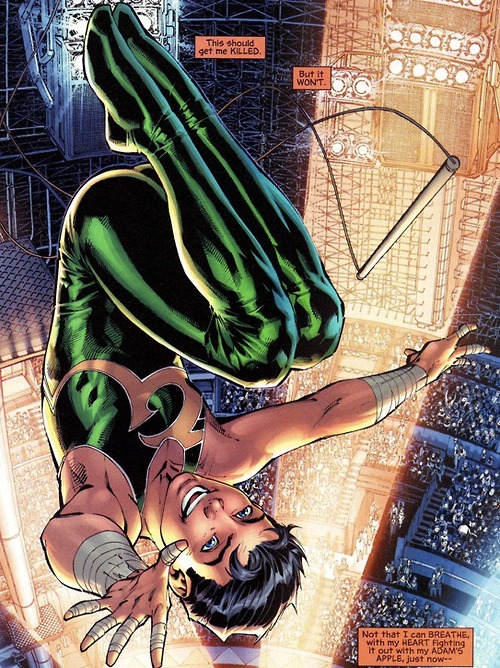
That got me wondering what the equivalent might be for Dick Grayson. Right away I decided that a wordless video about Dick would require more movement. And this is the series of shots I came up with.

1) A fanfare from a pipe organ. Bright lights illuminate the back of a preteen boy’s head and shoulders: black hair combed and sprayed into barely acceptable neatness. The boy leaps up and forward, then plunges down and straight away from us viewers on a trapeze, swinging in an arc up and out of sight in the distance.

2) As the boy is off screen for two or three second, the pumping music is drowned out by oohs and ahhs and applause. The boy comes swinging back toward us, face front and grinning infectiously, and comes to a halt in the foreground where he began.

3) The boy moves out of the frame to the left, and a woman’s back appears from the right. She, too, swings down and then up and out of sight on the trapeze.

4) The music suddenly cuts off and the crowd gasps. The trapeze swings back into the foreground, empty with one rope broken. The bright lights fade as the broken trapeze swings away again. There is one second too long of emptiness.

5) From the distance the Batman swings down on his rope and up into the foreground. He comes to rest and moves out of the frame to the right.

6) The boy’s head appears again, his hair not so tamed and his shoulders now draped in yellow. Batman and Robin swing away into the distance on twin ropes.

7) Batman and Robin swing back into the foreground in parallel arcs. Batman now has a yellow oval around his chest emblem. Dick is a year older and smiling as before.

That’s enough for an origin. But in the interest of completeness and loyalty to the pre-New52 universe:

8) Batman and Robin swing into the distance. Robin is another few inches taller. Swinging slightly behind Batman, he takes advantage of the privacy to curl upside-down on his rope.

9) Batman and Robin swing back into the foreground on their ropes. Batman is serious. Robin, now in his mid-teens, looks grumpy.

10) The teenaged Robin swings away, alone.

11) Robin the Teen Wonder swings back, once again smiling, flanked by Wonder Girl and Starfire in flight.

12) Dressed in a high-collar outfit with light blue highlights, Dick as Nightwing kisses Starfire as she carries him into the distance.

13) Encouraging a new, pants-wearing, and not quite as graceful Robin swinging forward on the rope, Nightwing glides in from the distance, using the aerodynamics of a new outfit with yellow highlights and wings and an unfortunate haircut.

14) Nightwing swings away to the distance, now handsomely coiffed and in a sheer black outfit with blue highlights all the way down his arms. Another second passes.

15) Batman swings in from the distance, coming to rest in the foreground as in shot #5. At the last instant, Batman cracks the same smile as the preteen boy in shot #2.

22 November 2013

Hacking OIP Derangement Syndrome

Sophos’s Naked Security blog noted a little-reported aspect of the Healthcare.gov rollout—at least sixteen cyberattacks on the site from 6 to 8 November. It’s unclear whether there were more on other days.

In addition, Information Week reported on software programmed to overload the website. As distributed on right-wing websites, it says:

"This program continually displays alternate page of the ObamaCare website. It has no virus, Trojans, worms, or cookies. The purpose is to overload the ObamaCare website, to deny serivce [sic] to users and perhaps overload and crash the system," reads the program's grammar- and spelling-challenged "about" screen. "You can open as many copies of this program as you want. Each copy opens multiple links to the site."
The technology magazine goes on to say that the “Destroy Obama Care” tool isn’t well designed for its intended task, and therefore is less effective at slowing the federal website than the lack of cooperation from Republican state governments.

Opponents of health-insurance reform have also tried to attack the law by spreading false news. Most notoriously, on the day the website went live an anonymous person posted a long complaint from a “Will Sheehan” about suffering penalties, including loss of a driver’s license and garnished income, after trying to sign up. Politifact and other news sources showed how that story could not be true. But clearly someone had put a lot of time and imagination into concocting it.

These efforts to stop people who need health coverage from obtaining it seem akin to gluing shut the doors of a hospital, tearing down the signs to a soup kitchen, or pushing in front of poor kids at a school cafeteria. Who would do something that cruel? Only people with OIP Derangement Syndrome.

21 November 2013

Creating a Safe Place

As long as I’m linking to videos, I’ll add this time-lapse record of Dean Trippe’s work drawing a significant page in his autobiographical Something Terrible comic, available here.

The completed image, titled “You’ll Be Safe Here,” reflects what heroic fiction can provide to troubled readers. Most of the comic is in muted two colors, but for this image Trippe bursts out in full, bright coloring, as the last seconds of the video shows.

The video was created by Scott Fogg, writer of a comic-in-progress called Phileas Reid Knows We Are Not Alone. The artist is Marc Thomas. Trippe is slated to do the coloring and Vito Delsante the lettering. There’s a Kickstarter campaign for the book going on now.