31 May 2013

Gabriel Gomez Repudiates His OIP Derangement Syndrome

It’s hard to suffer from OIP Derangement Syndrome in Massachusetts. The population is well educated and exposed to a range of news, making it difficult to maintain prejudices and false beliefs about President Barack Obama without challenge. Gabriel Gomez, the neophyte now asking to be one of Massachusetts’s US Senators, has found that out.

Back in 2012, a group of special-forces veterans formed what they called the Special Operations Opsec Education Fund, or OPSEC for short. This was a 501(c)(4) non-profit “social welfare” organization that was not supposed to have politics as its primary function.

But the group was bankrolled by Republican/Tea Party operatives, and its main activity was an election-year video criticizing the President for how he’d announced the raid that killed Osama bin Laden. OPSEC drew immediate comparisons to the deceitful anti-Kerry “swiftboat” campaign of 2004.

OPSEC’s video was based on falsehoods, as the New York Times campaign blog pointed out:
Anyone who watched the late-night address in which Mr. Obama announced Bin Laden’s death will remember that he praised the “tireless and heroic work of our military and our counterterrorism professionals” and the “years of painstaking work by our intelligence community.” The Opsec video includes a clip of that address, but omits the “heroic work” and “painstaking work” lines so that it seems as though Mr. Obama gave himself undue credit.
The question of whether Obama should have said more about the military personnel or less about his choice to deploy them is a value judgment, colored by how well people can accept the man as President. But on factual matters Politifact evaluated three other statements from OPSEC as Half True, Mostly False, and False.

Gomez helped to publicize OPSEC’s positions. A former Navy SEAL, he went on television to speak for the group, doing so in the first person: “We’re not saying he didn’t thank the troops and he didn’t give credit to the troops. What we’re saying is a big majority of the presentation was focused on him and his administration.”

But that was last August. A few months later Gomez decided to become to a Massachusetts Senator, and he scurried to deny that he’d ever exhibited OIP Derangement Syndrome. He privately promised the governor that he’d support major parts of the President’s agenda if he were appointed to the seat. When that didn’t work, he repudiated those policy positions, but he’s also tried to repudiate his propaganda work, as the Springfield Republican reported:
“I did two interviews for OPSEC,” Gomez said. “I was never associated with OPSEC. I never donated to OPSEC. I wasn’t part of OPSEC.”

When he appeared on MSNBC in 2012, Gomez was described as a “member” of OPSEC, but he now says, “I represent the point of view. I never represented the group.”
Gomez apparently doesn’t understand how television interviews are, like Presidential speeches, recorded for replay later. He tried to rise by playing to OIP Derangement Syndrome, and now he’s hobbled by his own words.

30 May 2013

Taking Inspiration and Making It Chittier

From the Oxford Dictionary of National Biography comes this life of Louis Vorow Zborowski, a racing-car maker and driver active in Britain in the early 1900s.

Zborowski provided the inspiration for one children’s adventure novel with his post-World War I application of aeronautic technology to automobiles:
The end of the war led to the ready availability of large capacity aero engines, exactly the type Zborowski needed to build his own racing cars in the stables at Higham Park. . . . The first car, powered by a 23 litre 6 cylinder Maybach aero engine used in Zeppelin airships, and fitted with an angular body made by Blighs, was christened Chitty-Bang-Bang. A second car, Chitty-Bang-Bang II, was powered by an 18.9 litre Benz aero engine. . . .

Chitty-Bang-Bang was driven up from Kent on trade plates to make a winning début at the opening meeting of the Brooklands season in March 1921, attracting much attention as the ‘mystery’ car (The Times, 29 March 1921). . . . The novelist Ian Fleming, who had seen Zborowski’s car at Brooklands in the early 1920s, and who was later a visitor to Higham Park, used elements of it in his children’s fantasy Chitty-Chitty-Bang-Bang (1964–5).
Both Zobrowski and his father died in racing-car accidents.

29 May 2013

Kipling’s Law

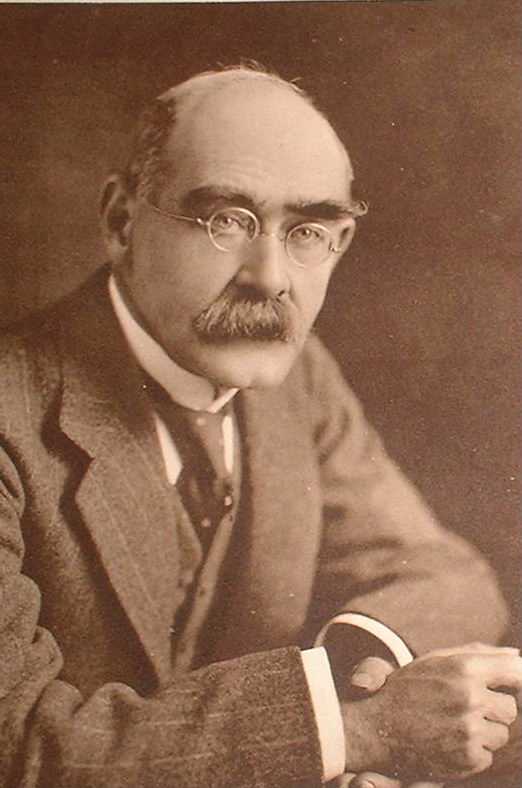
The Telegraph just ran a story headlined “Rudyard Kipling letter admits plagiarising parts of the Law of the Jungle”. That’s simply untrue.

The actual news hook is that an 1895 letter in which Kipling discusses his inspiration for The Jungle Book is up for auction. In that letter Kipling was replying to someone who evidently wanted to know the source of the novel’s “Law of the Jungle.”

Kipling had to tell his correspondent that he had made most of it up for the purpose of the story. In other words, he hadn’t plagiarised it. He said only, “a little of it is bodily taken from (Southern) Esquimaux rules for the division of spoils,” and politely acknowledged that he might have been inspired by other sources he “at present cannot remember.”

Given, however, that the “Law of the Jungle” is written in the voice of a wolf pack, I heartily doubt anyone could find sources that Kipling directly cribbed from.

Now this is the Law of the Jungle—as old and as true as the sky;
And the Wolf that shall keep it may prosper, but the Wolf that shall break it must die.
As the creeper that girdles the tree-trunk the Law runneth forward and back—
For the strength of the Pack is the Wolf, and the strength of the Wolf is the Pack.


Wash daily from nose-tip to tail-tip; drink deeply, but never too deep;
And remember the night is for hunting, and forget not the day is for sleep.
The Jackal may follow the Tiger, but, Cub, when thy whiskers are grown,
Remember the Wolf is a Hunter—go forth and get food of thine own. . . .
Read the rest here.

It should go without saying, but there’s no plagiarism in writing an original story or poem that explores the ramifications of an ethical rule long in the public domain. The Telegraph’s characterization of what Kipling did and admitted is either sensationalist or a sign that its editors no longer understand the fair use and exchange of ideas.

28 May 2013

“What worse way to wake up?”

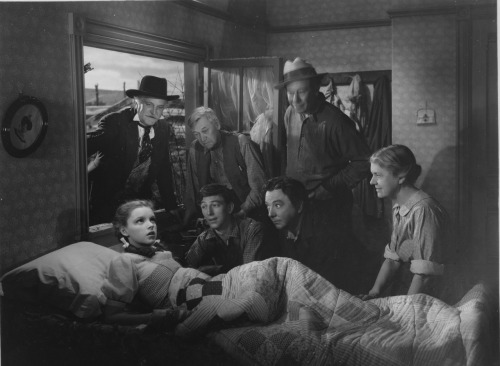
In the Boston Globe last weekend, Peter Keough offered a roundup of “morning after” movies, saying that the group “is virtually its own film genre.” Among them he chose to list MGM’s The Wizard of Oz:
What worse way to wake up from a Technicolor dream of self-empowerment fantasy than by discovering that you are really living in a dusty, monochrome, joyless Kansas surrounded by yokels and are destined to grow up into the same. It’s enough to drive you to drink.
Of course, that’s presaged by the stifling “lesson” this movie’s Dorothy Gale learns from her adventures in Oz: “If I ever go looking for my heart’s desire again, I won't look any further than my own back yard. Because if it isn’t there, I never really lost it to begin with!”

27 May 2013

Common Sense in the Gun Industry

This morning’s New York Times includes Mike McIntire and Michael Luo’s article on records from a lawsuit about ten years ago arguing that gun companies bore some responsibility for the harm caused by the lethal instruments they manufacture.

Most gun-company executives denied any such responsibility, but there were a couple of exceptions.

Ugo Gussalli Beretta, a scion of the family of Italian firearms makers,…indicated that he did not understand how easy it was to buy multiple guns in the United States, compared with his home country. Questioned by a lawyer for the Brady Center to Prevent Gun Violence, he said he believed — incorrectly — that Beretta U.S.A. had a policy requiring its dealers to first determine if there was “a legitimate need” for someone to buy so many guns.

Asked why he thought that, Mr. Beretta replied, “Common sense.”
Toward the end of the article, McIntire and Luo note that in 2000 Smith & Wesson, then the country’s largest handgun manufacturer, agreed to settle the lawsuit, design a handgun that children couldn’t operate, and require its dealers and distributors to run background checks on all sales, including at gun shows. So what happened?
Smith & Wesson’s sales quickly plummeted amid an industry backlash. Documents produced through the discovery process in the municipal suits show other gun makers seeking to isolate the company. A letter from Dwight Van Brunt, an executive at Kimber America, a gun maker, to top officials at a firearms industry trade group urged them to confer with the N.R.A. and “boycott Smith now and forever. Run them out of the country.”
The company came under new management the next year and stopped carrying out that agreement. Note that Kimber America expected to use the NRA in its campaign against a competitor.

26 May 2013

A Mystery in Miniature Cosplay

This photo popped up on a friend’s Facebook feed. Alas, I don’t know the ultimate source.

The Dynamic Duo’s styling—and the exhaust emissions—suggest a date from the 1960s or ’70s. But the other cars in the background are much more recent.

22 May 2013

The NRA’s Movie Choices Show What Its People Really Think about Guns

This week the National Rifle Association’s American Rifleman website featured an unsigned list of its top ten “Coolest Gun Movies.” It’s an interesting window into how people in the organization think.

To begin with, this list has little or no praise for gun design or marksmanship. It doesn’t include Winchester 73 or Sgt. York, for instance. Nor is there any regard for gun-collecting, supposedly the reason people need to be able to buy a dozen guns at once. Even Lock, Stock, and Two Smoking Barrels has more regard for that hobby than this article.

Instead, the list’s main impetus is fantasizing about social breakdown. Of the ten films listed, five take place in some horrible future that the writer enjoys imagining and presumes his audience will, too. Thus, the writer praises The Road Warrior despite the fact that, as he admits, “There are very few firearms featured…as well as very, very little ammunition.” But lots of desperate violence.

The article’s emphasis on dystopic futures is particularly odd given its claim that “Many of these movies also take us back to simpler times.” We can hope the writer means that he saw most of these movies in high school—which seems about right for the maturity and values expressed. (You’ll note that I’m assuming the author is male.)

Another common element of the list’s choices is an emphasis on amoral power and destruction. Only one film features a police officer as hero, and John McClain in Die Hard is supposed to be off-duty. There’s no room for Dirty Harry, Lethal Weapon, or High Noon, films that show lawmen carrying guns to protect society against criminals.

Instead, the writer celebrates gun-toting criminality. Of The Godfather’s murderous crime boss, he says, “Who has not dreamed of having the power and respect of Michael Corleone? That he built his empire through violence is only that much more alluring.”

As Talking Points Memo pointed out, earlier this year NRA consigliere Wayne LaPierre responded to the Sandy Hook Elementary School massacre by complaining about how Hollywood
sells, and sows, violence against its own people. Isn’t fantasizing about killing people as a way to get your kicks really the filthiest form of pornography?
But “fantasizing about killing people” is precisely what LaPierre’s colleague did as he wrote this list.

That must be a fun workplace.

19 May 2013

“His uncle, Dick Grayson”

This panel from Batman, #159, drawn by Sheldon Moldoff for Bob Kane, suggests how Alfred saw the relationship between Bruce Wayne and Dick Grayson—and thus how scripter Bill Finger (credited with this story in the Grand Comics Database) saw it shortly before the arrival of the “New Look.”

This is one of the “imaginary stories” featuring a putative son of Bruce Wayne and Kathy (Batwoman) Kane, as pictured by Alfred. The story refers to Dick Grayson as Bruce’s “ward.” But it also matter-of-factly refers to him twice as “uncle” of redheaded Bruce Wayne, Jr.

Thus, Dick wasn’t an older brother to Bruce’s son, as a later generation of scripters would portray his relationship to Jason Todd, Tim Drake, and Damian Wayne. Instead, he was a younger brother to Bruce himself.

14 May 2013

And Now for Something Quite Different

From preteen reviewer Milo Kotis’s write-up of Gilbert Hernandez’s Marble Season at The Graphic Novelologist:

I remember another thing from when I went to see Gilbert Hernandez's talk, he said that in the 60's, parents were only there to spoil your fun. He also said that old ladies with horn rimmed glasses ran the show. As I'm sure you know, it's quite different now.
Good to have that confirmed.

11 May 2013

How We Remember Voting in 2012

It’s quite eye-opening to compare actual election results to how people say they remember voting. People are eager to report that they voted, and also to have voted respectably, however they perceive that.

A Wall Street Journal poll from late February (PDF download) asked registered voters whom they had voted for four months earlier. The results:
  • Barack Obama: 43%
  • Mitt Romney: 36%
  • Someone else: 5%
  • Voted, but not sure for whom: 7%
  • Did not vote: 8%
  • Not sure whether they voted: 1%
Of course, the actual turnout among registered voters was closer to 58% than to the 91% who told this pollster they’d voted, or even the 84% who could remember whom they voted for. In other words, if someone tells you he voted, there’s higher than a one-in-four chance he’s not telling the truth.

If we take just those respondents who could clearly remember voting for someone, then Barack Obama won a little over 51%—an accurate reflection of the actual election. But Mitt Romney’s percentage dips from 47% to 43%. And the “Someone else” category pops from under 2% of the real total to nearly 6% of the claims. That leads to two conclusions:
  • A significant number of people shy from admitting they voted for Mitt Romney.
  • If someone tells you she voted for a third-party candidate in 2012, in almost two out of three cases she’s not telling the truth.