05 May 2009

Where It All Started

And speaking of folks who grew up in Lexington, Massachusetts, tireless children's book blogger Jen Robinson describes herself as "a native of Lexington, MA (where the first battle of the Revolutionary War was fought)."

But the fictional Alvin Ho would differ with that. He says that the "American Revolutionary War" started in Concord, which happens to be where he lives. Partisans of the two towns have been debating that point for nearly two centuries.

What's more, Thérèse, the narrator of Gail Gauthier's The Hero of Ticonderoga, tells us the Americans didn't win at either Lexington or Concord. As a native of Vermont, she counts the first American victory of the war as the Green Mountain Boys' takeover of Fort Ticonderoga across Lake Champlain in New York. Though, to be fair, the provincial militiamen certainly didn't lose on 19 Apr 1775.

My take on the start of the Revolutionary War? December 1774 in Portsmouth, New Hampshire. And I'm not even from New Hampshire.

04 May 2009

Out of Lexington

I first read Scott McCloud’s recollection of being dragged kicking and screaming into superhero-comic fandom by Kurt Busiek in, I believe, his introduction to Busiek’s Astro City: Life in the Big City. Both boys from Lexington, Massachusetts, went on to become award-winning comics creators.

That story appears in more detail in McCloud’s new Zot! collection, which both collects his black-and-white comics published from 1987 to 1991 and serves as a portrait of a comics artist as a young man. I wasn't surprised to see McCloud mention the Million Year Picnic, the same Harvard Square comics shop I used to visit; there weren’t a lot of choices at the time (though back then Newbury Comics was actually a comics store on Newbury Street).

I was surprised to see McCloud drop the name of Christopher Bing, the Caldecott Honor-winning picture book artist. He was the boys’ “slightly older friend,...deadly serious about breaking into the big leagues.” But then I remembered hearing Bing talk about growing up in Lexington, and realized he was about the same age as McCloud, so it made sense for them to be a crowd.

Also in the same little cohort were Ted Dewan, a cartoonist and children's-book illustrator now based in England, and his brother Brian, now a musician and graphic artist.

And I found yet another familiar name: these guys started to come together at the William Diamond Junior High School. Diamond was the teenager whose drum summoned the Lexington militia on 19 Apr 1775, the first day of America's Revolutionary War. Diamond's name has also been adopted by a modern-day youth fife and drum corps.

03 May 2009

Robin Sits Out an Anti-Drug Campaign

In the early 1980s, the New Teen Titans was DC Comics's hottest magazine. It had characters in their late teens and very early twenties, and its creators--Marv Wolfman and George Pérez--were addressing serious issues like teenaged runaways.

As a result, the US Department of Education arranged with DC to use the Titans magazine in a drug awareness campaign. Each magazine would contain a very special letter from Nancy Reagan. Education Week announced the first magazine on 4 May 1983, and it was so popular (whether or not it was successful) that two more followed.

Within the DC universe, the Titans had a personal reason to fight illegal drugs. In 1971, Neal Adams and Dennis O'Neil had created a story in the pages of Green Lantern/Green Arrow about Green Arrow's kid sidekick, Speedy, having a heroin habit. A habit that he kicked in a mere two issues, but still it was groundbreaking. In fact, it was so radical that the character's addiction was never mentioned in the Teen Titans magazine of the time, where Speedy also appeared.

Wolfman, who had been an ambitious young writer back then, remembered that story when he and Pérez relaunched the Titans in 1980. Readers asked what had happened to Speedy, as well as to Aqualad, another founding member left out of the new lineup. In 1981, therefore, Wolfman and Carmine Infantino collaborated on a ten-page story called “Reunion,” published in the Best of DC, #18. This quick and rather empty superhero procedural showed Speedy and Aqualad returning to work with the Titans in fighting a drug ring. It established Speedy as a government agent with a special interest in stopping drugs because of his own past.
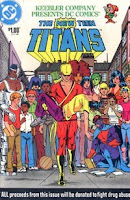
Thus, it was easy for Wolfman to motivate a series of three drug-awareness stories to be published with government support in 1983. Once again, Speedy returned to the Titans for help taking down drug dealers. The first very special issue had art by Pérez, the second (profiled at Polite Dissent) art by Ross Andru, and the third a script by Joey Cavalieri from Wolfman's plot and art by Adrian Gonzales.

The first issue actually has an interesting structure, profiling young addicts to examine why they got into drugs, and it has that gorgeous Pérez art. The third story shows the younger brother of an addict in the first starting to take drugs himself--implying that a visit from the Titans is actually quite ineffective at discouraging drug use.

In a 1987 interview, Pérez talked about the creation of these stories:

Unfortunately, with the drug books we were dealing with so many committees, it became a much more watered-down book than it was intended to be. Marv's research on real drugs was muted by a lot of editing down. They didn't want to cause blame here, they didn't want parents to feel intimidated there; a lot of groups were kind of cross-pressuring, until the book became a watered-down version of what it was originally intended to be. Had we produced the same story strictly as a DC book, I am sure it would have been a lot more potent--and probably a lot closer to reality than the book ended up being.
And even after those committees approved the scripts, that wasn't the end of the outside pressure on these magazines.

Each special issue had a sponsor that bought lots of copies for distribution to fourth-graders, thus subsidizing the project. Keebler paid for the first, IBM the second, and the American soft drink industry ("The only good white powder from Latin America is sugar!") the third.

And that's why none of these magazine featured Robin, the established leader of the Titans. DC Comics had already licensed exclusive commercial rights to that character to Nabisco. Robin therefore couldn't appear in a magazine associated with Keebler, a competing company.

So, in a last-minute change, the DC staff came up with...the Protector!
In an interview at Titans Tower, Pérez recalled how that worked:
Dave Manak--who was editing that book--whited out the entire costuming on Robin and drew this costume they quickly designed, and renamed him The Protector. So you have The Protector doing all the Robin-type things, like flying the T-jet, and giving all the orders--and who is this guy? Every single pose he's in, that was Robin in the original pose. Anyone who has the original artwork can see all the whiteout on that Protector figure and, if you hold it up to the light, you can see Robin's costume underneath.
Only later, for an edition of Who's Who in the DC Universe, did the company come up with a backstory for the mysterious Protector (curiously giving him the same first name as the boy who replaced Dick Grayson as Robin):
Young high school student Jason Hart watched helplessly as his young cousin, Ted, slowly became a drug addict. . . . He thought that if a family member couldn't talk to Ted, maybe a Batman-type super-hero could. He adopted the guise of the Protector, seeking to help his cousin.

The masquerade backfired, however, when, through a long chain of events, Jason had to pretend to actually be a super-hero, and actually protect his cousin from drug dealers who were looking to exploit Ted.
So far as I know, that "long chain of events" has never been told, and probably never figured out. That Who's Who entry (written after Dick Grayson had given up being Robin to become Nightwing) concludes: "When the story eventually broke, it came to the attention of Nightwing, who rewarded Jason with an honorary membership in the New Teen Titans, and an intensive training course."

The Protector also appeared in a New Teen Titans anti-drug commercial produced by Hanna-Barbara. He was last seen was in a crowd in Infinite Crisis, DC's big crossover event for 2005-06. Nobody knows if he survived. Then again, nobody cares.

But here's one way for the Protector to return. Obviously, he's into protection and public-service announcements. He's got a mostly purple costume with a big bright red triangle on the front. DC could use more gay heroes. I think the Protector's got a future talking to youth about safer sex. Give the character to Judd Winick, creator of Pedro and Me, and let's see what happens!

02 May 2009

Your Tax Dollars at Work on Comics

This posting is Oz and Ends's observation of Free Comic Book Day. Last month Publishers Weekly's Comic Week brought news that the University of Nebraska at Lincoln has a website of government-issued comics, free for downloading. These include instructional booklets, hortatory stories, and advice about safety on everything from disposing of chemical waste to surviving nuclear war.

As far as I can tell, the earliest example of a government comic in this collection is a 1918 booklet called The Cartoon Book, designed to sell Liberty Bonds. It collects many drawings from political cartoonists of the era, most of them single panels. But two artists used sequential images, like this.
Other examples cover a broad range of topics:

My favorites are, of course, two of the three very special anti-drug issues of The New Teen Titans from 1983. Tomorrow's weekly Robin will look at corporate influence on these comics, and why the Titans were missing their leader.

As government documents, all these comics are in the public domain, and eminently downloadable. But be warned: the pages have been scanned into TIFF format, so a 36-page color comic fills nearly 100 MB.

01 May 2009

Where to Find Finding Oz

Here are two long interviews with Evan Schwartz, author of Finding Oz: How L. Frank Baum Discovered the Great American Story--

What Do Jughead, Goober, and Bim Have in Common?

Oz and Ends is not about to institute an award for Archie comics research to go along with its occasional honor for Batman research. Nonetheless, the editorial board feels a need to recognize the work at the "I'm Learning to Share!" blog on the history of Jughead's hat.

Though pictured these days as a crown, that hat originally had a crown, and covered more of Jughead's pate. It was, in other words, a recognizable version of the hats that other characters wore in the 1940s and even, in the case of The Andy Griffith Show's Goober Pyle, well into the 1960s. In American culture at the time the Archie comics launched, such hats were a marker of youth, and thus appropriate for the Jughead character.

The In Crowd has collected many examples of such hats, including one worn by Leo Gorcey in the Dead End Kids' finest film, Angels with Dirty Faces (1938). And that indefatigable blogger has gone further to theorize about how such hats were created:

It appears that the first people to wear the original 'Jughead'-styled caps were auto mechanics, welders and other workmen who found they could get the same 'safety' function of a factory worker's beanie by altering an old worn-out fedora.

The method was to turn a fedora upside-down, push the hat's crown inside-out, then turn up the brim and trim away its excess with a scalloped cut.
Oz and Ends breathlessly awaits further research on these questions:
  • Can we confirm the In Crowd's hypothesis by, for example, unearthing magazine instructions on how to make such a hat when they were cool?
  • What term people did use for such headgear before it became nearly exclusive to Jughead? Were such caps seen as a simple variation of the 1920s "whoopee hat"?
(Tip from Good Comics for Kids.)

30 April 2009

Call for Oz Papers

The deadline for proposals for the Oz conference in Kansas this October has been extended to 9 May 2009.

PEN New England Children’s Book Discovery Evening for 2009

This Sunday, 3 May, PEN New England’s Children's Book Committee (formerly a “caucus”) is hosting its annual Discovery Evening at Lesley University.

This year's winners of the Susan P. Bloom Award for unpublished writers include the hard-working facilitator of one of the writing groups I attend: Maria Gianferrari for her nonfiction picture book, Terrific Tongues. So huzzah for Maria!

The other honorees will be:

  • Anna Staniszewski for her middle grade novel, The Tinkerers
  • J. James Keels for his YA novel, Starving Hysterical Naked
  • Shelagh Smith for her YA novel, A Mouthful of Straw
All four writers will read from their promising works, and then there will be a reception, free to the public.

The event starts at 6:30 PM in the Amphitheatre in University Hall, 1815 Massachusetts Avenue, Cambridge. There’s even parking in the lot behind the hall.

(Giraffe tongue by William Warby, via Flickr.)

29 April 2009

Picture Book Hall of Fame?

The American Booksellers Association recently announced “the first three inductees to the Indies Choice Book Awards Picture Book Hall of Fame”:

In addition, the organization named these finalists:
  • Alexander and the Terrible, Horrible, No Good, Very Bad Day, by Judith Viorst and Ray Cruz
  • Chicka Chicka Boom Boom, by Bill Martin, Jr. and John Archambault and Lois Ehlert
  • Corduroy, by Don Freeman
  • Curious George, by H.A. Rey
  • Goodnight Gorilla, by Peggy Rathmann
  • The Little Engine That Could, by Watty Piper
  • Madeline, by Ludwig Bemelmans
  • The Napping House, by Audrey Wood
  • Stellaluna, by Janelle Cannon
  • The Story of Ferdinand the Bull, by Munro Leaf and Robert Lawson
I have no strong impression of The Napping House, but otherwise recognize all these titles as classics in the genre. Nonetheless, I think it's worthwhile to consider what's or who's not listed here.

Anything by Margaret Wise Brown, particularly The Runaway Bunny and Goodnight Moon. Anything by Virginia Lee Burton, particularly The Little House and Mike Mulligan and His Steam Shovel.

The Story of Babar, by Jean de Brunhoff. Harold and the Purple Crayon, by Crockett Johnson. The Very Hungry Caterpillar, by Eric Carle.

Anything by Chris Van Allsburg, who spearheaded the picture-book revival of the 1980s. Anything by Dr. Seuss who, though he became synonymous for easy readers, wasn't bad at the old art. Anything by Richard Scarry, who filled up pages with words and pictures as well as anyone.

The Monster at the End of This Book, a monster seller for the Sesame Street Workshop produced by Jon Stone and Michael Smollin, which has delicious fun with the form. The Poky Little Puppy, by Janette Sebring Lowrey and Gustaf Tenggren; this title from the first Golden Books list helped bring full-color picture books to wider audiences and keeps selling.

My personal list would have a place for Ellen Raskin, now better known as a novelist but one of the masters of the picture-book form when most creators were expected to provide their own four-color separations.

But if this hall of fame is supposed to represent the range of American picture books and their history, I think the biggest omission is The Snowy Day, by Ezra Jack Keats. Do any of the chosen titles and finalists feature black people?

At Fuse #8, Betsy Bird has been doing the VH1 thing with a top 100 picture books. She's just reaching the high teens, where we might expect to see the most overlap between her voters' list and the ABA's list.

28 April 2009

Tick Talk

I was excited to read that the live-action TV version of The Tick is now on YouTube. With the exception of the original Eerie, Indiana, it might be my favorite American fantasy sitcom.

Unfortunately, a crucial ingredient in comedy is


timing. And my YouTube connection

just isn't smooth enough to serve the

jokes.

There must still be some copies of the DVD set out there.