With an Uplifted Axe in His Hands

Thanks to Fuse #8 for the link.
Thanks to Fuse #8 for the link.
"Tremble, evildoers! For we have four-drawer file cabinets!"
(Panel from the legendary Batman: From the '30s to the '70s.)
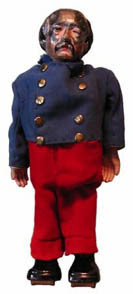 The gentleman to the right is Gen. and Rep. Benjamin Butler, one of Massachusetts's Civil War heroes. But this is a miniature Butler, made to march along powered by clockwork. In other words, this is the nineteenth-century equivalent of a celebrity Bobblehead doll.
This image comes from a new overview of the toys and games in the collection of the Longfellow National Historic Site in Cambridge, Massachusetts. This three-page, illustrated pamphlet is available as a downloadable PDF file.
The three little daughters Henry Wadsworth Longfellow wrote about in "The Children's Hour" and their two older brothers were probably the owners of these playthings. We can glimpse those children at different ages in the historic site's gallery of ambrotypes and daguerreotypes.
In the pamphlet curator David Daly writes: These toys are excellent examples of what privileged children in mid-to-late 19th century America played with, and how they entertained themselves. The collection also reflects some of the social, technological, and political changes the world at large underwent during the 19th century.
Among the other notable items is a "Kirby's Planchette" from 1860, a predecessor to the oiuja board that was supposed to write out its messages with a pencil instead of spelling them out.
My English teacher during junior year in high school, David Outerbridge, assigned everyone to memorize and recite a poem in class. Cheeky bastard that I was, I chose "An Address to the Rev. George Gilfillan," by William Topaz McGonagall. I still remember most of it, which is probably Mr. Outerbridge's revenge.
And so, for Poetry Friday: All hail to the Rev. George Gilfillan of Dundee,
I think that last couplet's daring use of metre is the high point of the poem, but you can find the concluding four lines at McGonagall Online.
He is the greatest preacher I did ever hear or see.
He is a man of genius bright,
And in him his congregation does delight,
Because they find him to be honest and plain,
Affable in temper, and seldom known to complain.
He preaches in a plain straightforward way,
The people flock to hear him night and day,
And hundreds from the doors are often turn'd away,
Because he is the greatest preacher of the present day.
He has written the life of Sir Walter Scott,
And while he lives he will never be forgot,
Nor when he is dead,
Because by his admirers it will be often read;
And fill their minds with wonder and delight,
And wile away the tedious hours on a cold winter's night.
He has also written about the Bards of the Bible,
Which occupied nearly three years in which he was not idle,
Because when he sits down to write he does it with might and main,
And to get an interview with him it would be almost vain,
And in that he is always right,
For the Bible tells us whatever your hands findeth to do,
Do it with all your might.
That site's front page quotes a note from the Rev. Mr. Gilfillan himself, which was probably how he earned this encomium. The minister had this to say about McGonagall's poetry: Dundee, 30th May 1865
I'm in Scotland right now, so this posting is doubly timely.
I certify that William McGonagall has for some time been known to me. I have heard him speak, he has a strong proclivity for the elocutionary department, a strong voice, and great enthusiasm. He has had a great deal of experience too, having addressed audiences and enacted parts here and elsewhere.
George Gilfillan

I'm now in Falkirk, Scotland, and can report from personal experience that the British nation has its own regional reincarnation of the exclusively-plural "you" (lost after "you" pushed out the singular "thou" to cover both plural and singular numbers).
All that's a long way of saying that tonight at dinner, the waitress repeatedly addressed my father and me as "youse" or "youse guys."
I'm in Great Britain now, so it's an appropriate time to quote Peter Bradshaw in the Guardian on the new Incredible Hulk movie: "Hulk. Smash!" Yes. Hulk. Smash. Yes. Smash. Big Hulk smash. Smash cars. Buildings. Army tanks.
Hulk not just smash. Hulk also go rarrr! Then smash again. Smash important, obviously. Smash Hulk's USP.
What Hulk smash most? Hulk smash all hope of interesting time in cinema. Hulk take all effort of cinema, effort getting babysitter, effort finding parking, and Hulk put great green fist right through it. Hulk crush all hopes of entertainment. Hulk in boring film. 
Via Jason Kottke.

Let us begin by highlighting this evidence: The page layout does not operate on empty panels, but must take into account their contents. It is an instrument in the service of a global artistic project, frequently subordinated to a narrative, or, at least, discursive aim; if it submits a priori to some formal rule that constrains the contents and, in a certain way, creates them, the page layout is generally elaborated from a semantically determined content, where the breakdowns has already assured discretization in successive enunciations known as panels. However, the page layout cannot be defined as a phase that follows the breakdown, with the mission to adapt it to the spatio-topical apparatus; it is not invented under the dictation of the breakdown, but according to the dialectic process where the two instances are mutually determined.That sort of prose is hard enough to interpret, and this book's translation (by Bart Beaty and Nick Nguyen) doesn't inspire my trust.
 In discussing layout, the text says one of the fundamental qualities to consider is how "discrete" the page is, which seems plausible. (Note how Groensteen calls "discretization" an essential element of panel breakdowns above.) Except that the text opposes this term to "ostentatious," meaning the word should be have been spelled "discreet."
Buffalo buffalo Buffalo buffalo buffalo buffalo Buffalo buffalo.
Last week Publishers Weekly ran an interview with Diana Wynne Jones on the occasion of the landing of House of Many Ways, the second sequel to Howl’s Moving Castle. She had some interesting comments on her working methods. You’ve said you don’t start out with a thoroughly plotted-out book. What do you start out with, when you begin writing?
I’m much more comfortable with an outline myself, but results are results.
I start out with people very often. Also some very, very clear scenes from the middle of the book. And usually a notion of how it’s going to go in the end, but that isn’t always the case. But it’s the clear picture from the middle that’s the important bit, I think. In the case of House of Many Ways, it was the bit when Peter first comes in out of the rain into all the bubbles in the kitchen and Charmaine reaches out and shuts his mouth with a clop. Because that for some reason was a very enduring image and I knew that was in there somewhere. But as I say, the Lubbock, which came just before that, was completely uncharted.
When I used to go and visit schools I always used to shock the teachers because I used to tell the kids that I didn’t plan it out, I waited to see how we got from the beginning to the picture I’d got of the middle of the book, or somewhere into the book, anyway. They were always very shocked. Because they always insisted on all their kids planning it out in advance, and I did sort of plead with them that this was not always necessary. In fact, some people are better for making it up as it goes along.
If I try to plan anything out in that kind of detail it just goes completely blank on me. And I don’t understand what I’ve written as a plan. I just found a plan several weeks ago, actually, when I was looking through stuff to see what I’ve got. And I looked at this plan, and I knew it wasn’t any plan of any book that I’d actually written, and I could not understand a word of what I’d done.
Jones’s choice to name a villainous character after a city in Texas reminds me vaguely of a book that Douglas Adams published a few years ago.

Greenpinoy offers a handy impromptu exhibit of various action figures of Robin, and this is by no means an exhaustive collection. He shows three variations on Nightwing, in each of his major costumes. And there are at least forty different ways you can buy Batman.
The next step up in the hobby seems to be posing your dolls action figures in dramatic photographs, such as these posted to Flickr by Shaun Wong, Graphic Knight, and dreamonix.
My brother had a Mattel Batman and Robin set for a while. As I recall, we spent very little time playing with them, but they nevertheless managed to end up with practically none of the removable accessories left.




