31 August 2007

The Sayings of J. K. Rowling

When it was announced that Harry Potter and the Deathly Hallows would have an epilogue, I, for whatever reason, expected it to be a comprehensive rundown of many characters' futures. I thought Rowling would compile a complete "Where Are They Now?" special, with discrete paragraphs for each major name.

Instead, it's a single scene set nineteen years after the rest of the book, paralleling Harry's own first departure for Hogwarts in HP1. Without going into specifics (yet still at the risk of spilling ***SPOILERS***), the epilogue lets us see that:

  • Harry has found a loving family to replace the one he lost as an infant.
  • The home away from home that Harry found at Hogwarts School remains much the same as it was before.
  • Harry's four most prominent classmates--Ron, Hermione, Neville, and Draco--and Ron's sister Ginny are doing fine.
The epilogue has become just as notable in what it doesn't tell. We don't see Harry's actual home, his profession, or the profession (if any) of more than one of his peers. We don't learn about the future of any series character besides the ones I've already named, and we don't learn much about them. The epilogue offers a thematic conclusion to the series, not a factual one.

But it's clear from the questions that fans had for Rowling that they wanted facts. Rowling's interview with NBC, parceled out on the Today and Dateline shows on 26 July, produced these revelations:
  • "Harry and Ron utterly revolutionized the Auror Department in...the Ministry of Magic. . . . And by the time [of the epilogue]--19 years later--I would imagine that Harry is heading up that department."
  • "Hermione, I think she's now pretty high up in the Department for Magical Law Enforcement."
  • "Luna Lovegood...is now traveling the world looking for various mad creatures." [This tidbit appears only in an article promoting the Today interview.]
Then in an webchat through her British publisher on 30 July Rowling elaborated further:
  • "Ginny Weasley stuck with her athletic career, playing for the Holyhead Harpies, the all-female Quidditch team. Eventually, Ginny left the team to raise...children....while writing as the senior Quidditch correspondent for the wizarding newspaper, the Daily Prophet."
  • "Hermione Granger, Ron's wife, furthered the rights of subjugated creatures, such as house elves, in the Department for the Regulation and Control of Magical Creatures before joining the magical law enforcement squad." Furthermore (this is the only loose end in the whole book that bothered me) "she brought [her parents] home straight away."
  • "Luna...ended up marrying...a fellow naturalist and grandson of the great Newt Scamander (Rolf)!"
(Is the man's name Rolf, or was this a typo for "rofl"?)

Already there have been difficulties and differences in how to interpret these remarks. For example, some Child_Lit readers took Rowling's statement to NBC that "McGonagall was really getting on a bit" as meaning that professor never became headmistress of Hogwarts. However, the context shows Rowling was answering a question about Hogwarts at the time of the epilogue, not immediately after the preceding book. Prof. McGonagall may well oversee the rebuilding of Hogwarts ("The Slytherin common room will be reserved for Peeves for the next five years").

As another example of overeager interpretation, this site interprets Rowling's webcast statement that George Weasley has "a very successful career, helped by good old Ron," as meaning that Ron went to work in his brother's joke shop instead of in the government. Of course, someone like George would probably benefit from the help of good old relatives in law enforcement.

There are also some gaps. I don't think anyone in Rowling's audiences asked about Hagrid, for instance. (After all, his personality is so consistent that it's pretty easy to figure out what he'll do in any given situation.) And while people asked about the Dursleys, nobody really seemed to care.

I'm most intrigued by the question of how Rowling's remarks fit into the Harry Potter "canon." Those factual statements aren't in the books, at least not yet. She colored her first remarks with a tinge of doubt: "I would imagine...I think..." Some of her later statements about characters' futures seem to have been developed to assuage fan disappointment with her earlier ones, as in giving Hermione a civil-rights career before "the Department for Magical Law Enforcement." I suspect that Rowling realized between these two dates what sort of things her fans wanted to know, and became more definite in her answers. And how could she be wrong about her own creation?

Based on the early response, I anticipate that Rowling's fans will take all her remarks of this sort as authoritative. They'll be catalogued on websites and perhaps in books, and Harry Potter fan fiction will have to adhere to these statements to be considered deuterocanonical.

The best analogy I can think of is the Islamic hadith, sayings and anecdotes attributed to Muhammad and written down a century after his death. This body of literature is not the Qur'an, which Muslims believe was dictated by God. However, some adherents consider some hadith to be directly inspired by God, though expressed by Mohammad, and most Muslims (though not all) take the hadith as essential teachings of their faith.

30 August 2007

Harry Potter Altogether

As I read Harry Potter and the Deathly Hallows, only months after Potter movie star Daniel Radcliffe had won good reviews for his performance in Equus on the London stage (publicity photo at left), I couldn't help noticing that J. K. Rowling had written a couple of nude scenes for Harry. Or at least for some reflections of Harry.

The first moment is in Chapter 4, when six of Harry's friends have taken on his form in order to fool the Death Eaters:

He watched as his six doppelgangers rummaged in the sacks, pulling out sets of clothes, putting on glasses, stuffing their own things away. He felt like asking them to show a little more respect for his privacy as they all began stripping off with impunity, clearly much more at ease with displaying his body than they would have been with their own.
And that theme returns in Chapter 35, with Harry's soul free of his body in "King's Cross":
...Harry became conscious that he was naked. Convinced as he was of his total solitude, this did not concern him, but it did intrigued him slightly. . . .

It was a pitiful noise, yet also slightly indecent. He had the uncomfortable feeling that he was eavesdropping on something furtive, shameful.

For the first time, he wished he were clothed.

Barely had the wish formed in his head than robes appeared a short distance away. He took them and pulled them on.
Was this motif in the book merely coincident with Radcliffe's theatrical performance? That seems unlikely. Radcliffe's contract to appear in Equus was announced in late July 2006, with headlines that played up the character's/actor's nudity. Rowling famously finished writing her Deathly Hallows manuscript in the Balmoral Hotel in January 2007, months later.

Harry is also self-conscious about being naked in Chapter 25 of Harry Potter and the Goblet of Fire, when Moaning Myrtle visits him in the prefects' bathroom. And Radcliffe had spoken somewhat self-consciously about filming that scene in 2005. But that incident didn't have the same sense of letting it all hang out as the two passages from HP7. They read like a bit of a joke between author and actor.

29 August 2007

Reexamining More Harry Potter Predictions

Yesterday I started a post mortem of my Deathly Hallows predictions by noting that it wasn’t as much of a post mortem as some fans had feared: none of the Harry Potter series' three main characters died. Now for my more detailed predictions, stated on 14 July 2006. Once again, this posting contains ***SPOILERS***.

To start with, I didn’t hit what I'd called the "grand slam, run-the-board perfecta." That prediction would have had to be completely correct to pay off. Of course, if I'd been right, the reward would have been enormous: the castle in Scotland, a slice of the movie grosses, several hundred action figures, etc.

But I did fairly well on individual predictions, if I do say so myself.

1. One of Harry's dead father figures (his father, Sirius Black, Dumbledore) will be resurrected in a form that lets Harry have a meaningful conversation with him, if only to say goodbye.
The only flaw here was understatement. Four of Harry's dead father figures come back and have meaningful conversations with him (chap. 34-35). That's even more dead father figures than he had going into this book. Plus, there's a final conversation with Dumbledore's portrait.
2. Harry will have the chance to kill one of his worst enemies (Voldemort, Snape, a Malfoy, a Death-eater he learns was directly responsible for his parents' deaths), but will refrain from doing so because, he realizes, he's better than that.
In his fight to escape from Malfoy Manor (chap. 23) and even in his duel to the death with Voldemort (chap. 36), Harry uses stupefaction and disarming spells instead of fatal ones.

In the earlier chapter, Harry even tries to save the life of one of his enemies (see prediction #3). In Chapter 32, Ron rightly tells Draco, "that's the second time we've saved your life tonight, you two-faced bastard!"
3. Another of those worst enemies (not including Voldemort) will refuse to kill at a crucial time, also showing that he's better than that. His refusal will most likely cost him his own life (that's where Voldemort comes in), but by saving a good person's life he will redeem himself.
Peter Pettigrew in Chapter 23. (Narcissa Malfoy also redeems herself by sparing Harry's life in Chapter 36, but doesn't lose her own life because of it.)
4. A major enemy will die as a consequence of his own or another enemy's actions, giving Harry (and us) all the satisfaction of seeing him die but none of the guilt. Because we want to see the bad guys die, but have to believe that we're better than that.
Vincent Crabbe in Chapter 31. Even more so, Voldemort in Chapter 36.
5. Harry will believe that one of his closest friends has been killed, but either that will turn out to be a mistake or the friend will be magically resurrected in a process that proves crucial to the outcome of the overall conflict.
I made this prediction under the influence of Lloyd Alexander's The Arkadians and T. H. Barron's The Lost Years of Merlin. In both of them, the hero's comic companion appears to die near the end of the book, only to be happily resurrected in better form a chapter or two later. I guessed that might happen in Deathly Hallows as well, with Dobby, Hagrid, and Ron as the most likely near-death experiencers. Which, of course, left me waiting for 200 pages for Dobby to pop back up out of the grave.

That didn't happen.

Instead, J. K. Rowling faked me out by using this motif with Harry himself. Instead of Harry believing Hagrid has died, Hagrid believes Harry has. And instead of Harry being so angry at seeing a friend's corpse that he attacks his enemies with new vigor, that role goes to Neville Longbottom. Clever.

28 August 2007

Reexamining My Harry Potter Predictions

On 13 July 2006, I posted these predictions of what would not happen in Harry Potter and the Deathly Hallows. Having now read the book, I'm going back to those comments to see how J. K. Rowling matched and didn't match my expectations. This posting will therefore contain some ***SPOILERS***.

I wrote in confident capital letters:

HARRY POTTER WILL NOT DIE. . . .

Some people have written that dying would be a fitting end for a tragedy--but the Harry Potter books aren't tragedies. And unlike some callow heroes, Harry doesn't need to experience death in order to mature. He's suffered loss his whole life. He can grow up only by getting beyond that.

I'm not saying that Harry should or shouldn't die for the sake of young readers, or literature, or commercialization. I'm saying he won't die. He just won't.
And he just didn't. At the same time, however, Rowling got to explore the series' theme of death by having Harry prepare to die (chap. 34), and even enter a state between life and death (chap. 35). So this was a bet that no one could lose.
HERMIONE GRANGER WILL NOT DIE.

In all the Harry Potter books, boys get beat up more than girls. At the end of HP1, Ron and Harry are knocked unconscious while Hermione is left unscathed. Harry has been to the infirmary for serious injuries in practically every book. Hermione has gone there for cosmetic problems: teeth and, um, fur. . . .

Rowling's values are, at bottom, traditional. She has created smart, athletic, powerful female characters, and then largely protected them. Though she sends boys out onto the firing range, she doesn't write so comfortably about violence against girls.
Hermione survives as well. But what about the larger pattern of the author shielding her and other female characters from physical violence? Chapter 23 shows Bellatrix Lestrange dragging Hermione by the hair and holding a knife to her throat hard enough to draw "beads of blood." We hear Hermione's screams of pain as Bellatrix tortures her with the "Crucio" curse.

But in the same chapter Harry suffers an "excruciatingly painful face" and a choking attack; "Bellatrix hit [Ron] across the face"; "Dean [appears], his face bruised and bloody"; and "Draco doubled over, his hands covering his bloody face." You see a pattern here?

The boys suffer more physical (as opposed to magical) violence than Hermione. They suffer within the scene while her worst treatment is off-stage. No males attack Hermione; only another female does. Rowling still seems more squeamish about violence against her girls.
RON WEASLEY WILL NOT DIE.

This statement may be a little more iffy than the last two, but I'm still betting the odds. Ron will be put in terrible danger, be injured, and lose a relative or two. (There are so many, after all.) But he won't die, either.
And indeed, Ron has one fewer living relative at the end of chapter 31.

It's interesting to consider that, as many fans as that relative had (did I mention ***SPOILERS***?), he was really just one-half of a joint character. That's the wonderful thing about identical twins--an author can use them to put more people into a scene without having to come up with two independent personalities. (No resemblance to actual identical twins is implied.)

Rowling told NBC that she portrayed those twins differently: "George is slightly gentler. Fred is normally the funnier but also the crueler of the two." But that was news to me. Fred and George never act separately. Rowling said she mourned with the survivor of the pair, yet also that she had planned the other young man's death from the beginning. She developed the twins over six books in order to kill off one in the seventh. There were so many of them, after all.

So on those basic, "won't die" predictions I was three for three. But those weren't the hard ones.

TOMORROW: Gauging my predictions of what would happen in HP7.

27 August 2007

Harry Potter and the Deathly Phrasing

I'm making this Deathly Hallows Week at Oz and Ends. For the next few days, or as long as my interest holds out, I'll focus on the now-complete Harry Potter series. After all, I usually write about fantasy literature of the past, and it's been over a month since volume 7 was published.

To start off, here's a link to linguist Mark Liberman's Language Log analysis of this sentence from page 655 of the US edition of HP7:

"My wand of yew did everything of which I asked it, Severus, except to kill Harry Potter."
As Liberman notes, most people would say something like "did everything I asked of it." Liberman diagnoses anxiety about the old shibboleth against ending a sentence with a preposition, which might have been particularly acute if J. K. Rowling's first-draft phrasing was "did everything I asked it to."

The story behind this long-disregarded and lately discarded "rule" of English grammar involves a rivalry between poets Ben Jonson and John Dryden, even though the former was long dead. Liberman and his colleagues tracked down Dryden's original complaint, in which he confessed to having made the very same "mistake" himself. All in all, the prohibition seems to have more to do with Dryden's ego than Jonson's or anyone else's style.

But Dryden was tremendously influential as a poet and critic, and some people still believe that they'll be judged by his rule and therefore overcompensate against it. A similar example of grammatical overcompensation appears in Alberto Gonzales's resignation letter: "I believe this is the right time for my family and I to begin a new chapter in our lives." (Us think so, too.)

We could even argue that the tortuous speech pattern above is part of Rowling's characterization of the man speaking those words: Voldemort, that insecure, social-climbing pseudo-aristocrat. In that case, it wasn't she or her many editors who were too concerned about "asked of it," but He Who Must Not Be Named himself.

Liberman calls that the "more charitable interpretation."

26 August 2007

How Do You Say "Kalidah" in Japanese?

Passed on from the Gjovaags' Wonderful Blog of Oz is this look at Oz in Japan by "Michael Sensei," an overseas Canadian.

This particular image from L. Frank Baum's The Wonderful Wizard of Oz shows Dorothy and her companions being menaced by a Kalidah. The Cowardly Lion describes Kalidahs like this:

"They are monstrous beasts with bodies like bears and heads like tigers, and with claws so long and sharp that they could tear me in two as easily as I could kill Toto. I'm terribly afraid of the Kalidahs."
And what's worse, in the English text there are two of them.

The Japanese artist drew only one Kalidah, but made it twice as large as the Lion, with tusks and horn and a striped tail besides.

The Kalidahs return memorably in The Magic of Oz, one of the first Oz sequels I read. It gives us the further information that they:
  • are the "most powerful and ferocious beasts in all Oz."
  • "attack all other animals and often fight among themselves."
  • "can swim like ducks."
Needless to say, I found Kalidahs very scary when I was growing up.

The best Kalidah literature I've read is Eric Shanower's short story "Gugu and the Kalidahs," available in Oz-Story #1 and The Salt Sorcerer of Oz, both published by Hungry Tiger Press.

25 August 2007

Why Children's Book Week Is Rising Up in the Calendar

Late last year the Children's Book Council was shaken up by budget cuts, a new Executive Director, and a change in strategy. My analysis focused on how the organization was trying to shift from promoting children's books because they're a Good Thing to promoting children's books because its bills are paid by companies that publish children's books.

I quoted this line from a Publishers Weekly article about the new strategy:

The consensus from members [i.e., children's-book publishers] is that they want it first and foremost to be a trade association, with a mission of supporting its members' business.
Now the CBC has made a quite visible outward manifestation of those changes: shifting its Children's Book Week reading promotion from November to May in 2008 and future years. And that's kicked up some concern from children's librarians.

Elizabeth Bird at Fuse #8 shares the CBC's rationale for the change, which mentions some difficulties the November timing had created for some teachers and librarians. Note, however, the message's mentions of "entire children's book community" and "all constituencies." I read that as hinting, "You know, we have to think about other people besides librarians."

Publishers and booksellers already have a lot of promotions slated for November. That's when they push their big holiday books: titles directly tied to Thanksgiving, Christmas, Hannukah, and so on; glossy gift books; handsome reissues of childhood classics. November and December are already busy times for retailers.

May, on the other hand, has only Mother's Day as a promotion. Placing Children's Book Week there can give publishers and stores a chance to promote Summer Reading to families at a time when sales are typically slow. Not that there's anything wrong with that.

24 August 2007

Mapping Mystery Manor

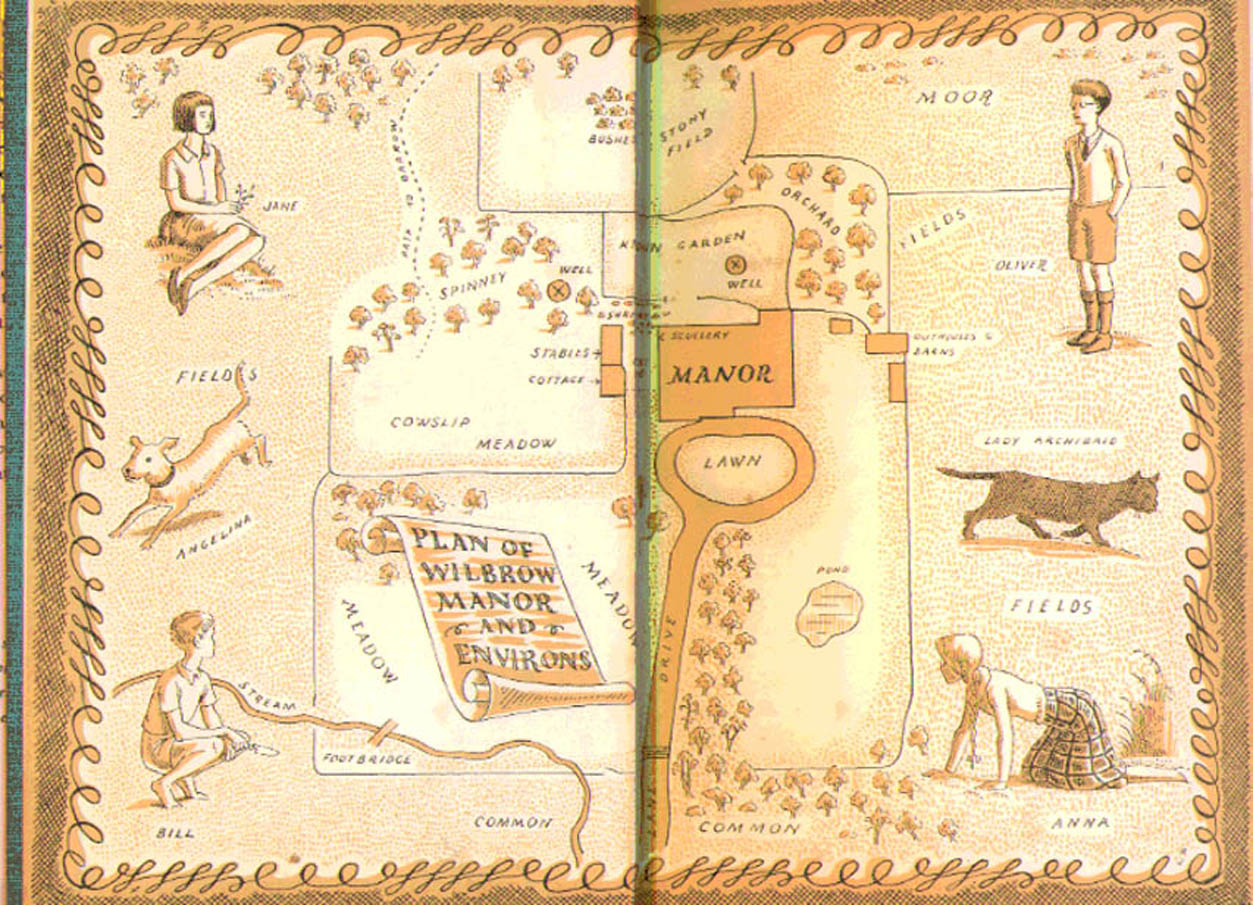
Thanks to Strange Maps, I visited the Culture Archive's collection of maps that appeared on British endpapers, a most evocative ingredient in books. The same site archives a variety of other fictitious maps from literature and advertising, including charts from Arthur Ransome's books.

The thumbnail at left comes from the endpapers map from Mystery Manor, a children's novel by Mary Evelyn Atkinson in 1939. The illustrations, including this map, are by Harold Jones.

The title Mystery Manor is, of course, intriguing. What story lurks behind the details on that map? Who are the four children pictured in the endpapers? (Two boys and two girls, naturally.) Why is the cat named Lady Archibald?

Some Googling brought me to reports from a British homeschooling family who read this book last fall. And I'm even more confused now. In fact, it almost sounds like a writing exercise: can you create a plot that takes readers from this beginning to this end? Here's how the book starts:

Oliver and Bill, the main children in the book, go spying on Mr Hugh, the main suspect. It starts at Mr Hugh’s cottage, where he shows them his fly fishing equipment and tells them all about it. He then goes off saying that they can’t come with him. Of course they don’t believe he is really going fishing him, so they follow him. But much to their surprise he really does go fishing...
That blog characterizes the male leads as "Oliver the bookish boy studying for exams or Bill, the lively one that prefers to dig in streams and climb trees and for whom maths is a mystery." The endpapers show Oliver in necktie, jersey, and socks pulled up, and Bill in a casual shirt with no socks at all. The blog offers no word on the girls, Jane and Anna.

And this is what happens at the end of the book:
The children finally found the tru[th] about what had been going on, but there was just one thing that puzzled Oliver, the eldest. He still didn’t understand why Mr Hugh had attacked Bill while he was wearing the red school tie. He knew at the time that it was something to do with communism, but really didn’t understand it.

M.E. Atkinson often uses the lack of knowledge in her characters to inform children about current affairs, and communism was a current affair in 1937. So over the last two pages of the book Oliver explores communism...
What an exciting finish! From a fisherman who actually goes fishing to two pages on Communism in the late 1930s. We just don't write mysteries like that anymore.

23 August 2007

How I Spent My Summer Vacation

Last July I hiked up Little Crow Mountain in the Adirondacks, as documented here.

This August the same crew--me, godson, twin brother, their dad, and friendly professional photographer--tried Baxter Mountain.


Click on the picture for more of the view.

And here's the path down. I gave these boys their first Red Sox T-shirts in 2004, and, as you can see, the moral influence of the godfather is lasting.

22 August 2007

On the Way to the Emerald City

From Bookshelves of Doom comes a peek at this Japanese cotton canvas fabric.

The same series of fabrics seems to include other stories I don't recognize, and some I do.