30 June 2007

Oz through the Comics, Comics through Oz

At the end of Oz and Ends's first COMICS WEEK, I'm circling back to Oz. It might be possible to track every major thread of American popular culture through versions of Oz. Within a decade after L. Frank Baum and W. W. Denslow published The Wonderful Wizard of Oz in 1900, it had already inspired a blockbuster Broadway show, movies, records, and--what else?--comics. In fact, looking at the earliest Oz comics offers a window onto how that medium developed.

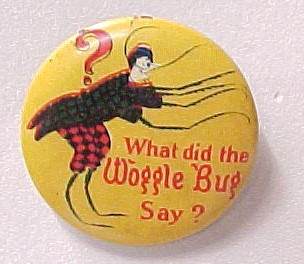
The first entry was the Queer Visitors from the Marvelous Land of Oz comics page, written by Baum and illustrated by Walt McDougall, an established newspaper cartoonist (more samples here and here). That comic was created to publicize The Marvelous Land of Oz (1904), and built around that book's grotesque characters: the Scarecrow, Tin Woodman, Jack Pumpkinhead, Sawhorse, Gump, and Woggle-bug. But those gentlemen and animals weren't in Oz. No, they were traveling around America, learning our strange ways.

To fill a page in each Sunday's paper, Baum wrote a short story and McDougall illustrated the tale with a series of panels packed with characters and speech balloons--some echoing the dialogue in Baum's prose, some new. Each episode ended with the thoroughly educated Woggle-bug about to answer some mystery the tale had brought up. In an interactive feature, readers were invited to mail their local papers the answer to the weekly question, "What did the Woggle-bug say?" Queer Visitors was therefore not quite a comic, and its stories were not quite stories. It lasted not quite half a year.

[ADDENDUM: Some panels from Queer Visitors reproduced in color can be found by scrolling down in this page from the BCF archive of Oz book discussions.]

Shortly afterward, Baum's erstwhile collaborator W. W. Denslow, who shared the copyright in The Wonderful Wizard of Oz, spun its most popular characters into his own comics page, Denslow's Scarecrow and Tin-Man. He, too, brought the Scarecrow and Tin Woodman, as well as the Cowardly Lion (whom Baum was neglecting), to America for rollicking adventures. They even meet Dorothy again, though (as shown above) she's much more frilly than before. Denslow's bold, rounded style matches modern tastes in cartooning better than MacDougall's, but his storytelling tended toward the "let's crash vehicles together" style. He also told his story through long captions, not speech balloons. Denslow's comic page lasted twelve installments.

By the time of the next Oz newspaper comic, in 1932-33, the medium had settled into the form we know best today: a short strip of black and white installments in each daily paper. Walt Spouse's The Wonderland of Oz adapted five of Baum's titles into this style. He followed the original stories closely, and based many of his pictures on John R. Neill's illustrations for the books. Spouse's comics still had no word balloons; instead, long prose captions beneath each panel told the stories. Among today's popular newspaper comics only Prince Valiant seems to follow that style. When some Wonderland strips were reprinted in a comic book called The Funnies in 1938-40, they were retrofitted with balloons.

In the last few years Hungry Tiger Press (also publisher of the John Dough and the Cherub pictured at right) has repackaged all three of these Oz comics in book form. Each book's format differs from the original publications, and from the other two, reflecting the strengths of the three sources and modern tastes.

Hungry Tiger Press has turned Queer Visitors into The Visitors from Oz, basically a volume of Baum short stories without McDougall's artwork. Instead, the book has art by the young Eric Shanower, before he received two Eisner Awards (and before his hair turned white).

Denslow's newspaper pages have been reformatted to make a picture storybook, The Scarecrow and the Tin-Man of Oz. That reprints all of Denslow's art, though only in black and white.

Finally, Shanower wrote a new script for Spouse's strips, using short speech balloons and short captions--thus turning those cartoons into more like what we expect from all comics today. Hungry Tiger Press has issued three volumes in the Wonderland of Oz series.

And Oz continues to be adapted into the latest trends in comics. In 2005 David Lee Ingersoll produced this thorough listing of Oz comics from the previous fifty years. And this month over at the Wonderful Blog of Oz, Eric and Tegan have shared news that The Land of Oz will soon be adapted in manga style.

29 June 2007

Look Out, Everyone!

Hours of fun may be found at Mister Kitty's Stupid Comics. The panel above, for instance, comes from 1989's Guardians of Justice & the O Force. Wonder why comics don't get more respect in our culture? Look at the sloppy, venal, and derivative work archived and mocked here.

If that's not enough, this month Fantagraphics will publish I Shall Destroy All Civilized Planets: The Comics of Fletcher Hanks. Fifteen crappy yet utterly unforgettable comics starring the likes of Stardust and Fantomah. Or, as Jules Feiffer has delicately blurbed, "It's a pleasure to see this first published edition of his puzzlingly effective work."

The volume also includes an interview with Fletcher Hanks, Jr. In this Lehigh alumni profile, he recalls his father as "the most no-good drunken bum you can find," a volatile, paranoid child abuser. Which, frankly, is not a surprise after you've seen his comics.

28 June 2007

The Great Canadian Graphic Novel

My comments yesterday about the minority of comic strips that have their characters age reminded me that for months I've been meaning to declare that the greatest Canadian storyteller of our time is not Margaret Atwood, nor Rohinton Mistry, Douglas Coupland, Farley Mowat, and other talented writers.

It's Lynn Johnston, creator of the comic strip For Better or For Worse.

For the first three years or so of the strip, Johnston's characters didn't age--a phenomenon most apparent in the kids, of course. Since then, however, everyone's grown older in "real time," and the storylines have expanded along with them.

The fact that the saga is being created in "real time" with daily reader feedback means that Johnston can both set up developments years in advance and change course or pursue new ideas as she goes along. That creates a new kind of storytelling, even apart from the graphic dimension.

Reader interaction has become even more public since the strip began because of the internet. Johnston and her staff maintain an extensive website that offers "Q & Eh" [it is Canadian, after all] and discussion boards. Elly's blog is the current site for reader feedback. Current issue: Does the character of Shannon have any function besides enlightening April and her classmates about people with disabilities?

Web-only features even offer information not found within the panels of the strip, as well as helping occasional readers catch up, as in monthly letters from characters like Michael and Elizabeth.

The site also includes, for fans of all ages, a step-by-step guide to how Johnston and her staff create each strip. It contains such insights as, "For Lynn, it's important to begin inking her character illustrations with the eyeballs."

And for Oz and Ends's Divided by a Common Language feature, I quote from the short section on "Canadianisms":

Bags of Milk: OK, it only appeared once, but this also confused even most of Canada! In Ontario and in some parts of other provinces, you can buy your milk in convenient plastic bags that slip into a jug. You snip off one corner of the bag and voila, you go with the flow! In one strip, Farley punctures a milk bag, streaming milk all over. We received many letters asking: "what the heck was that all about?"
I seem to recall hitting the same problem reediting Toronto-published children's books for the US market years ago. Bags of milk? Is that proper talk for a children's book, or a daily newspaper?

27 June 2007

Hobbesian Philosophizing

From Philip Sandifer's "When Real Things Happen to Imaginary Tigers," in InterText:

Let us begin more simply – with a straightforward observation about Calvin and Hobbes. The observation is this: Hobbes is imaginary.
Why wasn't anyone around to tell me this in 1985?

Actually, I found this essay straining alternately to say too little and too much. Setting aside the lit-crit language, it aims to illuminate our expectation in reading Calvin and Hobbes: that each morning we'd find a small joke that could be part of a small weekly story but wouldn't greatly change the characters and situation, so that the next morning we could have the same experience; but, ironically, that the characters and situation portrayed would have a fluid relationship with the physical and biological world.

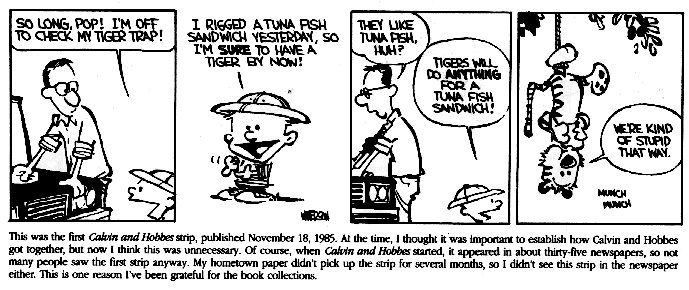
When Bill Watterson started Calvin and Hobbes, focused on two supporting characters from another proposed strip, he offered an "origin" story that creates a beginning to the strip's reality:
However, as Watterson later noted, that first strip ran in so few newspapers that hardly any readers saw it in "real time." Almost all of us came to Calvin and Hobbes while the story was already going on. And we didn't mind because we're used to figuring out most comic strips that way.

Sandifer's essay briefly acknowledges another model of comic strip in which characters age and change over time: Gasoline Alley, Doonesbury, and Jump Start, for instance. And that's not even getting into other forms of comics, such as monthly magazines and standalone graphic novels.

I think it might be more illuminating to consider how such different types of strips portray time and space. As it is, an essay on Calvin and Hobbes must conclude with little more insight than:
  • Six-year-old boys can have wonderful imaginations which outrun objective reality, but not the possibilities of the graphic medium.
  • Six-year-old boys and most daily comic strips exist in the moment.
As for reading too much, Sandifer's argument puts great emphasis on a character who appeared for one week:
In fact, the reader is often expected to specifically forget things – for example, the character of Uncle Max, who Watterson admits was a mistake to introduce, and of whom he says simply "Max is gone" (Watterson, Tenth 76). This is telling – the audience is expected to forget Uncle Max. He is gone – not a part of the strip.
Twice Sandifer insists we readers are supposed to "forget" Uncle Max. But Watterson never insisted on that. He simply wrote in an anthology:
After the story ran, I realized that I hadn't established much identity for Max, and that he didn't bring out anything new in Calvin. The character, I concluded, was redundant. It was also very awkward that Max could not address Calvin's parents by name, and this should have tipped me off that the strip was not designed for the parents to have outside adult relationships. Max is gone.
Max never appeared again in Calvin's house or in the strip, but we readers didn't have to wrote Max out of out memories. That week of strips kept being reprinted. Just as Calvin mentions grandparents who are never seen, so Uncle Max remained available off-stage if Watterson ever found a use for him. In the meantime, there was a new strip each morning, so we never had reason to miss him. And that's all we asked for.

26 June 2007

Divided by a Common Language While Clubbing

Clubbing, by Andi Watson and Josh Howard, is a Minx graphic novel published in the US but set in rural England. (See yesterday's posting for how I found myself an owner and then reader of a preview copy.)

For the benefit of the comic's American readers, page 4 offers the following announcement, in the voice of the teenaged heroine from London:

"The coppers have nicked my corned beef hash and Yorkshire puds and bogged off down the motorway."

Don't have a clue what I'm talking about? Consult my Lexicon on pages 147-149 to translate English slang into fluent American.
Only problem is that three-page glossary doesn't contain entries for "coppers," "corned beef hash," or "motorway." There is a full explanation for corned beef hash inside the comic. However, since the American equivalent is "corned beef hash," I'm not sure why that was presented as an example of a British term needing translation.

The lexicon does include such opaque Britishisms as "Butlins" (old-fashioned holiday camp), "top herself" (commit suicide), and "Wellies" (rubber boots). There are also useful cultural references: Glastonbury, F1, Ruskin. (I suppose the closest Yankee equivalents to those would be Woodstock, NASCAR, and Emerson.)

But the Clubbing lexicon also includes several terms that, while they have their roots in British culture, should be familiar to most Americans: bedlam, bonkers, namby-pamby. And there are a few terms that aren't particularly British at all, and appear in any dictionary: septuagenarians, compost, frock.

Meanwhile, the glossary doesn't include several true Britishisms that appear in the comic, such as:As for Clubbing as a comic, I didn't find it anything special. The graphics seemed to be at the level of the better TV cartoons. The story: Londoner moves to English village, stumbles into sinister happenings, discovers that the roots of that evil lie in what seems most quaint.

If you want to see that plot played out for far more laughs, action, and emotion, I heartily recommend the movie Hot Fuzz.

25 June 2007

Passing On Re-Gifters

For reasons as untraceable as a mistake in a sodoku puzzle, I find myself on the mailing list for Minx, DC Comics's imprint for graphic novels aimed at adolescent girls. Not being an adolescent girl, I haven't known quite what to do with these advanced copies. Every so often I would peek inside one and then tiptoe away, as if I'd accidentally started to push open the door of the wrong restroom.

Then one volume caught my eye for the wrong reason (maybe tomorrow), and it contained an appealing sneak peek at another book, and I found I had a copy of that, too, so I read it.

And enjoyed it. That comic is Re-Gifters, by Mike Carey, Sonny Liew, and Marc Hempel. The story involves a martial-arts tournament in a multiethnic, working-class Los Angeles neighborhood. Heroine Jen (Dixie) Dik Seong is a black belt with an unrequited crush on a boy in her dojo and a dose of attitude for everyone else.

I didn't care for a similarly grumpy adolescent in Abadazad, but the preview that caught me up included a healthy dose of wisecracking best friend for perspective. The illustration style also intrigued me. It wasn't big-eyed manga wannabe, nor jaded realism, nor deliberately distorted underground, nor musclebound superhero, nor any other style I could easily classify.

One provocative aspect of Re-Gifters is that none of its creators is from Los Angeles. In fact, two aren't even American. Writer Mike Carey is a Londoner. Penciler Sonny Liew is a Malaysian with English and New English education who now lives in Singapore, and inker Marc Hempel is in Baltimore. And Carey told Newsarama last week, "I’m so far from being an expert on any of the martial arts stuff that it isn’t even funny. . . . As a Brit writing about Southern California, I’m never going to get all the details right. Can I capture the Korean-American experience? Of course not! I couldn’t even make a decent fist of the Korean-British experience."

And as to Liew and Hempel's graphics, Carey said:

Sonny was reluctant to let anyone else ink his stuff on [previous collaboration My Faith in] Frankie, but when he saw Marc’s sample pages he was really pleased with how it worked. He does very detailed pencils, and to some extent Marc abridges some of that detail, but he captures the essence and the essence is absolutely beautiful. It’s one of these fortuitous pairings that seems inevitable in retrospect.
Now my real challenge: figuring out whom to pass Re-Gifters on to. Because with that title I really shouldn't keep it on my shelf.

(From that first batch of Minx comics, I later read The PLAIN Janes, written by Cecil Castellucci and illustrated by Jim Rugg. It was fine, but I didn't feel it added up to a full meal--more a graphic short story than a graphic novel. Here's the Tea Cozy Interview with Castellucci.)

24 June 2007

Graphic Novels, Some More Graphic Than Others

This will be COMICS WEEK at Oz and Ends since I’ve built up a bunch of thoughts on that topic and have nowhere else to put them.

To start, here are two links related to recent comics uniting Dorothy Gale of the Oz books, Wendy Darling from Peter Pan, and Alice from Lewis Carroll's dream adventures.

ImageText, an online journal of "interdisciplinary comics studies," has released an issue on Comics & Childhood. Among the items is a roundtable discussion of Lost Girls, written by Alan Moore and illustrated by Melinda Gebbie. Contributions from moderator Philip Sandifer, Kenneth Kidd, Chris Eklund, Charles Hatfield, and Meredith Collins include sexually explicit language and topics, of course.

Hatfield concludes about Lost Girls:

Many who merely hear about it will be offended by the very idea. But, to be honest, the novel's revisionist and erotic take on Alice, Wendy, and Dorothy isn't that radical. This kind of take has already been prepared for – even in comics, where revisionist if not erotic treatments of Alice and Oz are common to the point of dullness. . . .

Unfortunately, as a novel Lost Girls strikes me as fundamentally unpersuasive. It seems to me that Moore & Gebbie have trouble getting beyond the titillating "novelty" of reinterpreting their source stories pornographically, and I can't escape the feeling that, for all its smarts, handsomeness, and high hopes, the project is a boondoggle. . . .

Yet from a novelistic viewpoint, I think Lost Girls obviously, spectacularly, fails. It fails to do something genuinely subversive with the art of pornography, that is, it fails to tell a credibly human story. Instead of such a story, it offers a baroque monument to the idea of sexual-cum-spiritual freedom – pursued naively, unrelentingly, and at exhausting length.
The other responses are more admiring of the enterprise. Everyone likes Gebbie's art.

In less high-falutin' news, the third issue of Cheshire Crossing is now available on the web. Click on the thumbnail above to go right to it. Writer-artist Andy Weir is shifting among the three heroines with every switch of a page. Interesting that in this digital medium the single page is the defining unit, as opposed to the page spread.

23 June 2007

The Stormbreaker Contrivance

Yesterday I wrote about a passage in Lionboy: The Chase that impressed me as a good example of how authors can plant information and occasionally remind readers about it, preparing us for the moment when it will become crucial to a plot. Today I turn to an example of how not to do this. Namely, not even trying.

Anthony Horowitz's Stormbreaker introduced the world to the young Alex Rider, a surprisingly capable teenaged espionage agent. "Surprisingly" not just because he's fourteen years old, but because whenever Alex needs an unusual skill, Horowitz reveals that he already has it.

For instance, page 21 tells us:

He had started learning karate when he was six years old. One afternoon, with no explanation, Ian Rider had taken him to a local club for his first lesson and he had been going there, once a week, ever since. Over the years...
Six sentences follow, describing Alex's black belt and how he'd use it to deal with bullies at school. Unfortunately, that long flashback paragraph comes in the middle of what's supposed to be a fast-moving fight scene, just after a junkyard guard has confronted Alex. So the explanation slows down the action as well as making the contrivance of the plot inescapably obvious.

This defect is especially regrettable since establishing Alex's skills could fill another big hole in the book: the lack of detail about the life he enjoyed with his uncle Ian, the life he's lost with his uncle's death. The book opens with Alex learning that Ian Rider has died. Horowitz thus has a grand opportunity to mention Alex's memories of special times with his uncle. Going to karate lessons, for example. Such specifics would make Alex's loss more real and thus more touching, and lay the groundwork for the junkyard fight.

Instead, over and over Stormbreaker springs new information on us. On page 56 we discover that Alex is an expert pickpocket--after he's picked someone's pocket. The book never provides a reason for a boy to have learned this skill, which even he should have found remarkable.

On page 61 the book reveals that Alex has "lived abroad so he now speaks French, German, and Spanish." Yet there's no mention of such long foreign sojourns or languages back on page 3 when Alex thinks briefly about traveling with his uncle.

Page 166, ridiculously late for a 192-page book, tells us that Uncle Ian has made sure that Alex knows how to drive. And wouldn't you know it? There's a jeep available!

Horowitz makes a great deal of how the MI6 spy agency doesn't train Alex in using a gun; in contrast to all that information he leaves out, he repeats this fact so we can't miss it. But, as it turns out, Alex can fire a pistol so accurately that from many metres away he can hit the Prime Minister in the hand rather than the chest, and knock a computer plug out of a wall. At just the crucial moment, of course.

22 June 2007

He Wondered If He Would Ever See Julius Again

On page 124 of Lionboy: The Chase, Zizou Corder inserts what seems at first glance to be an extraneous paragraph. Young hero Charlie Ashanti is trapped with his lion friends in a Venetian palazzo, wondering where his parents are.

At that moment the novel brings up someone else entirely:

He thought about them in bed that night, wishing that Julius was asleep on a bunk above him. Julius knew so much, he would have been able to help. But he had never been able to tell the truth to Julius, because he was a circusboy and would not have understood how the lions had to escape. That didn't stop Charlie from missing him, though. He wondered if he would ever see Julius again.
This paragraph seems to have nothing to do with the preceding scenes. We last saw Julius in chapter 1, when he and his fellow circus performers on board the Circe discovered that Charlie had absconded with their lions. The narrative hasn't shifted back to the circus ship since page 31.

Furthermore, there's no sound logic to Charlie's thinking. Julius's expertise lay in knowing how the circus worked; he'd have little to say about the politics of Venice. So this passage tells us about Charlie's emotional state, but does it serve the narrative in any other way? In short, what's it doing in the book?

I think it's there so that sixty-five pages later when Charlie's parents have found their way to the Circe to talk to the circus boss, and "a curly freckled boy ran up to them," we readers quickly think, "Yes! It's Julius! Julius is Charlie's friend! Julius will help!"

Without that reference on page 124, we readers would be more likely to have forgotten Julius and how nice and knowledgeable he was. But just a little reminder, which seems to be nothing but Charlie moping before going to sleep, can be all it takes to tie things together.

I think Corder (actually author Louisa Young) does an excellent job through most of the Lionboy trilogy in doling out those hints and reminders and details from her several plot threads. The small exception involves the ending of volume the third, Lionboy: The Truth, and thus the ending of the whole trilogy.

******* SPOILER ********

The dénouement depends on Charlie having extraordinary computer skills. Page 208 reminds us: "Months ago, in Major Tib's cabin [on the Circe], he had listed among his strengths 'good at computers.'" But by that point Charlie's already started hacking into a worldwide corporation's main system, which goes well beyond being "good" at typing and videogames. A little damage is done, therefore: Charlie's skill appears more convenient, and thus contrived, than it has to be.

I think Corder could have inserted a few more references to Charlie hacking computers over the course of the book. Yes, that could be a challenge since he's usually on the run and kept incommunicado. But there are opportunities, given all the little computers he meets with: a boat's autopilot, cell phones, etc. Just a few references, every sixty to eighty pages, and his special skill would have been no surprise.

21 June 2007

Divided by a Common Language Into the Wild

Usually I use the "Divided by a Common Language" heading to discuss difference between American and British English. But there are also language gaps within a nation, and one of those might become a challenge as young people discover Sarah Beth Durst's debut novel, Into the Wild, published today.

The premise of Into the Wild is that the force behind fairy tales has escaped from under the young heroine's bed (where else?) and taken over a swath of central Massachusetts. A recognizable swath, in fact. The fabled discount and salvage store Spag's (now under new management) is the lair of a pimply young wizard. The Higgins Armory Museum is an ogre's castle. Folks from the author's home town of Northboro’, Massachusetts, will no doubt recognize even more locales.

I live in the next county, but close enough to offer help with a difficult word at the beginning of Chapter 15:

On the Route 290 bridge over Lake Quinsigamond, the griffin sunned himself. He stretched, exposing his lion stomach, across three lanes. Shortly beyond him, the bridge ended in mid-air. Blueness stretched on and one into the horizon.

Julie tried to sound casual. "You know, Worcester used to be on the other side of this bridge." Even to her own ears, her voice sounded weak. "I also don't recall a griffin last time I was here."
One place name in that passage is hard for people from other places to pronounce correctly. No, not "Quinsigamond"; that sounds just like it looks, with the accent on the "sig."

The hard word is "Worcester." It looks like it should contain three syllables, two of them ending with R-sounds. Instead, there are two accepted pronunciations:
  • "Wood-stir" without the D-sound.
  • "Wiss-tah," favored by some locals--but don't let them think you're making fun of them by saying that!