Showing posts with label censorship. Show all posts

24 August 2019

The Journey from Fighting Caravans to Wagon Wheels

In 1929 Zane Grey published The Fighting Caravans, a novel about a scout who leads wagon trains across Native American lands to the Oregon Territory. Grey was already a best-selling, brand-name novelist with a deal at Paramount, and that studio came out with a movie version of the book in 1931.

Aside from the basic situation, however, the Fighting Caravans film had little to do with Grey’s novel. The book follows hero Clint Belmet from childhood to a career as a cross-country “freighter” driving wagons. He loses his mother, childhood sweetheart, father, best friend, dog, childhood sweetheart’s adoptive father, and childhood sweetheart turned fiancée to various groups of Indians. At the end [SPOILER] he finds his childhood sweetheart again.

In contrast, the movie focuses on the movement of a single wagon train. Gary Cooper plays Clint Belmet, a scout rather than a freighter. Orphaned as a child, he’s been raised by two grizzled scouts; those characters come not from the novel but from a previous Paramount western, The Covered Wagon (1923). At the start of the story, Belmet and a French woman meet cute in Independence, Missouri. They pretend to be married, he to get out of jail and she because she thinks single women aren’t allowed in the wagon train.

A lot of the movie’s comedy involves Belmet trying to enjoy the benefits of that sham marriage. Meanwhile, his two dads try to keep him away from women. Also along on the journey is a wagon of what are obviously, if not explicitly, prostitutes. [SPOILER: Those women all marry men from the wagon train at the end of their journey.]

The most striking parts of The Fighting Caravans come from the second unit, which filmed an actual long train of wagons moving up and down hills, across snowy plains, and over rivers. Those long shots show where the movie’s budget of close to a million dollars went. I assume the men moving the wagons in those scenes had actually done that work as a living not too long before.

In 1933 Paramount released a second adaptation of Grey’s novel, this time titled Wagon Wheels. Why so soon? Evidently because of the Hays Code. Though the major Hollywood studios officially adopted that set of moral guidelines in 1930, the first couple of years of enforcement were a joke. Indeed, in 1931 The Hollywood Reporter quoted a screenwriter saying, “The Hays moral code is not even a joke any more; it’s just a memory.” But more public pressure forced the studios to strengthen the system, and by 1934 it had become a rigid set of rules. The Fighting Caravans had no chance to get past the censors into theaters again.

Wagon Wheels was just as far from Grey’s novel as The Fighting Caravans was, but it was almost as far from its cinematic predecessor. The hero was still scout Clint Belmet, now played by Randolph Scott. He was still working with two grizzled older scouts, but there’s no suggestion those men constituted a family. And the new movie had an entirely different attitude toward marriage.

The female lead was Gail Patrick, not yet typecast as the overly respectable other woman in screwball comedies but respectable enough. She played a young widow with a little boy—actual four-year-old Billy Lee, enjoying himself immensely. There’s no fake marriage. Instead, she and Belmet start out at odds and become close over time. The old scouts don’t try to get in the way of that relationship; in fact, one of them marries another woman in the train. There’s no wagon full of ladies of the evening, to be redeemed or not. What’s more, there are multiple musical numbers.

The major overlap between The Fighting Caravans and Wagon Wheels is the footage of the wagons on the move. And that’s because it’s the same footage, simply recycled and redubbed into the new movie. That’s why Paramount could make Wagon Wheels for only a quarter of the cost of the earlier picture. And, now that the Hays Code was in force, it could play in theaters and later on TV.

18 November 2014

The Wizard of Oz teapot tempest”

In 1957 Ralph Ulveling, director of the Detroit Public Library, received nationwide criticism for remarks he was reported as having made about the Oz books.

I’ve been looking into that story, and this is part of one of the documents from it: Ulveling’s counterattack in the October 1957 American Library Association Bulletin.

Ulveling insisted that his library system hadn’t gotten rid of The Wizard of Oz—it simply wasn’t in the children’s rooms. To be fair to him, that decision had been made “More than thirty years ago,” or shortly after L. Frank Baum’s death. On the other hand, his endorsement of that policy acknowledged rather than refuted the anti-Oz-book sentiments attributed to him.

Ulveling went on to accuse the Michigan State University Press, of all people, of ginning up the controversy to sell books.

And you know, he might have been right.

30 September 2014

A Myth about Oz’s “Women in Strong Leadership Roles”

A new myth about banning The Wonderful Wizard of Oz has cropped up and spread on the web.

Back in March 2013, R. Wolf Baldassarro posted a blog essay about objections to the book. Baldassarro isn’t a librarian, educator, or scholar. He’s a “seasoned paranormal investigator” who happens to feel strongly about book banning.

I found several faults with that essay, including falling for a 2004 Deadbrain hoax about Jerry Falwell and misquoting sources.

Baldassarro’s essay also said about the book:
Nevertheless, it has come under attack several times. Ministers and educators challenged it for its “ungodly” influence and for depicting women in strong leadership roles. They opposed not only children reading it, but adults as well, lest it undermine longstanding gender roles.

In 1928, the city of Chicago banned it from all public libraries.
Note that the words “depicting women in strong leadership roles” were Baldassarro’s own. While ascribing that thought to “Ministers and educators,” he didn’t cite any source, person, place, or date for that complaint.

Despite (or because of) how it overstated the evidence, Baldassarro’s essay got quoted on Buzzfeed and other sites.

Then this February Kristina Rosenthal at the University of Tulsa’s McFarlane Library posted her own essay on the book’s troubles with librarians and censors, which said:
In 1928 all public libraries banned the book arguing that the story was ungodly for “depicting women in strong leadership roles”. This argument remained the common defense against the novels from ministers and educators through the 1950s and 60s.
Baldassarro’s statement about a supposed policy in Chicago thus became a statement about “all public libraries,” and his phrase “depicting women in strong leadership roles” appeared as if it were a direct quotation from those 1928 book banners. That’s shoddy scholarship.

Furthermore, that statement doesn’t stand up to the briefest historical scrutiny. In 1928, Reilly & Lee was publishing one book every year in the Oz series, and would continue to do so for over a decade. How would that have remained economic if “all public libraries banned the book”? Hollywood adapted The Wonderful Wizard of Oz as a feature film in 1925, a cartoon in 1933, and a major feature in 1939. If the book had so many opponents, why was it so broadly popular?

Was there really widespread opposition to “women in strong leadership roles,” even in a fairy tale, in 1928 America? Women had just finished serving as governors of Wyoming and Texas. In 1929 nine women took seats in Congress, including one elected from Illinois.

Finally, people who actually read The Wonderful Wizard of Oz know that its “women in strong leadership roles” consist of Glinda and possibly the Good Witch of the North; two others, the Wicked Witches, are actually eliminated. Meanwhile, the story shows the Scarecrow, Tin Woodman, and Lion all becoming males in strong leadership roles.

I don’t think there’s any evidence of widespread, powerful objections to The Wonderful Wizard of Oz or its sequels based on their depiction of Glinda, Ozma, or Dorothy as strong females. There’s certainly no evidence that was cited in 1928 as a reason for “all public libraries” or any to ban the book. That’s a myth based on our wish to see ourselves as greatly superior to the people of past decades.

24 September 2014

Carol Tilley on “When Comics Almost Died”

On Monday night I had the pleasure of attending a lecture by Carol Tilley of the University of Illinois on Dr. Fredric Wertham’s crusade against comics in the late 1940s and early 1950s.

I knew that basic story well from Jules Feiffer’s Greatest Comic Book Heroes and more recent books. In fact, I remember finding a copy of Wertham’s Seduction of the Innocent in a library during a high-school summer and wondering at its form of argumentation.

Tilley’s research has filled out that picture in several ways. One was, as I noted back here, to document how Wertham edited his notes on counseling sessions when he wrote his book, making his young patients say what fit his thesis and leaving out significant evidence that would undercut it.

Another, and for me this was a highlight of Tilley’s talk, was to collect and display the letters from young comic-book readers to Wertham arguing against his conclusions. They pointed out, sometimes eloquently, that they were more representative of kids who enjoyed comics than the juvenile delinquents and troubled youth he saw in his psychiatric practice.

Tilley had also found those teens’ yearbook photos and interviewed them so she could put (perfectly ordinary) faces up on the screen beside their names and words. Evidently Wertham read through their letters, marking grammar, punctuation, or spelling mistakes, before filing them away and never answering.

After Prof. Tilley’s talk, the question came up about how Wertham, a very progressive child psychiatrist who set up a practice in Harlem and provided evidence for the plaintiffs in Brown v. Board of Education, could be so oppressive when it came to comics. My view was that all those actions came from the same crusading desire to protect vulnerable children. These days most book challenges in America seem to come from the political right, but the anti-comics critics were all over the political spectrum.

Afterwards, a bunch of us went out for dinner and had a lot of laughs, so I should start calling Prof. Tilley “Carol” now. If you get a chance to see her “When Comics Almost Died” lecture, take it.

16 August 2014

What Do Those Challenges to The Giver Mean?

Slate just ran Ben Blatt’s article with the incendiary headline “The Giver Banned” and the more temperate subtitle “Why Do So Many Parents Try to Remove Lois Lowry’s Book?”

Blatt wrote:
Since its release in 1993, The Giver has been one of the most controversial books in American schools. Between 1990 and 1999, The Giver ranked 11th on the list of the books most frequently requested for removal. In the 2000s it was 23rd, just two spots below To Kill a Mockingbird. This Friday marks the release of the first film adaptation of The Giver, which is likely to renew fandom, as well as opposition, to the dystopian young adult novel.
That analysis is lacking several crucial variables:
  • just how many schools and school libraries have The Giver as a standard title. The more schools use a book, especially as assigned reading for a whole class, the more likely it is to prompt challenges, but the rate of those challenges could still be much lower than for other titles.
  • how much difference there is between the top of the list and 23rd.
The article states that, in contrast to most other controversial titles, and especially the most challenged, “The most frequently cited reasons to challenge The Giver have been ‘Violence’ and claims that the book is ‘Unsuited to [the] Age Group’—or in other words that it’s too dark for children.” That point is accompanied by a chart showing how types of challenges to The Giver compared to the ALA’s total database. But the chart offers no “n value”—no statement of how many challenges were counted.

And that complaint brings up another missing variable: what grades the complaints were coming from. To a parent “Unsuited to Age Group” doesn’t mean too dark for all children but too dark for the particular children assigned to read it.

And let’s face it, The Giver is a dark book, regardless of what age its readers are. That’s kind of the point.

13 April 2013

Really Most Sincerely

The biggest Oz news of the weekend is a collision of politics, historical accuracy, and poor taste that arose in the UK in the wake of Margaret Thatcher’s death.

Opponents of Thatcher’s policies made a concerted effort to drive up sales of a 51-second version of “Ding, Dong, the Witch is Dead,” written by E. Y. Harburg and Harold Arlen for the 1939 Wizard of Oz movie. As with the nation’s annual competition to put particular songs on the top of the British charts at Christmas, this wasn’t so much a matter of what music people actually want to hear as what statement they want to make charts make.

The campaign got the song to #3, which normally would mean that BBC Radio 1’s “Official Chart Show” would play it as part of a Top Ten list. But the controller of that station decided that the show would instead report on the song’s placement in its newscast and play a short clip. The whole song won’t appear in the countdown. At least not this week.

As a Facebook commenter noted, Harburg would be pleased—not because of a fresh batch of royalties accruing to his estate but because he was committed to the political left. Harriet Hyman Alonso’s biography Yip Harburg: Legendary Lyricist and Human Rights Activist, published last year, goes into great detail about his political activity as well as his songwriting.

Thatcher might have the last word, though. Thousands of her opponents probably now have that song stuck in their heads. And so, probably, do you.

06 March 2013

Getting Oz Censorship Right

This week’s posting at Banned Books Awareness highlighted L. Frank Baum’s The Wonderful Wizard of Oz as a story kept off certain shelves over the years. Unfortunately, it overstated the case with this anecdote:
In 2004 both Jerry Falwell and Pat Robertson conspired to get the movie banned from broadcast on public television because of “moral turpitude.” Robertson would publically state that “The Almighty told me that flying monkeys and witches are an affront to all good Christians.”

When asked at the time if either had ever seen the movie or read the book, they denied, saying that they “feared ungodly influence.”
Those quotes and the story came from this story at Deadbrain.com, a parody site that describes itself as “America’s least reliable news source.” Falwell, Robertson, and the FCC were too politically savvy to take on an American institution like the television showings of the MGM Wizard of Oz.

Complaints about how Baum depicted witches as potentially good, like Glinda, did fuel some small-town religious challenges to The Wonderful Wizard of Oz in the late 1900s. However, religious objections had little to do with the policy of several big library systems not to stock the Oz books in the middle of that century. I think there’s a risk of projecting present-day issues back into earlier controversies.

As memos reprinted in The Baum Bugle in 2000 showed, some American librarians objected to restocking the Oz books because they were:
  • fantastic and unrealistic.
  • a long series of increasingly indifferent literary quality.
  • cheaply made (and enthusiastically read) and thus quick to wear out.
Glinda had nothing to do with it.

In 1957, this Toledo Blade article shows, Detroit library head Ralph Ulveling told a state library conference: “There is nothing uplifting or elevating about the [Oz] series.” He said they promulgated “negativism” and have “no value.” [Not “no value for children of today,” as the Banned Book Awareness article and other webpages render the quotation.] Some sources state that Ulveling also said the books dragged children down to a “cowardly level,” but that’s a paraphrase from the Blade’s editorial against Ulveling’s policy.

Two years later, Florida librarian Dorothy Dodd wrote a memo calling the Oz books “unwholesome for children in your community.” But, as this editorial in Life magazine shows, she didn’t single out the Oz books. She grouped that series with “Uncle Wiggly [sic], Tom Swift, Tarzan, the Bobbsey Twins,…Horatio Alger, the Campfire Girls, the Hardy Boys, and others of the ilk.” That editorial also reports and exemplifies the reaction against Dodd’s edict.

The 1950s brought to light other examples of librarians choosing not to stock or shelve the Oz books. But that institutional disapproval wasn’t really a reflection of the decade. In at least some cases, those practices had been in place for years. Responding to critics, Ulveling protested that he was simply explaining a policy that was three decades old.

The fact that people were asking about the Oz books and newspapers were covering the controversy showed how Americans of that decade wanted more access to the series. Few people complain about libraries stocking books that nobody wants. In 1956, The Wonderful Wizard of Oz entered the public domain, and in 1959 the MGM movie was shown on television for the first time. Widespread access to the original story cemented its place in American culture, good witches and all.

06 October 2012

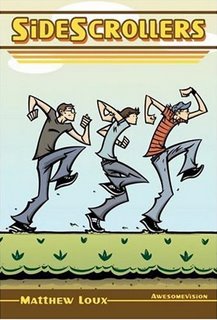
SideScrolling Through Life

When I first read that Matthew Loux’s SideScrollers had been challenged as a title on a high school’s summer reading list for incoming freshmen, my response was:

Who in the world put SideScrollers on a summer reading list?! Bwahahahahaha!

As Loux just told the National Coalition Against Censorship:
SideScrollers was inspired by my own slackerish social life when I was a teen, hanging out with friends during the summers after high school and college. In retrospect it was a great time of very little responsibility or expectations allowing the freedom to work at a crappy job and use the money earned on snacks, toys, and video games.
In sum, SideScrollers is the absolute antithesis of the summer reading list.

This is a story about lazing around and doing nothing productive. By dint of great effort, followed by mortal necessity, the heroes manage to save a girl from date rape and stand up to bullies. But most of the time their level of motivation is half a step above the self-preservation instinct of sea slugs.

Evidently one Enfield, Connecticut, parent objected to the book’s blue language. And yes, one parent shouldn’t be able to dictate an educator’s choice of reading possibilities for an entire class, especially when the list offered plenty of other books to choose from. But I have a hard time believing that educator had actually read SideScrollers before assigning it. (Loux has become better known for his Salt Water Taffy series for younger readers.)

Assigning SideScrollers as summer reading goes against its very nature. It’s the sort of book that should be recommended with a sly sidelong whisper: “Hey, kid, are you that bored? You want some mindless fun?” And then the young folk might learn something.

Fortunately, the local TV station reported:
The book has become very popular among young readers and there is a wait at the library and local bookstores to purchase or borrow it.

However, SideScrollers will not be on next year's summer reading list, [school superintendent] Schumann said.

23 August 2012

Redoing Mickey’s Monkey?

The legend of Maurice Sendak’s In the Night Kitchen is that “librarians across the country” painted a diaper or underwear over the hero Mickey’s genitals. This month at School Library Journal Kathleen T. Horning pointed out that the great majority of librarians supported full access to the book as Sendak had created it, as they supported him for most of his career.

Horning found three sets of evidence for authorities painting in the book:

  • a letter to School Library Journal from one Louisiana librarian in 1971, which prompted a semi-public response from Sendak’s editor, Ursula Nordstrom.
  • a school system in Missouri doctoring forty books before using Night Kitchen in a classroom.
  • Sendak’s own statement in 1991 that “I have a number of [altered] copies smuggled out to me by embarrassed librarians.”
However, in that same 1991 speech Sendak declared:
It’s been brought to my attention by a number of people that Mickey, in the lithograph I prepared for this American Booksellers Assn. convention, is still the 1970 little boy he always was—but that, oddly, his privates have grown way out of proportion. Now, this is true—I was unaware of that detail—and I’d like to think I inadvertently touched on some significant unconscious point—and not merely that I’m guilty of bad drawing. Either explanation might be correct, but of course I prefer the former.

What could be more reasonable under the circumstances? It makes a kind of comical sense; like Pinocchio’s nose displaced downwards (in Freud, it usually goes the other way), Mickey’s penis grows in response to the lie that is censorship, the lie that says children must be protected from such a sight.
Actually, all those explanations and symbolic interpretations are based on a faulty premise. The image of Mickey on the ABA 1991 poster was basically traced from a panel in Night Kitchen. And he shows little significant growth or shrinkage at all. Well, except in his feet.

03 December 2011

Coming to Americus

I first sampled this story as the webcomic Save Apathea. In print form, the graphic novel by scripter M. K. Reed and artist Jonathan Hill is titled Americus. And what valuable lessons about life does it hold for its readers?

The one that came through most clearly for me was:
People with dark hair are good.
Any Americus character who appears for more than one scene and has inked-in hair is smarter, funnier, more tolerant, and more interesting than the average person. People with lighter hair, left uncolored in this black-and-white book, can be nice or nasty, but all the major nasty people have lighter hair. Only three minor characters with dark hair break this rule, two just by being boring.

Unfortunately, that simple dichotomy reflects the overall story, which follows a protest against a fantasy novel in the library of a small American town. The woman challenging the book is not only self-righteous, but also bigoted, duplicitous, tyrannical, violent, and—just to cap the stereotype—overweight. 

The further away the story gets from that central conflict, the more true-to-life it seems. The main character’s social struggles as a high-school freshman, the horizons that literature and music can open up, the potential depths in some supporting characters—those details seem real and intriguing. In that respect, the title Americus plays to the book’s strengths: the portrait of a community is stronger than the battle to save the Apathea books in the fictional town library.

02 December 2011

Useful Term: “Plumber’s Review”

In my family we have the term “plumber’s review,” which is so useful that I’m surprised not to see it anywhere else. Perhaps we’ve got the wording wrong.

A “plumber’s review” is an assessment of a novel, or other work of art, based on one narrow concern. Say, a review of Robert Louis Stevenson’s Treasure Island focused entirely on details of south Pacific navigation, or an analysis of D. H. Lawrence’s Lady Chatterley’s Lover for its remarks on coal mining. In the academic world, it’s the comments from the professor miffed that you haven’t said more about the particular event or compound or poetic form that he or she happens to study.

An expert plumber’s perspective can be valuable, particularly on books about plumbing. Even a review of Edward Gibbon’s Decline and Fall of the Roman Empire focused entirely on water-systems engineering might offer useful insights.

In fact, it would have been valuable to have a whaler’s review of Moby Dick back in 1851. Instead, we had to wait nearly a century until Howard P. Vincent’s The Trying-Out of Moby Dick studied where Herman Melville got his technical information and what detail in the novel has no support in any other source of the time (the blacksmith’s apron).

The best type of “plumber’s review” acknowledges its narrow focus and the fact that there are other, wider perspectives. It offers inside information that general readers wouldn’t know but can incorporate with other responses. The worst “plumber’s review” misses that point, as well as other big points—which can make them very entertaining.

This fall at MICE I got to hear a preview of the “plumber’s review” echoing through this SLJ roundtable discussion of M. K. Reed and Jonathan Hill’s Americus. One of the important supporting characters in that graphic novel, Charlotte, is a youth-services librarian. And librarians, folks of that profession wish to make clear, don’t behave like her!

Despite public assumptions, Charlotte wouldn’t be reading in the middle of the day—she wouldn’t have time! She wouldn’t keep a patron waiting until she’d finished her reading. Most important, she wouldn’t snap back at a person lodging a complaint about a book, or tell a teenager that the complainer was a “control freak.” As Eva Volin stated in the SLJ discussion, “I would have been in big, big trouble had I handled the first contact the way Charlotte did.”

And since that conflict over a library book defines Americus’s plot, it seems like a problem for the novel. Indeed, it might subvert the book’s appeal to a key constituency.

TOMORROW: More lessons from Americus.

01 October 2011

Cute Couples

Yesterday Anita Silvey’s Book-a-Day Almanac spotlighted The Rabbits’ Wedding by Garth Williams:
Published first in 1958, The Rabbits’ Wedding features black and white rabbit protagonists. The artist most likely chose these colors to help delineate the two characters in a limited-color book, but adults interpreted this lovely romp in the forest as an endorsement of interracial marriage.

As Leonard Marcus recounts the controversy in Minders of Make-Believe, the Montgomery Home News condemned the book, then Alabama politicians rallied against the book and spoke out against the director of the Alabama Public Library Service Division, Emily Reed.
Showing how much things have changed, the most frequently challenged book in America last year was And Tango Makes Three by Peter Parnell and Justin Richardson, a picture book about two male penguins who raise a chick together. Adults interpret that true story as an endorsement of same-sex marriage.

Some people just don’t like seeing certain cute little animals happy together.

20 March 2011

Dick Gray and Richard Grayson

Marc Tyler Nobleman, author of Boys of Steel: The Creators of Superman and an upcoming biography of Bill Finger, co-creator of Batman and Robin, recently alerted me to the sensational character find of 1903: The Boy Wonder, Dick Gray!

Appearing in one story in the pulp magazine Brave and Bold, Dick Gray was “athletic in figure and singularly agile in his movements”—but then so were most other dime-novel heroes.

In the Comic Buyer’s Guide, David Frank reported that “The Boy Wonder, or Dick Gray’s Marvellous Pump” is “about the adventures Gray gets into with his anti-gravity device.” It thus seems to be of a piece with the Stratemeyer syndicate’s Tom Swift series, L. Frank Baum’s Master Key, and similar young men’s tales from that age of technological wonder.

I doubt this 1903 magazine had any influence on the creation of Dick Grayson in 1940. Finger, Jerry Robinson, and Bob Kane weren’t even born when Dick Gray was pumped out. But the similarity of the characters’ names highlights one ubiquitous aspect of American pop fiction until recently: the WASPiness of its heroes and heroines.

Both Baum and Edward Stratemeyer had German surnames, but practically all their main characters had surnames from the British Isles. Two generations later, many of the first generation of superhero creators were Jewish: Finger, Bob Kane (originally Robert Kahn), Jerry Siegel, Joe Shuster, Will Eisner, Joe Simon, Jack Kirby (originally Jacob Kurtzberg), Stan Lee (originally Stanley Leiber), and so on. But they created heroes with names like Bruce Wayne, Clark Kent, Lois Lane, Denny Colt, Steve Rogers, Reed Richards, and Peter Parker.

That trend in popular culture both reflected and amplified the trend in real life for some Americans to shed their “ethnic” names. Which brings me to a real Richard Grayson.

Back during the national crisis over the edition of Tom Sawyer and Huckleberry Finn published without ethnic slurs, one small electronic press announced the publication of The Hipster Huckleberry Finn. It replaced the “n word” with “hipster.” The editor and publisher of that edition is a writer, teacher, and activist named Richard Grayson.

In this autobiographical essay he explains:

I was born Richard Arnold Ginsberg in Brooklyn on June 4, 1951, two years after my parents, Marilyn and Daniel, had married. When I was six months old, Mom and Dad changed our Jewish last name to the ethnically neutral Grayson.
At that time, superhero comics were in a doldrum. Robin was one of the handful of costumed heroes who continued to appear often in comic books—Batman, Detective, and World’s Finest—but even he had lost his cover slot on Star Spangled Comics.

The Batman newspaper comic strip had stopped years before. The low-budget movie serial Batman and Robin had appeared in theaters in 1949 and then disappeared, and there was no TV show in daily reruns.

As a result, most Americans might not have seen any particular meaning in the name “Richard Grayson,” aside from the “ethnically neutral” quality this man’s parents were seeking.

But as the former Richard Ginsburg grew up, superhero comics came back. He even read them:
I also was a big fan of superhero comic books. I proudly possessed the early issues of Justice League of America, Green Lantern, Spider-Man, and Daredevil. At 11, I would pretend to be The Flash – Fastest Man Alive – as I bicycled around the neighborhood, playing hooky from Hebrew school.
Alas, Grayson doesn’t discuss whether he identified with Batman’s Boy Wonder, or was teased for sharing that character’s name. Perhaps one day he’ll make a story about it.

19 March 2011

In Twain

I visited Hannibal, Missouri, at an awkward time: during the big Mississippi flood of 1993. Even with water up the side of the levees and the bridge to Illinois impassable, the town was determined to celebrate its Tom Sawyer Days and Independence Day.

The son of the manager of my hotel won the Tom Sawyer half of that year’s Tom & Becky competition. Later he put his experience as a tourism ambassador to work by starting a website about the city. All of which seems far more responsible than Tom Sawyer himself.

This year the Mark Twain Boyhood Home & Museum in Hannibal is inaugurating a scholarly conference on Twain, scheduled for 11-13 August. Here’s the call for papers:

Abstracts for proposals are being accepted immediately through May 1. These should be e-mailed in Word format to Henry Sweets at henry.sweets@marktwainmuseum.org for review. The abstracts will be reviewed in timely fashion. Presenters will receive a discount on the conference fees.

Subject matter is wide open. Presentations are expected to address some topic related to Mark Twain, his life, or his works.
That’s mighty wide open indeed. Usually the CFPs I see throw out a lot of possible topics for scholars to pursue. But this conference is open to anything Twainish.

In addition, this upcoming week Sweets, the museum curator, will be part of a panel discussion at Quincy University on “Mark Twain’s Literary Legacy: Censorship and Whitewashing in a ‘PC’ World.” None of that discussion was part of Tom Sawyer Days.

06 January 2011

Standing Up for the Public Domain

As we consider the current kerfuffle over an edition of Tom Sawyer and Huckleberry Finn, Americans are united on several points:

Opposing censorship is a Good Thing. Preserving our history (even of Bad Things) is a Good Thing. Preserving our culture (especially the Great American Novels) is a Good Thing.

But standing up for the public domain is also a Good Thing.

All the books that Mark Twain published in his lifetime are in the public domain. (Canny author-publisher that he was, he managed to figure out how to generate new copyrights and new publicity.) That makes changing Tom Sawyer and Huckleberry Finn different from demanding changes to, or restricting access to, a book still under copyright with limited availability.

For one thing, such censorship won’t work. With Project Gutenberg, Google Books, more cheap “classic” paperback editions than you can swing a dead cat at, and millions of copies already printed, there’s no way the original texts of Twain’s best novels will disappear.

One edited edition of Huck Finn from one small press doesn’t erase all the other books on the market. It doesn’t stop bookstores, libraries, and schools from using unexpurgated versions if they decide those are more desirable. I can’t imagine a credible scenario in which this edition pushes out the original text.

Furthermore, because Huckleberry Finn is in the public domain, Prof. Alan Gribben has every right to do whatever he wants with the text. He chose to remove the word “nigger” and insert the chapter from Life on the Mississippi that Twain himself edited out, and in his introduction (PDF download) he explains why.

We all have the same right. For very little money I can put out an electronic edition with the word “nigger” replaced with “n!gger” and that extra chapter pulled out. White supremacists could issue an edition that replaces the word “nigger” with “naturally ignorant nigger.” Less stupid authors could rewrite the book to make Jim less childish, or substitute a better plot in the last third. People can write sequels, and fanfiction. The public domain makes all that possible. Then it’s up to the reading public to choose which uses have value.

Yesterday I noticed that several blog posts about this controversy are illustrated with the cover of the Troll Illustrated Classic edition, shown above. Perhaps that’s an ironic commentary on watering down the book to a childish level, but I suspect it’s because that edition has a big, iconic illustration of Huck and Jim on their appropriated raft.

That Troll edition clocks in at 48 pages. Obviously it’s been abridged for younger readers, another possibility made cheap and easy by the public domain. I’ll bet that a lot of Twain’s words were taken out of that book, and that “nigger” was one of the first to go. Nobody seems to have objected.

I can imagine a philosophical argument for barring people from making any changes to a reproducible work of art that its creator didn’t approve. But the cultural cost of such a restriction would far outweigh the benefits.

As long as no one misrepresents a changed edition of Twain as the original, then it’s up to readers which to choose. Gribben is quite explicit in his Tom Sawyer/Huck Finn edition about what he changed—probably more explicit than the folks at Troll Illustrated Classics.

TOMORROW: A modest technological solution.

05 January 2011

Cutting Through the Huck Finn Weeds

The edition of Tom Sawyer and Huckleberry Finn that I wrote about on Monday hit the national news today, with boringly predictable results: lots of complaints about “political correctness,” censorship, how other people are simple-mindedly misreading the book. I made up a few rules for myself for sorting through the noise.

1) If you say that it’s appropriate to use the “n word” in classrooms, but completely avoid using it in your own essay, then you lose a point. And for that reason, I’m going to use offensive terms with scare-quotes instead of euphemisms. Internet filtering programs, beware.

2) If you’re personally affected by the use of the terms “nigger” and “Injun,” then I’m more interested in your opinion than if you’re (like me) a white person for whom the issue is more abstract. Those words aren’t generically offensive—they’re particularly offensive because they derogate particular people.

Thus, I’ve sought out responses from African-American writers like Jamelle Bouie at The Atlantic and Elon James White at Salon, and from folks with African-American family members like Ann Freeman at Upside My Head. (But Freeman loses a point under rule #1. [REFEREES’ RULING: Freeman supports the use of the unedited Huckleberry Finn in the classroom, but opposes teachers’ or students’ use of the word in classroom discussions. So is that worth a point or not? It’s unexpected nuances like these that can make the issue so thought-provoking.])

3) If you’re a teacher who’s used Huckleberry Finn in the classroom recently, then I’m more interested. Some examples I’ve found include Sara Goodman as Sara*ndipity; David Ulin at the LA Times’s Jacket Copy; and Biblioklept before news of this edition broke. (But Goodman loses a point under rule #1.) Jinx as a former classroom teacher and a black woman gets double points.

Students and parents do sometimes object to Huckleberry Finn because of its language, as this news item from Seattle in 2003 explores. Teachers do sometimes choose not to use it, as described in this article from Multicultural Education in 2006. It’s more valuable to see how educators and students address the book’s challenges than to see an outsider loftily insist that they should.

I’d especially like to see some professionals address not just how to draw useful lessons from Twain’s use of “Injun” and “nigger,” but also how to do so in an environment increasingly concerned with preparing kids for standardized tests. Is there enough time in the school day? Does the book work better in certain schools, or certain grades?

4) If you use this incident to complain about “political correctness” on the left, I simply laugh at you. Not just because of the tired cliché, but because you’ve made a foolish assumption. The editor, Prof. Alan Gribben of Auburn, presented himself as a victim of the radical left in a political-academic controversy at the University of Texas back in the 1990s. For details, see Julius G. Getman’s In the Company of Scholars: The Struggle for the Soul of Higher Education, John K. Wilson’s The Myth of Political Correctness: The Conservative Attack on Higher Education, and Gribben’s own version of events.

Gribben is quite clear in his introduction to the new edition about why he feels it has value. I quoted that introduction on Monday (PDF download). Opponents should take his arguments into account before making any assumptions about the thinking behind this book.

5) If you make up ridiculous scenarios of what this editing might lead to, then I’m not interested in your opinion. This is about changing one word (or 236, depending on how we count) in Huckleberry Finn and two in Tom Sawyer. It doesn’t change the book’s plot, characters, or themes. It doesn’t affect any other editions or copies already on shelves.

And it’s not about just any offensive language. Novelist Walter Kirn joked, “Let's add offensive words to American novels that don't have enough of them. Little Women could use a few more 'shits.'” But “shit” doesn’t demean a particular class of people. If we want an equivalent, the joke would suggest renaming Little Women to “Little Cunts.” But who would say that (outside of the porn industry)?

TOMORROW: What the public domain means.

30 September 2010

Shocked, Shocked at Violence in Comics

For Banned Books Week, the Huffington Post ran an article (a slide show really) about the books in comics form most often challenged in public and school libraries.

Here are the titles and the reasons provided for the challenges.

  • Absolute Sandman, by Neil Gaiman – Anti-Family, Offensive Language, Unsuited to Age Group
  • Blankets, by Craig Thompson – Sexually Explicit content, Other (unspecified)
  • Bone (series), by Jeff Smith – Sexually Explicit content, Offensive Language, Unsuited to Age Group, Drugs
  • Fun Home, by Alison Bechdel – Sexually Explicit Content
  • Maus, by Art Spiegelman – Anti Ethnic
  • Pride of Baghdad, by Brian K. Vaughn – Sexually Explicit Content
  • Tank Girl, by Alan Martin & Jamie Hewlitt – Nudity, Violence
  • The Dark Knight Strikes Again, by Frank Miller – Sexually Explicit Content [not to mention an Evil Robin]
  • The League of Extraordinary Gentlemen: The Black Dossier, by Alan Moore & Kevin O’Neill – Nudity, Sexually Explicit Content, Unsuited to Age Group
  • Watchmen, by Alan Moore & Dave Gibbons – Unsuited to Age Group
The only comic on the list dinged for “Violence” is Tank Girl.

Maus involves little things called World War 2 and the Holocaust. Pride of Baghdad takes place during the US invasion of Iraq, and includes animals killing, eating, and raping each other. But perhaps, readers might say, we can’t complain about historical and biological violence.

So what about fantasy violence? Bone ends in a war. The superhero comics—Dark Knight Strikes Again, Watchmen, League of Extraordinary Gentlemen—include everything from fist fights to futuristic weapons. That volume of Sandman depicts a convention of serial killers, among other horrors.

The only comics of this list that don’t include significant violence are the two coming-of-age memoirs, Blankets and Fun Home. Both involve sex, for natural reasons. Sex is more “graphic” in a graphic novel, or at least easier to find. And since our culture perceives anything in comics form as meant for younger readers, it’s not surprising that some parents might find those stories about young adults unsuited for younger kids.

But back to Tank Girl, the only comic on this list challenged as too violent. Is it actually more violent than all the rest? Or is it simply the only action comic with a female in the central role?

23 September 2010

“Frequently Arrested Journalists”

This morning I got to read this in the New York Times:

The American military has frequently arrested journalists in Afghanistan and Iraq, holding them for long periods of time before releasing them without charges. So far as is known, no journalists have been convicted by a court on charges of working for insurgents either in Afghanistan or in Iraq.
I would be much happier if the word “American” didn’t have to appear in the first sentence. Locking up journalists without charge is the sort of thing our nation should be standing against.

20 September 2010

An Unbalanced Complaint about Speak

Laurie Halse Anderson reports on an attempt to ban her acclaimed young-adult novel Speak from a public high school’s curriculum. Evidently business professor Wesley Scroggins found that the novel’s description of date rapes aroused him enough to brand the book as “soft pornography.”

Revealing what perspective he’s coming from, in June Scroggins spoke at an event devoted to “the role of fundamental, Biblical Christianity in the establishment and function of our legal, legislative, and educational system, and…the successful reestablishment of these values in our society” (PDF download).

Among the sad ironies of this all-too-familiar situation is that the professor’s employer, Missouri State University, is promoting his services by declaring:

As an educator, Wes Scroggins is all about balance – balance in his teaching, balance in his research and balance in his service.

27 January 2010

There’s a Bear in the Woods?

I’m starting to lose my sense of outrage at parents trying to prevent other people’s children from reading certain books in school. The “challenges” are becoming so ridiculous that my dominant response is…entertained.


In a new school district in Riverside County, California (land of my birth), officials have decided that Merriam-Webster’s Collegiate Dictionary will remain in fourth- and fifth-grade classrooms even though it offers a defintion of “oral sex.” But, the Los Angeles Times reports, students will have to take permission slips home, and parents who don’t want their children to look in that book can insist they use “alternative dictionaries.” Oh, that’ll work.

In Union, Oklahoma, a parent objected to a book spun off from the Arthur and Postcards from Buster TV shows in 2005, which depicts children making maple sugar with their moms in Vermont. Two of those moms are a couple. One of Education Secretary Margaret Stallings’s first acts in office was to take back a federal grant because of this episode, showing how hollow her boss’s claim to “compassionate conservatism” was. The Tulsa World brings news that the school board voted to keep that book in the library since:
  • The whole point of Postcards from Buster was to show how different people live.
  • The board was pretty sure some children going to Union schools might have two parents of the same sex as well.
From the McClatchey syndicate comes the story that the Texas State Board of Education removed the author of Brown Bear, Brown Bear, What Do You See? from a curriculum as an example of an author who might be studied for his cultural contributions. The board had mixed him up with the author of Ethical Marxism: The Categorical Imperative of Liberation because they had the same name. What name is that? Bill Martin. Because, of course, there couldn’t be two Bill Martins writing wildly different books at the same time.

I can hardly wait to see how would-be censors top those.