Showing posts with label BOOK Scarecrow of Oz. Show all posts

11 September 2013

A Shirt Is a Terrible Thing to Waist

Yesterday I quoted L. Frank Baum’s description in The Patchwork Girl of Oz of a Munchkin boy wearing “a blue ruffled waist.” When I first read that book, I must have glossed over the phrase because:

  • John R. Neill’s pictures show Ojo wearing a white shirt with a ruff around his neck.
  • I had no idea what a “ruffled waist” might be.
This year, thanks to Google Books, I solved that mystery for myself. In 1897, the American Home Magazine published this picture of a ruffled waist.
Elsewhere in the magazine are examples of a shirt waist, blouse waist, silk waist, Norfolk waist, tucked waist, full waist, draped waist, and military waist.

The magazine also used “waist” to mean a person’s midriff or its circumference, as we still use the term (and once in a metaphor for how “the Chesapeake, like a great arm, reaches up and entwines itself about the waist of Maryland”). But obviously turn-of-that-century readers understood that the word could mean a garment of the sort we’d call a shirt.

Thus, Baum described Ojo wearing a blue ruffled shirt, perhaps with vertical ruffles like this lady. And Neill chose instead to draw Ojo with a ruff around his neck and a plainly sewn, if floppy, white shirt.

Baum used “waist” in similar ways in his other fantasy novels. In Sky Island he described the boy Button-Bright this way: “He wore a blouse waist, a short jacket, and knickerbockers.” And in The Scarecrow of Oz, Button-Bright looks like this: “He was dressed in a brown velvet jacket and knickerbockers, with brown stockings, buckled shoes and a blue shirt-waist that had frills down its front.”

Baum always portrayed Button-Bright as an upper-class, fairly precious (though indestructible) little American boy. His mother or governess (he had both) therefore dressed him in loose, frilly shirts. Or, as his contemporaries would say, waists.

30 October 2012

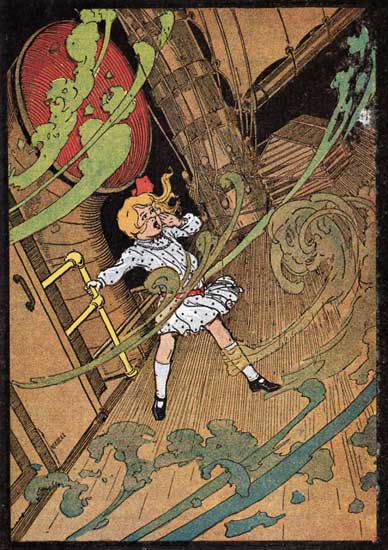
“A terrible storm”

The opening paragraphs of Ozma of Oz, by L. Frank Baum:
The wind blew hard and joggled the water of the ocean, sending ripples across its surface. Then the wind pushed the edges of the ripples until they became waves, and shoved the waves around until they became billows. The billows rolled dreadfully high: higher even than the tops of houses. Some of them, indeed, rolled as high as the tops of tall trees, and seemed like mountains; and the gulfs between the great billows were like deep valleys.

All this mad dashing and splashing of the waters of the big ocean, which the mischievous wind caused without any good reason whatever, resulted in a terrible storm, and a storm on the ocean is liable to cut many queer pranks and do a lot of damage.
Having sent Dorothy Gale to fairyland by cyclone (tornado), for her second trip Baum turned to this storm at sea. Next, in Dorothy and the Wizard in Oz, he used an earthquake. And then, since he’d exhausted the range of natural disasters, her next two trips were caused by magic from the Emerald City.

In The Scarecrow of Oz Baum had Trot and Cap’n Bill start their journey via a whirlpool—another type of nautical disaster. As with the earthquake suddenly opening a huge crack in the ground in Dorothy and the Wizard, people in the 1910s believed that such whirlpools existed in nature, but they don’t really. Does that mean magic must have been at work in those journeys too?

20 September 2011

Dubious Monarchy in the Work of L. Frank Baum

Last week I discussed the penchant of children’s fantasy for depicting monarchies instead of other forms of government. Such books show bad rulers as a source of societal unhappiness, but usually portray the solution as installing or restoring good rulers rather than, say, establishing democratically chosen legislatures and respect for individual rights.

L. Frank Baum’s books fit this pattern, in that most of his little societies are monarchies and few are republics. The most famous, Oz, is a benevolent dictatorship, with young Princess Ozma owning all goods, maintaining a monopoly on magic, and with Glinda keeping tabs on everyone through their Great Book of Records and Magic Picture.

But Baum he also tends to poke fun at monarchies by lampooning how rulers come to power. In Queen Zixi of Ix, young Bud becomes king of Noland simply because he’s the 47th person to enter the capital city one day. Among the Pinks of Sky Island, the woman with the palest skin is made queen—but in return she has to live in the worst house.

Other rulers, good and bad, have taken on different titles. The boss of Flathead Mountain calls himself the Su-Dic, short for “Supreme Dictator.” The Boolooroo bosses the Blues on Sky Island. And the High Coco-Lorum of Thi explains in The Lost Princess of Oz:
“In reality, I am the King, but the people don’t know it. They think they rule themselves, but the fact is I have everything my own way. No one else knows anything about our laws, and so I make the laws to suit myself. If any oppose me, or question my acts, I tell them it’s the law, and that settles it. If I called myself King, however, and wore a crown and lived in royal state, the people would not like me, and might do me harm.”
Though Baum occasionally showed hereditary dynasties being restored (most notably in the case of Ozma), more often he portrayed populations choosing their rulers:
  • Before the events of The Wonderful Wizard of Oz, the Wizard became ruler of the Emerald City because the initials on his runaway balloon made people think that he was linked to the country. 
  • At the end of that book, the Winkies choose the Tin Woodman to rule them because he seems kind and shiny. 
  • In Hiland and Loland, a population divided between tall thin people and short round people can agree on only one person as their king: a gingerbread man who appears out of the sky one day.
My favorite example of such a scene comes at the end of the long Jinxland episode in The Scarecrow of Oz, which swirls together hereditary monarchy, democracy, feminism, and true love:
When all were assembled, the Scarecrow stood up and made a speech. He told how Gloria’s father, the good King Kynd, who had once ruled them and been loved by everyone, had been destroyed by King Phearce, the father of Pon, and how King Phearce had been destroyed by King Krewl. This last King had been a bad ruler, as they knew very well, and the Scarecrow declared that the only one in all Jinxland who had the right to sit upon the throne was Princess Gloria, the daughter of King Kynd.

”But,” he added, “it is not for me, a stranger, to say who shall rule you. You must decide for yourselves, or you will not be content. So choose now who shall be your future ruler.”

And they all shouted: “The Scarecrow! The Scarecrow shall rule us!”

Which proved that the stuffed man had made himself very popular by his conquest of King Krewl, and the people thought they would like him for their King. But the Scarecrow shook his head so vigorously that it became loose, and Trot had to pin it firmly to his body again. a ”No,” said he, “I belong in the Land of Oz, where I am the humble servant of the lovely girl who rules us all — the royal Ozma. You must choose one of your own inhabitants to rule over Jinxland. Who shall it be?”

They hesitated for a moment, and some few cried: “Pon!” but many more shouted: “Gloria!”

So the Scarecrow took Gloria’s hand and led her to the throne, where he first seated her and then took the glittering crown off his own head and placed it upon that of the young lady, where it nestled prettily amongst her soft curls. The people cheered and shouted then, kneeling before their new Queen; but Gloria leaned down and took Pon’s hand in both her own and raised him to the seat beside her.

”You shall have both a King and a Queen to care for you and to protect you, my dear subjects,” she said in a sweet voice, while her face glowed with happiness; “for Pon was a King’s son before he became a gardener’s boy, and because I love him he is to be my Royal Consort.”

That pleased them all, especially Pon, who realized that this was the most important moment of his life. Trot and Button-Bright and Cap’n Bill all congratulated him on winning the beautiful Gloria; but the Ork sneezed twice and said that in his opinion the young lady might have done better.
Even though Jinxland ends up as a small hereditary monarchy within a larger one, one could hardly say this scene is a ringing endorsement of the divine right of kings.

20 November 2006

The Return of Button-Bright

Button-Bright first appears in the Oz books in The Road to Oz as a little boy, perhaps kindergarten age, who perplexes the Scarecrow and others with his frequent answer, "Don't know."

L. Frank Baum brought the boy back, older and smarter, in Sky Island, one of his best and most original fantasies. And finally he decided to move Button-Bright to Oz permanently in The Scarecrow of Oz, his book for 1915. In that book and from then on the boy seems to revert to his original character, clueless and contented. He has a knack for being in just the right place at the right time, with neither ability nor desire to explain how he got there.

That pattern is established as soon as Button-Bright makes his entrance in chapter 8 of The Scarecrow of Oz:

The little girl went to the window and looked out. The air was filled with falling white flakes, so large in size and so queer in form that she was puzzled.

"Are you certain this is snow?" she asked.

"To be sure. I must get my snow-shovel and turn out to shovel a path. Would you like to come with me?"

"Yes," she said, and followed the Bumpy Man out when he opened the door. Then she exclaimed: "Why, it isn't cold a bit!"

"Of course not," replied the man. "It was cold last night, before the snowstorm; but snow, when it falls, is always crisp and warm."

Trot gathered a handful of it.

"Why, it's popcorn?" she cried.

"Certainly; all snow is popcorn. What did you expect it to be?"

"Popcorn is not snow in my country."

"Well, it is the only snow we have in the Land of Mo, so you may as well make the best of it," said he, a little impatiently. "I'm not responsible for the absurd things that happen in your country, and when you're in Mo you must do as the Momen do. Eat some of our snow, and you will find it is good. The only fault I find with our snow is that we get too much of it at times."

With this the Bumpy Man set to work shoveling a path and he was so quick and industrious that he piled up the popcorn in great banks on either side of the trail that led to the mountain-top from the plains below. While he worked, Trot ate popcorn and found it crisp and slightly warm, as well as nicely salted and buttered. Presently Cap'n Bill came out of the house and joined her. . . .

Suddenly Trot heard [the Bumpy Man] call out:

"Goodness gracious--mince pie and pancakes!--here is some one buried in the snow."

She ran toward him at once and the others followed, wading through the corn and crunching it underneath their feet. The Mo snow was pretty deep where the Bumpy Man was shoveling and from beneath a great bank of it he had uncovered a pair of feet.

"Dear me! Someone has been lost in the storm," said Cap'n Bill. "I hope he is still alive. Let's pull him out and see."

He took hold of one foot and the Bumpy Man took hold of the other. Then they both pulled and out from the heap of popcorn came a little boy. He was dressed in a brown velvet jacket and knickerbockers, with brown stockings, buckled shoes and a blue shirt-waist that had frills down its front. When drawn from the heap the boy was chewing a mouthful of popcorn and both his hands were full of it. So at first he couldn't speak to his rescuers but lay quite still and eyed them calmly until he had swallowed his mouthful. Then he said:

"Get my cap," and stuffed more popcorn into his mouth.
And here's a fine picture of how Button-Bright might look today by David Lee Ingersoll.