Showing posts with label Ozma. Show all posts

18 June 2024

The Missing Princess of the Marvelous Land
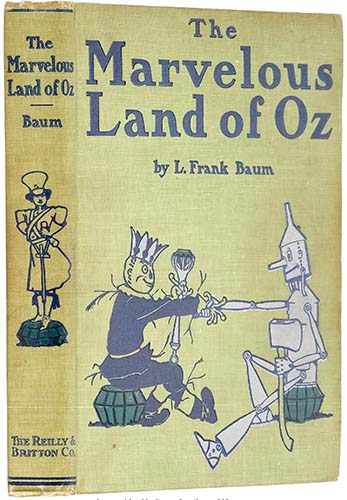
I’ve been thinking about how The Marvelous Land of Oz could be more of a mystery. As it is, the book is a roller-coaster ride of political events. Every so often it raises the question of who should rule the Emerald City. But the book doesn’t give us all the clues to its ultimate answer until quite late.

Baum and his colleagues had introduced the character of Pastoria, former king of Oz, in the 1902 stage extravaganza The Wizard of Oz. Therefore, when the Scarecrow mentions his name in the sixteenth chapter of Land, it wouldn’t have been a complete surprise to all readers.

Nonetheless, that was two-thirds of the way through the book. Furthermore, Glinda doesn’t drop the bombshell that Pastoria left a missing daughter until four chapters later. That means readers have only three chapters to be thinking about this mystery, on which the conclusion of the story will hinge.

There are plenty of signs that Baum didn’t like going back to revise. He occasionally excised whole chapters or inserted new passages, but his surviving manuscripts and correspondence show none of the fiddling with details that other writers regularly performed.

I don’t think it would have taken much revising to cue readers into thinking about Pastoria and his daughter for much of the book. Here are some slightly rewritten passages in which characters discuss the history of Oz.

In Chapter 3, the boy Tip is trying to orient his creation, Jack Pumpkinhead:
“Where are we going?” asked Jack, when they had resumed their journey.

“I’m not exactly sure,” said the boy; “but I believe we are headed South, and that will bring us, sooner or later, to the Emerald City.”

“What city is that?” enquired the Pumpkinhead.

“Why, it’s the center of the Land of Oz, and the biggest town in all the country. I’ve never been there, myself, but I’ve heard all about its history. It was built by a mighty and wonderful Wizard named Oz, around the estate of the former king Pastoria, and [later] . . . the people of the Emerald City invited the Scarecrow to rule them.”

“Dear me!” said Jack. “I’m getting confused with all this history. Who is the Scarecrow?”

“Another friend of Dorothy’s,” replied Tip.

“And who is Dorothy?”

“She was a girl that came here from Kansas, a place in the big, outside World. She got blown to the Land of Oz by a cyclone, and while she was here the Scarecrow and the Tin Woodman accompanied her on her travels.”

“And where is she now?” inquired the Pumpkinhead.

“Glinda the Good, who rules the Quadlings, sent her home again,” said the boy.

“Oh. And what became of the Scarecrow?”

“I told you. He rules the Emerald City,” answered Tip.

“I thought you said it was ruled by a wonderful Wizard,” objected Jack, seeming more and more confused.

“Well, so I did. Now, pay attention, and I’ll explain it,” said Tip, speaking slowly and looking the smiling Pumpkinhead squarely in the eye. “Around the time King Pastoria vanished, the Wizard came and built the Emerald City and ruled for many years. Dorothy went to the Emerald City to ask the Wizard to send her back to Kansas; and the Scarecrow and the Tin Woodman went with her. But the Wizard couldn’t send her back, because he wasn’t so much of a Wizard as he might have been. And then they got angry at the Wizard, and threatened to expose him; so the Wizard made a big balloon and escaped in it, and no one has ever seen him since.”

“Now, that is very interesting history,” said Jack, well pleased; “and I understand it perfectly all but the explanation.”
After Jack and Tip get separated, the boy meets a pretty young woman in a colorful military uniform. With a little tweaking, this conversation could have been part of that Chapter 8:
“I am General Jinjur,” was the brief reply.

“Oh!” said the boy surprised. “What sort of a General?”

“I command the Army of Revolt in this war,” answered the General, with unnecessary sharpness.

“Oh!” he again exclaimed. “I didn’t know there was a war.”

“You were not supposed to know it,” she returned, “for we have kept it a secret; and considering that our army is composed entirely of girls,” she added, with some pride, “it is surely a remarkable thing that our Revolt is not yet discovered.”

“It is, indeed,” acknowledged Tip. “But where is your army?”

“About a mile from here,” said General Jinjur. “The forces have assembled from all parts of the Land of Oz, at my express command. For this is the day we are to conquer His Majesty the Scarecrow, and wrest from him the throne. The Army of Revolt only awaits my coming to march upon the Emerald City.”

“Well!” declared Tip, drawing a long breath, “this is certainly a surprising thing! May I ask why you wish to conquer His Majesty the Scarecrow?”

“Because the Emerald City has been ruled by men long enough, for one reason,” said the girl. “Before the Scarecrow there was the Wizard, and before the Wizard, or even the city as it stands today, there was King Pastoria. Some people say Pastoria had a daughter who was meant to rule over us, meaning that we should have had a girl ruler by this time, but no one has seen that child for years.”

That lost heir was not part of the history of Oz that Tip had heard from Mombi. He puzzled over this rumor as Jinjur went on:

“Moreover, the City glitters with beautiful gems, which might far better be used for rings, bracelets and necklaces; and there is enough money in the King’s treasury to buy every girl in our Army a dozen new gowns. So we intend to conquer the City and run the government to suit ourselves.”
Tip and Jack Pumpkinhead reunite in the Scarecrow’s palace, only for General Jinjur to seize the Emerald City. Later the Scarecrow seizes the palace back with the help of his close friend, the Tin Woodman. But at that point in Chapter 16, the straw-man ruler is ready to abdicate:
Tip soon cut the stitches that had fastened the crown to the Scarecrow’s head, and the former monarch of the Emerald City removed it with a sigh of relief and hung it on a peg beside the throne.

“That is my last memento of royalty,” said he; “and I’m glad to get rid of it. The former King of this City, who was named Pastoria, lost the crown to the Wonderful Wizard, who passed it on to me. Now the girl Jinjur claims it, and I sincerely hope it will not give her a headache.”

“A kindly thought, which I greatly admire,” said the Tin Woodman, nodding approvingly.

“Have you ever heard,” Tip asked the straw man, “that King Pastoria had a daughter who disappeared?”

“Some people do say that,” answered the Scarecrow, “and some say otherwise. That happened well before my time, so I cannot say anything about it. Why—do you think General Jinjur is this lost heir to Pastoria?”

Tip shook his head. After all, Jinjur was the person who had first told him about the missing princess, and she had made no claim to rule the Emerald City other than by force and cunning.

“Well, now I will indulge in a quiet think,” continued the Scarecrow, lying back in the throne.
Finally, the Scarecrow and his supporters reach Glinda’s palace in Chapter 20:
“Therefore I have come to beg your assistance,” resumed the Scarecrow, “for I believe you are always glad to succor the unfortunate and oppressed.”

“That is true,” replied the Sorceress, slowly. “But the Emerald City is now ruled by General Jinjur, who has caused herself to be proclaimed Queen. What right have I to oppose her?”

“Why, she stole the throne from me,” said the Scarecrow.

“And how came you to possess the throne?” asked Glinda.

“I got it from the Wizard of Oz, and by the choice of the people,” returned the Scarecrow, uneasy at such questioning.

“And where did the Wizard get it?” she continued gravely.

“I am told he took it after Pastoria, the former King, had not been heard from for some time,” said the Scarecrow, becoming confused under the intent look of the Sorceress.

“Then,” declared Glinda, “the throne of the Emerald City belongs neither to you nor to Jinjur, but to this Pastoria from whom the Wizard usurped it.”

“That is true,” acknowledged the Scarecrow, humbly; “but Pastoria has been gone for many years now, and some one must rule in his place.”

“Pastoria had a daughter, who is the rightful heir to the throne of the Emerald City. Did you know that?” questioned the Sorceress.

“Not for certain,” replied the Scarecrow. “But if that girl still lives I will not stand in her way. It will satisfy me as well to have Jinjur turned out, as an impostor, as to regain the throne myself. In fact, it isn’t much fun to be King, especially if one has good brains. I have known for some time that I am fitted to occupy a far more exalted position. But where is the girl who owns the throne, and what is her name?”

“Her name is Ozma,” answered Glinda. “But where she is I have tried in vain to discover. For the Wizard of Oz, when he stole the throne from Ozma’s father, hid the girl in some secret place; and by means of a magical trick with which I am not familiar he also managed to prevent her being discovered—even by so experienced a Sorceress as myself.”
By that point, readers would have been thinking about the Emerald City’s deep history for most of the book, and the mystery of the missing heir for a dozen chapters. Where could that child be?

01 December 2015

Oz Art to Wish for from Linda Medley

This is one of the most potent images from the Oz book mythos: Dorothy is wearing the Magic Belt and making a wish. Something’s gonna happen. Somebody’s going down.

This illustration comes from Linda Medley, the comics artist best known for Castle Waiting and a long-time fan of the Oz books. It’s one of five greeting cards featuring Oz characters that she just offered on Etsy. The others show Scraps, Jack Pumpkinhead, the Wizard, and Glinda.

Medley has also created a print of Ozma, the Wizard, and Dorothy (and Toto, too). Her picture of Dorothy is an enthusiastic little girl, notably younger than Ozma and ready for adventure.

29 September 2015

The Electric “Elements of Oz”

Elements of Oz is a new stage/video show that seems to combine an homage to the MGM movie with Ozma’s Magic Picture. (Which, as we all know, can show you any place or person you ask to see.)

Here’s a taste of the review in today’s New York Times:
At “Elements of Oz,” having its premiere as part of the Peak Performances season at Montclair State University here, viewers are encouraged to use smartphones or tablets during the performance. . . . You download a special app that instructs you to put your phone in airplane mode until the show starts. The app then provides access to various elements that enhance the production, primarily nifty filters that, when you point the phone at the stage, add new layers of imagery to the action. When Dorothy’s house in Kansas flies skyward, for example, you can hold up your phone and see a real corker of a tornado and slashing rain that isn’t apparent to the naked eye.

Directed by Marianne Weems, “Elements of Oz” was jointly created by James Gibbs and Moe Angelos. Ms. Angelos is also one of the three performers, alongside Sean Donovan and Hannah Heller. A loose, loopy and enjoyable seminar on the making of the movie and its influence on pop culture, the production combines live video and performance — several famous scenes from the movie are more or less filmed anew before us — with anecdotes about its production and other random arcana about the film and the book it was based on by L. Frank Baum. . . .

The live re-creations of scenes from the movie are technically marvelous; the digital video (by Austin Switser) is dazzlingly pristine, and it’s fun, at least for a while, to watch the wry comic impersonations of the performances in the movie. . . . But ultimately these sequences don’t provide enough comic stimulation to justify their length. It begins to feel a bit too much like a draggy day on the back lot, and you might find yourself tempted to escape the app and fire up the real movie on your phone…
The performers, who each play multiple roles, all get praise, as does Bert Lahr.

11 February 2014

Shirley Temple in Oz

Shirley Temple was known in her childhood as an Oz fan, mentioning the books in interviews and being photographed with them. Her name was attached to MGM’s Wizard of Oz for a while, but since she was under contract to another studio, that possibility was always slim.

Instead, Temple produced and starred in an adaptation of The Land of Oz for television in 1960 as part of her Shirley Temple Storybook series. As a middle-aged mother she made a somewhat awkward Tip but a fine Ozma. Agnes Moorehead as Mombi stole the show.

07 January 2014

Ozma with “Tresses of Ruddy Gold”

This is Brigette Barrager’s portrait of Ozma, created for the Gallery Nucleus exhibit.

Barrager’s webpage shows a sketch for this image, as well as some other preliminary sketches of Ozma and Dorothy. They look like what might have graced the Oz books if they’d been published about 1960.

28 November 2013

Let Us Be Thankful That This Isn’t Rerun Every Year

In 1980 the Muller Rosen animation company released a half-hour holiday special for television titled Thanksgiving in the Land of Oz. That show was then recut to remove the Thanksgiving references and released on video as Dorothy in the Land of Oz; as of this holiday, it can be watched in two parts on YouTube. In 1982 Romeo Muller adapted his screenplay into a short illustrated book titled Dorothy and the Green Gobbler of Oz.

Like most Oz videos in the television age, this cartoon was written to invoke MGM’s Wizard of Oz. Dorothy meets the Wizard in Kansas again, the Cowardly Lion is bipedal, there are songs, and so on. But the filmmakers also obviously knew the Oz books and used them as inspiration for characters, settings, and plots points, albeit without being faithful to those books.

Thus, for example, just as in L. Frank Baum’s original novel and the MGM movie, Dorothy and Toto accidentally travel to Oz and meet three male companions who help her on a quest to vanquish a villain. One of those companions is an animated refugee from a farm, another made of metal, and the third a big carnivore with gentle habits. But in this movie those characters are Jack Pumpkinhead, Tic Toc [sic], and the Hungry Tiger, whom Baum introduced in different ways in his second and third Oz books.

Jack lives in a pumpkin house, as John R. Neill drew it in The Road to Oz. Other Oz houses resembles those he and W. W. Denslow designed, and a sequence of children opening Christmas presents owes a lot to Denslow’s art, rendered with less character. However, a trip over a rainbow at the end is clearly inspired by the MGM movie’s most famous song.

The end of the cartoon shows Ozma as rightful ruler of the Emerald City, but there’s no explanation of how she came to the throne. This Ozma seems much older than Dorothy and more like the Glinda of the movie.

Another element that the filmmakers borrowed from Baum’s books appears at the start: Uncle Henry and Aunt Em are about to lose their farm to the bank. The couple plans to go into an “old folks’ home” while Dorothy will have to live somewhere far away with a cousin—perhaps Zeb Hugson from Dorothy and the Wizard in Oz. This is a better fate than what Baum wrote about in The Emerald City of Oz, which suggested Dorothy would have to go to work while her aged relatives might end up begging. Still, it was probably a shock to many viewers.

The big-name star of the production is Sid Caesar, who plays the Wizard and narrates the story in that role. Caesar also plays a mince pie that’s brought to life, takes the name U.N. Krust, and delivers every line in a different foreign accent. The pie and its speech patterns play no role in the plot; they seem to have been included just to put Caesar’s shtick to use. We haven’t seen so much ethnic humor in an Oz adaptation since the 1903 Broadway show.

Another notable casting detail: Joan Gerber supplied the voices for both Ozma and Tic Toc.

The cartoon includes a couple of forgettable songs. Dorothy uses one to convert the villain back into a benevolent toymaker, and at the same time deliver a paean to Christmas shopping. In that respect, this modestly produced special was a perfect start to commercial television’s holiday season.

01 October 2013

Munchkin Economics

Mari Ness harrumphs over a comment from a Citibank economist: “The world’s largest economy looks like the Land of Oz run by munchkins.” Quoting largely from L. Frank Baum’s The Emerald City of Oz, Ness writes:
Allow me to say, alas, if only.

I have, of course, been one of the loudest and fiercest critics of Ozma, the girl Ruler of Oz, carefully documenting all of the numerous historically attested examples of what I have termed "Ozma fail," including, but not limited to, actions leading to gross injustice, kidnapping, an attack on the Emerald City, war or genocide. So I think I cannot be accused of bias when I say both "if only" and "how unfair," or of gross partisanship if I take up cudgels in her defense.

Oz, after all, is arguably one of the most successful economies in the known or unknown universe, so wealthy that it can even offer a free suite of rooms, elegant food, and free jewels to American hobos who just happen to be passing by. The Emerald City also provides lavish parties and entertainment at no cost to the local population. Areas of the kingdom suffering economic distress can apply for and receive economic assistance from the central government in the Emerald City. The result is an economy that is the marvel of the magical world. . . .

Mind you, by the standards of Citibank's chief economist, some aspects of the Oz economy may seem a bit alarming. Oz, after all, is a centralized, planned economy offering free universal health care (provided by magic wand and natural, genetic immortality) and education -- an education which children and college students are literally forced to swallow down. Farmers are forced to turn over all agricultural surpluses to the Emerald City to be stored in giant warehouses to be distributed for the common good; products are evenly distributed, with no profit margin. . . .

To be fair, this economy is run by Ozma, not Munchkins. Point to Citibank.
Even there, however, I think the economist’s comments are unfounded. Munchkinland is usually called the most pleasant and peaceful quadrant of Oz. Even shortly after the death of the Wicked Witch of the East, the populated areas that Dorothy visits seem prosperous and developed with little evidence of recent hardship.

The Munchkins appear to have distributed government power more evenly than people in other parts of Oz. Rather than a single ruler, three Munchkin gentlemen greet Dorothy alongside the visiting Good Witch of the North. By the end of The Wonderful Wizard of Oz Baum established strong monarchs for the Quadling and Winkie Countries and the Emerald City’s central region, and later stated that the Gillikin Country lacked such a ruler and was the wildest part of Oz. And in Munchkinland? While Baum made occasional brief mentions of an unnamed Munchkin king, that figure leaves so little impact that I’m not sure he really existed or was more than symbolic. And yet the Munchkins remain prosperous and happy.

We can ask related questions about the Munchkinland in the MGM movie. We meet a mayor, a coroner, uniformed soldiers, and representatives of two civic organizations. There’s a village in good repair and a good road. Clearly civil society continued even under the Wicked Witch of the East. Munchkinland is one of the two pleasant parts of Oz that Dorothy visits in the movie, the other being the Emerald City—where citizens run to a humbug wizard at the first airborne sign of trouble.

The Citibank economist used “Munchkins” as a synonym for “little people,” and suggested that little people can’t run an economy. That may be how life looks to Citibank, but most people would rather have a society run by and for the little people as a whole than by humbug wizards, straw men, or even pretty young absolute monarchs.

03 April 2013

More Revisionist Ozian History from L. Frank Baum

L. Frank Baum revised the character of the Wizard of Oz back to a capable and even lovable showman in his fourth novel in the series, Dorothy and the Wizard in Oz. After all, it wouldn’t do for Dorothy’s protector on that book’s journey to fairyland to be a child-stealing fraud, which is how the Wizard had last appeared in The Marvelous Land of Oz.

In the latter part of Dorothy and the Wizard, Oz gets to explain himself to Princess Ozma, the very child he had stolen (though no one has the effrontery to bring that up here):
“One day my balloon ran away with me and brought me across the deserts to this beautiful country. When the people saw me come from the sky they naturally thought me some superior creature, and bowed down before me. I told them I was a Wizard, and showed them some easy tricks that amazed them; and when they saw the initials [O.Z.] painted on the balloon they called me Oz.”

“Now I begin to understand,” said the Princess, smiling.

“At that time,” continued the Wizard, busily eating his soup while talking, “there were four separate countries in this Land, each one of the four being ruled by a Witch. But the people thought my power was greater than that of the Witches; and perhaps the Witches thought so too, for they never dared oppose me. I ordered the Emerald City to be built just where the four countries cornered together, and when it was completed I announced myself the Ruler of the Land of Oz, which included all the four countries of the Munchkins, the Gillikins, the Winkies and the Quadlings. Over this Land I ruled in peace for many years, until I grew old and longed to see my native city once again. So when Dorothy was first blown to this place by a cyclone I arranged to go away with her in a balloon; but the balloon escaped too soon and carried me back alone. . . .”

“That is quite a history,” said Ozma; “but there is a little more history about the Land of Oz that you do not seem to understand—perhaps for the reason that no one ever told it you. Many years before you came here this Land was united under one Ruler, as it is now, and the Ruler’s name was always ‘Oz,’ which means in our language ‘Great and Good’; or, if the Ruler happened to be a woman, her name was always ‘Ozma.’ But once upon a time four Witches leagued together to depose the king and rule the four parts of the kingdom themselves; so when the Ruler, my grandfather, was hunting one day, one Wicked Witch named Mombi stole him and carried him away, keeping him a close prisoner. Then the Witches divided up the kingdom, and ruled the four parts of it until you came here. That was why the people were so glad to see you, and why they thought from your initials that you were their rightful ruler.”

“But, at that time,” said the Wizard, thoughtfully, “there were two Good Witches and two Wicked Witches ruling in the land.”

“Yes,” replied Ozma, “because a good Witch had conquered Mombi in the North and Glinda the Good had conquered the evil Witch in the South. But Mombi was still my grandfather’s jailor, and afterward my father’s jailor. When I was born she transformed me into a boy, hoping that no one would ever recognize me and know that I was the rightful Princess of the Land of Oz. But I escaped from her and am now the Ruler of my people.”

“I am very glad of that,” said the Wizard, “and hope you will consider me one of your most faithful and devoted subjects.”

“We owe a great deal to the Wonderful Wizard,” continued the Princess, “for it was you who built this splendid Emerald City.”

“Your people built it,” he answered. “I only bossed the job, as we say in Omaha.”
Some of this history is reflected in the new movie, Oz the Great and Powerful:

  • the Wizard’s full name, with its embarrassing later initials spelling out “PINHEAD.”
  • the assumption that the Wizard must be the land’s savior if he comes from the sky in a balloon bearing the letters OZ.
  • the notion that the Wizard landed in the midst of a fight among the land’s witches.

However, in the new movie the Emerald City is already built, and green instead of made so by green glasses—all the better to bring up memories of the city in the 1939 MGM movie.

02 April 2013

“He wasn’t so much of a Wizard as he might have been.”

This is how Tip, the young hero of L. Frank Baum’s second Oz book, explains the first to his creation Jack Pumpkinhead:

“Where are we going?” asked Jack, when they had resumed their journey.

“I’m not exactly sure,” said the boy; “but I believe we are headed South, and that will bring us, sooner or later, to the Emerald City.”

“What city is that?” enquired the Pumpkinhead.

“Why, it’s the center of the Land of Oz, and the biggest town in all the country. I’ve never been there, myself, but I’ve heard all about its history. It was built by a mighty and wonderful Wizard named Oz, and everything there is of a green color. . . And in the Country of the Munchkins, over at the East, everything is blue; and in the South country of the Quadlings everything is red; and in the West country of the Winkies, where the Tin Woodman rules, everything is yellow.”

“Oh!” said Jack. Then, after a pause, he asked: “Did you say a Tin Woodman rules the Winkies?”

“Yes; he was one of those who helped Dorothy to destroy the Wicked Witch of the West, and the Winkies were so grateful that they invited him to become their ruler,—just as the people of the Emerald City invited the Scarecrow to rule them.”

“Dear me!” said Jack. “I’m getting confused with all this history. Who is the Scarecrow?”

“Another friend of Dorothy’s,” replied Tip.

“And who is Dorothy?”

“She was a girl that came here from Kansas, a place in the big, outside World. She got blown to the Land of Oz by a cyclone, and while she was here the Scarecrow and the Tin Woodman accompanied her on her travels.”

“And where is she now?” inquired the Pumpkinhead.

Glinda the Good, who rules the Quadlings, sent her home again,” said the boy.

“Oh. And what became of the Scarecrow?”

“I told you. He rules the Emerald City,” answered Tip.

“I thought you said it was ruled by a wonderful Wizard,” objected Jack, seeming more and more confused.

“Well, so I did. Now, pay attention, and I’ll explain it,” said Tip, speaking slowly and looking the smiling Pumpkinhead squarely in the eye. “Dorothy went to the Emerald City to ask the Wizard to send her back to Kansas; and the Scarecrow and the Tin Woodman went with her. But the Wizard couldn’t send her back, because he wasn’t so much of a Wizard as he might have been. And then they got angry at the Wizard, and threatened to expose him; so the Wizard made a big balloon and escaped in it, and no one has ever seen him since.”

“Now, that is very interesting history,” said Jack, well pleased; “and I understand it perfectly all but the explanation.”
A number of touches show the influence of the Wizard of Oz stage extravaganza that debuted to great crowds in 1902:

  • the vaudeville crosstalk of the conversation itself. Baum’s first Oz book has relatively little dialogue, and much of it is straightforward and declaratory. With this sequel he began writing patter. That offered more chance to distinguish his characters, but also more chance to stretch for cheap laughs.
  • the omission of the Cowardly Lion as one of Dorothy’s companions, just as Baum omitted him from this book. The big stars of the stage show were the Scarecrow and the Tin Woodman, and this sequel was designed to give the public more of them. 
  • the portrayal of the Wizard as a villainous fraud, as he appeared in the stage show, rather than a good-hearted humbug. In The Wonderful Wizard of Oz, the Wizard builds a balloon in a sincere attempt to take Dorothy home to Kansas, but he can’t stop it once it’s launched. As Tip retells the story, the Wizard built the balloon simply to escape before Dorothy and her companions could reveal his secrets.

Or is that actually how the people of Oz came to look upon the Emerald City’s former ruler?

20 March 2013

What Oz the Great and Powerful Draws from Baum’s Works

The credits for Oz the Great and Powerful say the movie is “Based on the Works of L. Frank Baum.” Those works are in the public domain, meaning the moviemakers could use as many details from Baum’s Oz books as they wanted for free.

In fact, the moviemakers used very few details from those books, aside from The Wonderful Wizard of Oz itself, filtered through other versions (more on that tomorrow). Fans of the series have been tallying the items they recognize from the later books, and the list is short:
  • The Wizard’s full name is as stated in Dorothy and the Wizard in Oz (1908). That book also adds a few details to what the Wizard told Dorothy earlier about his arrival in Oz and finding himself caught between the witches.
  • When a map of Oz appears, it includes the name “Wogglebug.” Baum introduced that character in The Marvelous Land of Oz (1904), and the maps credited to his highly educated self appeared in Tik-Tok of Oz (1915).
  • A group of mechanically inclined inventors is called the Tinkers, and Ozma of Oz (1907) includes a Mr. Tinker as co-inventor of the Tik-Tok the clockwork man.
  • As discussed yesterday, The Road to Oz (1909) introduced the notion of traveling inside a bubble. That main inspiration for that detail of the new movie nonetheless appears to be its reappearance in the 1939 movie.
  • Oz has to escape from aggressive plants in a forest, reminiscent of man-eating flowers in The Patchwork Girl of Oz (1913). However, since both the book and movie forms of The Wizard of Oz include aggressive plants, Patchwork Girl might not be the source.
  • The land of Oz’s recent history echoes the situation Glinda explains in The Marvelous Land of Oz: the last rightful king was deposed and destroyed, leaving a daughter out of power. In the books, that daughter is Ozma. In Oz the Great and Powerful, that daughter is Glinda herself.
That last tidbit demonstrates the new movie’s real relationship to Baum’s books. While crediting them as its basis, the new movie’s story is incompatible with them.

In The Wonderful Wizard of Oz, for example, the Wizard explains that he oversaw the building of the Emerald City and had his subjects wear green glasses, ostensibly to shield their eyes but really to make the city glow like emeralds. In the new movie Oz arrives at the Emerald City, its green towers already scraping the sky. That leaves less for him to do.

And there’s no way for this land of Oz to become the fairyland of The Marvelous Land of Oz and beyond because there’s no way to fit Ozma into that political history. The new movie’s Glinda is not only the Good Witch of the South as in the books and the obvious analogue of the Good Witch of the North in the 1939 movie, but also the rightful heir to the throne of the Emerald City.

There’s nothing wrong with offshoots of the original mythos. Indeed, Baum was so unconcerned with consistency that he created offshoots in his own books and plays. But this latest version of Oz isn’t on a trajectory to end up at the happy paradise under Princess Ozma where Baum ultimately left us.

05 December 2012

Glinda as a "respectable sorceress”

As I wrote yesterday, in The Marvelous Land of Oz (1904) L. Frank Baum started describing Glinda the Good as a “Sorceress” instead of a “Good Witch.” In later books he referred to her as “the Royal Sorceress” or “the Good Sorceress.” But Glinda wasn’t his first sorceress.

The first in Baum’s oeuvre was Maetta, a Glinda-like character in A New Wonderland, completed in the mid-1890s and finally published in early 1900. Three years later that book was republished as The Magical Monarch of Mo. The second sorceress was Gayelette, who created the Golden Cap that enslaved the Winged Monkeys at some unspecified time before the Wizard’s arrival in Oz.

The Wonderful Wizard of Oz mentions sorceresses elsewhere as well. The Good Witch of the North says, “In the civilized countries I believe there are no witches left, nor wizards, nor sorceresses, nor magicians.” The Munchkins keep calling Dorothy a sorceress because she’s killed the Witch of the East and taken her shoes, and because she wears white: “only witches and sorceresses wear white.”

Those statements suggest that “witch” and “sorceress” are similar, overlapping categories. But then there’s this remark early in The Marvelous Land of Oz:
Mombi was not exactly a Witch, because the Good Witch who ruled that part of the Land of Oz had forbidden any other Witch to exist in her dominions. So [she], however much she might aspire to working magic, realized it was unlawful to be more than a Sorceress, or at most a Wizardess.
That implies that a Wizardess was somehow superior to a Sorceress, and both inferior to a Witch.

However, later in that same book Glinda herself suggests that a major difference between a Sorceress and a Witch involves the type of magic each does:
“Really,” said the Sorceress, “that is beyond my magic. I never deal in transformations, for they are not honest, and no respectable sorceress likes to make things appear to be what they are not. Only unscrupulous witches use the art…”
That said, in Rinkitink in Oz (1916), Glinda disenchants a character without discussing such scruples. So it’s not that she can’t do transformations as a sorceress; with Mombi available to reverse her own spell, Glinda chooses not to.

Baum often has characters discuss different types of magic, as in Ozma’s remark to Dorothy in his last book, Glinda of Oz (published 1920):
“I am a more powerful fairy than any other inhabitant of Oz, I am not as powerful as Glinda the Sorceress, who has studied many arts of magic that I know nothing of. Even the little Wizard of Oz can do some things I am unable to accomplish, while I can accomplish things unknown to the Wizard. This is to explain that I’m not all-powerful, by any means. My magic is simply fairy magic, and not sorcery or wizardry.”
That novel also introduces a “krumbic witch,” who esoteric spells baffle even Glinda, and offers our second view of a “yookoohoo,” a magician who specializes in transformations.

Baum was not a consistent writer, and he never laid out all his different forms of magic and which type of magician was more powerful than another. If he had done so, he might well have contradicted that system a few books later when he had a better idea.

But one thing Baum was consistent about was that Glinda is the most powerful magician in Oz. That might imply that a Sorceress is more powerful than a Witch, but perhaps that particular Sorceress is simply more powerful than any Witch. In any event, if Glinda wants to call herself a Sorceress, not many people would dare to object.

27 November 2012

Oz, the Small and Meek

At Slate, Aisha Harris raised some serious questions about Sam Raimi’s upcoming movie Oz, the Great and Powerful, based on the most recent online trailer:
“You are here at last, and the prophecy shall be fulfilled,” says one witch. “I’ve waited for you to come and set things right,” says another. Is Oz slipping into an old-fashioned story about women needing a great male savior? Why are all these women with their own supernatural powers waiting around for an ordinary guy to come along and save them all?

L. Frank Baum’s original Oz books were published during the peak of the suffragette movement, and they were quite progressive in their depictions of a young female hero. Dorothy Gale, who ultimately reveals the man behind the curtain as the fraud that he is, was inspired by pioneer women and has been championed by some as the “first feminist role model.”
All that’s true. Not only was Dorothy the main protagonist of the Oz series, but the most powerful rulers in Oz were Ozma and Glinda.

I think Harris overstated her case, however, when she went on to say: “The 1939 film The Wizard of Oz stayed impressively true to this vision, giving us Judy Garland as an independent, curious young woman who aids a group of hapless men on their quest to see the wizard.” No, Judy Garland plays a breathy, largely reactive adolescent who decides she should never leave her own backyard to find her heart’s desire. The movie turned Dorothy’s happenstance visit to Oz from an adventure to a lesson about the dangers of running away, and thus into a punishment. In contrast, we next see Baum’s Dorothy on a voyage to Australia. Now that’s independent and curious.

But back to the Wizard. The whole point of The Wonderful Wizard of Oz is that “Oz, the great and terrible” (the book’s words) is a humbug. And that’s clearly part of Raimi’s story as well. When a movie sets up a character as “Great and Powerful” in the title, we know that has to be ironic or a challenge. Otherwise, there’d be no place for the story to go, nothing to reveal.

Back in July, the director laid out the main character arc:
As for the plot itself, everything is centered around [James] Franco’s Wizard, who is kind of a dick. “It’s the story of a selfish man, who’s a little bit of a lothario, a little bit of a cad.” Oz is “a land of second chances” for the Wizard, who’s also redeemed by the love of Glinda, the Good Witch. “It’s how he became ensconced in the Emerald City,” said Raimi. “By the time this picture ends, the audience has one interpretation of how it all came to be [...] how he became the protector of that great city.”
The phrase “love of Glinda” gives me pause because the Good Sorceress has no—needs no—love interest in the books. But will this movie’s Glinda offer Oz romantic love, or does he merely assume so? Does he set out to show himself protecting Oz just to impress Glinda and become a bigger, better man along the way? We’ll see next year.

21 August 2012

Ozma, the Birthday Girl

Though L. Frank Baum probably never intended to convey this information, today is the birthday of Ozma, fairy queen of Oz. Some passages in The Road to Oz mention that her birthday is on the 21st of the month. Another passage says that the month is August. So there we go.

One of Baum’s longest descriptions of Ozma comes in The Magic of Oz, his penultimate novel:
Ozma, the beautiful girl Ruler of the Fairyland of Oz, was a real fairy, and so sweet and gentle in caring for her people that she was greatly beloved by them all. She lived in the most magnificent palace in the most magnificent city in the world, but that did not prevent her from being the friend of the most humble person in her dominions. She would mount her Wooden Sawhorse, and ride out to a farm house and sit in the kitchen to talk with the good wife of the farmer while she did her family baking; or she would play with the children and give them rides on her famous wooden steed; or she would stop in a forest to speak to a charcoal burner and ask if he was happy or desired anything to make him more content; or she would teach young girls how to sew and plan pretty dresses, or enter the shops where the jewelers and craftsmen were busy and watch them at their work, giving to each and all a cheering word or sunny smile.

And then Ozma would sit in her jeweled throne, with her chosen courtiers all about her, and listen patiently to any complaint brought to her by her subjects, striving to accord equal justice to all. Knowing she was fair in her decisions, the Oz people never murmured at her judgments, but agreed, if Ozma decided against them, she was right and they wrong.

When Dorothy and Trot and Betsy Bobbin and Ozma were together, one would think they were all about of an age, and the fairy Ruler no older and no more “grown up” than the other three. She would laugh and romp with them in regular girlish fashion, yet there was an air of quiet dignity about Ozma, even in her merriest moods, that, in a manner, distinguished her from the others. The three girls loved her devotedly, but they were never able to quite forget that Ozma was the Royal Ruler of the wonderful Fairyland of Oz, and by birth belonged to a powerful race.
Ozma is clearly devoted first to her ideals and second to the protection and rule of her country. I think those priorities present a challenge for people who want to write adventures for her. Ozma leaves her capital for extended periods in order to carry out what she sees as important duties (e.g., Glinda of Oz, The Magical Mimics of Oz), she can be kidnapped (e.g., The Lost Princess of Oz, Grampa in Oz, Kabumpo in Oz, The Hungry Tiger of Oz), and she can even suffer amnesia about her duties (e.g., The Forbidden Fountain of Oz). But I don’t see it as in her character to “go off on an adventure” the way Dorothy does. She’s got things to do.

30 May 2012

Reconciling with the Wizard of Oz

Yesterday I described a review of a latter-day Oz book by Hugh Pendexter III. Among Oz fans he’s best known for his short book Oz and the Three Witches, published in 1977. It was inspired by two contradictory passages that L. Frank Baum left us about the Wizard of Oz, the evil witch Mombi, and the baby princess Ozma.

First, near the end of The Marvelous Land of Oz (1904), Baum narrated Glinda the Good’s interrogation of Mombi this way:
“I will ask my first question: Why did the Wizard pay you three visits?”

“Because I would not come to him,” answered Mombi.

“That is no answer,” said Glinda, sternly. “Tell me the truth.” . . .

Mombi now saw how useless it was to try to deceive the Sorceress; so she said, meanwhile scowling at her defeat:

“The Wizard brought to me the girl Ozma, who was then no more than a baby, and begged me to conceal the child.”

“That is what I thought,” declared Glinda, calmly. ”What did he give you for thus serving him?”

“He taught me all the magical tricks he knew. Some were good tricks, and some were only frauds; but I have remained faithful to my promise [to hide] the Princess Ozma—the child brought to me by the Wizard who stole her father’s throne.“
Baum wrote that book because of the popularity of the 1902 stage extravaganza adapted from The Wonderful Wizard of Oz. That show used the Wizard as an antagonist, a charlatan and mountebank who had stolen the rightful king’s throne, and the book reflected that characterization.

But in Dorothy and the Wizard in Oz (1908), Baum brought the Wizard back as a capable and reliable protector for Dorothy. What happened when they reached the Emerald City and the Wizard met up with its new ruler, Princess Ozma? She asks him about his first arrival in Oz.
“At that time,” continued the Wizard, busily eating his soup while talking, “there were four separate countries in this Land, each one of the four being ruled by a Witch. But the people thought my power was greater than that of the Witches; and perhaps the Witches thought so too, for they never dared oppose me. I ordered the Emerald City to be built just where the four countries cornered together, and when it was completed I announced myself the Ruler of the Land of Oz. . . .”

“That is quite a history,” said Ozma; “but there is a little more history about the Land of Oz that you do not seem to understand—”
Aha—the J’accuse moment when Ozma confronts the Wizard with his misdeeds: “Do you remember the child you handed over to an evil crone? I, sir, was that little baby you sold into slavery!”

But no. She continues:
“Many years before you came here this Land was united under one Ruler, as it is now, and the Ruler’s name was always ‘Oz,’ which means in our language ‘Great and Good’; or, if the Ruler happened to be a woman, her name was always ‘Ozma.’ But once upon a time four Witches leagued together to depose the king and rule the four parts of the kingdom themselves; so when the Ruler, my grandfather, was hunting one day, one Wicked Witch named Mombi stole him and carried him away, keeping him a close prisoner. Then the Witches divided up the kingdom, and ruled the four parts of it until you came here. That was why the people were so glad to see you, and why they thought from your initials that you were their rightful ruler.”

“But, at that time,” said the Wizard, thoughtfully, “there were two Good Witches and two Wicked Witches ruling in the land.”

“Yes,” replied Ozma, “because a good Witch had conquered Mombi in the North and Glinda the Good had conquered the evil Witch in the South. But Mombi was still my grandfather’s jailor, and afterward my father’s jailor. When I was born she transformed me into a boy, hoping that no one would ever recognize me and know that I was the rightful Princess of the Land of Oz. But I escaped from her and am now the Ruler of my people.”

“I am very glad of that,” said the Wizard, “and hope you will consider me one of your most faithful and devoted subjects.”
And nothing more is said of kidnapping and baby-selling and other disagreeable subjects.

Ruth Plumly Thompson explored the history of Ozma’s father and Mombi in The Lost King of Oz (1925), but many gaps and inconsistencies remained. (Indeed, we haven’t even touched Baum’s later statement that Ozma was really a fairy left by a fairy queen in the far distant past.)

Pendexter’s Oz and the Three Witches picks up after the second conversation above as Glinda comes to the Emerald City to quiz the Wizard about the whole Ozma matter. The result is a lively little tale of the Wizard trying to fend off the Wicked Witches of East and West through his humbug illusions while navigating the tricky politics of pre-Dorothean Oz. He doesn’t realize who Mombi is, and he’s very, very sorry. All in all, it’s about as good a reconciliation of Baum’s contradictory statements as possible.

First published in 1977, Oz and the Three Witches was reprinted in its entirety with Patricia Ambrose’s quite competent illustrations in Oz-Story, #6.

02 February 2012

The Second Oz Series

When L. Frank Baum returned to the Oz series, he had left Dorothy and Ozma in a good place. Too good a place, in fact. Supposedly he wasn’t even able to contact them any more. Solving that problem (through the new technology of wireless) was less challenging, however, than coming up with a new fuel for stories about Oz now that Dorothy could live with her family in the Emerald City and Ozma could feel safe about Oz.

Furthermore, since Baum evidently now planned to keep writing Oz books as long as he could, he was no longer thinking ahead to a series end. He needed to keep his characters interesting, or come up with new ones.

With a story called “Little Dorothy and Toto” in The Little Wizard Stories of Oz (written for younger readers than the novels), Baum found a new unresolvable foundational conflict for Dorothy. Though she has a perfectly comfortable, safe home in the royal palace, she insists on wandering into the countryside and heading off on dangerous missions. In that story, the Wizard tries to cure Dorothy of this bad habit. It doesn’t work.

Thus, in The Magic of Oz, Dorothy’s idea of birthday shopping means going into a forest of wild beasts and asking to borrow a dozen monkeys. In Glinda of Oz she’s eager to go to the edge of Prof. Wogglebug’s map to get involved in a war. In The Patchwork Girl of Oz she invites herself on Ojo’s quest, and in Rinkitink in Oz she heads to the Nome Kingdom.

As for Ozma, she continues to be so kind-hearted that she has trouble governing. In Glinda of Oz, the title character advises her to stay out of the turmoil in one corner of Oz, and she insists on heading there anyway and telling her subjects they should be nice. In The Lost Princess of Oz she gets kidnapped, and Dorothy (of course) heads out to rescue her.

But for most of in his second series of Oz books, Baum had antagonists drive the plot, or found other young protagonists: Ojo, Betsy, Trot, Button-Bright, Inga, and Woot. Most of those new kids didn’t hold up for more than one adventure because they didn’t have unresolvable foundational conflicts. Once Inga rescues his parents, or Betsy finds a home, there’s nothing left for their characters to do.

The two young characters who play important, distinct roles in more than one of Baum’s novels came with foundational conflicts that continued to drive them into adventures. Trot is little, but curious and just as brave as Dorothy. Button-Bright gets lost whether he means to or not. If either of those sources of conflict ever disappeared, so would their stories. Like Dorothy and Ozma, Trot and Button-Bright are built for an open-ended series.

20 September 2011

Dubious Monarchy in the Work of L. Frank Baum

Last week I discussed the penchant of children’s fantasy for depicting monarchies instead of other forms of government. Such books show bad rulers as a source of societal unhappiness, but usually portray the solution as installing or restoring good rulers rather than, say, establishing democratically chosen legislatures and respect for individual rights.

L. Frank Baum’s books fit this pattern, in that most of his little societies are monarchies and few are republics. The most famous, Oz, is a benevolent dictatorship, with young Princess Ozma owning all goods, maintaining a monopoly on magic, and with Glinda keeping tabs on everyone through their Great Book of Records and Magic Picture.

But Baum he also tends to poke fun at monarchies by lampooning how rulers come to power. In Queen Zixi of Ix, young Bud becomes king of Noland simply because he’s the 47th person to enter the capital city one day. Among the Pinks of Sky Island, the woman with the palest skin is made queen—but in return she has to live in the worst house.

Other rulers, good and bad, have taken on different titles. The boss of Flathead Mountain calls himself the Su-Dic, short for “Supreme Dictator.” The Boolooroo bosses the Blues on Sky Island. And the High Coco-Lorum of Thi explains in The Lost Princess of Oz:
“In reality, I am the King, but the people don’t know it. They think they rule themselves, but the fact is I have everything my own way. No one else knows anything about our laws, and so I make the laws to suit myself. If any oppose me, or question my acts, I tell them it’s the law, and that settles it. If I called myself King, however, and wore a crown and lived in royal state, the people would not like me, and might do me harm.”
Though Baum occasionally showed hereditary dynasties being restored (most notably in the case of Ozma), more often he portrayed populations choosing their rulers:
  • Before the events of The Wonderful Wizard of Oz, the Wizard became ruler of the Emerald City because the initials on his runaway balloon made people think that he was linked to the country. 
  • At the end of that book, the Winkies choose the Tin Woodman to rule them because he seems kind and shiny. 
  • In Hiland and Loland, a population divided between tall thin people and short round people can agree on only one person as their king: a gingerbread man who appears out of the sky one day.
My favorite example of such a scene comes at the end of the long Jinxland episode in The Scarecrow of Oz, which swirls together hereditary monarchy, democracy, feminism, and true love:
When all were assembled, the Scarecrow stood up and made a speech. He told how Gloria’s father, the good King Kynd, who had once ruled them and been loved by everyone, had been destroyed by King Phearce, the father of Pon, and how King Phearce had been destroyed by King Krewl. This last King had been a bad ruler, as they knew very well, and the Scarecrow declared that the only one in all Jinxland who had the right to sit upon the throne was Princess Gloria, the daughter of King Kynd.

”But,” he added, “it is not for me, a stranger, to say who shall rule you. You must decide for yourselves, or you will not be content. So choose now who shall be your future ruler.”

And they all shouted: “The Scarecrow! The Scarecrow shall rule us!”

Which proved that the stuffed man had made himself very popular by his conquest of King Krewl, and the people thought they would like him for their King. But the Scarecrow shook his head so vigorously that it became loose, and Trot had to pin it firmly to his body again. a ”No,” said he, “I belong in the Land of Oz, where I am the humble servant of the lovely girl who rules us all — the royal Ozma. You must choose one of your own inhabitants to rule over Jinxland. Who shall it be?”

They hesitated for a moment, and some few cried: “Pon!” but many more shouted: “Gloria!”

So the Scarecrow took Gloria’s hand and led her to the throne, where he first seated her and then took the glittering crown off his own head and placed it upon that of the young lady, where it nestled prettily amongst her soft curls. The people cheered and shouted then, kneeling before their new Queen; but Gloria leaned down and took Pon’s hand in both her own and raised him to the seat beside her.

”You shall have both a King and a Queen to care for you and to protect you, my dear subjects,” she said in a sweet voice, while her face glowed with happiness; “for Pon was a King’s son before he became a gardener’s boy, and because I love him he is to be my Royal Consort.”

That pleased them all, especially Pon, who realized that this was the most important moment of his life. Trot and Button-Bright and Cap’n Bill all congratulated him on winning the beautiful Gloria; but the Ork sneezed twice and said that in his opinion the young lady might have done better.
Even though Jinxland ends up as a small hereditary monarchy within a larger one, one could hardly say this scene is a ringing endorsement of the divine right of kings.

20 April 2011

Two Issues of Oziana Back to Back!

Oziana 2009 (described yesterday) and Oziana 2010 comprise a double issue, bound back to back, each with a full complement of new and original Oz fiction and art. (For folks who enjoy back covers, however, you’re out of luck.)

The theme for Oziana 2010 is “The Challenges of Governing Oz,” and it starts with Tim Art-McLaughlin’s spectacular color image of “The Queen and Her Court.” Tim is an Oz fan and professional artist from Shropshire, England; email him if you’re interested in Ozzy commissions.

Tim also provided the art for “Celebrating Ozma: The Silver Jubilee Issue,” in which the father-daughter team of Andrew and Rachel Heller introduce us to Oz’s postage stamps and postal service. They are, of course, magical.

“Fiddle’s Revenge,” by Arianna Brown, won a student writing award at last year’s International Wizard of Oz Club conference at the Arne Nixon Center in Fresno. This adventure, set back when the Scarecrow ruled the Emerald City, brings back the Cowardly Lion, the Tin Woodman, and the Winged Monkeys—as well as the danger of a giant spider. Author-illustrator Dennis Anfuso provided the suitably scary art.

In “Invisible Fence,” the Emerald City’s war against unauthorized magic takes the Wizard, the Tin Soldier, Snif the Iffin, and Dorothy to a dark Gillikin forest, where they find a most innocent-looking outlaw. This mystery story from me comes with nine charming illustrations by David Lee Ingersoll.

Copies of Oziana 2009/2010 are on their way to subscribers, and can be ordered from the Oz Club. The double issue offers two full-color covers, seven new stories, and original art at every turn.

24 February 2011

To Ozopolis and Back

Ozopolis is a new Oz comic, written and published by Kirk Kushin and illustrated in black and white by Gonzalo Martinez. It’s firmly based in the Oz that L. Frank Baum left us, without severe reinventions for the sake of novelty or shock.

I also discern the influence of Eric Shanower’s older Oz comics, lately collected in Adventures in Oz. Martinez’s characterization of Dorothy, for example, looks a lot like Shanower’s, with strong chin, blonde hair, and dark Ann-Margret eyebrows. As in Shanower’s drawings (and John R. Neill’s before him), Dorothy dresses in contemporary style. Unlike in Adventures in Oz, however, Ozma has also updated her fashion, making her look a little more like General Jinjur.

If you understood that allusion, then you’re well positioned to appreciate the story in Ozopolis, #1. It really requires having read The Wonderful Wizard of Oz, The Marvelous Land of Oz, Ozma of Oz (the series’ first three volumes), and The Patchwork Girl of Oz (the 1913 relaunch). Fortunately, those are among Baum’s most enjoyable and widely available titles.

On the other hand, if you don’t know that the Woozy can shoot fire from his eyes, and what prompts him to do that, then the end of this episode will seem like a Woozy ex machina. Along with that cubical creature, the story’s stars are Tik-Tok, the Sawhorse, and the Glass Cat, with appearances from several more favorites. The result is a funny, action-filled adventure with the promise of a big conflict to come.

Ozopolis is available by mail through its website, which also offers a few preview pages. (I picked up one panel back here.) Delivery was swift, and I hope there will be more issues to come.

21 February 2011

Fables and Ozian Decadence

Yesterday I quoted comics scripter Bill Willingham’s 2009 essay against “Superhero Decadence,” which appears to be a politicized way of expressing the common thought that superhero comics aren’t as good as they were when a person was twelve.

Willingham’s major work in comics now is Fables, which takes fairy-tale heroes and moves them to our world, where they live in secret among us. (Other authors exploring this idea include Michael Buckley in The Sisters Grimm and Sarah Beth Durst in Into the Wild and Out of the Wild.)

All public-domain fantasy characters are available to Willingham. The unusual copyright situation of Peter Pan caused him some troubles, but L. Frank Baum’s Oz characters are fair game. Glinda and her swan-drawn chariot appeared in one frantic panel of an early issue of Fables, and Dorothy Gale and her companions have shown up several times in the companion series, Jack of Fables.

The most prominent refugees from Oz in the Fables comic books are Bufkin the winged monkey, whom I’ll discuss tomorrow, and a young witch identified as Ozma in issue #87. She’s not precisely like Baum’s Ozma: there’s no mention of fairy ancestry, early life as a boy, or the throne of the Emerald City. But with a poppy in her hair, she’s clearly meant to evoke the little queen of Oz.

Except that Baum’s Ozma was entirely benevolent, sometimes naively so—as in The Emerald City of Oz, when she’s willing to let evil creatures overrun her kingdom because she can’t think of any way to stop them without hurting them, and Ozma of Oz and Glinda of Oz, in which she heads off to help other kingdoms without thinking of how to protect herself.

In contrast, Willingham’s Ozma is a little schemer, fairly ruthless at the internal politics of Fabletown and promising to be more ruthless about its latest adversaries. She’s also very good at magic, while Baum’s Ozma gains her magical knowledge gradually, and never seems as capable as Glinda the Good Sorceress.

Indeed, the character in Fables is a much better match for Baum’s Glinda, who is far more authoritarian, secretive, and militaristic than Ozma in her approach to protecting Oz. But Glinda doesn’t offer the striking visual paradox of a little girl acting like a tough commander.

Meanwhile, Cinderella, a Fables spin-off scripted by James Roberson, has featured another version of Dorothy Gale, as Jer Alford reports at Emerald Hearts in Oz. That magazine features Cinderella as a deadly secret agent, and Dorothy shows up as a rival assassin from Russia. She’s fully grown, and—based on this panel, which is all that I’ve seen—goes around pointing guns in her underwear.

Willingham and his colleagues have every right to use Baum’s characters as they choose, and Fables continues to be an entertaining adventure comic. I don’t insist that depictions of Oz remain pure and childish, having frequently pointed out Glinda’s realpolitik and even published an article titled “Dorothy the Conqueror,” about the character’s tendency to wipe out her enemies.

But Ozma’s different. Open, unadulterated, and sometimes heedless kindness is what defines Ozma in Baum’s books. Willingham’s rant about superheroes becoming “decadent”—straying from their traditional characterizations to become violent, selfish, and cynical—seems to apply even more to his series’ treatment of Ozma.

22 February 2010

Not a Bit of It

Doing far more than is called for, Mari Ness recently reviewed The Cowardly Lion of Oz, by Ruth Plumly Thompson, at the Tor website. Published in 1923, this is the earliest Oz book still under copyright protection. It’s also one of the few strong arguments I know for keeping books that old out of the public domain.

Ness zeroes in on one of the annoying aspects of this book, the character of Notta Bit More, the neurotic circus clown:

The clown follows, he explains, four rules whenever he is in danger. One, try to disguise himself. Two, be polite—very polite. Three, joke. And Four, when all else fails, run away. And not at all to his credit, he follows these same four rules over and over throughout the book, leading to the same scene, over and over:

Clown sees, or thinks he sees, danger.

Clown puts on disguise.

People react with fear/anger/weapons/claws/large buckets of water.

Clown attempts to be polite to justifiably irritated/angry/frightened/distrustful people who are now in no mood for politeness.

Clown tells unfunny jokes.

People tie up or sit on clown. Readers wait in unfulfilled hope for someone to kill the clown.
In addition, Notta Bit More overshadows the book’s young American protagonist, erasing one of the strengths of the Oz books, even others with poor plots: empowered children.

One recurring theme of Ness’s reviews of the Oz series is “Ozma fail,” or poor decisions by the young ruler of the Emerald City. Of course, the biggest challenge of telling stories about Oz is that after the first eight books or so Ozma and her mentor Glinda are so powerful and have so much information available to them that it’s hard to build up a real threat. Some things we have to accept for the sake of the story.

But Notta Bit More isn’t one of them.