Showing posts with label MOVIES Laurel and Hardy. Show all posts

24 February 2025

The Strangeness of “Wiggle Your Ears”

“Wiggle Your Ears” (IMDB; YouTube; Lucky Corner) was a weird entry in the Our Gang series.

The storyline was not only adult, it was bleak.

Mary is infatuated with Harry because he can wiggle his ears. He treats her like dirt, making her crack his nuts and mend his pants. One line of Harry’s dialogue is even, “You got any money today, woman?”

Joe craves Mary’s attention, but he can’t wiggle his ears.

Pretty blonde Jean comes along. She also likes Harry’s ears, and Harry likes her. He doesn’t just toss Mary aside; he has her buy ice cream for him and Jean and then push them in his go-cart. Mary blubbers her woes through a donut. Farina advises her to doll herself up as a flapper.

Mary paints her cheeks and rolls down her stockings. But that “vamping” doesn’t work. Harry just takes her ring so he can marry Jean (shown in Mary’s imagination).

Meanwhile, Wheezer grudgingly helps his older brother Joe fake the feat of wiggling his ears with tape and string. (This was in fact how the Hal Roach Studios did the ear-wiggling trick.)

Mary becomes Joe’s girl, though that relationship is based on a lie. Harry’s ears get cramped as Jean makes him carry her doll and push her in the go-cart. The End.

Underscoring that bleak plot is how Robert F. McGowan shot nearly the whole movie in tight close-ups. So we get a clear view not only of the boys’ wiggling ears, but of Wheezer’s raspberries, Jean’s eye-batting, Harry’s underpants, and even a fly landing on Mary’s cheek. The result is almost Expressionist in its intensity.

In their book on the series, Leonard Maltin and Richard W. Bann wrote that “Wiggle Your Ears” is “an amusing but absolutely bizarre two-reeler.” The story spoofs adult relationships. There’s even an odd moment when Harry seems to be in orgasmic ecstasy while being licked by a cat. But as the kid actors play the situation straight, the close-up shots convey their emotions stronger than the parody.

At this time, several years into the Our Gang series, Bob McGowan was trying out unusual filmmaking techniques in various shorts. “Yale vs. Harvard” included lots of shots upward through glass. “The Spanking Age” cut all the adults’ heads out of the frame. “Cat, Dog & Co.” features a surreal dream sequence with giant chickens. “Wiggle Your Ears” is one of that set.

Some of those Our Gang pictures are lost. They weren’t released by Pathé, which produced additional 16mm prints for markets outside of cinemas. They didn’t have sound like the later MGM releases which got reproduced for television. And a fire at MGM in 1965 destroyed a lot of negatives. Thus, we can’t actually see how weird some of those late silent movies were. But we can see “Wiggle Your Ears.”

McGowan might have simply been in the mood to try something different. And a peek behind the scenes offers another reason for why “Wiggle Your Ears” was made as it was.

At the end of 1928, Hal Roach Studios was under pressure to finish all the shorts it had promised to MGM for the spring season before the place shut down for five weeks.

At the Laurel and Hardy unit, “Liberty” had taken more time than expected, so in one month they rushed through both “That’s My Wife” and “Big Business.” The former has a well-worn premise that hinges on pleasing a rich uncle (Our Gang’s “Baby Clothes” was one precursor). The latter took inspiration from the Christmas season and needed very little plot at all. 

For the Our Gang unit, the solution was overlapping productions, as recorded at the Lucky Corner website. Bob McGowan shot “Wiggle Your Ears” on a short schedule from 4 to 12 December. His nephew and namesake Robert A. McGowan, working as Anthony Mack, shot the very different movie “Fast Freight” (IMDB; YouTube; Lucky Corner) from 10 to 27 December.

By using a small cast, barely-glimpsed settings, and few group shots in “Wiggle Your Ears,” Bob McGowan could work with just two or three actors at a time, leaving others free to start their scenes for “Fast Freight.”

Thus, Allen “Sunny” Hoskins as Farina performed only two short scenes in “Wiggle Your Ears.” (As a black boy, he’s left out of the romantic maneuvers.) Pete the Pup appeared in only one. Neither filmed the final scene with the rest of the gang.

But Farina and Pete had extended scenes together riding the rails in “Fast Freight,” with no other cast members in sight. So while most of Our Gang were working with Bob McGowan on the streets of Culver City, Farina and Pete were probably off with Anthony Mack at the railyard.

08 February 2025

“I just didn't know how to steer it”

By the spring of 1932, two years after Buddy McDonald first acted in an Our Gang movie, there had been some big changes at the Hal Roach Studio.

The Great Depression had caught up with the movie business. At the end of 1931, Bank of America set a new condition for renewing Roach’s credit: he had to hire Henry Ginsberg to supervise production and keep down costs.

Within the Our Gang unit, long-time players Allen “Farina” Hoskins, Mary Ann Jackson, and Norman “Chubby” Chaney all aged out in mid-1931. The next March, Bobby “Wheezer” Hutchins went off to make movies elsewhere for a while. The only cast members left from Buddy’s first three films were Dorothy DeBorba and Matthew “Stymie” Beard.

There were also two important additions to the gang. In spring 1932 the studio hired Dickie Moore, already established as a child actor, to play lead in the next several films. And from Texas the irrepressible George “Spanky” McFarland had stepped into Wheezer’s baby shoes as cute little brother and absolute chaos agent.

As a younger man producer-director Bob McGowan had been a firefighter, and he’d already applied that experience to two Our Gang movies: “Fire Fighters” (1922), the second to be filmed and released, and “The Fourth Alarm!” (1926).

To start a new slate of movies for fall 1932, McGowan remade “The Fourth Alarm!” with sound as “Hook and Ladder” (YouTube; IMDB; Lucky Corner). Dickie is the fire chief. Stymie is his right-hand man. Spanky is the wise-ass baby brother who can’t be left behind because he has to take his medicine every half-hour.

In “The Fourth Alarm!” there were a dozen gang members in the fire company. “Hook and Ladder” had eight—perhaps a sign of cost-cutting. And one of those kids was Buddy McDonald.
At this point, nine-year-old Buddy was the tallest in the gang (though not the oldest). He didn’t have any significant lines or close-ups. But he was tasked with driving a makeshift fire engine through the streets of Palms, California. Indeed, that job might have been why McGowan cast him again: the movie needed a kid big enough to handle a horse.

That didn’t go great. McDonald told Our Gang historian Richard D. Bann:
I was on the back of the hook and ladder trying to drive the thing and they had to pull me off of there. Don Sandstrom had to take over. I was supposed to steer from back there [behind the camera], but it was difficult for me and also a little dangerous. Scary, too. I allowed the contraption to get away from me, and it scared us all, so the assistant director took over. I just didn't know how to steer it. The thing wasn’t meant to swing side to side; I couldn’t keep it running straight. It must have looked funny because even after Don Sandstrom took over steering, it continued swaying back and forth. This time on purpose. I was lucky I didn’t kill somebody on the city streets!
At least Buddy didn’t have to work with goats again.

That was Buddy McDonald’s last film, from Hal Roach or any other studio. He stayed in show biz, singing on the Juvenile Revue radio show, which started in 1933. His photo appeared in the 30 Aug 1933 Los Angeles Herald-Examiner as a member of the cast of the radio soap opera Molly Malone’s Family, produced by star Edith Greaves. McDonald recalled doing that job “every afternoon when I wasn’t at Hal Roach Studios.”

But late in 1933 Buddy’s parents blew up his career:
Then my parents separated and my mom grabbed we three kids—my older brother, my younger brother, and myself—and we went to Oregon. She had an aunt up there she thought would take us in. All the aunt did was point to the berry field. “Go help yourself,” was her advice. We lived in a tent, slept on the ground, picking and eating berries and fruit to live. We were fruit tramps. In time we scraped together enough money to get back to Southern California and return to our same house.
That was “About a year later.”
With the money I’d earned in pictures and radio, my parents had been able to pay off the house. In those days a nice, four bedroom house in the town of Bell was something you could have bought for around $800 to $1,200. While we had been tramping up in Oregon, my dad told us—before he left—that Hal Roach Studios called six to eight times looking for me to do more picture work. Then that finally stopped. . . .

During the Prohibition era in this country, my dad had a cafe on Florence Avenue, and he was bootlegging out the back door. When Prohibition was repealed [December 1933] he turned the place into a bar and then he got a liquor license for a second operation in Bell. Trouble was, he and my mother were their own best customers.
The McDonalds divorced. Buddy started drinking himself, then committing petty crimes. He went to a high school for “incorrigible boys,” served in the US Marines in the war, and did a stint in jail for armed robbery.

In 1953, Bud McDonald joined Alcoholics Anonymous and started living sober. He helped to raise a family and to run a trucking business. He founded programs to help addicts.

After his talk to Bann in 2001, McDonald was invited to some Los Angeles gatherings of the Sons of the Desert, the society founded to celebrate Laurel and Hardy, which had also adopted Our Gang and other Hal Roach series. Thomas “Bud” McDonald died in 2008, a couple of weeks short of turning eighty-six and more than three-quarters of a century after his last ride with Our Gang.

(This is the end of an analysis of Bann’s interview with McDonald, considered through other sources about the Our Gang movies, that started with these posts:

05 February 2025

Buddy McDonald Dropped from the Gang

In this posting, I posited that while working on the Our Gang comedy “School’s Out” (IMDB; Lucky Corner) in June 1930, seven-year-old Buddy McDonald showed up one day without any shoes.

Speaking in 2001 to Richard W. Bann, McDonald recalled: “my mother never noticed. She had to drive all the way back to Bell to get my shoes, and in the meantime they went and bought a new pair of shoes for me at the studio.”

I wonder if there was more fallout from that day. Buddy’s mother wasn’t always easy to get along with. He told Bann frankly:
My parents were both “lushes.” . . . My mother was a violent drunk and my father was a passive drunk. My mom could start a fight in an empty room when she was drunk. . . . My brothers and I would try to disappear if my mother was drinking, because we were scared to death of her.
There’s no hint that alcohol was involved in this particular incident, but it may have convinced the studio that the McDonalds weren’t reliable, or worth the trouble.

I suggest that because after “School’s Out,” Buddy McDonald disappeared from the gang. He didn’t appear in any of the four Our Gang movies filmed in the rest of 1930—not even “Love Business” (YouTube; IMDB; Lucky Corner) which was a sequel to “Teacher’s Pet” and “School’s Out.”

The studio had its pick of freckled boys in that period. In addition to Buddy, there were Donald Haines and Douglas Greer. In fact, all three appeared in “School’s Out” (which needed a big cast of schoolmates), and all three played boys nicknamed “Speck” in 1930–32.

At the end of 1930 Paramount hired Jackie Cooper away to star in Skippy. Donald Haines played Harley Nubbins in that film, and Buddy McDonald appeared in the background. By McDonald’s account, he also appeared in the sequel, Sooky. Jackie went on to an Oscar nomination and more starring roles as an MGM contract player. Donald returned to the Our Gang series by May 1931.

In contrast, Buddy was called in to the Hal Roach Studio only sporadically. His work consisted of:
  • Sometime in late 1930, a small part in the Laurel and Hardy feature Pardon Us, later cut from the movie.
  • February–March 1931, the Charley Chase short “One of the Smiths,” as discussed before.
  • October 1931, the Thelma Todd–Zasu Pitts short “On the Loose” (YouTube; IMDB; Dave Lord Heath), directed by Hal Roach himself.
  • November 1931, another Todd–Pitts short, “Sealskins” (IMDB; Dave Lord Heath), as an office boy.
Meanwhile, the Our Gang unit made eight movies in 1931, none with Buddy.

It‘s clear from the Bann interview that Buddy McDonald really enjoyed his days at the Roach studio. He talked about the fun of watching other movies being made. He spoke about Our Gang producer-director Bob McGowan as “a very kind, sweet old man.”

Some people at the studio seem to have paid particular attention to Buddy. He named Jack Roach, the studio chief’s brother and administrator: “I was sort of a pet of his, and got to spend time with him, even in his office.” And Oliver Hardy: “He liked me. He would swing me up and I could ride around on his shoulders.”

One possible scenario is that folks at the Roach Studio realized that Buddy McDonald was a smart, willing kid from a troubled family. McGowan, who was known for keeping parents at a distance, chose to stop casting him. But other people at the studio showed him kindness and gave him small roles. For “On the Loose,” he even got the run of the Venice Pier amusement park for a few days.

COMING UP: One last ride on the fire engine.

03 February 2025

“One day I showed up at the studio barefoot”

In his 2001 interview with Richard W. Bann, Bud McDonald shared one memory from working at the Hal Roach Studio at age seven:
We were supposed to work out at the ranch on an Our Gang. Down home, in the summer time, I went barefoot, like everyone else. . . . One day I showed up at the studio barefoot. I didn’t put any shoes on and my mother never noticed. She had to drive all the way back to Bell to get my shoes, and in the meantime they went and bought a new pair of shoes for me at the studio. They had to scuff ’em up real bad.
Movies from the 1920s confirm that it wasn’t unusual for southern California boys to go barefoot. Coy Watson, Jr., didn’t wear shoes while starring in “A Nick-of-Time Hero” (1921) or playing a newsboy in “Galloping Bungalows” (1924). Neither did some players in the earliest Century Kids comedies and later Mickey McGuire movies.

More often, however, it’s ordinary kids called in as extras or hanging around in backgrounds who are shoeless. In the Our Gang movie “Big Business” (filmed September 1923, released 1924; Lucky Corner; YouTube), every anonymous walk-on is barefoot. One special example is the early Laurel and Hardy and James Finlayson short “Sugar Daddies” (1927; YouTube; Dave Lord Heath): a little fellow in overalls is so curious about what the comedians are doing on the Venice Pier that he pads alongside them staring for twenty seconds.

The Lucky Corner website reports that Buddy McDonald’s first three Our Gang movies were filmed on this schedule:
  • “Pups Is Pups” April–May 1930
  • “Teacher’s Pet” May 1930
  • “School’s Out” June 1930
Since McDonald referred to his shoeless arrival as happening “in the summer time,” that was most likely during the June shooting of “School’s Out.” That short was a sequel to “Teacher’s Pet,” with Jackie Cooper still mooning over teacher Miss Crabtree. Buddy was once again in the core group of school kids, though he didn’t have as many lines or close-ups as in the previous movie.

I suspect that the shoes incident affected how people at the Hal Roach Studio perceived Buddy McDonald. To begin with, he appears to have become the studio’s choice to play barefoot country boys.

Sometime later that year, Buddy and occasional Our Gang member Bobby Mallon shot a scene for the Laurel and Hardy’s first feature Pardon Us (Dave Lord Heath). That movie grew from a short subject as the studio kept adding episodes over several months, and I can’t tell when this scene was filmed.
Buddy and Bobby played two kids in overalls and straw hats, fishing and listening to Stan and Ollie discuss their criminal past. Ultimately that scene was cut from the English-language picture, but it survives in the treatment, this one publicity photo, and possibly the German print.

Buddy’s next release for Roach, filmed in February–March 1931, was the Charley Chase comedy “One of the Smiths” (YouTube; IMDB; Dave Lord Heath). He played a hillbilly kid, as shown at top. Though this character doesn’t have lines, his actions are crucial to the plot.

(McDonald also recalled a line he delivered in another Charley Chase movie, with Chase perhaps playing a druggist, but no one’s found that footage. It’s therefore possible Buddy filmed that scene before “One of the Smiths,” but I’m guessing not.)

COMING UP: Another effect of Buddy’s barefoot arrival may not have been so positive.

29 November 2024

The Significance of “Playin’ Hookey”

“Playin’ Hookey,” credited to director Anthony Mack (IMDB; YouTube; The Lucky Corner; Dave Lord Heath), is not one of the more inspired Our Gang comedies. Like a number of the series’ other silent shorts, it feels like two half-developed stories with only a loose connection between them.

In the first half, Joe Cobb’s dog Pansy gets blamed for scaring chickens and destroying property. Pansy’s misbehavior is actually the fault of Joe’s little brother Wheezer, played by Bobby Hutchins. In this stretch of the series, Wheezer was an unstoppable engine of chaos.

Joe’s dad prepares to kill the dog with a shotgun. [Kids’ comedy, folks!] But Joe unloads the gun and tells Pansy to play dead. He sneaks her away and tries to find her refuge with Farina and his little sister, portrayed by Sunny and Jannie Hoskins. Jannie’s character is called Zuccini because almost all the series’ black kids got assigned food names; usually Farina’s sister was named Mango, but other exceptions were Arnica and Trellis.

Then a police chase happens nearby. All the big kids run to see. That action turns out to be a scene from a movie being filmed on the streets of Culver City. By a stroke of luck, the movie crew is looking for a dog that can play dead. Joe offers to bring Pansy to the studio for $5. His pals sneak in after him.

In fact, the gang sneaks into the All-American Studios by pretending to be dummies in a truck, the exact same way the gang got into the West Coast Studios in “Dogs of War” (1923). That short also began as one story—an elaborate parody of trench warfare—and turned into a romp through movie sets. William Gillespie appeared in both films, in the first as a harried director and in the second as a harried actor.

For the rest of “Playin’ Hookey,” the kids and dog run around the studio, disrupt scenes being filmed in a variety of genres, and tangle with actors and security guards. At one odd moment we see the Triceratops costume from Laurel and Hardy’s “Flying Elephants,” filmed in early May 1927. Indeed, that Triceratops gets more screen time in “Playin’ Hookey” than in the surviving “Flying Elephants.”

Eventually, the action shifts to a set in a kitchen filled with custard pies and buns, the latter for some reason being filled with gunpowder. Charlie Hall plays a comedian made up to look as much like Chaplin as possible without risking a lawsuit. There’s a line of cops in old-fashioned helmets and long coats, looking nothing like the police officers earlier in this film. In short, we’ve entered a travesty of the Keystone Studio as it was more than a decade before.

The kids run onto that set. They see the comedian being chased by a knife-wielding chef. The gang’s current freckled boy—skinny, bespectacled Jay R. Smith—picks up a pie and throws it at the chef. Soon the other kids are tossing pies, as well as those exploding buns. Chaos ensues, but not hilarity.

Critics might quibble that this isn’t a full pie fight since nobody throws anything back at the kids. But the action does include the usual detail of pastry flying wild and hitting people not part of the initial conflict. Among the adults struck with pies are those Keystone-style cops, an actress played by Dorothy Coburn, and her hairdresser played by Edith Fortier (usually on set as the Hoskinses’s aunt and chaperone).

Eventually the studio security team led by Tiny Sandford catches the gang and literally throws them out of the studio. We never learn what will happen to Pansy. That concern was back in the first half of the movie, after all.

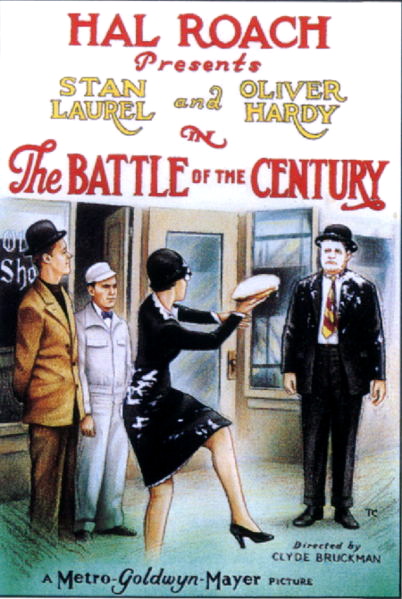
“Playin’ Hookey” isn’t a very interesting film. Even the backstage look at the Roach lot is unrevealing since the set-ups are so artificial; “Dogs of War” shows more. But “Playin’ Hookey” is significant as an example of a pie fight shortly before Laurel and Hardy’s lauded “Battle of the Century,” reflecting how the studio viewed that trope (IMDB; YouTube).

But wait! you say. “The Battle of the Century” is a 1927 film. “Playin’ Hookey” is listed as from 1928.

Quite true, I reply. But “Playin’ Hookey” was made in the summer of 1927 while “The Battle of the Century” went into production on 5 October. (For a complex discussion of when “Playin’ Hookey” was made, see its page at the Lucky Corner. For equivalent information about “The Battle of the Century,” see Dave Lord Heath’s page.)

MGM released “The Battle of the Century” on the very last day of 1927. Roach’s previous distributor, Pathé, had the rights to “Playin’ Hookey,” and it held that picture back until the first day of 1928. As a result, its significance has been masked.

“The Battle of the Century” starts as a boxing movie, inspired by the Gene Tunney–Jack Dempsey fight of 22 Sept 1927. In talking about where to go from there, someone on the writing staff suggested a pie fight.

The Hal Roach Studio was small and friendly. Hall, Coburn, Sandford, and other players in the Our Gang picture also acted in Laurel and Hardy movies that summer. Stan Laurel and his fellow writers had to have known about the making of “Playin’ Hookey.”

That picture reflected the dominant industry thinking about pie fights at the time: they were hokum, a relic of the previous decade, entertaining only for kids. A couple of years later, Laurel told Philip K. Scheuer of the Los Angeles Times that simply throwing pies “really had passed out with Keystone”—exactly as depicted in the Our Gang film.

Looking for something new, Laurel rethought the trope. “We made every one of the pies count,” he said. The scene wasn’t just messy chaos. It was messy chaos that built up gradually from character interactions. “The Battle of the Century” was a hit, and it resurrected the pie fight as nostalgic fun.

COMING UP: A changed Hollywood.

26 November 2024

“Extracted from a pie slinging episode”

In 1916 Charlie Chaplin released a movie called “Behind the Screen,” in which his character worked in the props department of a movie studio (IMDB; YouTube).

At the time Chaplin was under contract with Mutual, having moved on from Mack Sennett’s Keystone Studios. In this movie he made fun of one of Keystone’s trademarks, the thrown pie, with a scene labeled “The comedy department rehearsing a new idea.”

That involved a Keystone-style cop throwing pies incompetently, then Chaplin throwing a lot of pies at big Eric Campbell while ducking most of the pies thrown back at him. It went well beyond what surviving Keystone movies show, leaving that studio with no new territory to explore.

If Chaplin wanted to convey that pie-throwing was now old hat, some critics were already ahead of him on that score. The Moving Picture World review of “Behind the Screen” said:
There is throughout a distinct vein of vulgarity which is unnecessary, even in slapstick comedy. A great deal of comedy is intended to be extracted from a pie slinging episode which occurs during the rehearsal of a couple of scenes in a moving picture studio.
Soon Hollywood filmmakers were assuring people they had moved beyond pie-throwing. The comedian Lloyd Hamilton wrote in an essay in Motography in 1918:
There is not one phase in the production of motion picture comedies today that isn’t a great improvement over the fun film of the past. Of course everyone has his opinion as to the cause of the great improvement. The biggest reason is the public or fans themselves. They have become tired of the old hokum comedy, the poor sets, hideous make-ups and other stuff such as throwing pies. A year or two an audience would scream if someone was hit in the face with a pie–but today the kids are the only ones who seem to enjoy it…
In addition to quoting that essay, Silentology also showed an advertisement for a 1918 Eddie Lyons and Lee Moran movie that promised “No pie throwing.”

Over the next several years, many newspapers and magazines used “pie throwing” or “pie fight” as a synecdoche for all old-fashioned comic gags that sophisticated modern moviegoers would surely shun.

This despite the fact that there had been few to no fights with pies (as opposed to a pastry thrown singly) in movies aside from “Behind the Screen.” Like “bra burning,” the “pie fight” went straight from one isolated example to cliché without ever actually having been common.

The silent movie musician and scholar Ben Modell has written:
The confusing thing about the custard pie equivalent of a snowball fight is that it appears nowhere in silent movies except in this short [“Behind the Screen”] and in [Laurel and Hardy’s] “Battle of the Century” (1927). There are individual pies thrown in Keystone films, but no pie fights. Are all the pie fights in films from the Nickelodeon era…and are all lost films?
In fact, at least a couple of Hollywood pie fights appeared shortly before “Battle of the Century,” one filmed at the same Hal Roach Studio. How did they slip past critical opprobrium? The answer lies in that Lloyd Hamilton quotation above.

TOMORROW: “the kids are the only ones who seem to enjoy it.”