Showing posts with label plagiarism and its discontents. Show all posts

20 May 2025

Easy Cases Make Good Law?

The Washington Post and Forbes reported on how five US Supreme Court justices recused themselves on a copyright infringement case.

Four of those justices have book deals with Penguin Random House, a party in the case. There’s no obvious reason for the fifth justice’s decision, but people suspect some similar financial interest.

Some court observers saw these justices’ choice as an indication that they were paying more attention to ethical issues. Others saw danger in how many justices have income from book sales, potentially making it impossible for them to rule ethically about publishing law.

I have different thoughts. First, book income pales in comparison to the other outside income justices receive for appearing at exclusive legal conferences, especially compared to the work involved.

Furthermore, Justice Clarence Thomas has received millions of dollars in value through vacations, vehicles, and other presents for no work at all, and then repeatedly failed to disclose those gifts.

After the Thomas scandals broke, conservatives tried to build up Justice Sonia Sotomayor’s book deal into a comparable brouhaha. Justices had been publishing books for years before that (Thomas among them) without attracting so much criticism.

So while I do see the potential ethical problems when judges have financial interests aligned with large media companies, I don’t think that’s at the top of the list of what needs to be fixed at the Supreme Court.

Second, I looked at the case that the five justices recused from, Baker v. Coates et al., through this PDF. A man decided that Ta-Nehisi Coates had plagiarized his self-published book and sued not only Coates but lots of other people and corporations involved in other things Coates has written: The Atlantic Monthly, Disney (as owner of Marvel Comics), Oprah Winfrey and Apple (for broadcasting an interview), and so on. 

The filing includes pages and pages of side-by-side comparisons between Coates’s writing and the plaintiff’s—which show very little similarity. Unlike some plagiarism claims that make the news with obvious parallels, such as Pete Hegseth’s senior thesis, this one reveals no smoking guns. It doesn’t even offer water pistols.

A lower court dismissed that claim with prejudice—i.e., totally swatted it away. An appeals court upheld that decision. The Supreme Court’s inaction cements that result, but I think it’s extremely unlikely the court would have accepted this case anyway. The justices probably wanted nothing to do with it.

21 April 2020

The Strange Death of the Virus Vanguard!

On 20 April, the government of Singapore presented a new tool in the public-health armamentarium fighting the coronavirus epidemic: superheroes!

The Virus Vanguard team, created with the help of a large collective named Band of Doodlers, consisted of five heroes:
  • Dr Disinfector, who can spot, smell, and hear viruses and bacteria.
  • Fake News Buster, wielding his Mallet of Truth against false claims and fake news.
  • Circuit Breaker, a solar-powered robot mentally controlled by a young girl who volunteers at a nursing home.
  • Care-Leh Dee, pronounced “care lady,” who “uses empathy to absorb all negativity.”
  • MAWA Man, who Must Always Walk Alone, pushing people away with force beams.
A day later, the government took down the webpage and disavowed the team.

What happened? It looks like the saga began with a large collective named Band of Doodlers who do public art in a graffiti style.

On 7 April, on the Band of Doodlers’ Facebook page, an artist named Mas Shafreen presented the first proposal for the Covid Warriors, including Safe-Distancing Girl, Santizer Soze, Contact Tracer, Expressman, and the Nurse. They fought the evil King Corona. It looks like other artists and writers joined in the fun.

At some point, it appears, the government got involved. The heroes probably went through a committee process, emerging with a team that conformed to epidemiological priorities.

Once the Virus Vanguard was official, however, it became fair game for much more criticism than just a bunch of superheroes created by a friendly band of artists stuck at home with lots of time.

People complained that for the government to promote superheroes as thousands of people got sick and died was a waste of time and in poor taste.

Critics judged that not only were the characters derivative [duh!—they’re superheroes], but some of the artwork was clearly traced from others’ work.

But the most passionate criticism seems to have focused on MAWA Man. He’s of course supposed to embody the virtue of keeping two meters away from everyone. Mas Shafreen and his colleagues gave MAWA Man this tragic backstory: “a fanatical Manchester United fan who grew up in the 80s when Liverpool kept winning titles and he was constantly taunted by his two Liverpool fan brothers. This made him despise everything Liverpool including their motto You’ll Never Walk Alone (YNWA).”

Now that seems obviously satirical to me, but many football fans are passionate about their teams and their fight songs. Liverpool fans probably feel such slights even more keenly now that Man U has been on top for several years. Those fans, too, complained volubly about the Virus Vanguard and even started an online petition.

So the Singapore government took the webpage down, Mas Shafreen has apologized and even offered to leave the Band of Doodlers, and the world is bereft of the only Covid-19-fighting superheroes.

But wait! Now there’s a growing backlash against the backlash, supporting Band of Doodlers for its efforts.

06 November 2019

Going Deep for a Climactic Chase

He Walked by Night is a 1948 police procedural that gets better as it goes along, largely because the original director, journeyman Alfred L. Werker, left the project and the up-and-coming Anthony Mann took over.

The cinematographer, John Alton, stayed the same, so the whole movie has the same look. It’s a noir docudrama. Many of the opening scenes have no more zip than an educational film. But scenes with the bad guy, played by Richard Basehart, are strong, and the climax is terrific. The police chase the killer through the Los Angeles sewer drain system. Mann and Alton used light and dark, angles and shapes, tracking shots, and sound with no music to build up tension.

The sewer chase immediately brings up a comparison with The Third Man, directed by Carol Reed and released the following year. Did a B movie produced by a British-American distribution company that had just got into production influence that prestige project filmed in Europe with an international cast of stars? The similarity is striking, but it’s just a coincidence.

Producer Alexander Korda recruited Graham Greene to write a new screenplay for Reed after they had worked together well on The Fallen Idol. Korda had the idea of setting a story in Vienna, its policing divided among the Allied powers. Greene had one sentence in an old notebook about someone spotting an old friend a week after attending his funeral.

In early 1948, Greene traveled to Vienna to research and come up with more. Discussions with various people gave him two ideas: black-market penicillin and patrols of the city’s old sewer system. Greene went to Rome and drafted a novella incorporating all those elements, then adapted his prose into a screenplay. Filming on The Third Man began in October.

Meanwhile, Eagle-Lion Films was making He Walked by Night, inspired by the case of murderer Erwin Walker. In April 1946, after a shootout with police, Walker had escaped through Los Angeles’s storm drains. He did the same thing the following month. Walker was finally arrested in December 1946 in his apartment, the police having received a tip-off.

According to The Crime Films of Anthony Mann, the original scenario for He Walked by Night didn’t include scenes of the killer in the sewer. Instead, the climax was a chase at the Los Angeles Coliseum, which Werker probably filmed in the spring of 1948. When Mann took over, he reworked the screenplay. He and his chosen writer, John C. Higgins, changed the climax to be an extended capture in the storm drains. Those scenes were a technical challenge, but Alton and Mann captured that footage in reshoots in July 1948.

In November, Eagle-Lion released He Walked by Night in Los Angeles. That same month, Orson Welles arrived in Vienna and performed in a few shots of The Third Man. One of those involved going down into the sewer. But Welles famously balked at filming underground surrounded by actual drain water. The company had to build sewer sets in London and film the movie’s climax months later. Still, that timing shows how the sewer scenes of The Third Man were already mapped out by the time He Walked by Night was released.

Thus, the two movies’ chase scenes through drainage systems developed independently, each based on real events. Both scenes take advantage of the darkness and watery reflections of underground drainage tunnels. But they end up offering a strong visual contrast that reflects the two cities above. LA’s drains are all modern concrete, with smooth surfaces and sharp angles and arcs. Vienna’s Old World tunnels (or the studio reproduction of them) are bumpy brick and stone, filmed at vertiginous tilted angles. And both scenes are excellent.

01 December 2013

More Retrospective Than Retroactive

A while back I looked at DC Comics’s Legacies miniseries, a summary of its 1986-2011 superhero universe’s history. Just after Legacies the company announced a line called DC Retroactive, pitched as exercises in nostalgia.

Editor Ben Abernathy told Newsarama that “the opportunity to revisit that era, with the creators who made it great, is a welcome change from everything else going on in the industry these days.” It was almost an explicit admission that DC’s audience had become middle-aged folks chasing memories of their early teens.

That announcement ran in mid-April 2011. At the end of May, Newsarama was running breathless stories about DC’s “New 52,” which replaced the latest continuity with a new one. That news took up all the attention of comics fandom and critics, leaving little for the DC Retroactive magazines when they came out. I don’t know if this fact is at all pertinent, but Abernathy is no longer with DC Comics.

The idea behind DC Retroactive was to publish stories in the style of the ’70s, ’80s, and ’90s from creators who had worked on the properties then. There were triads devoted to Superman, Batman, Wonder Woman, the Flash, Green Lantern, and the Justice League. (There was no Teen Titans equivalent, but Marv Wolfman and George Pérez’s finally-completed Games would push similar buttons.)

The only DC Retroactive book to feature a Robin was the 1980s Batman issue. It was created by Mike W. Barr and Jerry Bingham, collaborators on the Batman: Son of the Demon graphic novel from 1987. But Barr’s story has more connections with Detective Comics stories he created with Alan Davis featuring a young Jason Todd.

Thus, as in Barr’s issues of the digital Legends of the Dark Knight, we see a Batman who calls Robin “chum” and shouts to him not to look at one of the villains kills another. The bat-cave’s criminal files are actually file cabinets.

Robin adds puns to a fight scene and needs to sit on a Gotham phone book to drive the Batmobile. It would have been nice to see Davis‘s small, spindly Robin in these scenes instead of Bingham’s bigger, tougher-looking version.

Barr’s DC Retroactive story is also a sequel to his Year Two series from 1987, set before any Robin. (A previous sequel, Batman: Full Circle from 1991, had brought Dick Grayson into the story.) All these stories featured a murderous vigilante named the Reaper, a role taken on by a series of people.

Year Two has been controversial for many Batman fans because it shows Bruce Wayne thinking about using a gun in his war on crime—and not just any gun but the gun that killed his parents. The fact that the story ends with him deciding against that method doesn’t stop many readers from declaring that action completely out of character.

At the end of its 1994-95 Zero Hour crossover, DC apparently repudiated the Year Two story. Yet here the Reaper is back. The DC Retroactive: Batman—The ’80s comic book even reprints the story that ends with Bruce holding up the old gun. This magazine was thus an exercise in reclamation not just for old readers but for an old writer.

(As I composed this posting, I discovered that weekly Robin essays comprise this website’s discussion of Jason Todd. Needless to say, I agree with most of the insights there, but I disagree on reprinting them without permission, credit, quotation marks, or links.)

05 August 2013

A Tale of Two Pandas—or Was It Three?

Last week the Hollywood Reporter noted the end of a lawsuit against Dreamworks concerning copyright claims on its movie Kung Fu Panda. A Massachusetts artist alleged that the studio had violated his copyright on a martial-arts panda character, registered in 2000. He could document that he had submitted his work to Dreamworks and received a form letter in reply saying that the company didn’t look at such work, but hadn’t received the full submission package back.

The plaintiff offered such exhibits as this, positioning one of his drawings alongside some images from Kung Fu Panda or its marketing.

However, Dreamworks’s lawyers came back with their own exhibits, including this juxtaposition of the plaintiff’s work alongside images from a Disney coloring book published four years earlier:
That obviously made it harder for the artist to maintain, as he had testified, that his own work was entirely original. The judge was already displeased that he had destroyed the paper and pixel trail leading up to the creation of his work just after seeing the first preview of Kung Fu Panda, when it would theoretically have been most important. Last week he withdrew his claim permanently.

29 May 2013

Kipling’s Law

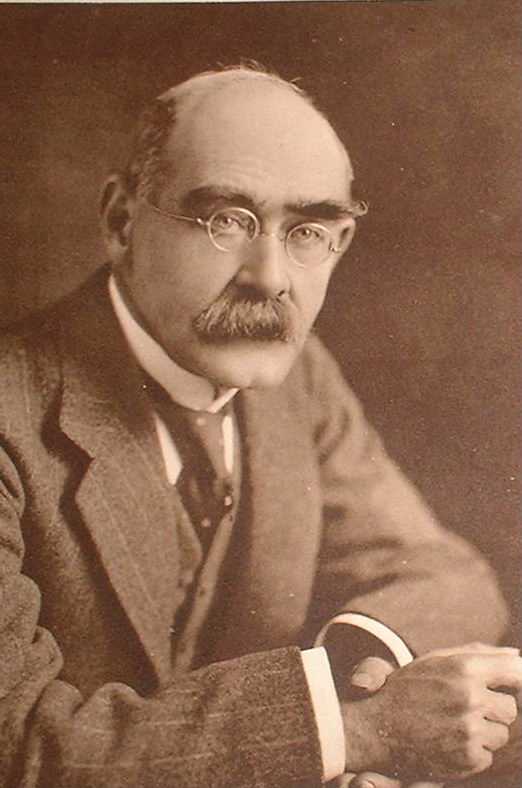
The Telegraph just ran a story headlined “Rudyard Kipling letter admits plagiarising parts of the Law of the Jungle”. That’s simply untrue.

The actual news hook is that an 1895 letter in which Kipling discusses his inspiration for The Jungle Book is up for auction. In that letter Kipling was replying to someone who evidently wanted to know the source of the novel’s “Law of the Jungle.”

Kipling had to tell his correspondent that he had made most of it up for the purpose of the story. In other words, he hadn’t plagiarised it. He said only, “a little of it is bodily taken from (Southern) Esquimaux rules for the division of spoils,” and politely acknowledged that he might have been inspired by other sources he “at present cannot remember.”

Given, however, that the “Law of the Jungle” is written in the voice of a wolf pack, I heartily doubt anyone could find sources that Kipling directly cribbed from.

Now this is the Law of the Jungle—as old and as true as the sky;
And the Wolf that shall keep it may prosper, but the Wolf that shall break it must die.
As the creeper that girdles the tree-trunk the Law runneth forward and back—
For the strength of the Pack is the Wolf, and the strength of the Wolf is the Pack.


Wash daily from nose-tip to tail-tip; drink deeply, but never too deep;
And remember the night is for hunting, and forget not the day is for sleep.
The Jackal may follow the Tiger, but, Cub, when thy whiskers are grown,
Remember the Wolf is a Hunter—go forth and get food of thine own. . . .
Read the rest here.

It should go without saying, but there’s no plagiarism in writing an original story or poem that explores the ramifications of an ethical rule long in the public domain. The Telegraph’s characterization of what Kipling did and admitted is either sensationalist or a sign that its editors no longer understand the fair use and exchange of ideas.

01 September 2012

Moore’s “concepts that I wanted to reflect in V”

As long as I’m cogitating about comics writer Alan Moore’s inspirations, I’ll quote something striking he wrote about V for Vendetta, his breakthrough series with David Lloyd. In an article published in England in 1983 as that comic was being published, reprinted as an afterword in the 1990 DC Comics collection, Moore wrote:
One night, in desperation, I made a long list of concepts that I wanted to reflect in V, moving from one to another with a rapid free-association that would make any good psychiatrist reach for the emergency cord. The list was something as follows:

Orwell. Huxley. Thomas Disch. Judge Dredd. Harlan Ellison’s “‘Repent, Harlequin!‘ Said the Ticktockman.” “Catman” and “Prowler in the City at the Edge of the World” by the same author. Vincent Price’s Dr. Phibes and Theatre of Blood. David Bowie. The Shadow. Nightraven. Batman. Fahrenheit 451. The writings of the New Worlds school of science fiction. Max Ernst’s painting “Europe After the Rains.” Thomas Pynchon. The atmosphere of British Second World War films. The Prisoner. Robin Hood. Dick Turpin...
For many writers, “concepts” might be themes or emotions. For others, they might be imagined scenes, or memories. For others, they might be questions about real people and their decisions. And so on.

But for Moore, the “concepts that I wanted to reflect” were the work of previous storytellers and performers. Even in a work of protest about the direction of British politics, he was thinking about science fiction, comics, and old movies.

No wonder Douglas Wolk writes in Reading Comics that “Virtually every comic Moore has written is inspired by some kind of pop-culture source of the past that he can elaborate and improve on.” In fact, Wolk listed V for Vendetta among the few “totally original major creations in [Moore’s] bibliography” (along with “A Small Killing, the never-finished Ballad of Halo Jones, the never-finished Big Numbers”). But that might be because Moore cast a wider net for “concepts that I wanted to reflect.”

29 August 2012

Mogo Doesn’t Plagiarize

A colleague in the Boston Comics Roundtable told a story of someone seeing his Green Lantern T-shirt and asking, “Hal, John, or Kyle?” To which he was pleased to answer, “Guy.”

Evidently that’s how Green Lantern fans talk. A few years ago, I wouldn’t have been able to make head or tails of the conversation. But now I could answer: “Mogo.”

Mogo is the planet-sized Green Lantern who debuted in the six-page story “Mogo Doesn’t Socialize,” published in Green Lantern, #188 (1985). That back-up feature, written by Alan Moore and drawn by Dave Gibbons, is collected in DC Universe: The Stories of Alan Moore.

As an Alan Moore character, however, Mogo almost perforce has a longer literary pedigree. Duy Tano just noted this panel from “The Bounty Hunters,” a story by Moore and artist John Higgins published in the British comics magazine 2000 AD in 1982.

One character says, “I read this story once where these guys are looking for an alien, not realising that the alien is really the planet they’re standing on…” That panel appears in The Complete Alan Moore Future Shocks. It shows Moore was already mulling over the idea that became Mogo.

By having his character allude to a “story,” I think Moore was hinting that he himself had read such a tale. Or two or more. Back in 1963, as Bob from Cartoonacy pointed out on Duy Tano’s site, a Green Lantern story featured a sentient planet: “The Strange World Named Green Lantern,” written by John Broome and drawn by Gil Kane. Marvel Comics had its own living planet, Ego, created by Jack Kirby and Stan Lee in 1966.

But Moore’s clearest comics antecedent is “Dead Planet,” published in Tales to Astonish, #27, with a cover date of Jan 1962. Scripted by Lee and drawn by Steve Ditko, this story is only five pages long. Nathan Mahney synopsizes it like so:
The Komok race travels from planet to planet, as each one of its warriors conquers a planet single-handedly. But if any one Komok fails, all of them will be forced to return home in disgrace. Mopox is dispatched to conquer his planet, but he can find no sign of life on its barren surface, despite what his instruments tell him. He dies of loneliness, not knowing that the life on this planet takes the form of sentient rocks.
See more panels on Bully’s Tumblr.

“Mogo Doesn’t Socialize” has the same plot as “Dead Planet”: a character bent on conquest comes to a planet and searches in vain for a foe to fight because he can’t recognize what he’s looking for. Like the Green Lantern in 1963, he eventually discovers he’s up against an entire planet.
Of course, Moore does the story better than his predecessors. He ties the episode into the larger DC mythos. He uses the Green Lantern symbol as part of the big reveal. His prose is lively.

Still, this is one of many examples of how Moore builds many of his best stories on preceding writers’ creations—combining them, building on them, twisting them in new ways. Without, however, rendering the sources unidentifiable.

09 June 2012

“The general confusion of office-work”

In late 1951 or early 1952, EC Comics writer-editor Al Feldstein combined two science-fiction stories he’d read into a single tale, adapted it into the comics form, and assigned it to artist Wally Wood. Apparently Feldstein was working on the belief that stealing from two stories at once wasn’t plagiarism but research.

He also apparently didn’t anticipate that anyone would notice. But on 19 Apr 1952 the author of those stories sent this letter to the company:
Just a note to remind you of an oversight. You have not as of yet sent on the check for $50.00 to cover the use of secondary rights on my two stories THE ROCKET MAN and KALEIDOSCOPE which appeared in your WEIRD-FANTASY May-June '52, #13, with the cover-all title of HOME TO STAY. I feel this was probably overlooked in the general confusion of office-work, and look forward to your payment in the near future. My very best wishes to you.

Yours cordially,
Ray Bradbury
In a postscript, Bradbury recommended that the editor check out his books for more stories, and even offered to send copies. No doubt pleased not to be facing a lawsuit for copyright infringement (Weird Fantasy, #12, had also contained a story inspired by one of Bradbury’s), EC paid the suggested fee and did indeed license several further stories in advance, thus time trumpeting Bradbury’s name on its covers.

That letter is reproduced in Grant Geissman’s Foul Play!: The Art and Artists of the Notorious 1950s E.C. Comics. Check out Histories of Things to Come for a peek at those stories.

22 March 2011

New Nesbit and Another Nesbit News Bit

The Guardian reports that Jacqueline Wilson, one of the UK’s most respected and popular writers for children, has signed a contract to “write a new version of E Nesbit’s classic Five Children and It.”

That seemed like such a wasted effort that I went looking for more detail, but even the original report in The Bookseller adds little—only that Wilson will write a “contemporary version.”

Does this mean retelling the same Psammead adventures in contemporary England, where children don’t have to worry so much about evading the household help? Or will a new set of children discover the grumpy little wish-provider and make new wishes?

Is Wilson writing The Psammead Comes Back: And This Times It’s Personal? Should we look forward to more Nesbit revamps that reflect modern lifestyles, like The Airline Children? The Enchanted McMansion? The Would-Be-Above-Averages?

Most of Nesbit’s novels are set in England a century ago, of course, and some display the racism and class attitudes of their times. But the children—almost always a gender mix of siblings, not vastly distinguishable—treat each other in easily relatable ways. The narrative style and voice in many of Nesbit’s fantasies is delightfully fresh. So I’m not sure what about Five Children and It is so dated as to demand a contemporary rewrite, which would therefore be driven by the new copyright claim and exclusive sales.

There are other ways to regain that old magical realism, of course. Edward Eager unabashedly updated Nesbit for the postwar suburban American child, and Laurel Snyder has updated Eager with Any Which Wall. In 1999 Books of Wonder commissioned new illustrations for Five Children and It from Paul O. Zelinsky, as shown above. All those editions and additions share a certain old-fashioned and nostalgic tone, but surely that’s what people seeking “a new version of E Nesbit” would be looking for. Perhaps Wilson will simply produce her own “inspired by Nesbit” adventure.

The other Nesbit news story for this week was the revelation that some beloved details of The Railway Children—particularly flagging down a train to prevent an accident and receiving an engraved watch as a reward—also appear in a novel published just a few years before: The House by the Railway, by Ada J. Graves. Since I dislike The Railway Children, this news didn’t derail me in the least.

10 January 2010

Boy Commandos and a Killer in the Big Top

This cover to Detective Comics, #65, shows Batman and Robin welcoming a new team to the magazine: the Boy Commandos, created by Joe Simon and Jack Kirby. Judging by art styles, it looks like Jerry Robinson drew the Dynamic Duo, and Simon and Kirby drew the commandos.

The Boy Commandos were a logical outgrowth of a trend that started in early 1940, apparently following market research that said many readers of superhero magazines were boys. Suddenly publishers introduced Captain Marvel, Robin, and a host of other wonder boys and kid sidekicks. Simon and Kirby joined that parade, creating Marvel Boy for Daring Mystery, #6 (Sept 1940), and Bucky as a sidekick for Captain America (March 1941).

What might be even more marketable than one boy? A whole gang of boys! Gangs of kids had roared through comics since the days of Hogan’s Alley, but Simon and Kirby used them for adventures rather than humor. First came the Sentinels of Liberty/Young Allies, featuring Bucky, Toro, and a set of stereotypes. Then the Newsboy Legion, featuring a set of stereotypes. And in 1942, with World War 2 raging, the Boy Commandos—international stereotypes on a mission!

Soon that team was popular enough to join Batman and Robin in Detective Comics—they actually arrived in issue #64, possibly a last-minute addition since the cover didn’t even feature a small picture of them, just a banner. The Boy Commandos remained in the magazine past the end of the war to 1949, but they never knocked the Dynamic Duo off the cover.

That wasn’t Simon and Kirby’s only brush with Robin the Boy Wonder, however. After the war they contracted with Harvey Comics for a new superhero comic called Stuntman, with the first issue dated April 1946.That hero’s origin story starts with a crook trying to shake down a traveling circus. The circus manager refuses the crook’s demands, and the star aerialists, the Flying Apollos, shrug off the threat. But at that evening’s performance, the Apollos’ trapeze breaks. The newest member of the trio, Fred Drake, sees the other two performers fall to their deaths.

Later that night, Fred stumbles across evidence that the trapeze didn’t break by accident. He narrowly escapes being killed for what he knows, then bumps into a rich, handsome man who leads a secret life investigating crime. That man makes Fred his partner, encouraging him to fight crime while wearing a mask, cape, and brightly colored costume.

Sounds rather familiar, no? There are significant differences:

  • Fred Drake is a young man, not a boy, and not related to the other members of the Flying Apollos.
  • The rich man is movie star Don Daring, who dabbles in detective work as a hobby. He has no secret identity, nor much detective skill; he becomes the stories’ comic relief.
  • Daring hires Fred as his stunt double at the studio—thus creating Stuntman!
Despite those differences, it’s clear that Simon and Kirby were recycling Bill Finger’s origin story for Robin from six years before.

The Stuntman comic entered a market glutted with other magazines after the end of wartime paper rationing. It lasted only two issues, so we never saw the promised arrival of Stuntboy.

Stuntman’s origin story and dozens of other comics in many genres have been restored and reprinted in the oversized anthology The Best of Simon and Kirby.

24 December 2009

Derivative Works—the Sequel

Yesterday I noted how the American comics world treats adaptations of retold stories with more apparent respect than the world of literary fiction does.

In that regard, children’s literature is more like comics than like adult literature. We celebrate picture books illustrating old tales like Snow White. We enjoy reinterpretations of those stories, as in Donna Jo Napoli’s Beast, and modernizations, such as Sarah Beth Durst’s Into the Wild. Those books get treated as serious work, not postmodernist play or slumming.

That may apply only to very old stories, however. Sequels and rewrites of works published in the past century or so, and linked to a particular originator, still seem a bit iffy. I’m thinking of the latter-day sequels and rewrites of J. M. Barrie’s Peter Pan (which was itself derived from his play, of course), A. A. Milne’s Winnie the Pooh, Laura Ingalls Wilder’s Little House books, and Lewis Carroll’s Alice in Wonderland. They can be entertaining, but they rarely win awards. I suppose that’s a variation on the rule that ”If you steal from one person, it’s plagiarism; if you steal from many, it’s research.”

In that respect, children’s literature reflects adult literature’s preference for the entirely new over the reworked. Critics and critical readers value originality for its own sake. In some fields, the dominant artistic values elevate a half-baked story we’ve never heard before over an old story executed in a completely entertaining way.

For the past century in the visual arts, the presentation of a new concept has gotten more respect than illustrations that bring a literary or historical moment to life because the concept is more original, even if that concept is “a square on a rectangle.” For much of the twentieth century, in fact, illustrations were seen as so derivative that their copyrights remained with the words unless the artist had an explicit agreement otherwise.

But in cogitating about the history of various arts, I’ve come to this conclusion:

Originality is overrated.

Or, rather, our literary and artistic culture has, probably since the Romantic period in literature and for over a century in the visual arts, valued originality more than highly competent reworkings. If we look back on the art and literature of previous centuries, we see artists and writers unabashedly exploring the same topics and tales. The competition among artists over the same ground fueled both technique and creativity.

Consider how many centuries people have been entertained by stories of the Trojan War. The tradition of retelling that legend is older than literature itself. It takes in Dante and Shakespeare and and all them other high-falutin’ Greeks. Dryden and Pope took translating Homer’s epics as the best way to demonstrate their prowess as English poets.

The rediscovery of the “Laocoön and His Sons” marble in 1506 inspired El Greco a century later to paint the same subject (shown above, courtesy of the National Gallery in London). Two and a half centuries later, sculptors were still borrowing from it. But in the early 20th century, critics like Irving Babbitt and Clement Greenberg used the Laocoön as a metaphor for an outdated standard artists should leave behind.

So how are storytellers exploring the Trojan War legend today? Not in “literary fiction”; most novels about it are published as genre fiction. The most publicized recent retelling has been the movie Troy, and the most critically acclaimed is Eric Shanower’s comics saga, Age of Bronze.

08 August 2009

“Give me a Superman, only have his other identity be...”

In 1939, Roscoe K. Fawcett, a second-generation executive of the Fawcett Publishing Company, looked at the success of adventure comic books and decided it was time to get into the superhero business.

In a 1997 interview by P. C. Hamerlinck, reprinted in The Fawcett Companion, Fawcett recalled:

The surveys showed the greatest comic book readership was among 10 to 12 year old boys. I said, “Give me a Superman, only have his other identity be a 10- to 12-year-old boy rather than a grown man.”
Historians are rightfully dubious about such recollections being complete and accurate since we all try to make sense of the past in our memories, sometimes in ways that serve our desires. Were there indeed market surveys at the time? Was Fawcett accurate in describing exactly how this new hero would appeal to boys?

One element of this quotation leads me to trust the general outlines of Fawcett's story: he acknowledged that he was trying to replicate the success of Superman, like everyone else in comics--though for legal reasons most couldn't acknowledge that fact.

Before the end of 1939, the Fawcett company created some "ashcan" issues of a new comic book, printed without color and hand-bound, to secure its copyrights and to show to potential advertisers. This proto-magazine was titled Flash Comics or Thrill Comics, depending on the copy. The lead hero was named Captain Thunder.

Captain Thunder wore a cape and tight coveralls, not unlike Superman. What set him apart was his alternate identity. Rather than being a mild-mannered reporter, idle playboy, or police detective, in his non-heroic life the superhero was a boy about twelve years old. His tale thus directly addressed the daydreams of the bulk of comic-book readers.

By the time Fawcett published the second issue of its magazine, competing trademarks had forced the company to change several names. The comic book was now called Whiz, though nonetheless labeled issue #2. And Captain Thunder had become Captain Marvel.

Captain Marvel was a quick and lasting success, outselling all other superheroes in the mid-1940s and inspiring several spin-offs. The magazines was still doing relatively well over a decade later, when Fawcett decided to walk away from the declining comic-book business to settle a long lawsuit from DC over--what else?--having plagiarized Superman.

Back in late 1939, the executives at DC Comics probably saw the same market data that pushed Roscoe Fawcett into asking for a comic-book hero who was also a kid. Some folks at DC might even have gotten a peek at the "ashcan" story of Captain Thunder. In any event, that was the market environment in which Robin made his debut in the April 1940 issue of Detective Comics.

07 January 2009

False Witness

From today's New York Times:

Neale Donald Walsch, author of the best-selling series “Conversations With God,” recently posted a personal Christmas essay on the spiritual Web site Beliefnet.com about his son’s kindergarten winter pageant. . . .

Mr. Walsch’s story was nearly identical to an essay by a writer named Candy Chand, which was originally published 10 years ago in Clarity, a spiritual magazine, and has been circulating on the Web ever since. Mr. Walsch now says he made a mistake in believing the story was something that had actually come from his personal experience.
I have that same problem all the time!

I keep having to remind myself that I wasn't actually carried off in my house by a cyclone after seeing my parents die because of a sabotaged trapeze. It's a lifelong struggle.

06 January 2009

The Boston Roots of Superman and Batman?

There's a series called "Comic Book Urban Legends Revealed" at Comics Should Be Good! because the comic-book culture seems to pass on legends as freely as old Hollywood publicists.

I plan to spend a few days raising my own questions about some widely accepted lore that's gathered around classic comic books. But first I'll commend other folks' debunkings.

I'll start with Boston's claim to be the birthplace of both Superman and Batman. "What??!!!" you say, in true comics fashion. "Didn't Jerry Siegel and Joe Shuster create Superman while living in Cleveland, as described in Marc Tyler Nodelman's Boys of Steel? Weren't Bob Kane and Bill Finger, the creators of Batman, working in New York when they set out to create another costumed hero?"

Well, yes. But men from Boston have disputed those claims and offered evidence for us to weigh.

About 1970 and again about 1997, a man named Mayo Kaan (1914-2002) promoted himself as the inspiration and model for Superman in 1936, two years before the character debuted in Action Comics, #1. He claimed Siegel and Shuster traveled to Boston in that year to sketch him. Kaan showed and sold photos of himself dressed in an unmistakable tight blue costume, such as the one here, courtesy of the Superman Super site.

However, as that site also points out, Kaan's photographs proved to be his debunking. Because some of them show him standing in front of Boston's Hatch Shell, the semihemispherical stage where the Boston Pops perform each Fourth of July. And the Hatch Shell wasn't built until 1940.

When challenged by DC Comics and people looking out for Siegel and Shuster, Kaan passed up the opportunity to explain that as Superman he'd been able to fly into the future. In fact, he apparently didn't offer any explanation at all. But he maintained his claim until he died, and in 2005 his family was still insisting on his role in comic-book history, according to this Boston Globe article.

As for Batman, in 1975 a man named Frank D. Foster II (1909-1995) went to a law firm to set down his recollections of creating Batman. Foster grew up in Arlington and went to art school in Boston before moving to Greenwich Village in the early 1930s. His son has offered a look at that interview and a set of his father's sketches bearing the date 1932 at OriginalBatman.com.

Here I'm relying on Cash Gorman's Hero Goggles blog, which gets this year's special recognition for Batman research from Oz and Ends. In addition to analyzing the Foster claim, Gorman also describes published precursors to Batman, including a rich man dressing up as a bat to take revenge on criminals in 1899. So the notion of a bat-themed crime-fighter wasn't that original to begin with.

Gorman points out how in the 1975 interview Foster spoke of being inspired by comic strips featuring

heroes of the day--such as, flying through the sky during the day and doing good deeds and so forth and so on--and I thought, well why couldn’t that be done at night? Have a good guy do stuff at night.
Foster dated that recollection to the late 1920s. The lawyers weren't able to elicit an explanation for the later date on the sketches.

Whether it was the 1920s or 1932, Foster recalled his creation occurred well before Batman's debut in 1939. But that was also before Superman appeared in 1938, or even Flash Gordon in 1934. Which raises the question of what comics heroes Foster saw “flying through the sky...doing good deeds and so forth.”

The details of Foster's recollection are so vague that it's impossible to disprove them, unlike Kaan's photos. But the fact that he was trying to emulate published comics with a man in a mask and skintight costume suggests that he really created his sketches in the late 1930s, when a lot of other artists were also trying to break into the newly hot comic-book industry.

TOMORROW: Captain Marvel, Jr., and the King.

03 December 2008

Looks like a Case for Nate the Great

GalleyCat ran these side-by-side images from Nate the Great Goes Undercover (1974) and what the L. A. Times reported was the first appearance of a character named "Emily the Strange" in 1991.

The similarity was first documented by a sharp-eyed RISD student named Chelsea McAlarney on the website called You Thought We Wouldn't Notice, dedicated to cataloguing curious, uncredited similarities between samples of visual art. Al Sweigart at CoffeeGhost noted some other parallels between Rosamund and Emily in 2006.

Emily and her cats have reportedly appeared lots of Goth merchandise--not that I'd ever heard of her before. Apparently nihilism is big business. More recently, GalleyCat says, Emily has inspired comics and an upcoming series of YA novels.

The Nate the Great series was written by Marjorie Weinman Sharmat and illustrated first by Marc Simont, who are no doubt in touch with their representatives.